Joint HHS/PHP Committee Meeting on FY27 Rental Assistance Programs - April 30, 2026
STREAMING COPY IN PREPARATION — RECORDING AVAILABLE FROM THE ORIGINAL SOURCE
Joint HHS/PHP Committee Meeting on FY27 Rental Assistance Programs - April 30, 2026
The Health and Human Services (HHS) and Planning, Housing and Parks (PHP) committees held a joint meeting on April 30, 2026, from 9:30 a.m. to 10:20 a.m. in the Council Hearing Room to review the FY27 Operating Budget for rental assistance programs funded through the Housing Initiative Fund (HIF). The discussion focused on the proposed $28.3 million in rental assistance (out of $52.3 million total HIF budget), the use of a $4.3 million contingency (15% of rental assistance), and the impact of potential federal cuts to housing programs. Councilmembers Laurie-Anne Sayles (HHS Chair), Andrew Friedson (PHP Chair), Natali Fani-González, Will Jawando, Dawn Luedtke, and Kristin Mink participated, along with staff from DHCA, HOC, and DHHS.
Discussion Items
-
Budget Overview: Legislative Analyst Naeem Mia presented the rental assistance programs, which are funded by recordation taxes restricted to rental assistance. The FY27 recommended budget includes $28.3 million for rental assistance, a 3% increase for most programs (HHS, HOC) and a 12.6% increase for DHCA programs. The contingency is set at $4.3 million (15% of rental assistance), a 79% increase over FY26 approved.
-
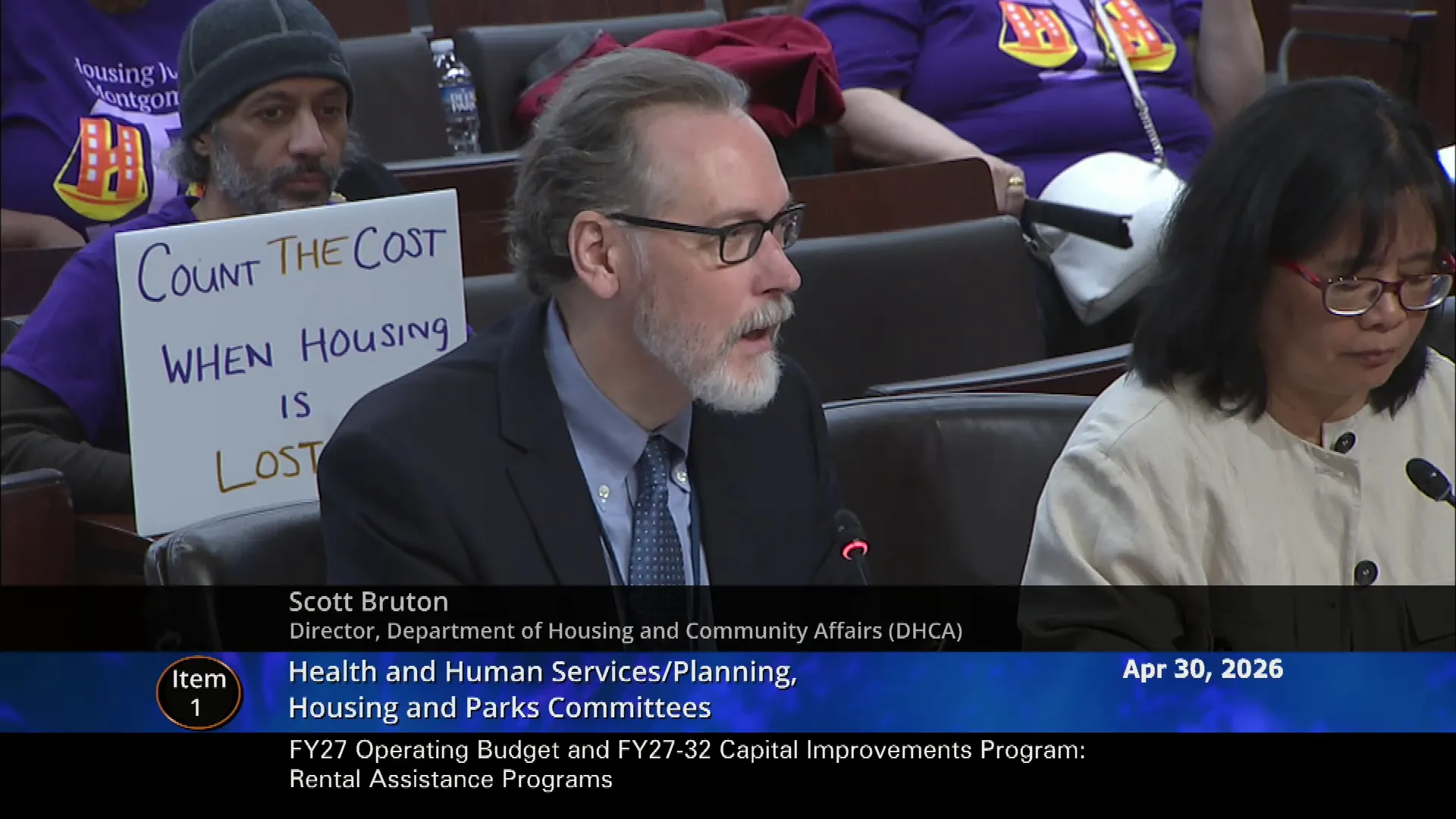
Contingency Use: Director Scott Bruton (DHCA) and Christine Hong (DHHS) recommended leaving the contingency as is to provide flexibility for potential federal cuts—specifically, a likely 40% reduction in federally funded housing programs (Continuum of Care NOFO) that could affect 350 people and $4.3 million in funding. They argued that the contingency could help offset cuts and allow for agile responses. Council staff proposed an alternative: use $1.4 million of the contingency to offset general fund dollars for rapid rehousing, which would free up general fund flexibility but reduce HIF flexibility. The committee discussed the trade-off, with most councilmembers supporting the department's recommendation to maintain the full contingency.
-
Federal Cuts Context: Ms. Hong explained that a recent appropriations bill set Tier 1 funding at 60% (down from the typical 95%), meaning the county could only renew 60% of its permanent supportive housing and rapid rehousing programs. This would leave about 350 vulnerable households without funding, requiring local replacement funds.
-
Recordation Taxes and Carryover: Chair Sayles inquired about total recordation tax revenue and the FY26 HIF carryover. Director Bruton estimated a $3.3 million carryover from FY26, which could be used for loans or reappropriated for emergencies. Ms. Hong noted that the move-up and youth bridge programs at HOC were decreased to reallocate funds to the Community Choice Homes program for individuals with disabilities, per HOC's request.
-
Coordination Call: Council President Fani-González urged a reimagining of housing assistance across agencies (DHCA, HHS, HOC) to better coordinate and simplify programs, suggesting a fall review before the new government takes office.
Key Outcomes
- Decision: The committee unanimously approved the County Executive's recommendation for the FY27 HIF-funded rental assistance programs at a funding level of $28.3 million, keeping the contingency at the 15% level ($4.3 million) as recommended by staff. The motion passed without objection.
- Directives: The committee requested that DHCA, HHS, and HOC collaborate on any future shifts in funding and keep the council informed. Staff will provide information on total recordation tax revenues and out-year projections.
- Next Steps: The full council will review the committee's decision during the FY27 operating budget deliberations the following week.
Meeting Transcript
Good morning, everyone, and welcome to today's joint convening of the Health and Human Services Committee and the Planning Housing and Parks Committees. Today we are joined by Councilmember Andrew Friedson, who chairs planning housing and parks, and also serves on the Health and Human Services Committee. We're also joined by President Natalie Fani Gonzalez, uh Councilmember Jawondo is in route, and Councilmember Ludke. I also want to thank our council staff, Naeemia, Tar Clemens Johnson, and Logan and Binder for their work on today's packet. Today marks the final committee review for HHS of the FY27 operating budget. Next week, the full council will begin reviewing all of the decisions made by this and other committees over the past several weeks as we work together to chart a path forward that meets the needs of our residents in a balanced and fiscally responsible way. Today's discussion will focus on the rental assistance programs offered by a county's Department of Health and Human Services, our Department of Housing and Community Affairs, and our housing opportunities commission. For thousands of working families and elderly residents across our communities who are facing eviction or leaving homelessness because the rent is just too high. Thank you for that. Really appreciate it. This is the first time I'm sitting on this committee where I both hats this joint committee, which I've sat on uh every year, uh, which uh really appreciate and it's a particularly challenging time. We've got a lot of community members who are struggling with the rents being high, but also everything else being high. Food prices, gas prices, challenges in the labor market. So um really thinking about that today, and hopefully that can help guide us as we navigate through these issues to humanize the difficult decisions that we have to make. So thank you for that opening. Thank you for all the work by staff and look forward to having the conversation. Thank you, Coach Friedson. I'll turn things over to Naeem. Thank you. Sure. Um departmental agencies and guests. Um good morning. Um so as a matter of background, uh the subject of today's session is rental assistance programs funded through the housing initiative fund. The housing initiative fund operating budget itself was reviewed by PHP committee on April uh 13th and was um uh recommended for approval as submitted by the executive. Um the rental assistance programs uh are a subset of the HIF operating budget. They comprise 28 uh for FR27, 28.3 million of the 52.3 million uh of the HIF overall budget, so more than half of the HIF operating budget is for rental assistance programs. Uh rental assistance programs are not uh uh I'm sorry, the HIF is as a as a non-tax supported fund is exempt from the council president's guidance, so there are no reconciliation list items uh for review today. The um the rental assistance programs in the HIF are funded through recreation tax revenues, so which are in the county code restricted for rental assistance purposes, so they cannot be used for any other purpose. And so each year um the HIF estimates the amount of recognition taxes it's receiving, and that amount is used for rental assistance programs. Um attachment one or circle one of your packet has the breakdown uh for both the FY26 approved and FY27 recommended. It shows where that 28.4 million for FY27 is going. You'll see the bulk of it, uh not the majority is going to HHS programs. Uh so permanent supportive housing and rapid rehousing, as well as rental subsidies are the uh the biggest recipients uh within that category. HOC receives a relatively smaller amount of 3.4 million for FY27, and the rest goes to DHCA programs. And so the HIF itself, while managed by DHCA is providing significant funding through rental assistance programs to other uh our partner agencies and departments. Um there's also $4.3 million allocation for contingency, which I'll explain as we go further uh how that's um uh developed and what it could be used for. Uh beyond that, um the packet contains details of each of the programs, um, the rental assistance programs as part of the rental assistance programs. Uh there are four HC programs, which for FY27 is a are receiving a 3% increase from the 26 approved. There are six programs in HHS that again are combined are receiving 3% increase as well. And DHCA is receiving a 12.6% increase for its six ongoing programs. And finally, contingency is getting a 1.5 million dollar increase over the FY26 approved, uh, which is a 79% increase uh from the previously approved operating budget. Um it is uh as a as a total amount of the uh of the rental assistance programs, recognition taxes. It accounts for 4.3 million or 15% of the total. Uh and for FY26 approved, the budget was uh about 10.5%. So the amount being held on contingency is a little higher than um uh the current year. Um stop there. I think that's it. Um there's some discussion we can get into further about contingency and what we could use it for if we want to held it for contingency purposes or consider it using for to offset general fund dollars. That's an option uh we can get into further, but I'll stop there at this time. Thank you.
openpublica.com