Education & Culture Committee FY27 MCPS Budget and CIP Review – May 1, 2026
STREAMING COPY IN PREPARATION — RECORDING AVAILABLE FROM THE ORIGINAL SOURCE
Education and Culture Committee FY27 MCPS Operating Budget & CIP Review – May 1, 2026
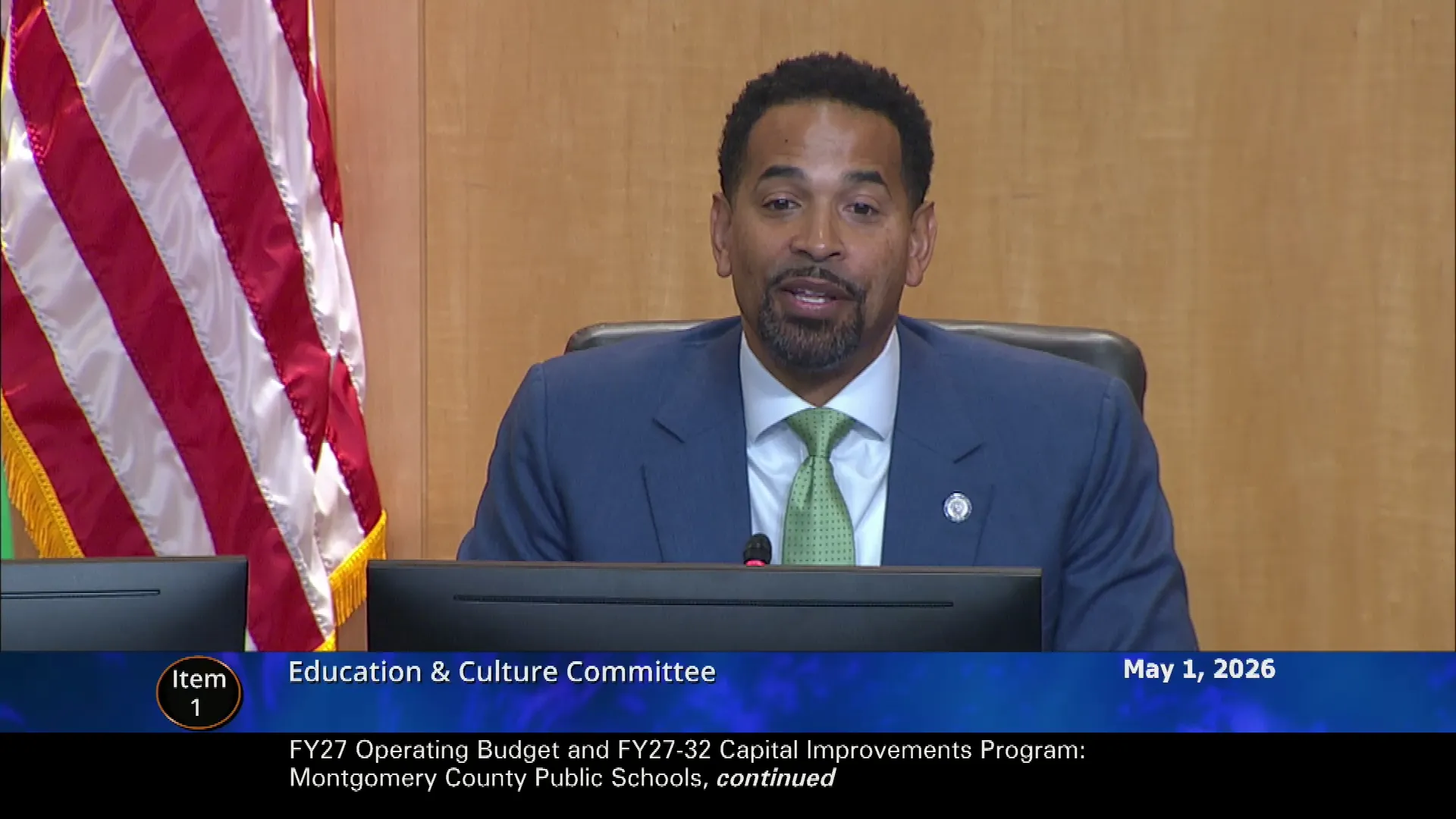
On May 1, 2026, from 9:37 to 11:08 a.m., the Montgomery County Council's Education and Culture Committee held its fourth and final session on the FY27 Operating Budget and FY27-32 Capital Improvements Program (CIP) for Montgomery County Public Schools (MCPS). The Committee reviewed technology modernization, facility planning, materials management, relocatable classrooms, and remaining budget enhancements, then made a funding recommendation. Present were Chair Will Jawando, Councilmember Shebra Evans, Councilmember Kristin Mink, and MCPS staff including Chief of Staff Ms. McGuire, Chief Technology Officer Kimberly Fields, Deputy Chief of Facilities Andrea Swiatocha, and Executive Director of Financial Oversight Carly Thompson.
Technology Modernization (TechMod)
- MCPS Chief Technology Officer Kimberly Fields reported that $27.3 million was appropriated for TechMod in FY26, with $11 million remaining unspent due to the normal summer refresh timing. The Board of Education requested $33.9 million for FY27; the County Executive recommended reducing that to $16.9 million.
- Ms. McGuire stated that the $16.9 million level would not sustain the year without a one-time bridge using the $11 million, and that the reduction would affect the planned device refresh. The Committee accepted the County Executive's recommendation without objection.
Facility Planning
- The Board requested increased funding for an area-wide elementary school boundary study and a feasibility study for a potential P3 partnership to redevelop the Carver Educational Services Center (CESC). The County Executive recommended funding switches, removal of $2.5 million for P3 costs, and level-of-effort reductions of $350,000 per year in FY29-32.
- MCPS Deputy Chief Swiatocha said the reduction would limit the ability to hire an advisor to evaluate alternative financing. Councilmember Evans urged addressing the aging Carver building. Council staff had recommended supporting the Board's expenditures pending reconciliation, but the Committee adopted the County Executive's changes.
Materials Management Building Relocation
- This $13.1 million current-revenue project funds interior construction of a new leased space for the materials management warehouse. The County Executive zeroed out $10.6 million in new FY27-28 expenditures, leaving $2.5 million previously approved.
- Ms. McGuire stated that even if restored, the project cost has grown to approximately $18-20 million, requiring an additional $5-7 million above the $10 million cut. The Committee reluctantly accepted the County Executive's reduction.
Relocatable Classrooms
- Due to declining enrollment, MCPS requested gradually declining funding for relocatable classrooms and did not submit a supplemental appropriation. The County Executive recommended no changes, and Council staff recommended approval. The Committee approved the project as proposed.
Additional Budget Enhancements
- The Committee reviewed unreviewed enhancements: $6.4 million for nonpublic special education tuition (driven by a 7.5% Teacher Parity Act tuition increase and 49 additional students), $3.7 million for technology services, $4 million for transportation, $1.6 million for an additional SEIU Local 500 training day, $1.5 million for an additional instructional staff professional development day, and $2 million for professional development.
- Staff highlighted that MCPS included more than $10 million in base budget reductions and 41 FTEs for a second consecutive year.
Funding Recommendation Discussion
- Chair Jawando opposed raising property taxes and opposed balancing the budget solely on MCPS. He proposed reducing the requested increase by $30 million, in three tranches of $10 million, while establishing $149 million as a floor.
- Councilmember Evans said cuts would hurt working families and preferred that the full council make the funding decision without a committee recommendation.
- Councilmember Mink argued that MCPS has already made deep base cuts, that $90 million in reductions would be untenable, and that the requested funding supports essential school-based positions. She supported the $149 million floor.
- Ms. McGuire said any reduction at or above $30 million would affect positions because MCPS has very few vacancies, and an untenable figure like $90 million would threaten contracts and jobs.
Key Outcomes
- The Committee voted 3-0 to place the entire $179 million request above FY26 local funding on the Reconciliation List for full council consideration.
- The Committee voted 2-1 (Jawando and Mink in favor; Evans opposed) to recommend that $149 million be treated as the minimum/floor for additional local funding, with the remaining $30 million considered in three tranches of $10 million each.
- The Committee requested that MCPS provide vacancy counts and scenario guidance for the full council's upcoming straw vote.
- The Committee recommended approval of the FY27 Operating Budget for MCPS, as amended.
- Note: The approved minutes state "10 tranches of $17.98 million each," but the transcript and the committee's final discussion reflect three tranches of $10 million after the $149 million floor; this summary uses the transcript language.
Meeting Transcript
Good morning. It is May 1st, and this is the Education and Culture Committee. We're having our fourth and final session on the operating budget and MC for MCPS. And we have a number of items to discuss to close out that we haven't touched yet, like technology modernization and a few other things, and then we will make a funding recommendation and talk through some of the scenarios that are in the packet and others that colleagues on the committee might want to talk about. So let's uh dig in. Uh, Mr. Proudie, do you want to start us off? Sure. Thank you very much, Church Rwando. So in your packet, you have information on pages uh two and three about um the technology modernization project. Um there also is a brief presentation from CPS about that. Uh and then following that, you have information on a number of CIP projects, facility planning, materials management, building relocation, and relocatable classrooms. And then finally, after that, we'll talk about a number of items that we haven't discussed yet that are um relatively big ticket items on uh the board proposal. And then there's some options for you uh in terms of your funding request or recommendation, I should say. Awesome. Thank you so much. Uh so Ms. McGuire, are we starting? Are you kicking us off? Certainly, I will just very briefly thank you. Uh, and then I'll turn to my colleague to talk more about um uh technology modernization. Um I do just want to start by saying uh first of all, Dr. Taylor had uh has uh a conflict um today that he regrets very much that he can't be here, but again, a requirement um with our state colleagues, and so uh he and I are in separate spaces today. Um thank you for for this opportunity. We'll answer questions. I would just say the first couple of items that you have here to discuss do reflect um some reductions that the um executive put forward in our current revenue projects in the CIP, and we'll talk through those, but uh those those do have implications for these projects, and we just want to um again acknowledge and be clear about that, understanding the fiscal limitations that the committee is uh is dealing with. But we can talk more about the specifics on those uh as we go through. Appreciate that. Yes. All right, good morning, council members of the education and culture committee. My name is Kimberly Fields, and I have the pleasure of serving as a chief technology officer for MCPS for about a year now. I welcome the opportunity to speak to all of you this morning as it relates to the FY27 technology modernization, also known as TechMod. The Tech MOP budget this morning resides within oh back a slide. Yep, yeah, thank you. Uh the TechMOD budget this morning resides in the division of technology services. It creates a consistent and technology experience across classrooms, offices, and shared learning spaces, as well as a modernized security and network infrastructure, which strengthens the data protection, cybersecurity, and system reliability. And then also, based upon the OIG Chromebook audit. This has also allowed for a value add, I would say, in the optimization of critical asset inventory management processes, which we are targeting to drive measurable efficiencies and improve resource allocations across the district. Next slide, please. What is tech mod? The technology modernization, tech mod project benefits students and staff district wide by providing safe, creative, collaborative, and up-to-date technology. It focuses on providing support for engaging learning environments by refreshing devices, interactive panels, printer security, and network infrastructure. From the pictures, you can see a sample of the learning engagement with the students as our technology implementation specialists have collaborated with teachers to enhance lessons using technology for students to learn how to code, be creative, brainstorming ideas, encouraging critical thinking, and complex problem solving, and an interactive project. The team has worked with students and teachers as it relates to robotics, engineering, bring students' stories to life, even additional using 3D printers and virtual reality platforms. Next slide, please. The Tech Mod assists students in being able to obtain internet access if access doesn't exist. Refreshing student and staff devices ensures technology can keep pace with the current curriculum, learning platforms and accessibility tools. Modern tools allow teachers to personalize instructions and better meet diverse learning needs. And we also want to make sure we have consistent and reliable student and staff experiences across the classrooms. We do support the STEM school support approved and technology supplies that they may need.
openpublica.com