Government Operations and Fiscal Policy Committee Reviews FY27-32 Fiscal Plan and Recommends Approval on June 11, 2026
STREAMING COPY IN PREPARATION — RECORDING AVAILABLE FROM THE ORIGINAL SOURCE
Government Operations and Fiscal Policy Committee Reviews FY27-32 Fiscal Plan and Recommends Approval on June 11, 2026
The Government Operations and Fiscal Policy Committee met on June 11, 2026, from 1:30 p.m. to 1:45 p.m. to consider a resolution adopting the County's Tax Supported Fiscal Plan Summary for the FY27-32 Public Services Program. The committee heard a staff presentation, discussed reserve policies, and unanimously recommended approval to the full Council.
Discussion Items
- Resolution to adopt the Tax Supported Fiscal Plan Summary for FY27-32: Council Staff Deputy Director Gene Smith presented the fiscal plan, noting it is a snapshot of the council's FY27 operating budget decisions and projects revenues, non-agency uses (debt service, pay-go, reserves), and agency uses (county government, schools, college) through FY32. Key projections include average annual revenue growth of 2.9%, a negative net transfer from the general fund due to declining alcohol beverage services revenue, and a debt service increase from raising the SAG to $300 million annually. Staff noted that agency use in FY28 is projected to decline by 2.1% compared to FY27, reflecting fewer available resources after non-agency commitments.
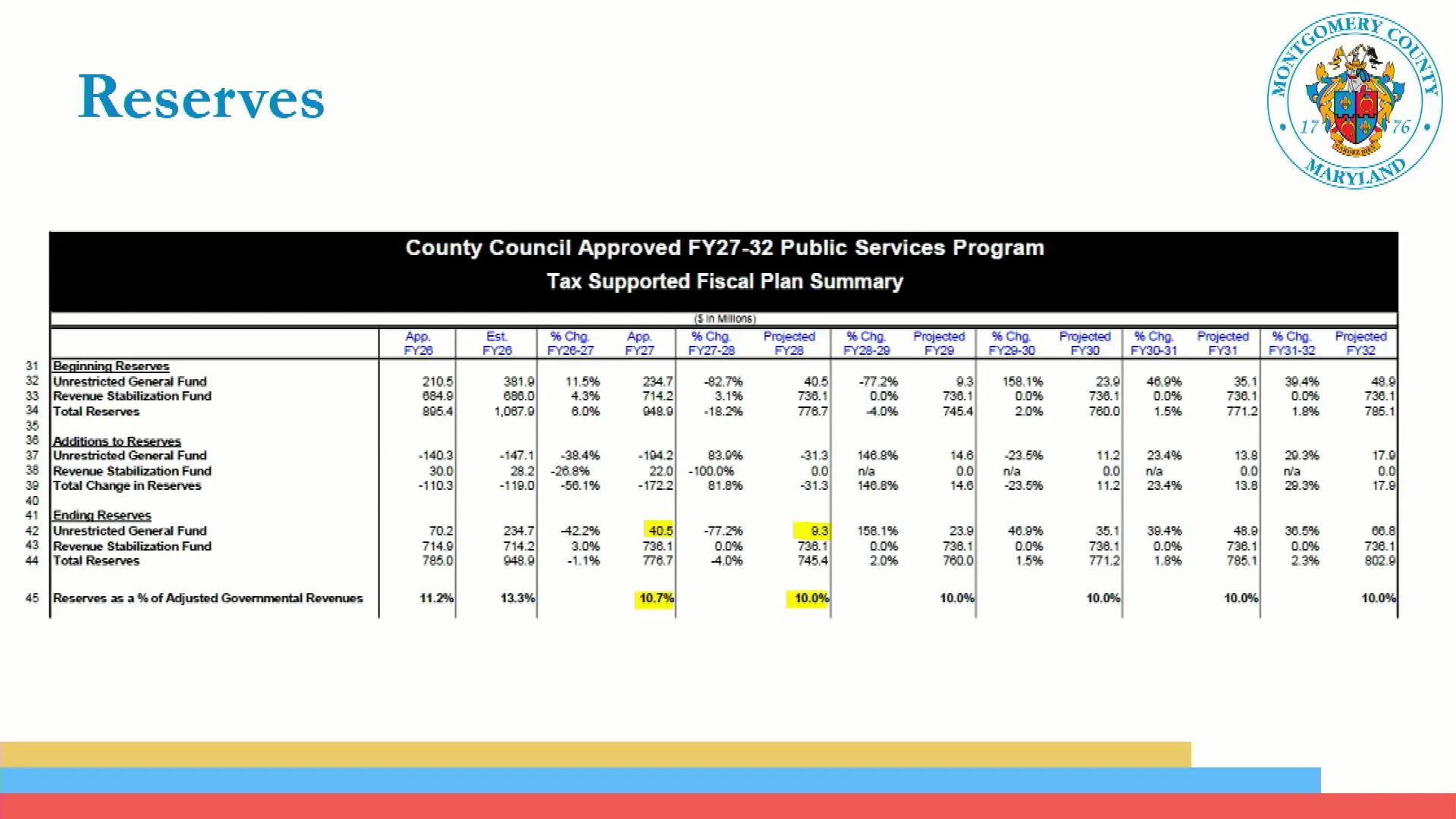
- Reserve policy review: Mr. Smith highlighted that the county's total reserves are estimated at 10.7% (above the 10% policy goal), but general fund undesignated reserves are only $40.5 million—low relative to the $50 million in unexpected snow cleanup costs incurred in January. He recommended the committee revisit the reserve policy later in 2026 to better balance the Revenue Stabilization Fund and undesignated reserves. Councilmember Katz agreed, noting a consultant report from the previous summer that had been deferred due to federal uncertainties, and suggested the timing was now appropriate.
Key Outcomes
- Committee voted to recommend approval of the resolution to the full Council for a vote on Tuesday, June 16, 2026. The motion passed without objection.
- Directive to schedule a follow-up session in the fall of 2026 to review and potentially revise the County's reserve policy, as proposed by staff and supported by committee members.
Meeting Transcript
Good afternoon, everyone. Today, the government operations and fiscal policy committee has one item on its agenda, which is a review of a resolution to support the county's tax supported fiscal plan summary for FY27 to 32 public service program. The FY27 to 32 tax supported fiscal plan summary reflects the fiscal projections and policy assumptions when the council adopted our FY27 operating budget and the FY27 to 32 CIP. I'll have the staff go over the packet and then we'll make our recommendation to the full council. Excellent. Thank you, Chair Stewart. And we'll have a presentation here and go ahead and get that loaded to help the millions watching at home understand our fiscal plan document. Before I jump in, also as always want to thank our colleagues from Office of Managed Budget and Finance, who we work collaboratively, not only throughout the year, but definitely during the budget. And as the chair just noted, this this document is a summary and a cumulation of all the decisions the council made during the fiscal 27 operating budget. And so there's nothing new here. It's just a display to help understand those decisions and kind of the projections in the next six years. As always, just to note the tax supported fiscal plan summary is a snapshot in time. We see it three times a year. This is the first one. This is the one the council will approve based on its fiscal 27 decisions. In December of 2026, the council will see the updated version for 27, which will have new revenue projections based on finances estimates. And then in March of 15, 2027, we will see the final version for 27 in terms of where our estimates are, not only in revenues, but also on expenditures and have therefore. That is what we'll see. Often we get questions like what are the projections? What are the projections are this until we see the next version? And so that is why it's an important document. And why do we do this? The charter requires the council to approve a six-year public service program. So this is how we do it and meet our fiscal policy goals. So you do not need to read this. I just want to be able to show it. This is our tax supported fiscal plan summary. It is on circle three for those following at home. And it's a lot of numbers, but I will walk through different elements. I thought it'd be helpful to actually look at what's specifically in the plan as we go through it today to understand it. But these are our projections. The most important projections are those that are in 27 and 28, because those are the current current fiscal year and the next fiscal year that we see. We have rejections all the way out to 32, but obviously, as I just noted, there will be updates, several iterations in this year or this fiscal year, and then in the following fiscal year. So obviously fiscal 32, five years, six years away, will have many revisions before we get there. And so this is helpful for us to see the overall lay of the land, but it is not immutable. The fiscal plan is broken up into major three major sections. First one is total revenues at the very top. This is all of the revenues we estimate to get from tax supported for tax supported revenues, primarily our taxes, but it also includes intergovernmental aid, primarily for Montgomery County public schools. The next section is our non-agency uses. These are primarily fiscal policy decisions. So debt service, pay-go, CIP revenues, as well as how our reserves change in any given year. Final section is the one that most people look at during the budget, which is our agency uses. How much money is going to uh Montgomery County government, Montgomery County Public Schools, Montgomery College, and parking planning. And as always, all of the fiscal plans in with the assumptions at the bottom. I'll highlight a few. All the property and income tax projections are based on the decisions the council made during the fiscal 27 operating budget, which includes the progressive income tax structure. The next one is for reserves, as the council has done the last couple of years because the revenue stabilization fund exceeds our 10% policy goal for reserves. The council has elected not to deposit the mandatory contribution into the revenue stabilization fund and have that go to general fund undesignated reserves. And then finally, I'll mention this again. What the other important thing is that for uh state aid, excluding mostly for Montgomery County public schools, there is no assumption of growth in those in the out years.
openpublica.com