Audit Committee Meeting – June 25, 2026: OIG Update, Short-Term Rental Audit, and Fire Rescue Fiscal Audit
STREAMING COPY IN PREPARATION — RECORDING AVAILABLE FROM THE ORIGINAL SOURCE
Audit Committee Meeting – June 25, 2026
The Montgomery County Council Audit Committee met on June 25, 2026 from 9:32 a.m. to 11:18 a.m. to receive an end-of-year update from the Office of the Inspector General (OIG), discuss a Maryland Public Information Act (MPIA) access issue, and review two OIG reports: Report 25-04 on the Short-Term Residential Rental Program and Report 26-07 on the Performance Audit of the Fiscal Management Division of the Montgomery County Fire and Rescue Service (MCFRS). Presentations were given by Inspector General Limarzi, representatives from the Department of Housing and Community Affairs (DHCA), the Department of Finance, and MCFRS.
Office of the Inspector General End-of-Year Update & MPIA Access
- Inspector General Limarzi reported that the OIG handled 442 hotline complaints in fiscal year 2026, a 17% increase over fiscal year 2025, issued 22 reports (including the annual report and a four-year work plan), and made 43 recommendations. The audit division remains understaffed, operating at just over 50% of the authorized level for four years, limiting the number of simultaneous engagements.
- Limarzi raised concerns about the application of the Maryland Public Information Act (MPIA) to OIG records requests. A Maryland Attorney General opinion has led some departments to treat OIG requests as ordinary MPIA requests, denying or delaying access to records that were previously available. This has hampered audits, including a review of the workers' compensation contract. State legislation to clarify inspector general access stalled in the rules committee late in the session. The committee expressed strong support for addressing this issue at the state level.
Discussion: OIG Report 25-04 – Short-Term Residential Rental Program
- Inspector General Limarzi presented the report, originally issued in October 2024, which found that more than 85% of estimated short-term rentals in Montgomery County were operating without a license, and the county was not ensuring collection of all owed taxes. The report made recommendations for DHCA, which took over the program from HHS during the audit.
- Kimberly Williams, DHCA Division Chief, reported progress: two of four recommendations for DHCA are closed. She noted that unlicensed properties decreased from approximately 700 in October 2024 to about 330 as of April 2026, thanks to enhanced enforcement, IT fixes to the licensing system, and outreach. New executive regulations took effect June 12, 2026. The remaining two open recommendations (on formalizing procedures and maintaining a current property list) are classified as "open in progress."
- Mike Coveyou, Director of Finance, discussed tax collection challenges. The state is developing a program to collect transient taxes from large platforms (Airbnb, VRBO), but implementation is not expected until 2029. The county currently relies on voluntary compliance and complaint-based audits. Finance has no routine audit program for this tax and is resource-constrained due to major IT projects. The department is working through MACo to shape state legislation.
- Councilmember Evans suggested exploring legislation to require online platforms to verify that properties have a county license before advertising. Mr. Coveyou noted federal protections for internet platforms may limit such actions.
Discussion: OIG Report 26-07 – Performance Audit of Fiscal Management Division, MCFRS
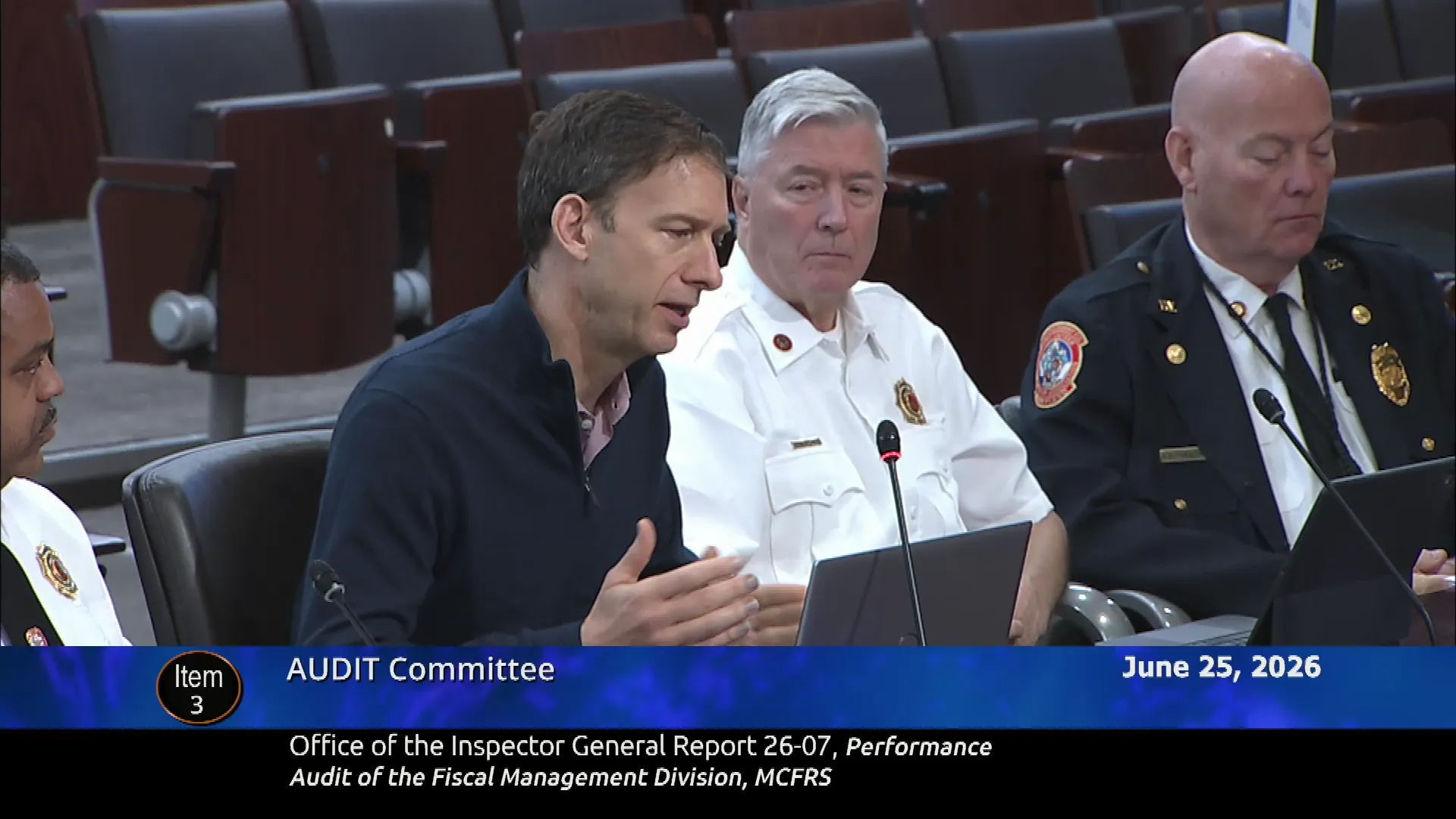
- Inspector General Limarzi presented the report (issued December 2025) on MCFRS's oversight of local volunteer fire departments (LFRDs). The audit tested 40 EMST (Emergency Medical Services Transport) fund projects valued at $1.2 million and found: 80% missing required timelines, 32% with insufficient supporting documentation, and 8 projects with no evidence of review. The Montgomery County Volunteer Fire Rescue Association disclosed that some EMST funds may have been spent on ineligible general expenses. The report made seven recommendations; one (on purchasing card approvals) is closed, six remain open.
- Chief Corey Smedley of MCFRS stated that the department had already begun addressing issues prior to the audit, including drafting a new EMST policy. He highlighted the need for better training and streamlined processes. Division Chief Dominic Del Pozzo detailed plans to develop a unified policy covering EMST, state AMOS, and ESPP funds, improve procurement documentation (bids and quotes), and enforce e-travel compliance for non-local travel.
- Michael Kelly, Division Chief of Volunteer Services, noted that EMST is only 12 years old and that LFRDs have a learning curve. Most funds are used for facilities and apparatus, not travel. The association has already held training sessions.
- Councilmember Katz thanked the volunteers and career staff for their service and emphasized that the audit is a tool for improvement, not a "gotcha." He acknowledged that past practices need to change.
Key Outcomes
- No formal votes were taken on the reports; the discussions were informational.
- Chair Stewart requested that the Department of Finance include Councilmembers Luedtke and Sayles, who represent the County on the Maryland Association of Counties (MACo), in discussions regarding the OIG’s recommendations for Report 25-04.
- Chair Stewart requested that Council staff draft a memo on behalf of the Audit Committee to the Chief Administrative Officer and the Council President, summarizing Audit Committee activities and responsibilities for the transition following the 2026 election.
- The committee noted the OIG's ongoing audit division staffing shortage and the need for additional resources to complete more audits.
- The committee will continue to track outstanding recommendations from both reports.
Meeting Transcript
Good morning, everyone, and welcome to the session of our audit committee. Um we are here today and we have um three items before us. The first uh we will have an update from the Office of the Inspector General on uh year end um items and then a discussion of uh what occurred with the Maryland Public Information Act access to records in this past legislative session, and then we will discuss um two reports. One is the short-term residential rental program, and the other is the audit of the fiscal management division for the Montgomery County Fire and Rescue Um service. And so I will turn it over to Mr. DeFasio to uh kick us off. Okay, good morning. Um so I wanted to point out a few items in the packet. Uh so the current um Inspector General internal audit engagements, they're on page 19. They start there just so you have an idea of what's going on currently going on. And now the other thing I want to point out is um and the beginning of page two. The inspector general now has an active website um that's showing the outstanding recommendations, which is really nice. And so today's two reports, they have the second, eighth longest outstanding recommendations. Now you can see it right here in the table, and you can see it online as well. And the longest belongs to the public information office, and it's about updating administrative procedure 6.8 on social media. So just let you know there. Um as well, um, Megan's gonna talk about the OIG's access to records, like you mentioned with the Maryland Public Information Act. And right now, Inspector General is in Maryland. Um, they've been treated sort of like ordinary public requesters for requests. And so again, this is based on an opinion from the Maryland uh Office of the Attorney General earlier on this year. And also for the two reports that are mentioned. There are executive summaries in the back and also uh CAO responses too. So that's it. Okay, I will turn it over to Ms. Lamarzi now. Thank you so much. Good morning to all of you. Uh as always, I appreciate the opportunity to speak with you about the work of the Office of the Inspector General. It's the end of June, so we are rounding out the fiscal year. Uh and the office has had a very busy and productive year. Uh we are fully staffed now and have been for the last several months. And so that has allowed us to do a lot of work and be responsive to the needs and requests of our community. Uh as you see in the information we've shared, uh, as of last week, we'd had 442 hotline complaints uh that we've been able to address. That's 17% increase from fiscal year 25. Uh we have issued and published 22 reports. That includes our annual report. It includes the work plan for the next four fiscal years that's required under county law that the inspector general present a work plan. There are 43 recommendations that we've made in the last fiscal year to address the findings in our interview. Do we want to go to the next slide? Mr. DeFarr. Oh, I'm sorry. No, no, yeah, I didn't know how to no, it's good. It's all good. You've made such nice slides. I want to make sure people can see them. Thank you. Thank you. Um currently we have seven open announced engagements that come off of the work plan. Those are reviews and audits.
openpublica.com