Government Operations & Fiscal Policy Committee Meeting - July 9, 2026
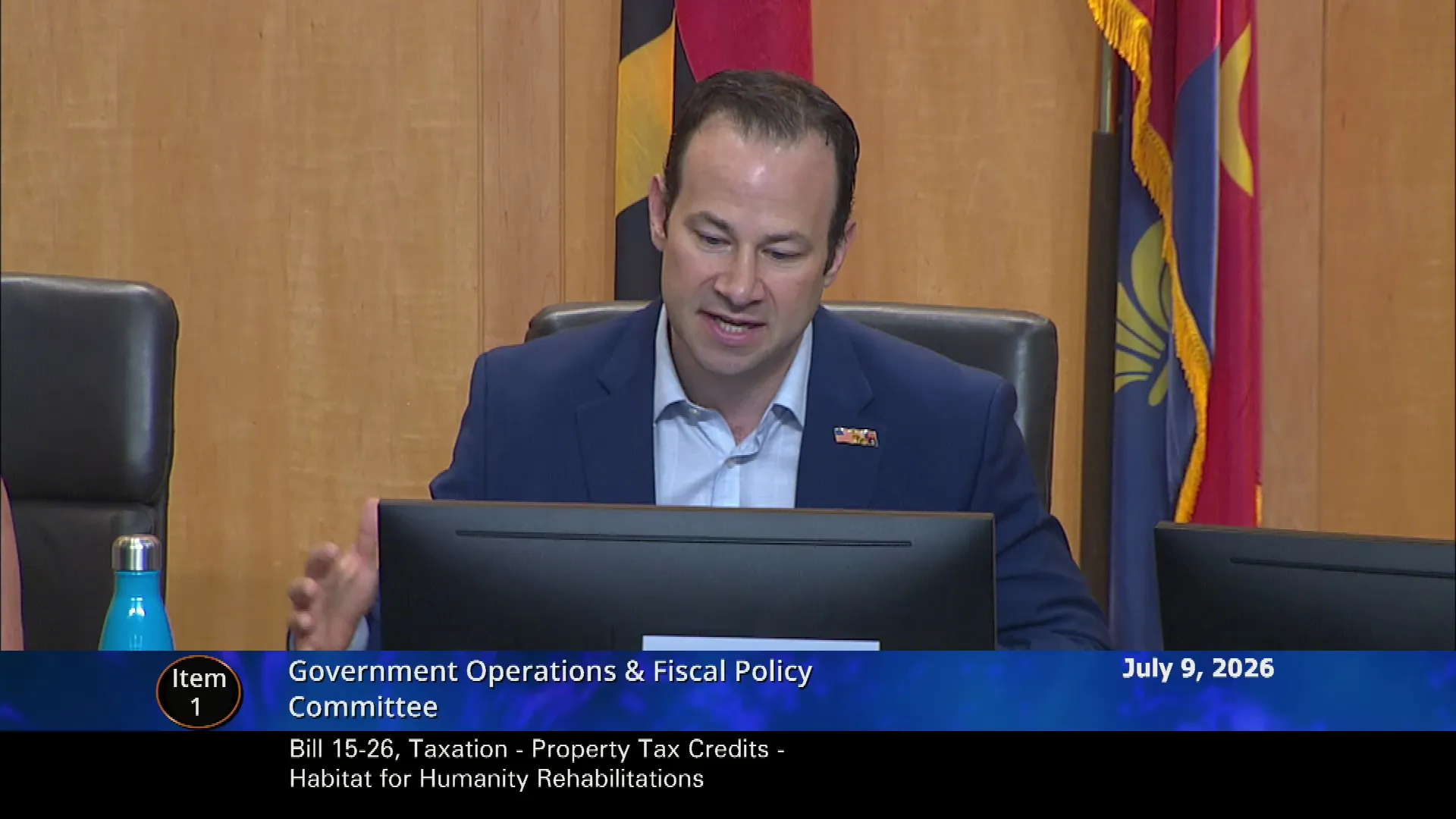
STREAMING COPY IN PREPARATION — RECORDING AVAILABLE FROM THE ORIGINAL SOURCE
Government Operations & Fiscal Policy Committee Meeting - July 9, 2026
The Government Operations & Fiscal Policy (GO) Committee, chaired by Councilmember Kate Stewart, met on July 9, 2026, from 9:30 a.m. to 12:30 p.m. in the Council Hearing Room. The committee considered two bills: Bill 15-26, creating a property tax credit for Habitat for Humanity rehabilitations, and Bill 21-26, amending the employee retirement system. Both bills were recommended for approval to the full County Council.
Discussion Items
Bill 15-26 – Taxation – Property Tax Credits – Habitat for Humanity Rehabilitations
Staff Attorney Ogorzalek explained that the bill implements state enabling legislation (Maryland Code Tax Property Section 9-252) to provide a 100% property tax credit on properties owned by Habitat for Humanity Metro Maryland during rehabilitation or construction until conveyance to the new owner. The credit applies starting July 1, 2027. The fiscal impact is an estimated decline in property tax revenues of approximately $458,000 over the first five years. Habitat for Humanity’s President/CEO testified that the credit would allow the organization to recoup about $70,000–$80,000 per year, aligning with the revenue loss. Councilmember Friedson, lead sponsor and co-sponsor with all councilmembers, noted that seven other Maryland counties have already adopted similar credits. He emphasized that reducing carrying costs during construction helps Habitat create more affordable homeownership opportunities, particularly for households earning 30–80% of area median income. Committee members expressed strong support. Councilmember Katz praised the state's targeted legislation and the value of homeownership.
Bill 21-26 – Employee Retirement System – Savings and Benefits – Amendments
The bill implements collectively bargained changes between the County Executive and MCGEO (Municipal and County Government Employees Organization). Key provisions include:
- Adding correctional health nurses to Retirement Group E (effective 2029)
- Removing minimum age requirements for Groups E and J, aligning with police and fire groups
- Increasing employee and employer contributions to the Guaranteed Retirement Income Plan (GRIP) and Retirement Savings Plan (RSP), phased in over several years
- Reopening GRIP enrollment for specified employees hired before July 2014 who had defaulted to the RSP
- Adding post-retirement cost-of-living adjustments for the GRIP annuity option
- Allowing a one-time opportunity for certain emergency communications center employees to purchase credited service years
Council staff raised a question about potential fee increases for RSP participants who do not transfer to GRIP. Initially, an analysis estimated a $32 annual fee increase, but updated analysis factoring in all eligible balances (including deferred compensation and drop plans) and specific member allocation data concluded that there would be no fee increase. Yan Yan, Chief of Retirement Administration, confirmed the updated analysis. The election deadline for transferring from RSP to GRIP is December 31, 2026, with the final impact known in January/February 2027. Chair Stewart requested that any indications of fee impacts be communicated promptly. Councilmember Katz noted the importance of these benefits for public safety employees and supported the bill.
Key Outcomes
- Bill 15-26: The GO Committee voted unanimously to recommend the bill to the full County Council for passage.
- Bill 21-26: The GO Committee voted unanimously to recommend the bill to the full County Council for passage, with a staff amendment to correct nomenclature. The committee also requested ongoing reporting on the fee impact of the GRIP transfer process.
Meeting Transcript
Good morning, everyone, and welcome to the session of the Government Operations and Fiscal Policy Committee. We have two items before us this morning. Our colleague Councilmember Evans, due to an illness will not be joining us this morning. But we are joined for the first item by Councilmember Andrew Friedsen. And so our first item today is Bill 15-26 taxation property tax credit, Habitat for Humanity. This would create a tax credit for properties owned by Habitat with the purpose of rehabilitating and transferring to a new owner in the near future and generally amend the law regarding property tax credits. It puts in place enabling legislation that we got from the state uh here in Montgomery County. And I will first turn it over to Mr. Gorslek to go through the packet and then to my colleagues. Absolutely. Thank you, Councilmember. So the the bill is actually relatively simple insofar as the legality. The actual implement implementation is uh fairly complicated, but we've we've worked closely with uh the staff at Habitat for Humanity Metro Maryland as well as the very capable staff in the Department of Finance's tax credits team to make sure they understand how the implementation will actually occur starting July 1st, 2027. Um essentially what the bill does as uh the chair indicated is it implements uh Maryland Code Tax Property Section 9252, uh, which creates a tax credit for properties owned by uh Habitat for Humanity Metro Maryland. It's it's possible it might be by some subentities or maybe another Habitat for Humanity entity operating for whatever reason in Montgomery County. Um, and during dependency of Habitat for Humanities ownership of the property while it rehabilitates or builds or what have you, the property until the conveyance to the ultimate owner of that property, it creates a 100% tax credit for that period. It's not for the entire tax year, and and we've already sort of created a process that's set forth within statute, as well as just conversations with the Department of Finance for how this will be implemented. Um the bill also requires an annual report from Habitat for Humanity. That's sort of a belts and suspenders approach to make sure that the dates when the conveyances occur align and the tax uh credits given are appropriate. It also happens to be required under the state enabling legislation. Um the summary of the impact statements is set forth on page two of the report. Uh very briefly uh the racial equity and social justice impact uh indicated the small positive impact, um little to no impact on climate, uh positive impact on economic conditions, and the fiscal impact would be a decline in property tax revenues by an estimated amount of about 458,000 over the first horizon, the first five-year horizon that uh the uh Office of Management budget looks at. Uh the flip side of that is the sole public testimony received was from the President's CEO of Habitat for Humanity, who indicated that they would uh be able to recoup about 70 to 80,000 dollars per year. That aligns almost perfectly with the declined revenues, obviously, to the county, which would be invested in future um projects that they could uh pursue. Thank you very much for that overview. I'll first turn to my colleagues on the committee and see if you have any comments. Councilmember Katz. Thank you very much. I really don't have much of a comment. I was saying before that it's so impressive that they that the state of Maryland did this for habitat. That they did the right thing, but it to be this specific for habitat was pretty impressive. But I'm certainly in favor of it. I think it's the right thing to do, and I think it that home ownership is the way that people can can get themselves into uh to a better situation, and habitat certainly does that for people, so uh and families. So I'm certainly in favor of it. Thank you. Thank you very much, Councilmember Katz, and I'll turn it now to Councilmember Friedsen, who is the lead. And I just will note that all the council members are co-sponsors on this, so I think it shows our uh great support uh for the work of Habitat for Humanity and increasing home ownership uh in our community. But I'll turn it over to Councilmember Friedson. Uh thank you, Madam Chair. Uh it's good to be here with the the old uh government operations and fiscal policy uh committee. And I'm not referring to my good friend Councilmember Katz. I want to note, I'm referring to the full committee here. Uh but uh just want to express my appreciation to all council members uh for their support of this effort. Just want to note uh Cecil, Carroll, Talbot, Dorchester, Harford, St. Mary's, and Caroline County have already implemented uh this. Uh so we're not on the bleeding edge. Uh we're frankly barely uh on the cutting edge. But we are making a meaningful impact in trying to provide pathways to homeownership and to address the huge challenge that we face in housing affordability, which is a broad-based issue, but specifically we lack very many meaningful tools to provide pathways to homeownership in the 30 to 80 percent area meeting income realm. Habitat for Humanity has this very specific carve-out in state law and enabling legislation because they're frankly the only organization that is doing this and that has done this and has been the most reliable partner for the county in providing these pathways to homeownership. I've been proud to work very closely with them.
openpublica.com