Planning, Housing & Parks Committee Meeting - July 13, 2026
STREAMING COPY IN PREPARATION — RECORDING AVAILABLE FROM THE ORIGINAL SOURCE
Planning, Housing & Parks Committee Meeting - July 13, 2026
The Planning, Housing & Parks (PHP) Committee met on July 13, 2026, at 1:30 p.m. to consider two zoning text amendments (ZTAs) and receive a briefing on the Planning Department's Community Trends Report. The committee voted unanimously to approve both ZTAs as amended.
ZTA 26-08, Nonconforming Use Reinstatement
- Chair Andrew Friedson, the lead sponsor, introduced ZTA 26-08, which allows reinstatement of a lapsed nonconforming use within five years of abandonment, subject to a conditional-use-like review by the Office of Zoning and Administrative Hearings (OZA). A public hearing was held June 16, 2026, with all testimony in support.
- Staff explained the process: applications require notice to neighbors; if a neighbor objects, a hearing must be scheduled within 60 days. DPS and Planning provide written comments. The hearing examiner must find no substantial adverse effects and no conflict with the most recent master plan. An annual report to DPS is required to confirm continued operation.
- Planning Board recommended three amendments: (1) limit reinstatement to only the most recent nonconforming use; (2) remove the “no substantial adverse effects” finding; (3) remove the annual report requirement.
- Committee discussion: Council staff disagreed with amendments (1) and (2). Chair Friedson opposed (1) noting the five-year window already limits risk. Planning’s Ben Berbert suggested a minor clarification to line 81 to specify “prior nonconforming use.” The committee adopted that clarification without objection. Amendment (2) was not adopted. On amendment (3), DPS requested the annual report; the committee retained it, with Chair Friedson noting the modest burden and DPS’s request. Councilmember Fani-González expressed concern about red tape but ultimately did not move to remove it.
- Key Outcome: ZTA 26-08 approved unanimously (3-0) as amended with the line 81 clarification (“nonconforming” added before “use”). The annual report requirement and the “no substantial adverse effects” standard remain.
ZTA 26-05, Expedited Approval Plan - Job Creation Project
- Council President Natali Fani-González, lead sponsor, presented ZTA 26-05, which amends the expedited approval process to attract major employers (at least 200 employees on site within two years) in strategic industries. The ZTA renames “signature business headquarters” to “job creation project” and expands eligible zones. A public hearing was held June 2026.
- Staff detailed the criteria: a project must employ at least 200 employees and meet one of three conditions – be in a strategic industry sector identified in the current Economic Development Strategic Plan, be in certain listed industries (biohealth, hospitality, life sciences, advanced technology, nonprofit/corporate headquarters), or have received county/state funding or incentives.
- Planning Board proposed amendments including an “AND” between strategic industry and 200 employees, removal of listed examples, and a net-new jobs requirement. After extensive debate, the committee crafted a compromise: maintain the “OR” logic but require 200 employees for all pathways, and replace “in an industry such as” with a specific list including “advanced technology” and “nonprofit or corporate headquarters.”
- Other amendments adopted: allow multi-tenant buildings where at least one tenant meets the criteria (with clarifying language); change “employees” to “net new jobs” to ensure new jobs are created; require DPS to receive employee verification. A non-compliance trigger (loss of future expedited eligibility) was discussed but not adopted.
- Planning Director Jason Sartori expressed concerns about workload, but Council President Fani-González committed to seeking additional resources if needed. MCEDC President Jared Smith supported the amendments.
- Key Outcome: ZTA 26-05 approved unanimously (3-0) as amended. The final criteria require at least 200 net new jobs and satisfaction of one of three conditions (strategic industry plan, listed industries/headquarters, or government incentives).
Planning Department Community Trends Report
- Planning staff (James Lee, Bobna Nestor Money In, Colin McNamara) presented the first comprehensive study of all 37 Community Trends Areas (CTAs) covering 2010-2022. The report includes a 400+ page document and an interactive dashboard.
- Key findings:
- Population growth concentrated: five CTAs (Clarksburg, Gaithersburg, North Bethesda, Rockville, Silver Spring) accounted for 52% of countywide growth. Many CTAs had little or no growth.
- Aging population: residents 65+ increased 50% countywide; in seven CTAs the share of seniors more than doubled.
- Young adult (18-34) population declining in some areas (e.g., Takoma Park, Germantown, East Silver Spring had significant losses).
- Households with children grew only 2% over 12 years vs. 9% for all households.
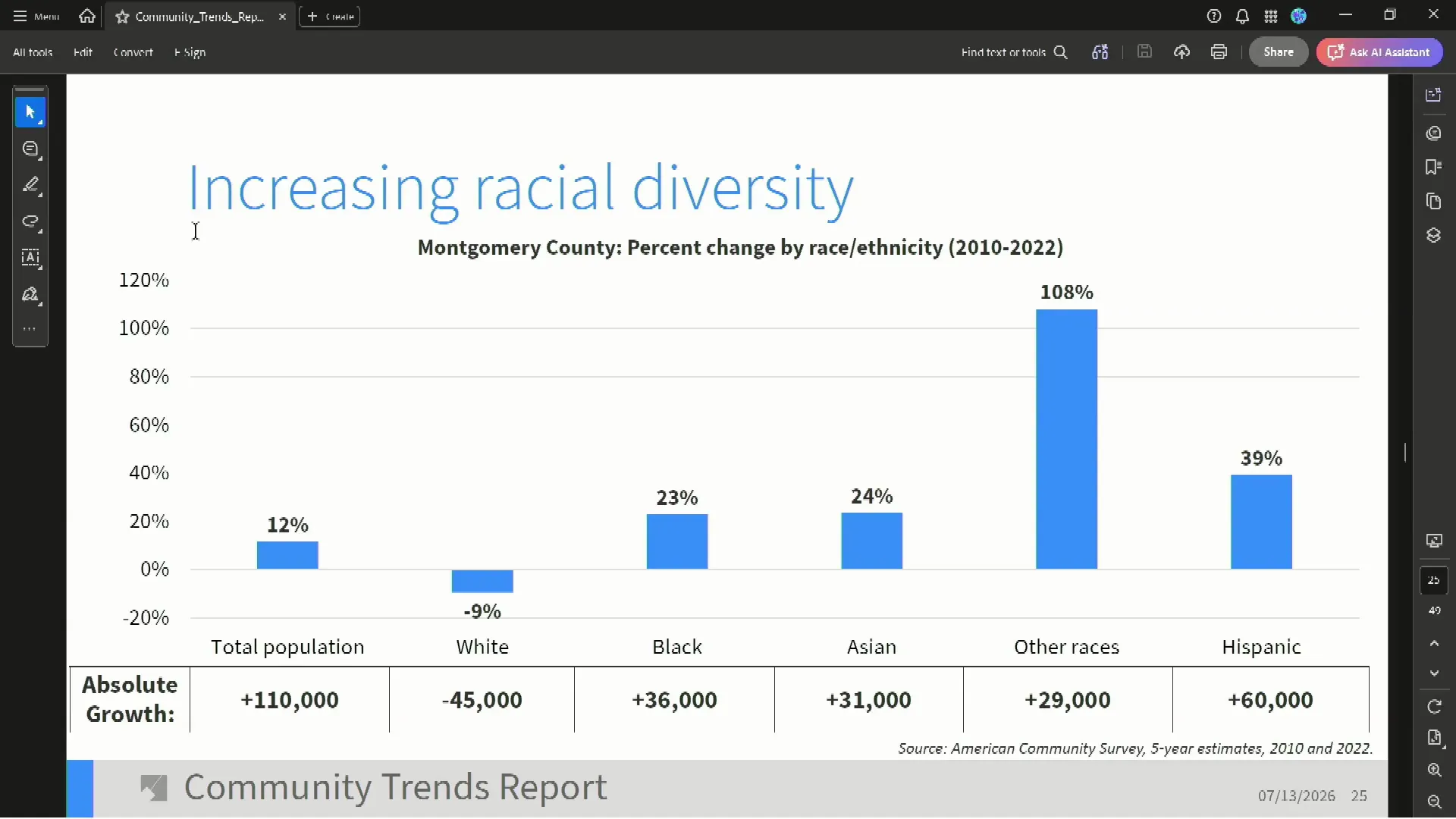
- Racial/ethnic diversity increased: Hispanic population grew by 39% (60,000 additional residents); county became majority people of color (59% in 2022).
- Non-English language use at home increased 26%; nine CTAs are now majority non-English speaking (up from three in 2010).
- Homeownership rate declined slightly; renter costs rose 40% vs. 14% for homeowners. Home value growth concentrated near employment centers.
- Dashboard demonstration: allows users to select a CTA, view place, people, and housing data, and compare across CTAs.
- Committee questions: Councilmember Fani-González noted Leisure World’s high HOA/co-op fees should be considered; Councilmember Jawando asked about CTA definitions and suggested including municipal-level data; Chair Friedson inquired about age/diversity disaggregation and the implications for housing policy. Staff noted ongoing Housing Preferences Survey results expected by end of summer.
- No vote required; the briefing was informational.
Key Outcomes
- ZTA 26-08 approved 3-0 as amended (line 81 clarification).
- ZTA 26-05 approved 3-0 as amended (200 net new jobs plus one of three conditions, multi-tenant allowance, DPS verification, net-new-jobs language).
- Committee received the Community Trends Report and dashboard; planning staff will continue to update and consider further analysis on age/diversity and municipal-level data.
Meeting Transcript
Good afternoon. It is just after 1 30 on July 13th. We have three items on today's planning housing and parks committee, starting with zoning text amendment 2608. I am the lead sponsor of the zoning text amendment. It was introduced on April 28th. It allows for the reinstatement of a nonconforming use under certain specific conditions. There was a public hearing on June 16th. After multiple discussions with council staff and with planning department staff, I realize that in certain contexts, reinstating a lapsed non-conforming use could be reasonable and even seen as a community benefit specifically to the neighboring community. Doing so can create new neighborhood businesses or amenities and help address buildings that have sat vacant for a period of time. And we know we have quite a bit of vacancy challenges, something that this council and this committee specifically has tried to address in multiple avenues. Ms. Nadu, thank you for all of your help with this zoning text amendment. Really appreciate it. And if there's no comments from colleagues, let me turn it over to you to walk us through the packet, please. Thank you. Good afternoon, committee. So as noted, uh ZTA 2608 will allow the reinstatement of a nonconforming use under a pretty thorough process. To start with, we had a public hearing June 16th. Um all testimony was in support, um, notice noting that issue with vacant buildings, um, and also that businesses sometimes have to close for personal or other economic um reasons. I believe COVID was listed as an example during the public hearing. Um so backing up slightly with what a non-conforming use is. Um, so a nonconforming use, um, very common in zoning across the country. It's a use that was lawful when it was established, but for some reason no longer conforms to the requirements of the zone. This can happen for a few reasons. Um, either the use is no longer allowed in that zone due to a zoning rewrite or a master plan. Um it can also be non-conforming because other um requirements have changed, such as setbacks or other use requirements. Um a nonconforming use under the current zoning ordinance is considered abandoned if it ceases operations for at least six consecutive months. Um and under the current zoning law, that use cannot be re-established again. Um the intent here is to phase out uses that are considered no longer appropriate for the zone. So, as noted by the sponsor, what this CTA would do is allow reinstatement if it's been abandoned for less than five years, and that five years would start at the date of submission of the application. Um if you look at the ZTA itself, um, there's a bit of a process for this, and those application requirements are basically the same requirements as a conditional use. Um the reason is that these would go to the Office of Zoning and Administrative Hearings, um, and there would also be notice provided uh via our usual application notice as well as posting the sign at the property. Um but one thing that will be unique about this process is unlike the traditional conditional use process, a hearing will not automatically be required. So part of the notice is notice that goes to municipalities, property owners, um, HOAs, civic associations, everyone in that regular vicinity, we use, I believe it's half a mile. Um if someone who received notice objects to the non-conforming use, um then they can submit that uh to OSA and specifically request a hearing. Um that has to be filed within 30 days of receiving notice, so the neighbors would have quite a bit of time to think about that use, meet with the property owner. Um if granted, that hearing must be scheduled within 60 days of the date the application was requested. Um, two other pieces to this to help the hearing examiner make a decision. Um, first, DPS must submit written comments to OSA within 30 days as well. Um, the intent of these comments is to describe the prior use and layout of the property, because presumably there was a U and O before. Um, and also any complaints that were received related to the use. So the reasoning there is there might have been a use, let's say, well, I won't call out specific uses, but if there was a use there that it had issues, um OZA would know that before allowing the reinstatement. Um second, planning will also provide a written recommendation, and that recommendation will note if there's a master plan that specifically calls out that use is not being allowed. So, for example, we've had recent master plans where we're saying we're phasing out auto uses. So it might be that those are not the ones you want to reinstate because the council through that master plan had already said that's not the use we want in this area. Similarly, planning's comments could include information about any effects from reinstatement of the use. This is adverse effects, including traffic circulations and other things that have changed. The hope is that that's going to be unlikely since five years is a pretty short window. But that's all the evidence that hearing the hearing examiner will have. Something else to note, if the hearing examiner finds that she needs more information to make a decision, she can also on her own decide to hold a hearing without getting that request from the community.
openpublica.com