Montgomery County Economic Development Committee Work Session - July 13, 2026
STREAMING COPY IN PREPARATION — RECORDING AVAILABLE FROM THE ORIGINAL SOURCE
Montgomery County Economic Development Committee Work Session - July 13, 2026
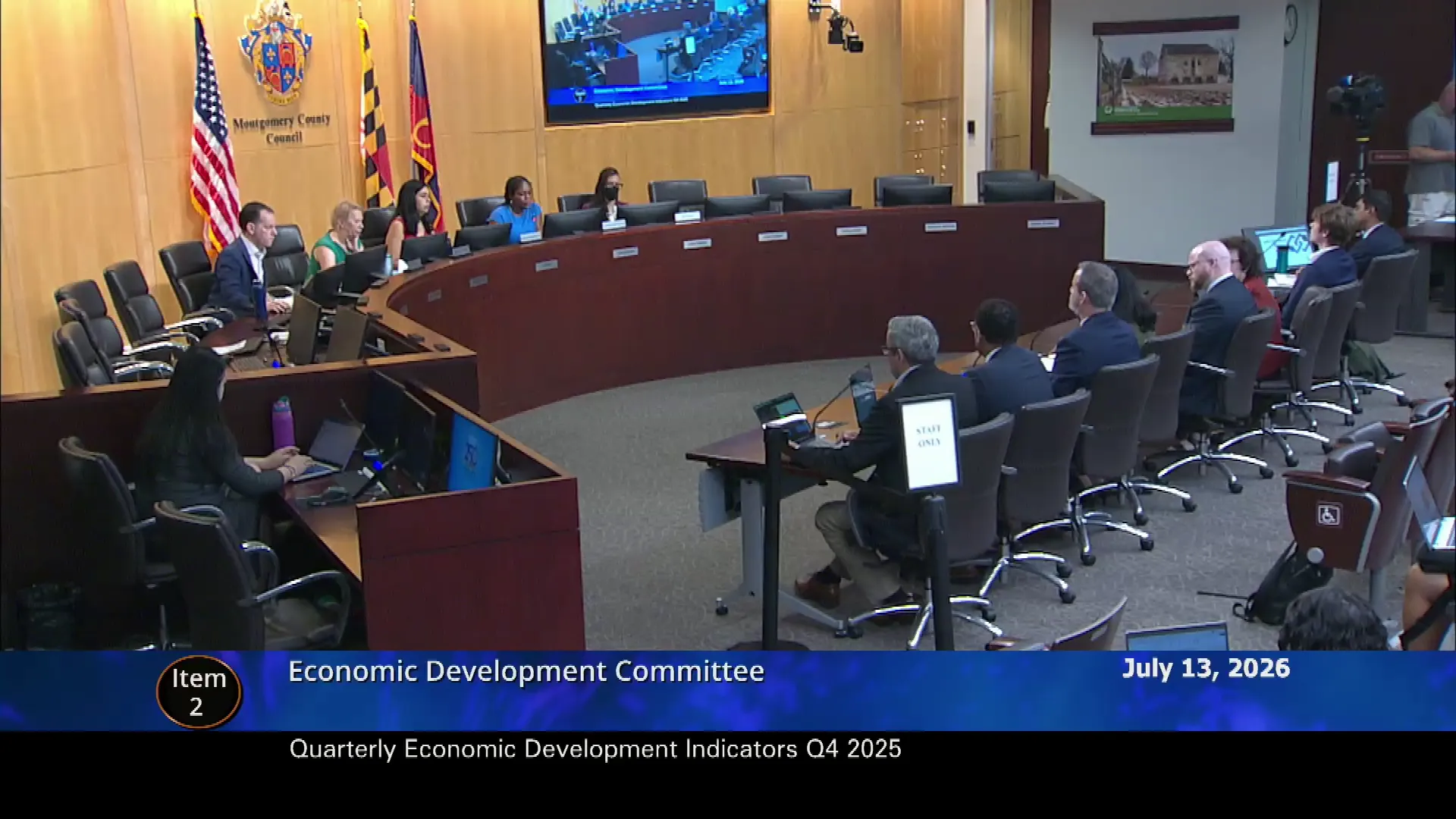
The Economic Development (ECON) Committee met on July 13, 2026, from 9:30 a.m. to 12:30 p.m. to review the Quarterly Economic Development Indicators for Q4 2025, including a special focus on the black labor market, and to consider Bill 22-26, which would repeal the sunset date on the SBIR/STTR matching grant program. Presenters included MCEDC, WorkSource Montgomery, the Department of Finance, and council staff. The committee discussed economic challenges from federal job losses, housing affordability, and racial disparities, and voted unanimously to advance the bill with amendments.
Discussion Items
- Quarterly Economic Indicators Q4 2025: Wesley Sarhan (MCEDC) and Ben Kraft (Montgomery Planning) presented data showing mixed conditions. The county’s unemployment rate was 3.5%, lower than the state (3.6%) and nation (4.2%). Federal job losses drove declines in professional services, but life sciences employment stabilized 16% above pre-COVID levels. Venture capital investment rebounded to $800 million across 31 deals, a ninefold increase year-over-year. However, the average single-family home price exceeded $1 million, and attached homes averaged $630,000. Multifamily permits spiked in Q4 2025/Q1 2026 but mostly came from publicly financed projects; Chair Fani-González noted that approximately 40% of those units were income-restricted due to public subsidies. Rents remained stable at an average of $2,000, but private-market construction remained challenged.
- Founders Fund Update: Dennis Hetman (Department of Finance) reported that $800,000 had been awarded to eight minority-owned businesses for technology commercialization. The fund’s $2.2 million remaining balance could support a second round, but administration funding constraints delayed the next cohort until spring 2027. Chair Fani-González pressed for acceleration, arguing the urgency given economic conditions; Ken Hartman-Spada (Assistant CAO) noted that previous direction limited grant funds to awards, not administration. The committee directed staff to explore using existing funds for administration to expedite the next round.
- Black Labor Market Special Update: Anthony Featherstone (WorkSource Montgomery) presented data sourced from Lightcast and county reports. Black residents make up 20% of the county’s population and are expected to grow 10% over the next decade. Black unemployment in the county is estimated above the countywide 3.5% rate (statewide black unemployment is almost double the state rate). Over 12,000 black residents were receiving unemployment assistance in April 2025. Homeownership among black residents is 46% versus 66% countywide. Black workers are concentrated in lower-wage occupations (e.g., protective service, healthcare support) and underrepresented in high-wage life sciences (16%). Alice (Asset Limited, Income Constrained, Employed) data shows 25% of households are Alice and 8% in poverty; black households have the highest poverty and Alice rates and the smallest percentage above Alice. Featherstone highlighted the need for expanded summer youth employment and entrepreneurship support.
- Bill 22-26: Staff presented the bill to repeal the sunset on the SBIR/STTR matching grant program, which had already expired. Two amendments were adopted unanimously: (1) change the eligibility period from “during the current fiscal year” to “within the 12 months preceding the application”; (2) codify the Phase Zero grant (up to $5,000 reimbursement for application costs) into law and expand eligible industries for Phase Zero to any sector (previously limited to three). Councilmember Sayles introduced four additional amendments regarding expanded demographic reporting, workforce pathways, supplier diversity, and outcome measurement. These were not voted on due to legal concerns and lack of preparation; they will be considered at the full council.
Key Outcomes
- The committee voted unanimously to send Bill 22-26, as amended with the two adopted amendments, to the full council for final approval.
- The committee directed executive staff to work on accelerating the next Founders Fund round, potentially using grant funds for administration, and to report back.
- Chair Fani-González committed to follow up on a summer youth employment program similar to those in other jurisdictions, and to coordinate with the Education & Culture committee for a joint work session on workforce development.
- Councilmember Sayles requested a dashboard tracking black labor market indicators; the committee agreed to continue discussions.
- The next quarterly economic indicators presentation will include a breakdown of multifamily unit subsidies and deeper demographic data on grant applicants.
Meeting Transcript
Good morning, everyone. Uh today is July 13 already. Uh my name is Natalie Fani Gonzalez. Thank you so much for coming today to an economic development committee work session. We have two items today to discuss. We're gonna start with the quarterly economic development indicators, quarter four, twenty twenty five. Um before I kick it off to staff and all of you to um provide your presentations and then discussion. Um I met with quite a few of you, probably like half of you, on this idea that came up after having different conversations with different groups really. It wasn't one group. It was several people throughout the year. Um, and looking at what's happening at the national level, and the need that I have that I think I'm not gonna say all, but most people agree that we do need to have an emphasis of the black community in Montgomery County after seeing how things are being handled from the federal government, how that's affecting people. And this idea that Montgomery County is immune to whatever is happening on the federal level is is wrong. And I think having data that can speak about our community in today's case, um, the black community is important. I want to thank Anthony Featherstone for from Work Source Montgomery. I know you're gonna be speaking on this particular issue, and there are other sessions that we're gonna be uplifting this particular segment. Um so I look forward to comments from ideas as well and things that we should be doing as a society to ensure that everyone, regardless of where they were born or the color of the skin, can have uh a great quality of life in this county. Um and um after speaking with quite a few people, I have some ideas, but I don't want to say them until I hear from you. Also, in case you were not aware, the we had a session uh last week with the at the full council with the Department of Health, and um they are doing a study focused on the black community. And I think that study that involves health, uh, plus what what we're doing here, and plus what we're doing at PHP. I'm a member of the planning housing and parks committee, and we talk about homeownership in that committee. And this is something that I also want to uplift over there. Um so I want to say that at the beginning as we move forward, and with that, I'm gonna turn it to Council Staff to kick us off, and then we can go around as we always do on this particular item. Go ahead. Awesome. Good morning. Yes. Um, so it does you mentioned here for the quarterly economic indicators briefing. There will be a special update on the black labor market from Works Force Montgomery, as well as all of the standard uh economic indicators that you've been receiving. Um there's a summary of them on page two of the packet. Um this uh edition special section is related to employment in the different council districts, and they have some maps and um information uh broken down that way uh to speak with you all about. Um there's also an update on the founders' fund and related to the comments that the chairs just made to understand uh the progress to date uh of this program that's intended to uplift small and minority-owned businesses specifically. Um so they're just gonna provide a recap of some lessons learned there and and the progress towards launching um a second round. Um and you can ask questions about um the status of that as well. Um we have some slides. Um, so with that, I'll turn it over to the experts. Yeah, good morning, uh, Council President, Councilman Sorry. We are spread down the uh table today. Jared Smith, President CEO at MCEDC. Good to be with you. Um Wesley's gonna deliver this presentation for us, but I just wanted to give a few opening comments, if that's okay. We are still in very challenging economic times. Uh to your point, uh, Council President, federal jobs continue to go down uh you know in in Maryland uh in the county. Um we are studying the effects of that now. As I've mentioned before, we are shifting the way we do research in our office to be one of economic competitiveness and not just uh straight research. Um I think it's I think it's important for for us to note that in some of the data you're gonna see today, there is a little bit of positive bounce back in the economy in certain areas, and and Wesley is gonna talk us through that. Um I think it's I think it's important for for us to note that in some of the data you're going to see today there is a little bit of positive bounce back in the economy in certain areas and and Wesley is going to talk us through that um but you you'll see this in uh VC dollars like new VC dollars starting to hit the market so there's there is there is a sign of some improvement still a little too early for me to be bullish on this uh because I want to be cautious um here at inside of our office at MCEDC you know we have we are in the final stages of wrapping up your four year county economic development strategy um that that will be coming to the C by the end of the month and to you uh per your very specific request uh and I I want to thank uh all the council members for being involved in that process with us um we at MCEDC are focused on job creation and you're gonna see in this data that job creation still struggles we are focused on investment and you will see in this data that there's still some struggles there as well um overall I'm excited about where the the coordination in the community to address these things uh but I think you're gonna hear a little bit of good a little bit of challenge and what Wesley's about to tell you so I'm gonna turn it over to him and I'll be around to answer any questions hi well good morning gonna wait for a second for the slides to get can you can you stay your name? Oh good morning my name is Wesley Sarhan I'm with MCADC as Jared just mentioned I'm here today to walk through the overall quarterly economic indicators this is for quarter four 2025 so that includes October November and December I'm also presenting here with Ben Kraft from permitting um and I'm going to be walking through largely what Jared had given you the great overview for here. So here in this next slide here this is the overall impact of where we are standing as of quarter for 2025. So as Jared had highlighted federal job loss did have an impact overall in the economy you can see that reflection in the overhead figures here for the unemployment rate um you can also see this in generally for the losses that you see however there is some positives within this impact clearly federal job loss has led to a lot of negative side effects here but there is a VC investment rebound looking compared to last year we have almost nine times more investment for the same period so there are optimistic things in here but that doesn't undercut the some of the realities however there is good news as well while we are facing higher unemployment overall there is less in Montgomery County when we compare this to our state and our overall region we're sitting at around three and a half percent of overall unemployment whereas the state of Maryland and the Washington DC region in general is slightly higher and we're still sitting about the full percentage under the United States overall as you can see here of course though there is still the reality of the impacts of the federal job loss. Going on to the next slide here and so I'm uh Ben Kraft uh from Montgomery planning for the record um and so just continuing on with the the employment and unemployment story the it's looking at weekly unemployment claims these are new unemployment claims it's as you know this we've seen this uh chart before it's it is very spiky but um if you if you look kind of under underneath uh look at the pattern underneath the the uh if you average the first four uh 14 weeks of 2020 uh six compare that to the average of the first 14 weeks of 2025 with new new claims it's down by about four percent so I think the one that if we're again talking about kind of like silver linings and points to to build on it for for how for how severely the federal uh employment base was really decimated it's actually um I think encouraging that it really hasn't had you know I when this was happening I would have have imagined that the employment rate by now unemployment rate new claims would be much higher than this so we're it's really tends to it seems to be kind of you know there there's a there's a problem there's new unemployment but it's not something that's overwhelming the economy which I think is something uh that we can be we can be uh thankful for at this point and there's some absorption so you can move on to continuing claims and again similar pattern um the it is definitely it's it's ending this period through the the end of the first quarter of 2026 on a a down uh a downslope and um so we'll see if that continues but still uh we're we're not seeing uh egregiously high levels of of just you know ongoing unemployment which I think is is uh an encouraging signal and kind of building off from there regionally we are looking at the lowest count of job loss for federal employment if you look at that third group being there however there's a higher concentration that we lost moving on to the next slide here I I like to say something about this if you don't mind thanks um good news bad news here like saying with that we are best
openpublica.com