Montgomery County PHP Committee Work Session - July 27, 2026
STREAMING COPY IN PREPARATION — RECORDING AVAILABLE FROM THE ORIGINAL SOURCE
Montgomery County Planning, Housing & Parks (PHP) Committee Work Session - July 27, 2026
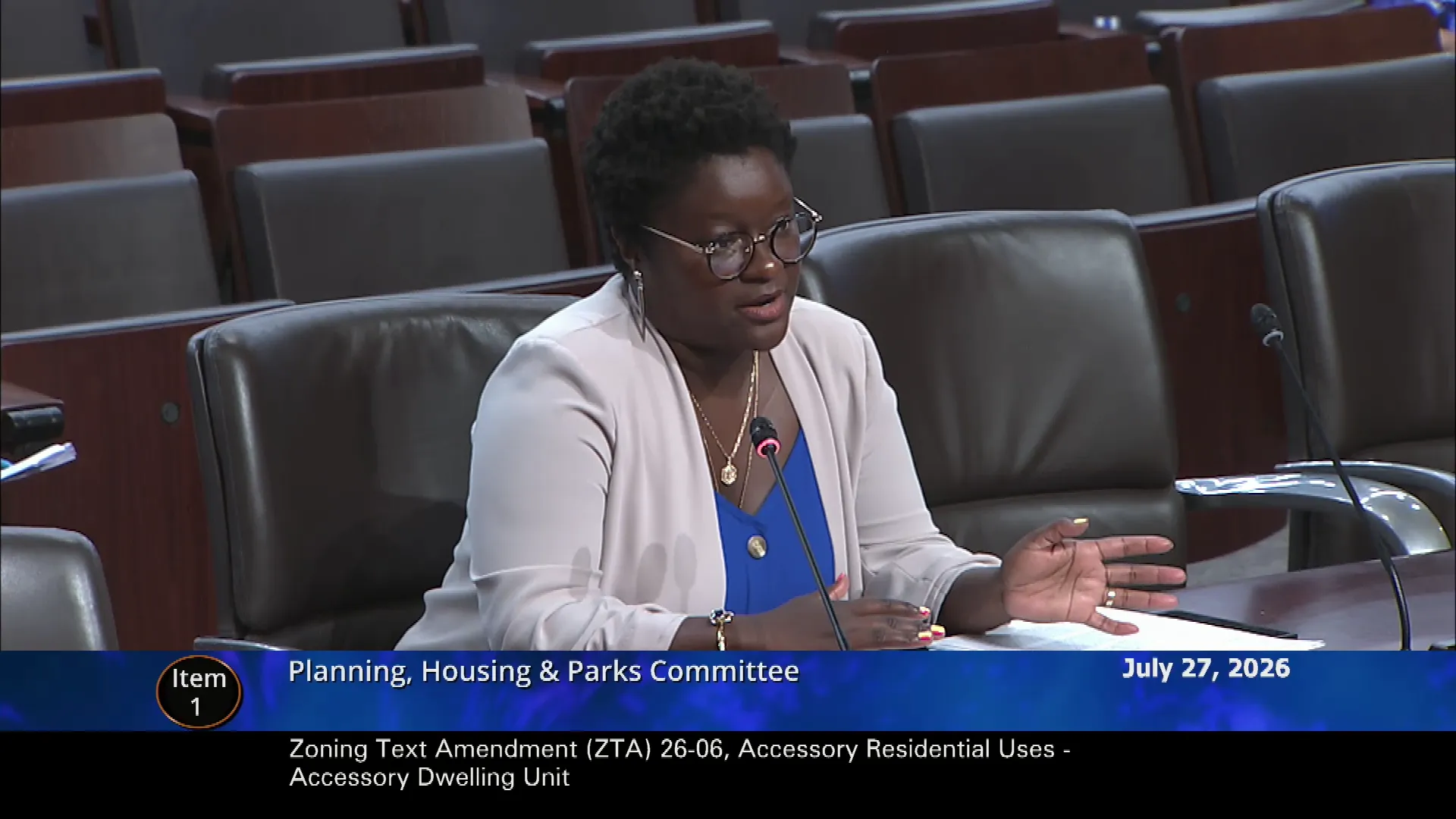
The PHP Committee, chaired by Andrew Friedson, met on July 27, 2026, at 1:30 p.m. to consider three items: two zoning text amendments (ZTA 26-06 and ZTA 26-07) to comply with recent state laws, and Bill 9-26 regarding air conditioning requirements in rental housing. The committee voted unanimously to approve both ZTAs as amended, and postponed action on Bill 9-26 to allow for formal submission of proposed amendments.
Public Comments & Testimony
- ZTA 26-06 (Accessory Dwelling Units): All public speakers expressed support for the ZTA, but several requested amendments to remove the owner-occupancy requirement and the two-adult occupancy limit. The committee noted that the owner-occupancy issue cannot be addressed in this zoning text amendment and would require a separate bill.
- ZTA 26-07 (Solar Collection Systems): One resident testified in support, noting that relaxing standards could help encourage young farmers. Written testimony included debate about whether rooftop solar should be preferred over ground-mounted systems given agrivoltaics potential.
- Bill 9-26 (Air Conditioning): DHCA Director Bruton (via written testimony) strongly supported the bill. The Housing Justice Coalition also supported. The Apartment and Office Building Association of Metropolitan Washington (AOBA) opposed, citing difficulties with central plant systems transitioning between heating and cooling and arguing that weather patterns do not support an earlier start date.
Discussion Items
ZTA 26-06 – Accessory Residential Uses – Accessory Dwelling Units
- Presented by Ms. Nadu. The ZTA brings the county zoning code into compliance with House Bill 1466 (passed April 2025), which requires local jurisdictions to authorize ADU development by October 1, 2026. Key changes: expanding ADU allowance to all zones, removing certain parking requirements (e.g., two spaces if a new driveway is built), and replacing setback and size standards with the state definition allowing up to 75% of the primary dwelling size. The Planning Board recommended a technical amendment (approved without objection) to strike redundant language. The Office of Legislative Oversight (OLO) provided a negative racial equity impact statement, noting that ADUs primarily benefit wealthier white homeowners; recommendations included incentives for low-income property owners. The committee discussed the need for financing assistance and fee waivers for affordability agreements. Councilmember Friedson requested that planning staff return with examples of fee waivers from other jurisdictions. The owner-occupancy requirement will be addressed in a future bill. Vote: 3-0 to approve as amended.
ZTA 26-07 – Solar Collection System – Use Standards
- Presented by Ms. Nadu. This ZTA responds to House Bill 1036 (April 2025), which preempts local land use regulations for solar systems under 1 megawatt (down from 2 megawatts). The ZTA creates separate definitions for rooftop-mounted and ground-mounted systems, relaxes rooftop standards, and retains existing language for conditional use in the Agricultural Reserve (AR) zone in case the county regains authority. Five technical amendments from the Planning Board were considered. Amendments 1-4 were approved without objection. Amendment 5 (adding “Chapter 59” before zoning ordinance references) was strongly opposed by council staff for consistency reasons; the committee voted 3-0 to reject it. The OLO racial equity impact statement noted a small negative impact, as solar benefits primarily high-income property owners. The climate assessment noted moderate positive impacts. Vote: 3-0 to approve as amended.
Bill 9-26 – Rental Housing – Maintenance Standards and Essential Services – Air Conditioning
- Presented by Ms. Wellons. The bill would update 2020 legislation by removing the exemption for detached single-family homes and extending the cooling requirement from May 15 (instead of June 1) through September 30. DHCA Deputy Director Nathan Bovell and Chief of Community Development Nathan Bovell presented three recommendations: (1) For multifamily buildings with central plant systems that cannot switch quickly, maintain the June 1 start date for cooling but require heating until then; (2) For buildings with tenant-controlled thermostats or instantaneous switching, use May 15; (3) For single-family homes without existing AC, provide a one-year hardship exemption. Councilmember Mink, the bill sponsor, expressed disappointment that these suggestions were not communicated formally before the meeting. The committee agreed to postpone action to allow DHCA to provide formal written language and work with council staff and the sponsor. The bill will be rescheduled for a future committee session.
Key Outcomes
- ZTA 26-06 (Accessory Dwelling Units): Approved 3-0 as amended. Directive to planning staff to research fee waiver examples for affordability agreements. A separate bill to address owner-occupancy requirements is expected before December 2026.
- ZTA 26-07 (Solar Collection Systems): Approved 3-0 as amended (with rejection of Planning Board amendment 5).
- Bill 9-26 (Air Conditioning Requirements): Postponed. DHCA committed to provide formal amendment language and work with council staff and the sponsor. The committee will schedule a future work session to vote before forwarding to the full council.
Meeting Transcript
Good afternoon. It is just past one thirty on July twenty-seventh. We're here for a planning housing and parks committee work session. We have a few items on our agenda, starting with a couple zoning tax amendments recommended by the planning board related to compliance with state law to get our zoning code in conformance with the state issues, starting with accessory dwelling units. So why don't we turn it over to Miss Nadu? You can walk us through the issues and we can take it up. Absolutely. Speakers were all in support. Although multiple speakers did ask for amendments to remove owner occupancy requirements, um, as well as the two adult occup to adult occupancy requirement, which I will address later. So turning to page two, the background of this is in April twenty twenty-five, the General Assembly passed House Bill fourteen sixty-six, and it explicitly required uh the county to adopt what all local jurisdictions, not just us, um, to adopt a local law that authorizes ADU development by October first, twenty twenty-six. So the county actually, as you know, already has ADUs allowed in the zoning ordinance, um, but several of the provisions were stricter than the state would like. And so planning um took on drafting and transmitting this CTA for request by the council, or for intro by the council. Um, so going through the various provisions in the DTA. Uh, first, the use table. Uh, previously, both attached and detached ADUs. Um, and to back up slightly, this whole ZTA will cover both types. I know we often think of the detached like converted garage, but basement apartments are also considered ADUs. So this covers both. Um, so the use table was amended to allow ADUs in all zones. Uh, currently, ADUs were only allowed in the agricultural rural residential and residential detached zones. Um, the reason for this change was the definition under state law as well as guidance documents that were provided by the state. And so planning reviewed all of those and interpreted that this should be changed in our zoning ordinance to bring us into compliance. Second, also about the definition. And so what they said was local jurisdictions need to do a parking study if you're going to have parking restrictions on ADUs. And also that if parking is going to be required, there must be a waiver provision. So planning had two choices here. We could have removed all of the parking provisions, or they could do a parking study and see where we can tweak what was already, I'll say hard fought. And so the current zoning ordinance requires one off street parking space, which is not required if you're a mile from Purple Line or MARC, and it also allows a request for a waiver from the hearing examiner. So park uh planning completed the study and had a few recommendations. First was to actually retain that one space per ADU as well as the exemption near transit. But there was a requirement that you have, if you did not have a driveway, you had to do additional parking spaces. So planning recommended removing that, and then also retaining the waiver that you get through the hearing examiner. So if you look at this ETA section about parking, first the language about if a new driveway must be constructed, then two spaces must be provided is changed so that if the principal dwelling has no existing on-site parking, such as a driveway, then the ADU only needs to provide one more parking space. So it's more consistent across all ADUs. And then also letting the hearing examiner do a waiver if the size or shape of the existing lot effectively precludes the ability to provide additional on-site parking. And that change is consistent with language in the state law about a parking waiver for small or irregular lots. We like to go through proofread update where we can. So there's things like making things that were lowercase, be uppercase, some language that was cut off. So that's number four on page three. And so what the ZTA does is apply that across the board in all zones. But we thought of a scenario where there's an ADU on a lot, and then you subdivide the lot. Now the ADU is on its own lot, so in that instance, you would then count that density. As for the use standards, this is a lot of stuff about the setbacks, which is probably the part where we were the least in compliance with the recent state law. So there were standards in the zoning ordinance about size specifications. Because the state definition made it clear that you could go up to 75% of the size of the primary dwelling. Just most of those setback and other size requirements are just taken out and replaced with that language. And so what the ZTA does is rely on those accessory setback provisions. I did receive a question or two about this, like then what would the setbacks be? It would be whatever the accessory structure allowances are in the underlying zone. So that varies across zone, but whatever zone you're in, whatever those accessory structure standards are, that's what the detached ADU standards would be.
openpublica.com