Mountain View Bicycle/Pedestrian Advisory Committee Meeting - June 26, 2025
STREAMING COPY IN PREPARATION — RECORDING AVAILABLE FROM THE ORIGINAL SOURCE
Mountain View Bicycle/Pedestrian Advisory Committee Meeting - June 26, 2025
The Bicycle/Pedestrian Advisory Committee (BPAC) met on June 26, 2025, to discuss two major projects: interim pedestrian mall improvements on Castro Street and the El Monte Corridor improvements. The committee also heard public comments on signage issues along El Camino Real and approved consent calendar items. Key decisions included recommending approval of concept layouts for Castro Street intersections with conditions, and approving the preliminary design for El Monte with additional recommendations.
Consent Calendar
- Approved the May 28, 2025 meeting minutes (Item 4.1) and the FY 2024-25 Work Plan (Item 4.2) unanimously.
Public Comments & Testimony
- Scott Mace (California Association of Bicycling Organizations, Silicon Valley Bicycle Coalition) raised concern that class II bike lane signs were placed on class IV facilities along El Camino Real, potentially causing confusion about mandatory use.
- Bruce England (Mountain View Coalition for Sustainable Planning, SVBC) echoed confusion about parking and signage on El Camino, noting that cars still park in bike lanes.
- Kevin Liu (resident, cyclist) supported the Castro Street pedestrian mall improvements and suggested adding speed bumps at intersections.
- Bruce England (again) supported the Castro Street design, recommended using “center” instead of “central” for naming, suggested speed bumps, and advocated for a large tree at the California Street roundabout.
- Valerie Finneck (resident, Performing Arts Committee member) supported signalized intersections, questioned the center crosswalk design, and urged coordination with the Downtown Committee.
- Jim Evans (resident, St. Francis Acres) asked how pedestrians would know not to continue walking into the intersection, expressing a safety concern.
- Mary Dado (resident, Questa Park) supported the Castro Street plans and requested additional large trees for canopy and heat island mitigation.
- Kevin Liu (again) supported the El Monte corridor improvements, praised slip lane removal, and suggested a cyclist-only signal phase to avoid conflicts.
- Bruce England (again) supported the El Monte project and urged a post-construction speed survey to potentially lower the speed limit.
- Jerry Maloney (resident, Hollingsworth Drive) expressed concern that two pedestrian refuge islands on Hollingsworth would make left turns difficult, suggesting one island instead.
- Mary Dado (again) expressed concern about the long right-turn lane at J Street and El Monte, and the narrow 4-foot bike lane on southbound Escuela.
- Jim Evans (again) supported the road diet, asked for better sidewalk lighting, and urged a lower speed limit on El Monte.
- Terry Bush (resident, Hollingsworth Drive) opposed the refuge islands, saying they would hinder left turns, and suggested removing them.
- Valerie Finneck (again) urged improvements at the Escuela/El Camino intersection, noting a recent fatality and dangerous conditions.
- Matthew Stengel (resident, Hollingsworth Drive) opposed the refuge islands, recommended a stop sign or pedestrian-actuated signal instead.
Discussion Items
- Interim Pedestrian Mall Improvements (Castro Street Intersections, Project 23-49): Staff presented concept layouts for Villa, Dana, and California streets. The design includes a central 21-foot crossing, new traffic signals, removable bollards, and reused decorative fencing. The project will be built in two phases: Phase 1 for Villa and Dana, Phase 2 for California Street. Committee discussion focused on crossing distance, signal timing, speed humps, and the need for pedestrian safety. Public comments were generally supportive with suggestions for speed bumps, lower speed limits, and more trees. The committee voted to recommend approval to the Council Transportation Committee (CTC) with recommendations to revisit signal timing, posted speed limits, and potential speed humps after implementation.
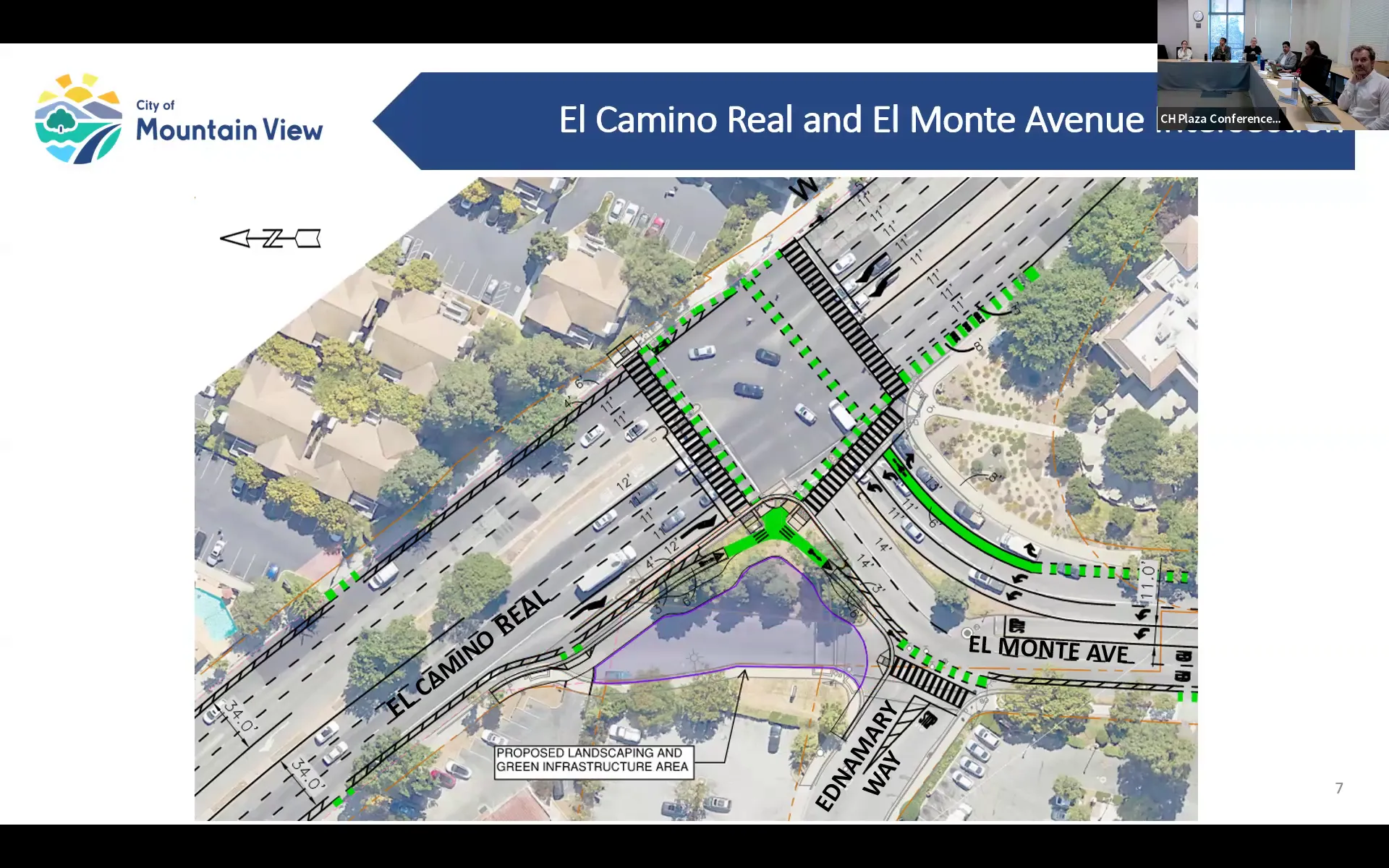
- El Monte Corridor Improvements (Project 21-38): Staff presented the preliminary design, which includes a road diet from four lanes to three lanes with buffered bike lanes, high-visibility crosswalks, protected intersection treatments, and signal upgrades at Escuela Avenue and El Monte Avenue. Coordination with Caltrans is ongoing. Discussion touched on the need for protected left turns, bike lane widths, pedestrian refuge islands, and a post-construction speed survey. Public comments raised concerns about refuge islands at Hollingsworth, the long right-turn lane at J Street, and the narrow bike lane on southbound Escuela. The committee approved the preliminary design with recommendations to: add a protected left turn from the private parking lot onto El Camino; evaluate costs for protected treatments on the southeast corner of El Monte/El Camino and at Escuela/El Camino corners; reduce the 18-foot northbound lane on Escuela to widen the bike lane; and conduct a speed study after construction to potentially lower the speed limit.
Key Outcomes
- Unanimous approval of the consent calendar (Items 4.1 and 4.2).
- Motion passed 4-0 to recommend CTC approve the Castro Street intersection layouts with additional recommendations on signal timing, speed limits, and speed humps.
- Motion passed unanimously to approve the El Monte preliminary design with specific recommendations regarding protected turns, lane widths, and a post-construction speed study.
- Next regular meeting scheduled for August 27, 2025.
Meeting Transcript
Chair, we have started the meeting and our recording. All right. Then let's go ahead and proceed with uh call the meeting to order and let's receive the throat call right now. Member Bate present. Member Stone. Vice Chair Kuzmal. Present. And member. Well. It's not present at this moment. Chair, we have quorum. Three members present. Two members absent. Let me read Terry Barton in the order. Chair Terry Barton. Not present. All right. Thank you, Brandon. We will now move to item three oral communications from the public. This portion of the meeting is reserved for persons wishing to address the committee on any matter not on the agenda. Speakers are limited to three minutes. State law prohibits the committee from acting on non-agendized items. Do we have any members of the public for general public comment in the room? No. Seeing none. Brandon, do we have any online? Yes, we do. We have one member. Thank you. Scott Mace. I'm gonna click to allow you to talk. Please unmute yourself and you will have three minutes. Thank you. Can you hear me? Yes. Okay. Good evening, uh members of the committee. My name is Scott Mace. I'm a district director for the California Association of Bicycling Organizations, also known as Cabo, also a life member of Silicon Valley Bicycle Coalition. I'm uh calling in tonight to raise concern about signs that have recently been erected along El Camino Real along the new bike facility. Uh in specifics, there are stretches of this facility that are class four, but have been marked with class two bike lane signs. That is not uh indicated by any uh SCALTRANs or state standards. Uh our organization will also be bringing this matter before the Caltrans District 4 Bicycle Advisory Committee. But I imagine that the city of Mountain View and your committee may have had some input into the placement of these signs. We understand that certain portions of this facility are class two, and such signage is appropriate there. The reason it matters is because uh motorists and even law enforcement who see a class two sign may assume that the facility is mandatory. And if you consult state law, you will find that class four bikeway facilities are not mandatory for use by cyclists. And of course, in many cases, even class two are not mandatory if certain conditions are met. At any rate, uh I had just ridden the new facility for the first time recently, and I wanted to bring this to your attention. Thank you.
openpublica.com