Council Sustainability Committee Meeting - June 27, 2025
STREAMING COPY IN PREPARATION — RECORDING AVAILABLE FROM THE ORIGINAL SOURCE
Council Sustainability Committee Meeting - June 27, 2025
Note: The transcript indicates the meeting was called to order on June 26, 2025, but the provided date of the meeting is June 27, 2025. This summary reflects the content of the transcript.
The Council Sustainability Committee (CSC) met to discuss and receive updates on reach code updates, decarbonization goal analysis, climate vulnerability assessment, and division progress. The meeting included presentations from city staff and consultants, public comment, and committee discussion.
Consent Calendar
- Approval of Minutes: The CSC unanimously approved the minutes from the April 29, 2025 meeting.
Public Comments & Testimony
- Bruce Carney (speaking on multiple items):
- On reach codes: Suggested a zoning incentive for all-electric homes with a 200 sq ft cap and a three-year sunset, and encouraged insulation improvements. Expressed hope that AB306 would fail or not be signed.
- On the climate vulnerability assessment: Raised concerns about river flooding from Stevens Creek Dam failure or overtopping, and noted that Mountain View's moderate wildfire risk may be higher due to proximity to Los Altos Hills and tree cover.
Discussion Items
5.2 Reach Code Updates (Presentation by Lindsay Hagen, Assistant Community Development Director)
- Staff presented the 2025 triannual building code update process, emphasizing the fast-moving AB306 bill that could restrict local amendments until 2031.
- Four potential reach code items were discussed:
- Expanded electric readiness/pre-wiring (lowering the threshold to include smaller renovations and appliance swaps).
- Energy performance/flex path (menu of options using points, e.g., heat pumps or insulation).
- Zoning incentive (voluntary: additional floor area for all-electric homes).
- Committee members expressed priorities:
- Chair Hicks and Member Showwalker favored focusing on the expanded pre-wiring and heat pump requirements, and considered the flex path too complex to administer.
- Member Clark suggested using the flex path framework to structure a tiered zoning incentive, and emphasized focusing on the first two items given limited time.
- All members supported the zoning incentive in concept, but advocated for a cap (e.g., 200 sq ft), a time limit, and a requirement for full all-electric construction.
- Staff confirmed they would work on the expanded pre-wiring and heat pump options, and pursue the zoning incentive outside the building code timeline (since it is in the zoning code and not subject to AB306).
5.1 2035 and 2040 Decarbonization Goal Analysis (Presentation by Cascadia Consulting)
- Cascadia presented a projection model showing three scenarios: business as usual (emissions increase ~103% by 2045), adjusted business as usual (including state/federal policies, emissions decrease 11% by 2045), and a future scenario with local actions.
- The revocation of California's Clean Cars II waiver significantly widened the emissions gap: without it, the city would need to reduce 44% of 2045 business-as-usual emissions through local actions (versus 7% with the policy).
- Committee members discussed:
- Member Showwalker questioned the population growth projections (based on the 2022 housing EIR) and suggested exploring alternative models.
- Member Clark supported local actions like time-of-sale electrification requirements, but cautioned against making housing more expensive; he preferred incentive-based approaches. He also noted the difficulty of regulating delivery emissions at the city level.
- Chair Hicks emphasized the need for more accurate local data on EV adoption and transportation emissions, and highlighted the importance of outreach and education to leverage public motivation.
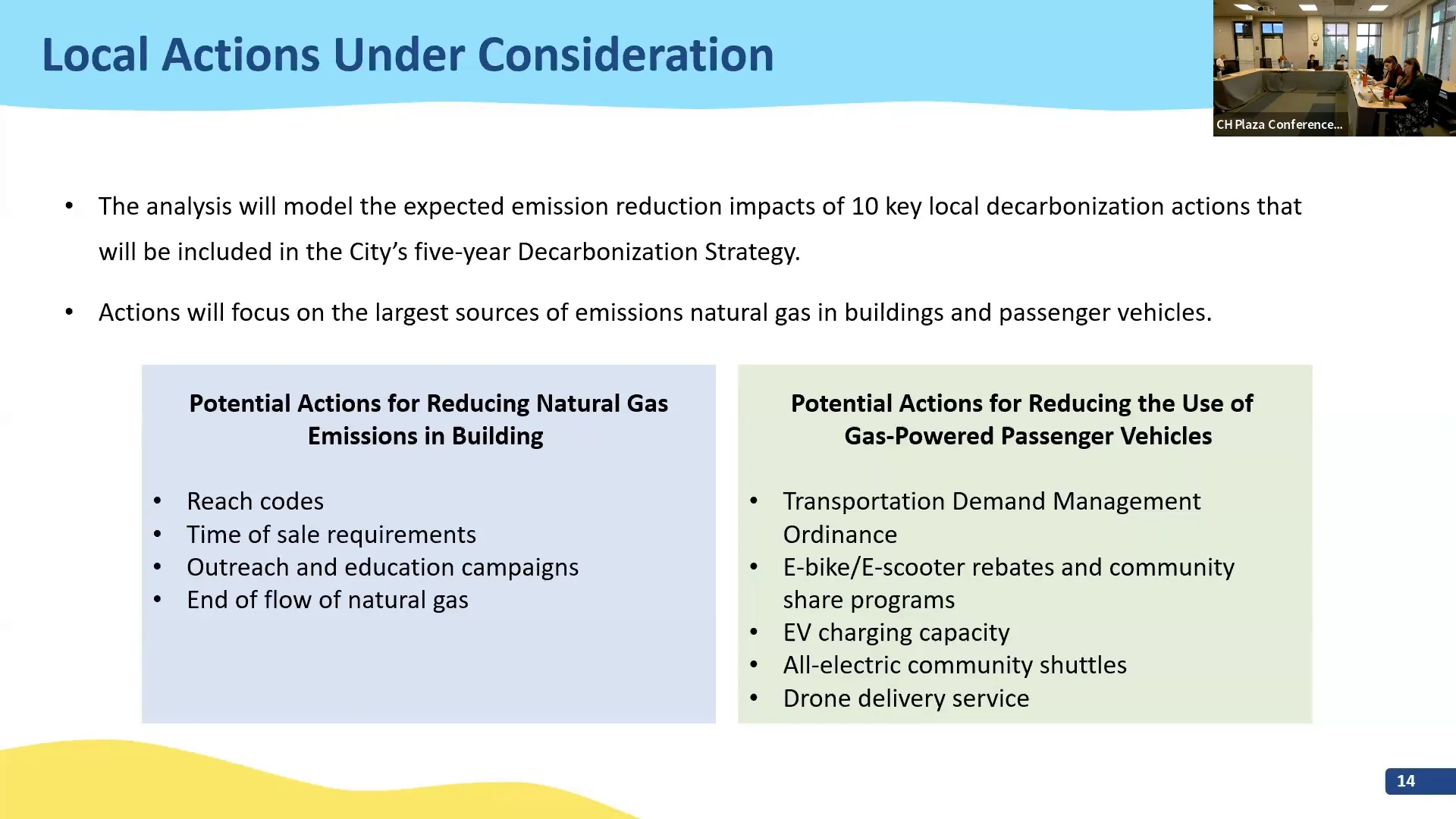
- Staff will model 10 key local actions over the summer and present results to the committee by the end of 2025.
5.3 Climate Vulnerability Assessment Progress (Presentation by Celine Fuchikawa, Cascadia)
- The CVA is 30% complete; this update focused on extreme heat hazards.
- Preliminary findings: Mountain View could see up to 17 extreme heat days and 38 warm nights per year by end of century under a high-emission scenario. Vulnerable populations include older adults, unhoused individuals, and renters without AC.
- The assessment will cover four sectors: health & well-being, emergency management, economic impact, and buildings & infrastructure.
- Committee members commented on the need to address localized flooding and stormwater management, tree planting to mitigate heat islands, and coordination with the fire chief on wildfire risk.
- Staff will complete the draft CVA by fall 2025 and present it to the committee.
5.4 Verbal Update on Sustainability & Resiliency Division Progress
- Staff reported on:
- Heat Pump Water Heater Rebate Program: Averaging 10 reservations per month; mailers sent to 1,846 homes; a community survey to gather water heater data.
- Extreme Heat Preparedness Grant: Flyers in four languages distributed; 200 resilience toolkits assembled for vulnerable populations, including those living in vehicles.
- City Operations Decarbonization: PG&E EV fleet application submitted; heat pump water heater conversions completed at two sites; solar PV installations at three sites ongoing (complete by April 2026).
- Upcoming items: multifamily EV charging analysis, decarbonization goal analysis update, draft CVA, and annual municipal decarbonization update.
Key Outcomes
- Minutes approved unanimously.
- Reach Code Direction: Staff to prioritize expanded electric pre-wiring and heat pump requirements, and develop a zoning incentive (with cap, time limit, all-electric requirement) for consideration outside the building code cycle. Flex path deprioritized.
- Decarbonization Goal Analysis: Staff to continue modeling local actions; committee requested more accurate local data and consideration of alternative population growth scenarios. Results expected fall 2025.
- Climate Vulnerability Assessment: Staff to proceed with full assessment; draft to committee in fall 2025, final to council early 2026.
- Verbal Update: Noted; no action required.
Committee Reports & Announcements
- Member Showwalker shared a tour of Google's thermal plant in Sunnyvale, which uses heat pumps, a water battery, and solar panel siding. Encouraged members to visit.
- Chair Hicks encouraged staff to continue outreach at neighborhood committee meetings.
Adjournment
The meeting was adjourned at 8:49 PM.
Meeting Transcript
Oh no, that's good. Okay, so should we start? Yeah. Coming on. Are we on? Yes. Oh, hello. Um so this is the council sustainability committee meeting from June 26, uh 2025. I'm going to call the meeting to order. Um this is item one call to order. Uh this meeting is being conducted with a virtual component. Anyone wishing to address the council sustainability committee virtually may join the meeting on Zoom using the link or phone number and webinar ID shown on the screen. When the chair announces the item on which you wish to speak, click on the raise hand feature in Zoom or dial star nine on your phone. When the chair calls your name to provide public comment, if you're participating via phone, please press star six to unmute yourself. For in-person attendees, please fill out a speaker card, which you can find on the sign-in table to the left of the door. We're now on item two, which is roll call. Ms. Lee, can you take roll call, please? Certainly. Chair Hicks. Yeah. Member Showwalker. Member Clark is absent on his way. I understand he'll be here momentarily, but we have the majority at this point. So number three is minutes approval. This would be the CSC meeting minutes from April 29th, 2025. Does anyone have any comments or questions about the meeting minutes? I don't see any comments or questions. Would anyone like to make a motion to approve the meeting minutes? Sure. Move approval. And I second. And all those in favor. Okay. Majority of those here. Number four item number four on our agenda is oral communications. From the public, this portion of the meeting is reserved for people wishing to address the committee on any matter not on the agenda. Speakers are allowed to speak on any topic for up to three minutes during this section. State law prohibits the CSC from acting on non-agendized items. So would any member of the public like to provide a comment on an item that is not on the agenda? If so, please click the raise hand button in Zoom or press star nine on your phone. Or if you're here in person, turn in a speaker card. Do you have any speaker cards? No, no, we do not. Okay. And any virtual speakers? Okay. In that case. We'll now close the oral communication item and move to discussion and action items. We are on item number five, um, which is new business.
openpublica.com