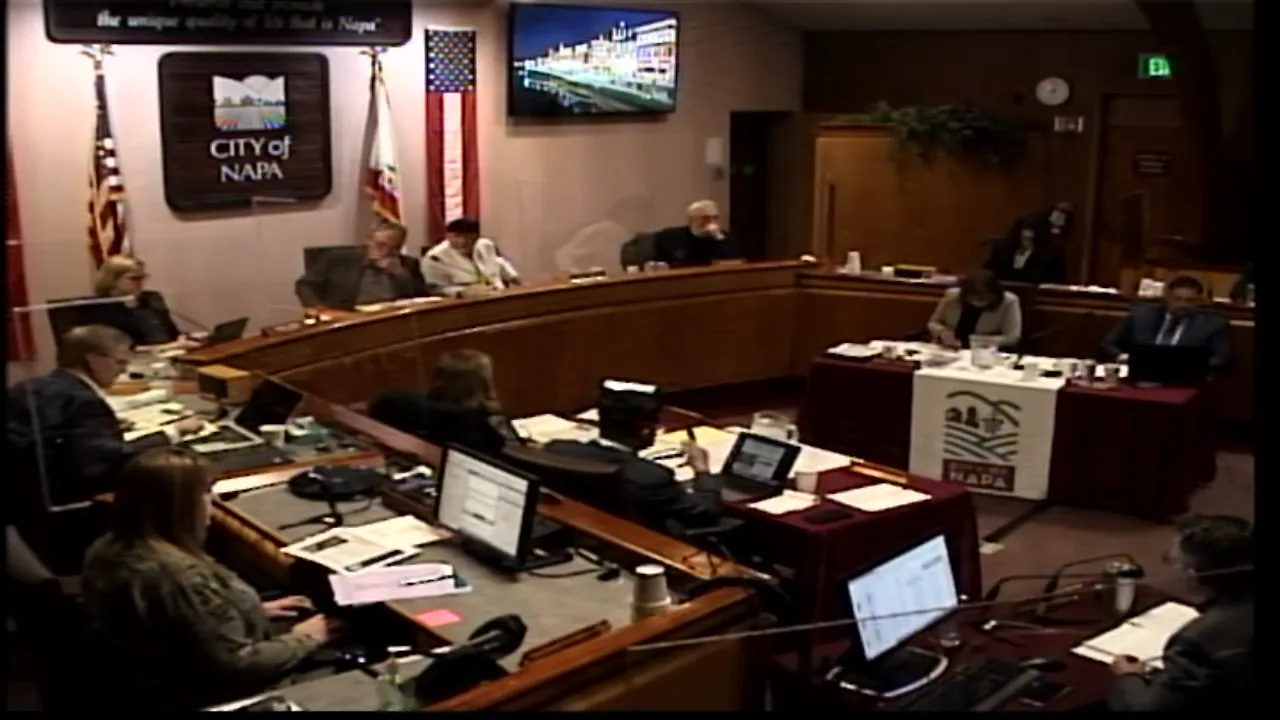
Napa City Council and Planning Commission Joint Meeting on Draft General Plan Update - March 28, 2022
STREAMING COPY IN PREPARATION — RECORDING AVAILABLE FROM THE ORIGINAL SOURCE
Napa City Council and Planning Commission Joint Meeting on Draft General Plan Update - March 28, 2022
The Napa City Council and Planning Commission held a special joint meeting on March 28, 2022, at 5:30 PM in City Hall Council Chambers to receive a report on the Draft General Plan Update (Napa 2040) and provide feedback to staff. The meeting featured extensive public testimony and council/commission discussion on land use, transportation, parks, climate change, and other elements. Key themes included calls for stronger climate language, traffic calming, bridge alternatives, housing-hotel balance, and park equity.
Public Comments & Testimony
- Greenbelt Designation: Joseph Keebler suggested combining the greenbelt designation with very low density (20 acres per parcel) to allow flexibility, noting few parcels are not already covered by scenic easements.
- Linda Vista Bridge (multiple speakers): Genji Schmider, Cindy Deutsch, Tom Andrews, Darryl and Shannon Hutton, Rob Brandon, Chuck Galivick, Jeff Prater, and others opposed the vehicle bridge extension across Redwood Creek, arguing it would increase traffic, endanger neighborhoods, and harm the environment. Many urged converting it to a pedestrian/bicycle-only bridge or removing it from the plan. Genji Schmider proposed a gate for emergency vehicles only, citing the Meadowwood Drive example.
- Climate Action (Napa Climate Now members): Chris Benz, Bayard Fox, Grania Lindbergh, Celeste Mirasou, Darlene Scott, Marilyn Knight Mendelssohn, Linda Brown, Jim Wilson, Christine McClure, and others called for stronger, more specific language in the Climate Change and Sustainability Element, including net-zero targets by 2030, a dedicated climate coordinator ("climate czar"), bans on new gas stations and gasoline-powered leaf blowers, and explicit inclusion of short-lived climate pollutants. They urged the city to develop its own Climate Action Plan rather than rely solely on the countywide committee.
- Traffic Calming: George Yesowich and Maureen Tripp (Slow Down Napa) requested that the general plan include policies to make it easier for neighborhoods to implement traffic calming measures (speed humps, roundabouts) due to dangerous speeding.
- Historic Preservation: Ernie Schlobaum (Napa County Landmarks) urged the plan to include goals for adopting potential historic districts into local landmark districts within 10 years, with streamlined zoning codes.
- Housing and Hotels: Chuck Shineman (former GPAC member) emphasized the need for affordable housing across the spectrum and expressed concern about potential overbuilding of hotels (up to 4,000 rooms by 2040) competing with housing sites.
- Bicycle and Pedestrian Improvements: Kara Verner (Napa County Bicycle Coalition) asked for clearer, more committed language in the transportation element, including targets for reduced vehicle miles traveled and increased mode share, and for bike facilities on all major corridors where feasible.
- Browns Valley Greenbelt: Andrew Healy (Browns Valley Action Group) thanked the planning commission for adopting greenbelt designation language for parcels around Timber Hill and endorsed its application.
- Other: Jay Jacobson advocated for a historic preservationist on staff and incentives to bring underutilized buildings into use. A speaker requested policies for disposable foodware ordinances.
Discussion Items
- Land Use and Community Design Element: Councilmember Painter raised concerns about the language on page 2-13 regarding density for public-serving lands (e.g., Harvest Middle School site), suggesting it should reference surrounding land use densities, not surrounding uses. She also recommended periodic updates to the build-out projection table (Table 2-2) and reviewing floor area ratios (FAR) for high-density residential and mixed-use to allow flexibility. Vice Mayor Luros noted that the table shows a 25% increase in housing units but a 56% increase in hotel rooms, and urged rethinking hotel growth projections. Councilmember Narvaez highlighted the potential of the Turner (Napa River) area as a gem for connectivity and housing. Commissioner Kelly supported tracking ADUs separately and revisiting downtown parking requirements to spur housing.
- Transportation Element: Councilmember Painter called for prioritizing safer streets and multimodal transportation, and specifically recommended removing the Linda Vista Bridge (a vehicle extension) from the plan, calling it a relic from 50 years ago. Vice Mayor Luros noted the absence of any planned Class IV protected bike lanes and suggested reconnecting Coombsville to Alta Heights. Mayor Sedgley preferred keeping the corridor for bicycle/pedestrian and emergency access, citing multimodal goals. Commissioner Kelly advocated for light rail and roundabouts for traffic calming. Commissioner Hurtado asked for a bike safety improvement table analogous to the roadway improvements table. Councilmember Alessio recommended a future staff report on the bridge to inform decision. Councilmember Narvaez supported keeping emergency access but not full vehicle traffic.
- Community Services, Parks, and Recreation Element: Vice Mayor Luros requested adding potable water reuse (advanced water purification) to goals, noting progress with Napa Sanitation District. Commissioner Kelly supported microparks for densifying areas. Councilmember Narvaez noted the park desert in South Napa and asked about South Jefferson Park (outside city limits but planned for future park). Councilmember Painter praised the bioenergy/anaerobic digester language and encouraged park acquisition in Timberhill area.
- Climate Change and Sustainability Element: Councilmember Painter urged using words like "achieve," "ensure," "establish," "prioritize" instead of weaker terms, and called for a dedicated climate action plan (CAP) with a timeline, not waiting for the countywide committee. She also supported a climate/sustainability coordinator position. Vice Mayor Luros asked if lawn and garden equipment emissions (less than 1% of 2005 inventory) included leaf blowers; staff confirmed. She suggested strengthening language on transitioning the city’s vehicle fleet. Commissioner Masaro proposed creating a matrix showing how public comments are addressed in the general plan, implementation plan, or CAP. Councilmember Narvaez emphasized that the climate element is the one where bold language is most appropriate, and specifically called for completing a citywide urban forest master plan (not just supporting its development). Councilmember Alessio suggested adding Providence Queen of the Valley Medical Center and Kaiser as partners, and adding a timeline for the CAP and urban forest plan. She also noted the importance of age-friendly communities language. Commissioner Hurtado agreed on including short-lived climate pollutants.
- General Discussion: Councilmember Narvaez asked about the legal defensibility of more specific language. City Attorney Michael Barrett and Community Development Director Vince Smith explained that the general plan must be internally consistent and flexible enough to last 20 years; specificity can create unintended conflicts. They noted that the implementation plan (Appendix A) can be amended and can carry more detailed actions. The planning commission will hold several more meetings to dig into elements, with staff providing a summary of how public and council comments are addressed.
Key Outcomes
- Direction to Staff and Planning Commission: The council provided high-level guidance for the planning commission to refine the draft General Plan. Key directives include:
- Land Use: Review FARs for higher-density zones, update the build-out table periodically, consider second home impacts, and evaluate hotel growth projections.
- Transportation: Prioritize multimodal safety, consider removing the Linda Vista vehicle bridge and replace with pedestrian/bicycle/emergency access language; evaluate Class IV bike lanes and traffic calming strategies.
- Climate & Sustainability: Strengthen language (use words like "achieve," "ensure") and establish a clear timeline for a city Climate Action Plan, potentially separate from the county committee; consider a dedicated climate coordinator/sustainability manager (subject to budget). Include urban forest master plan completion (not just support).
- Parks: Address park equity (South Napa), explore parkland acquisition (Timberhill), and consider microparks as density increases.
- Overall: The planning commission will hold additional meetings to review remaining elements (safety, noise, historic preservation, public health/equity) and the implementation plan. Staff will produce a matrix addressing comments from public, council, and commission.
- Next Steps: A follow-up joint meeting may be scheduled to discuss remaining elements. The city council will adopt a climate emergency resolution at its April 5 meeting. Public comments will be considered in the final draft.
Meeting Transcript
We follow the rules of the Brown Act, so we will actually run it like two meetings. But since I'm the mayor, I get to take charge. So kind of I'll get that. So uh we gotta share that microphone. We do, we share it. But uh we'll call the order the special meeting of uh March 28th, 530 tonight, and uh we will this evening we'll meet to receive a report introducing introducing the draft general plan update. So city clerk, if you're ready, could we have roll call from the city council? Certainly. Council members Narvaez, here painter here, Alessio present. Vice Mayor Luros here, Mayor Sentley. Present. You can co-roll call for we get roll call for the planning commission, please. That's just so important. Commissioners Hurtado Present. Kelly Present. Shotwell. Vice Chair Masaro. Oh, it is Chair Heuther. Here are there any uh changes or uh supplemental reports the agenda. There are no changes to the agenda, uh Mayor and Chair, but we do have supplemental uh supplemental um documents for item 3A. We have a PowerPoint presentation from city staff as well as 94 uh emailed written communications that have been received, added to the record, and forwarded to all council members and planning commissioners. Thank you very much. Since this is a special meeting, the subject of public comment is limited to items on the agenda. Therefore, we will first ask for a staff report for this administrative report item. We will take brief questions from commission members and council members, and then we will open public comment. Uh following the report of public comment, commission members and council members will provide comments and considerations to staff. Uh Mr. Michael Walker, take it over. Thank you, Mayor. Good evening, uh Mayor, Council, members of the planning commission. Uh, tonight's agenda is devoted to an introduction of the draft general plan and continue the conversation on various aspects of the plan and solicit your feedback. Over the course of the next few minutes, I'm gonna help set the stage for tonight's discussion and walk you through some additional background information and provide uh some guidance on the next stage stages of review. So, how did we get here? If you think way back to 2018 when we started with the speaker series, the uh couple meetings we had at the Uptown Theater and at the Archer, that was really the kick-off kickoff of our outreach and engagement. We continued that uh through presentations to groups such as Rotary and Kawanis, farmers market pop-up events and other pop-ups, Spanish language outreach, and even some local radio spots. Uh the last joint meeting of these two bodies uh was back almost three almost three years ago, uh discussing the existing conditions report and the economic profile of the city, providing a snapshot of where we were at that time. After that meeting, much of the work fell to the uh general plan advisory committee or the GPAC. The role of the GPAC cannot be understated uh with at least 16 meetings and countless hours of uh participation and community engagement. Uh we had workshops both in person and virtual, and it helped us engage with hundreds of community members on topics ranging from community visioning to land use to transportation. We conducted surveys and sent upwards of a hundred newsletters uh with our newsletter subscription now reaching over 900 uh 900 uh subscribers. As anticipated, much of the early focus was on land use and the land use plan uh between the GPAC and the planning commission, probably 10 meetings and workshops were dedicated to the creation of the draft land use plan. Input from the community has uh shaped this plan in other important ways. Uh the state requires us to address seven elements in our general plan. In addition to those, because of our community's commitment to historic resources and economic economic development, those two are additional uh areas of focus in our general plan. And in direct response to the community's strong sense of responsibility to climate change and health and all policies, two additional elements are included in the general plan. So general plans are required to do a number of things. In addition to the seven elements I previously mentioned, the general plan is also required to establish long range vision and policies. It is also required to provide a strong basis for not only development projects to be measured, but also other city actions that implement the goals and policies of the general plan. Detailed plans such like updates to the downtown specific plan and the zoning ordinance, bike and trails plans, implementing programs such as a climate action plan, and capital improvement projects like roadways and utilities. The general planal plans are also required to meet these three criteria to be comprehensive, be internally consistent, and take a long-term perspective, in this case, 2040.
openpublica.com