Nashville Metro Public Defender's Office Budget Hearing - May 15, 2024
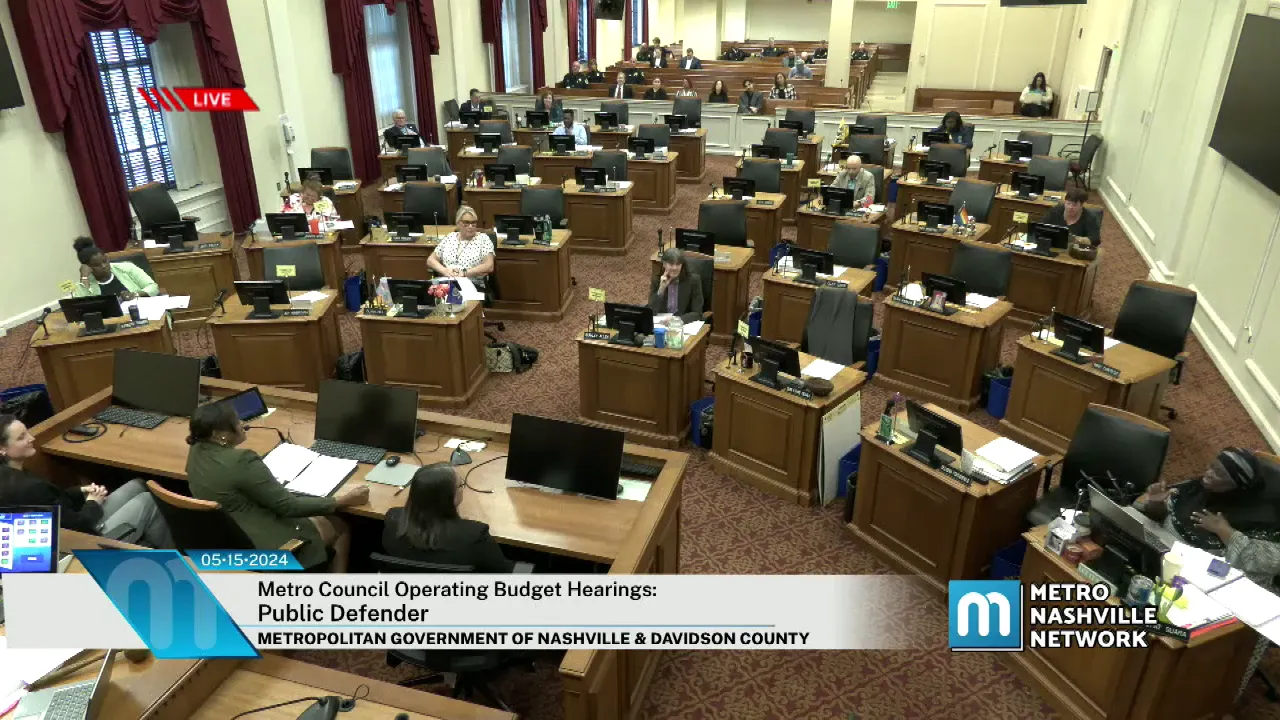
STREAMING COPY IN PREPARATION — RECORDING AVAILABLE FROM THE ORIGINAL SOURCE
Nashville Metro Public Defender's Office Budget Hearing - May 15, 2024
This budget hearing focused on the funding requests of the Nashville Metro Public Defender's Office, led by Chief Defender Johnson Moore. The discussion centered on salary parity, workload, retention, and technology needs, with council members asking detailed questions about the office's challenges and proposed solutions.
Discussion Items
- Salary Parity: Chief Johnson Moore highlighted that experienced attorneys in her office earn $20,000 to $50,000 less than their counterparts in the District Attorney's office. For example, a lawyer with 20 years of experience would earn $175,000 in the DA's office but is paid $45,000 less as a public defender. This disparity is causing retention issues, with several senior lawyers leaving recently.
- Workload: Attorneys in the serious felony team carry double or nearly triple the recommended caseload. General sessions attorneys handle between 100 and 300 cases each, while the target is 100. The office requested one additional position to address workload, but Chief Johnson Moore stated that even with that position, compliance with workload standards would not be achieved. A recent workload study indicated the need for seven additional attorneys for serious felony cases.
- Cloud-Based Storage: The office requested $62,000 per year for five years to transition to cloud-based storage for body-worn camera footage, following the police department's move to cloud storage. Without this, the office cannot store evidence properly due to different retention policies.
- Audit Compliance: The 2021 audit found workload exceedances. The office has been working on a plan, including participating in national workload studies, but additional resources are needed.
- Salary Savings Reallocation: Chief Johnson Moore stated that salary savings from vacancies cannot be used for operating costs. Councilmember Evans noted a potential inconsistency with other departments and asked finance to revisit the policy. Finance indicated they would look into it.
- IDEA Project: Councilmember Allen asked about funding for the Indigent Defense Excellence and Advocacy (IDEA) project, which requested $880,000 to handle 50 serious felony cases. Chief Johnson Moore said she would prefer that funding go to her office to address systemic needs, but acknowledged the appointed bar's low pay is also a critical issue.
- Incentives for Attorneys: In response to questions about non-monetary incentives, Chief Johnson Moore highlighted the office's strong training program, focus on self-care, and flexible culture, which help attract and retain staff despite lower pay.
Key Outcomes
- No formal votes were taken during this hearing.
- The finance team agreed to revisit the policy on reallocating salary savings for non-salary purposes, with a follow-up expected.
- The council members expressed appreciation for the public defender's office and indicated they would consider the budget requests in future deliberations.
Meeting Transcript
Increases whose cases have been entrusted to us. We are committed to providing them excellent representation. And we do that because our constitution guarantees everyone the right to counsel when their liberty is at stake. And we do more than that. You know, our clients don't get to choose us. We often meet them during some of the hardest moments of their lives. Therefore, at our core, we value being zealous advocates. We value to strive not only to deliver excellence in our representation of each and every client, but also to stand with our clients and the community in working to create a more just, fair, and compassionate legal system. Our staff is made up of legal assistants, paralegals, attorneys, interns, social workers, client advocates, investigators, and an administrative services team that have committed themselves daily to being public defenders, requiring us to do this work to ensure that our clients are seen as more than just names on a docket. We exist to remind people that our clients deserve dignity, respect, and humanity, regardless of what they look like, where they come from, or what they are charged with. And I want to take a moment to acknowledge the great work that my team does, my staff, and to thank them for their service. We are client-centered and committed to innovative advocacy. We are partners with the community and engaged in systemic reform, particularly around bail and ending wealth-based detention. We seek equal justice for some of our most vulnerable residents who often end up in jail because of the shortcomings in other systems, the lack of quality education, limited access and available resources for addiction or mental health support, and simply because they experience the childhood steeped in poverty and riddled with traumatic events. We are committed to partnering with other criminal justice stakeholders to focus on practices that are restorative, rehabilitative in nature, and focus on re-entry. And in short, we are dedicated to decriminalization of poverty. Metro has consistently funded the majority of our office's budget, which enables us to operate and represent our clients, and for that we are grateful. Our budget requests this year mainly focus on our needs related to retention and recruitment of our staff, addressing our workload, and keeping up with the resources and technology that we have to deal with day to day as we defend our clients, particularly related to technology and the uh changes to the way we store body-worn camera footage. Um, I'm happy to talk specifically about those requests. Um, the major issue for us is uh a request we made around parity for our lawyers. What happens when a lawyer in my office reaches a certain level of experience, the both the state scale and and what we pay Nashville's district attorneys begins to outpace them greatly. And so I have lawyers in my office who have been with us for a long time, but they can't earn in the same capacity, and it becomes a retention issue for me. Within the last couple of months, our office has seen some of our experienced lawyers leave us, quite frankly, because they can't stay around with the heavy caseloads we're asking them to take on with the sometimes double and triple the recommended workload for serious felony cases and make the amount of money that they continue to make each year. We have made strides in paying as much as we can. We spend all of the money that we can to offer merit-based increases and give re give increases to our salaries and whenever we can, but that has not been sufficient to sustain our senior level staff, and that is where we see the largest gap. So we have asked for a large lump sum payment to create parity for our lawyers in those areas and other staff members who are not receiving a salary that is on par with their counterparts in the DA's office or across the state as public defenders. We have asked for a position to address our workload. Um we have been a part, fortunately, of participating in a new workload study, and we are finding that many of our lawyers, particularly those again, who handle serious felony cases. It was interesting to be here and hear Sheriff Hall talking about the increases to his population because we see those increases because we are the ones who are visiting with those clients in the jails. We also see the increases and know the increases that the criminal legal system is experiencing on a day-to-day basis. And so, in order to be able to address those increases, I have to be able to move my staff with the times. And then we continue to create the disparities that don't allow us to provide excellent representation to our clients. So I'll be quiet for a minute. Colleagues, does anyone have any questions? I knew the first hand that was gonna go up. Uh uh public health and safety chair Evans, I'll start with you. Do you have any questions? Yes. Thank you, Chair. I have um, I guess could you give us an example when you're talking about the parity issue between like uh tenured or seasoned um attorney in your office and what that person would make if they were at the public defender or I'm sorry, the district attorney's office. Sure. I have done this calculation actually for all of the lawyers in my office. So let's take a lawyer who happens to be with us tonight who has been with our office more than 20 years. His salary on if he were in the district attorney's office right now would exceed 175,000. And I pay him about 45,000 less than that each year. On lawyers who have been in our office more than 10 years, um, their counterparts in the DA's office would make between 134,000 to 154,000. Many of them I can't even pay more than 100,000. So the disparities are pretty wide. When I first got in this position, there was a lot of conversation in this body about parity from the DA perspective. At the time, the parity issue was around starting salaries.
openpublica.com