Nashville Budget Committee Reviews Sheriff's Office Funding and Staffing on May 15, 2024
STREAMING COPY IN PREPARATION — RECORDING AVAILABLE FROM THE ORIGINAL SOURCE
Nashville Budget Committee Reviews Sheriff's Office Funding and Staffing
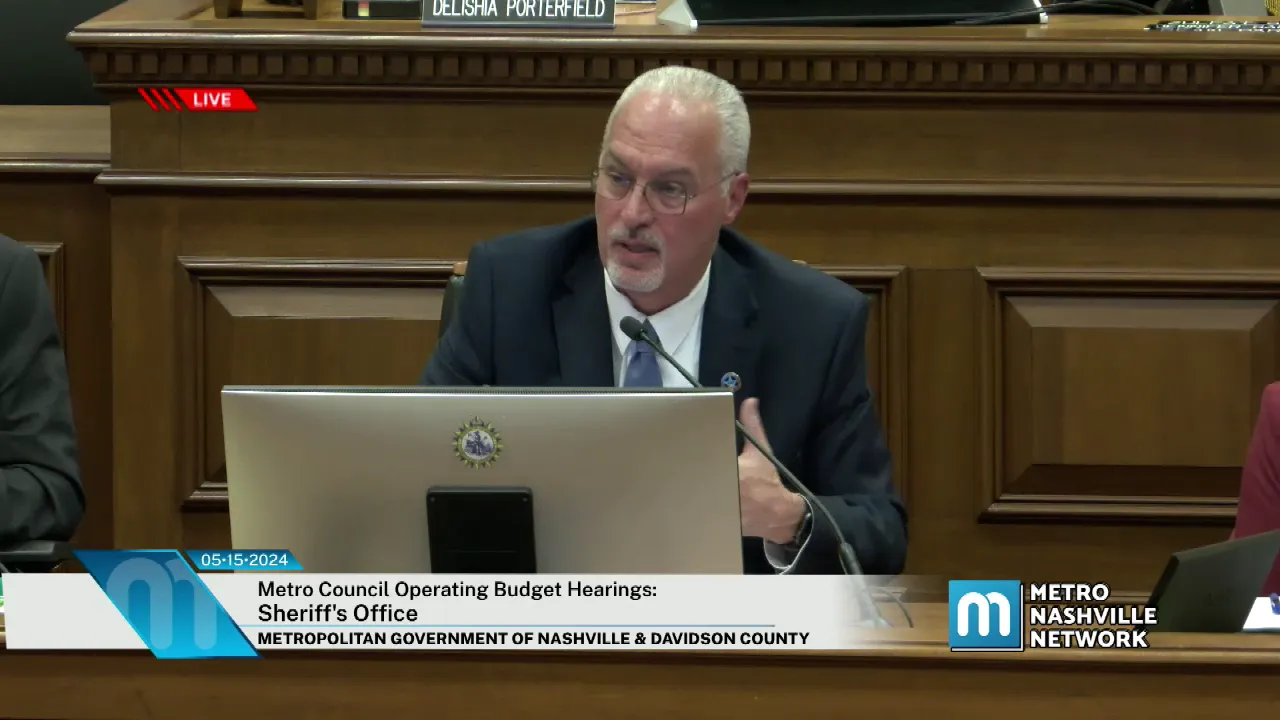
On May 15, 2024, the Metro Council Budget and Finance Committee held a hearing on the Davidson County Sheriff's Office budget request. Sheriff Daron Hall presented a "status quo" budget accompanied by an $8.5 million supplemental request to close a compounding deficit driven by jail population growth, state reimbursement delays, and staffing shortages. Council members questioned the Sheriff on costs, mobile booking, mental health programs, and facility needs.
Discussion Items
-
Budget shortfall and state reimbursement: Sheriff Hall said the office is not asking for new program money but for a "significant hole" to be patched. Since COVID, the jail population has increased 60%, with a 23% rise in the last year. The $8.5 million mayor's recommendation is largely a reimbursement from the state for housing former CoreCivic inmates; the state owes Metro an estimated $5–6 million from the prior year, creating cash-flow challenges. He emphasized that much of the appropriation will eventually return to the city's general fund.
-
Staffing and part-time worker program: The Sheriff described overhauling the hiring process to onboard applicants within days rather than 12–14 weeks, and creating a part-time program that pays higher hourly rates without benefits. Nearly 100 part-time workers currently fill shifts, and 60% are women with children. Overtime costs have declined steadily from nearly $4 million last year, but the agency still has about 120 vacancies.
-
Mobile booking units: Two mobile booking units exist, but only one is staffed. Mobile booking takes about 20 minutes compared to 1.5 hours for standard booking. The budget requests funding to permanently staff a unit for downtown, enabling police to return to patrol quickly. Without funding, the unit cannot remain downtown regularly.
-
Facilities and capacity: The Sheriff's Office operates five facilities with approximately 2,400 beds; the current population is about 2,330, meaning the system is effectively full. A jail facility built in 1996 is deteriorating and needs replacement; the Sheriff requested a feasibility study. He also noted a future need for a kitchen at the Harding campus.
-
Mental health and population drivers: The Behavior Care Center, opened in 2020, provides immediate mental health assessment by master's-level clinicians. The return-to-jail rate for participants is 20%, compared to a national rate of about 90% for mentally ill individuals released from jail. Sheriff Hall attributed the recent population increase to slowed transfers to state prison—166 inmates are awaiting TDOC placement—not to higher arrest rates, which remain steady at about 60 bookings per day.
-
Security technology request: The $200,000 request would fund equipment and technology to reduce manpower needs, such as scanning systems and monitoring devices, helping address staffing shortages.
-
Voter registration for incarcerated individuals: The transfer of an election commission employee to the Sheriff's Office supports voter registration and absentee voting for eligible incarcerated people, a program the Sheriff said is showing progress.
-
Food service contract: A new food service contract was recently awarded for the same vendor, with a 20% cost increase due to inflation and the difficulty of hiring staff in jail settings.
-
Hospital security clarification: Sheriff Hall clarified that his office still provides security for arrestees at hospitals. It stopped providing general public security at Nashville General Hospital in 2020 after a nine-year arrangement, because hospital security requires different training. Inmate medical costs are not in the Sheriff's budget.
Key Outcomes
- No formal votes were taken during the hearing; the committee will consider the Sheriff's requests during budget deliberations.
- The Sheriff's office is seeking $8.5 million in supplemental funding to cover state reimbursement shortfalls and operational costs.
- A schedule change was announced: the Public Defender would present next, followed by the Metropolitan Nashville Police Department.
Meeting Transcript
of your uh budget book starting on page two seventy six and sheriff you all are recognized all right thank you my madam chair and members of the committee and and also members of the council um very uh very happy to be up here I want to first uh thank you for your service my father was in this body many many years ago and uh as a young teenager I used to wonder why he was home late and I fully understand that especially during budget season but um but I appreciate your service and uh appreciate your help and understanding that this thing called Metro. So um you know I've been in this role for twenty three years been up here 23 years asking and and trying to get understanding of our budget and our situations and about three years ago uh I came in front of this group and said that in all of my years the biggest challenge that I've ever faced and our agencies ever faced is is the staffing situation we've had uh that's still the primary focus of our agency and thanks to you and thanks to uh the previous mayor and and surely this this mayor when he was a councilman and now mayor has has been supportive of of trying to rettif rectify or improve our our challenges a couple of things and because uh we're gonna be unlike I think some of the other other agencies are in front of you and in that we're not necessarily asking for any new monies for new programs or new ideas but we are asking for a significant uh hole that needs to be patched in in our agency it's it's been a compounding problem for the last really since COVID uh and there's significant steps that have occurred that I that I just want to kind of remind us uh of what happened. I've told people many times that we may be the only sheriff's office in the country that uh COVID wasn't our biggest challenge in the year 2020. Uh we were asked in the wee hours of the morning to take over a private prison uh in the middle of that situation which which we work very hard our staff work very hard to do but taking on a hundred new employees and four hundred people in the middle of basically a very short period of time was complicated, difficult and we're all now still feeling some of the effects of that budgetarily and so I'd like to kind of if I can walk through some of that here in just a minute. But we coming out of COVID and coming out of what was our low level of our jail population we did a lot of work in decreasing populations to to prepare for COVID and have space but over those next few years and including adding 400 people from a uh uh privately managed prison our population significantly changed and so since COVID our population's up 60 percent we're up 23 percent in our jail population in the last year that all drives our budget that is our staff our meals our our uniforms our utilities and so we were measured oftentimes by our population and it has significantly changed over the last uh four years for sure the thing that that I am the most nerdy about as a person and the thing I take the most pride about in our agency is is our staffing. I've always felt very uh interested in that subject and trying to get our hands around understanding it even before it became such a challenge very interested in how to manage people and very interested in how can we help uh the most important part of what we do uh is hire people and try to retain people it is it is what I call our three our three uh pillars of organization is to recruit train and retain that that's what we should be focused on doing and it's very hard to do uh in an environment uh we're basically you're asking people to work inside of a jail facility for twelve hour shifts on concrete uh it is not something most people grow up desiring to do uh and so we're often challenged with convincing or getting people to come and try it so uh a little different a little different marketing of that employment and we've tried very hard of last years uh in in a several ways one thing I want to do is is to to tell you that we didn't come up here just asking for money uh we also came in came up here asking over the last three years uh for some patients and understanding uh like to tell people we're not thinking outside the box we're standing outside the box throwing rocks at it and um and we're trying to come up with different ways of doing things in in an environment that's always been very structured and very uh limited really with creativity we have flipped our entire hiring process upside down uh we used to basically take you know 11, 12, 13, 14 weeks to bring you on board uh it just takes that long in the world of government quasi law enforcement work it's a lot of testing background checks, drug testing, physical exams, interviews, all these things it took forever. So I started having focus groups with people who work for us and said why did you come here and why aren't your friends here and what can we learn about our process I have a 30 year old son and a 22 year old son and if I told them it was going to take 12 weeks to come to work here they would laugh at me. They want instant gratification and we understand that and that's the age group that we're really targeting. And so for me to say 10 or 12 weeks and we'll let you know whether we're gonna hire you there's no wonder we couldn't get people to commit to this this line of work. So basically what we did was we flipped it upside down. And if you apply today in the for the sheriff's office online, uh tomorrow morning, someone in our recruiting office better be saying welcome to the sheriff's office. We believe that's the start of your employment, and we try very hard to get you uh engaged early and actually come and start onboarding that next week. Um for I jokingly say for two reasons. So you won't go find a job somewhere else, but also so we can learn about you and you can learn about us. Uh I don't really have a lot of confidence in these phone calls where you call previous employers because the law doesn't really allow you to say a whole lot. The people who do answer if they like you, they exaggerate. If you don't like it, can't tell you, so you end up hiring people you don't know much about. I actually like the idea of bringing you on board and learning something about you over the next several weeks as we're onboarding. Do you come to work on time? What is your attitude and how do you feel about this place? If you don't want to work here, we'd rather you decide that early on versus the time we've invested a lot of money in training you and preparing you for this work, and then you decide you didn't like it. So we we've tried hard to flip that upside down. The other thing we did uh that has never been done as far as I know in the country in this line of work, um, is basically we said, what if we go look for part-time workers? I'm talking about in what is a rigorous shift uh paramilitary system. Uh what if we found people who would come and just work shifts? Uh and one of the things that we learned in these focus groups was that if I walked up to you today and said, Hey, would you come to work in the sheriff's office and come and work in a jail and we'll pay you $50,000 a year? And if you stay 30 years, we'll give you a pension. And by the way, you're 25 years old and health care is really important to you, we'll give you health care as well. Two of those things don't matter at all to these people. A 25-year-old, at least let me speak about my children, and that I think there is fair to most young people, don't value a pension right now. They don't necessarily value the health care that's very expensive. So what we will offer you to do is if you want to come to work here part-time and not receive those benefits, we will pay you more hourly to come and work part-time shifts. Basically, the cost of those benefits are taken away. We roll it on top of an hourly rate and offer you to come to work here. Your husband, wife, significant other partner may very well have benefits that you don't need. So you can come here and work hourly for a much higher rate, and that's very appealing to a young person to come work a couple of shifts instead of commit to 30 year employment. Uh, we started that uh about two years ago. My own staff looked at me cross-eyed like I didn't know what I was doing and said it would never work. They're in the back right now, bragging how well it's working, I hope. Uh, but uh, but it's a very creative way of trying to do it. We have nearly a hundred people in our agency filling shifts today that we would not be able to fill uh with a full-time ask. And so uh very proud of that. It's working very hard. I think it's gonna one of the things that in our line of work that's very difficult to do is to recruit women, especially single moms, because daycare is challenging on 12-hour shifts and the and the shifts that we work, and so what we have found is 60 percent of the people who sign up for this part-time workers are basically women who have children. We didn't target that, but it's clearly what's happening because it gives them flexibility within our workforce. And so we allow you to move full time and the full time can run to work to part-time if you want to do that. And we've seen some some folks do both. So it's a lot of work. We've been challenged with that, and we're trying hard to reduce our overtime costs, which is very expensive. I've been listening to Chief Swan and others uh talk about what do you do with vacancies.
openpublica.com