Planning Department FY24 Accomplishments and Housing Initiatives Briefing - May 16, 2024
STREAMING COPY IN PREPARATION — RECORDING AVAILABLE FROM THE ORIGINAL SOURCE
Planning Department FY24 Accomplishments and Housing Initiatives Briefing - May 16, 2024
The Metropolitan Council's Planning and Zoning Committee heard a presentation from the Planning Department on its FY24 accomplishments, with a focus on affordable housing initiatives. The presentation highlighted the department's growth, housing production metrics, and strategies for utilizing Metro-owned land for housing. Council members posed questions regarding budget requests, property utilization, and funding gaps.
Discussion Items
-
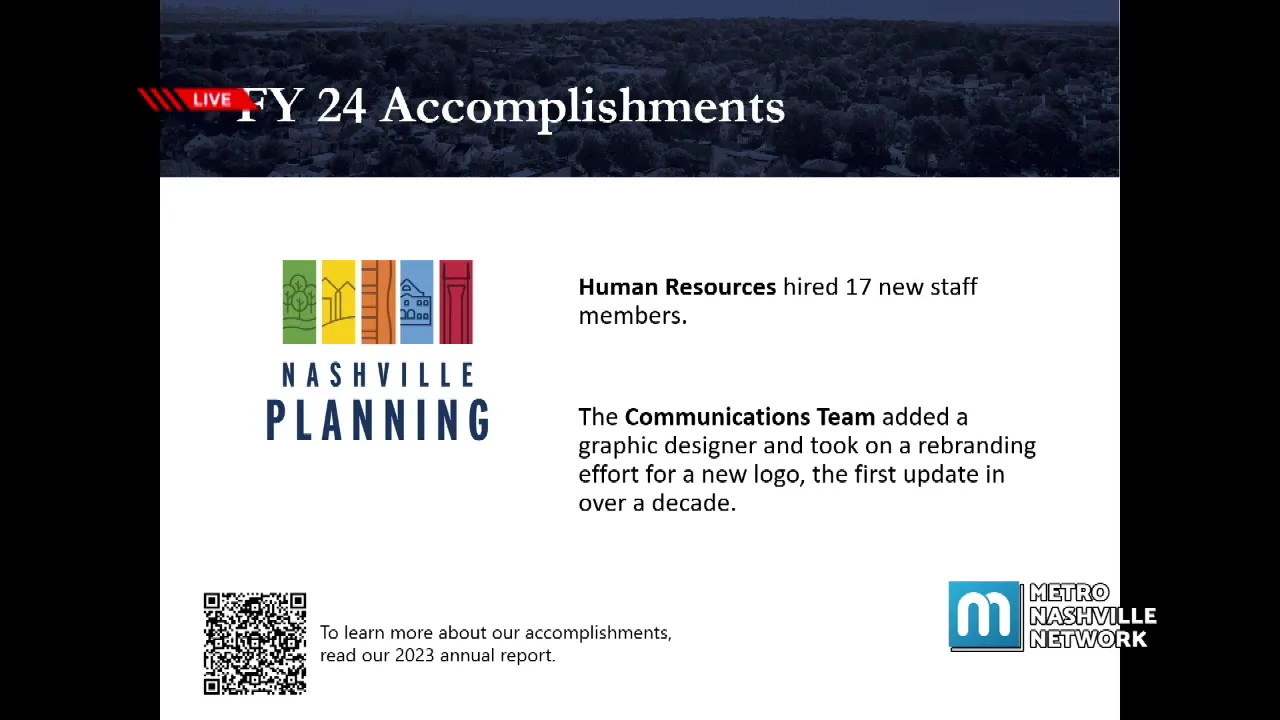
Department Overview and FY24 Accomplishments: Planning Director Lucy reported on the department's evolution from a regulatory body to a full-service planning agency. Key accomplishments included the Nashville Next strategic plan, the creation of a long-range planning section, a redesigned urban design quality focus, East Bank implementation, review of 1,600 building permits, and hiring of 17 new staff.
-
Housing Team Update: Angie Hubbard, Director of Housing, presented housing metrics: the department has funded an average of 3,500 homes per year (unduplicated) for preservation or creation, up from 1,300 in 2021. The goal is 5,000 annually to meet the need for 52,000 units over 10 years. The Barnes Fund has invested over $110 million, leveraging over $1 billion (9:1 return). Affordability restrictions have been extended from 20 to 30 years.
-
Upcoming Initiatives: The Catalyst Fund will launch soon to provide nimble capital. A Unified Housing Strategy is underway with HRNA advisors. Community engagement will begin. A new housing dashboard, required by ordinance, is now online and updated quarterly.
-
Metro-Owned Land for Housing: Hubbard detailed the process for evaluating tax-delinquent and surplus properties. Over 100 tax-delinquent properties have been awarded. A new land bank position will expedite title clearing. Surplus properties require coordination with multiple departments. An interactive map shows approximately 74% of Metro land is held by Parks, with other holdings by Schools and other entities. Specific opportunities include Water surplus properties, Second & Gay (Stroble Center), East Bank, Global Mall, 88 Hermitage, Brick Church Pike, school property, and Inglewood Library co-location.
-
Budget Requests: The department requested a $2.29 million adjustment for additional positions, salary adjustments, a pattern book, public engagement, and $1.1 million for a housing infrastructure study. It was clarified that the housing infrastructure study is actually funded at $2.4 million from surplus fund balance, available after January 2025. The pattern book may be delayed. $80,000 for dashboard maintenance was not funded, but the department hopes to manage within existing resources.
-
Council Questions: Councilmembers raised several issues:
- Chair Gamble asked about unfunded requests, particularly the housing infrastructure study. Staff confirmed funding via surplus.
- Councilmember Bradford asked about surplus school property (Hillwood High School site). Staff noted that two executive orders were filed that afternoon to clarify roles for surplus property disposition.
- Councilmember Allen asked about the $80k housing dashboard maintenance; staff said they would try to absorb the cost.
- Councilmember Cash inquired about vacant properties (not tax-delinquent). Staff explained that without code violations, the department is developing the Catalyst Fund to help nonprofits acquire and rehab such properties.
- Councilmember Quinn Evans Siegel asked about grant-seeking efforts and software licenses. Staff reported ongoing grant applications and plans for new community engagement software.
Key Outcomes
- The housing infrastructure study ($2.4 million) is funded through surplus, with planning department covering upfront costs and reimbursing later.
- The pattern book initiative may be delayed due to budget constraints.
- A follow-up communication will be sent to councilmembers linking to the Ernst & Young study and providing a list of available Metro properties.
- Two executive orders were signed by the mayor to clarify roles of departments in surplus property disposition.
- No formal votes were taken; the hearing was informational.
Meeting Transcript
Thank you, Chair Porterfield. Thank you so much for having us here today. I hope you'll forgive my voice. I'm recovering from some laryngitis. So I'm grateful to have the folks next to me for their expertise and also their voices. I'm joined today by Angie Hubbard, who's director of housing within the planning department, and George Rooker, who leads our operations team. I want to acknowledge Todd Oakle Cheney, Randy Semric, and Michelle Albright, who all do exceptional work for the planning department. And so I'm just gonna break our uh presentation. Can you go back, George, into two? Uh are you leading? You're leading the ship. Okay, uh, into two uh sections. The first uh our accomplishments in FY24, and then I wanted to give a particular focus to the housing team who has uh undertaken such important work on behalf of the city. Now it doesn't want to go. So this is a hard to read slide, obviously, but I wanted to acknowledge um the growth and evolution of the planning department, and say that that has happened through the support of mayor's office, this administration, the previous one, and also this body. So we've spent the last seven or so years on a project to evolve the department from one that is primarily regulatory in nature, reviewing individual projects, um, to one that can really provide the full complement of planning services for a city of this size. I think the hallmark of a healthy planning department and a healthy planning context is being able to plan at every scale. So, you know, certainly we delivered Nashville next, which is an award-winning plan and a very high-level strategic vision for our city. And then you see Lisa Milligan every several weeks talking about individual projects that through your stewardship are reviewed and approved at this level. And we felt like it was really important to build out the sections that go from major plan to implementation. That is absolutely a critical point. And so we've built out a long-range planning section that now has connections to expert advice, architecture, economics, uh, land planning, engineering, anything that our department needs to supplement our work. And again, that is through the support of this body. And then uh several years ago, uh, Angie Hubbard uh seated the housing team and has been roaring ever since. And so this is a dynamic and growing department. I just want to acknowledge we're still growing. We are still sort of creating the kind of platform that we think is right for a city, but we're partnering with you and the administration to make sure that that's done well. So I want to just talk very briefly about some of the key things that we focused on in 24. Um, we believe that urban design quality needs to be one of the central aspects of our work, and it's not just building, it's sustainability, it's environmental design quality. One of the coolest and most wonderful things about our community is the natural features that both frame uh our neighborhoods and our downtown serve as great design, but also for the health of our city from a resiliency perspective. And so we've created a section that really focuses on that. It's more holistic again than just looking site by site. Um uh director Mendez here today and his good partnership with us um on the East Bank team and his work with you and this body to ensure that we could take the East Bank vision and move it towards implementation. Again, our focus is how do you get from the great concept plan and the lines on the map to deliver? Because that is what the expectation is, I think, for Nashville's, and we did it under the stewardship of Mr. Mendats. Our land development team who sits with you every um several weeks. You know, Lisa Milligan. They reviewed 1,600 building permits. We have a customer service team that does incredibly hard and important work, serves as our face at the front counter. And then, as I mentioned previously, we have a program management team that's basically been able to build out the capacity between like that strategic plan level and implementation. So we no longer want to deliver a plan that's at such a high level that the departments don't know yet or don't have a pathway to how to implement. And so we are working closer in detail and thinking about those things. That work includes a global mall study, 88 Hermitage, and the Edge Hill Neighborhood Plan. And so we've been working through what's called an IDIQ program, which just basically means access to expert services if there are instances when the department's own expertise needs to be nurtured or strengthened. Human resources, which works under George Rooker has hired 17 new staff to make sure that we're meeting that mandate. And the other thing I would say is just a shout out. Um you grow as a department, ensuring that we deliver really good quality control on what we are pursuing in the department is critical. And that looks different when you go from a largely regulatory section to one that is doing a different kind of planning work. And George has really focused on ensuring that we have high quality measures in place to ensure the guardrails are in place.
openpublica.com