Nashville Metro Council Meeting - March 18, 2025
STREAMING COPY IN PREPARATION — RECORDING AVAILABLE FROM THE ORIGINAL SOURCE
Nashville Metro Council Meeting - March 18, 2025
The Metropolitan Council of Nashville and Davidson County met on March 18, 2025, at 6:30 p.m. in the Historic Metro Courthouse. The meeting included multiple elections, a public hearing on a controversial historic zoning bill, debates on a community safety camera network ordinance, and the passage of numerous resolutions and ordinances. Key actions included the election of five members to the Advisory Committee on Transportation, the passage of BL2025-742 (reorganizing historic zoning staff under planning), and the passage of BL2025-690 (establishing guardrails for community safety camera networks).
Consent Calendar
- Resolutions (RS2025-1062, 1075-1096, 1101-1102): Unanimously approved, including bond affirmations, claim settlements, grant acceptances (e.g., for affordable housing, HIV/AIDS, shelter animals, Homeland Security), engineering agreements, and contract approvals. RS2025-1101 (feasibility of a revolving loan fund for affordable housing) was also approved.
- Bills on Second Reading (BL2025-746, 747, 748): Approved, authorizing encroachments, alley abandonments, and utility infrastructure.
- Bills on Third Reading (BL2025-712 through 738, 744, 745): Approved, including multiple zoning changes and building material restrictions, a greenway conservation easement, and readoption of the municipal code.
Public Comments & Testimony
- BL2025-690 (Community Safety Camera Network): Several speakers opposed the ordinance, citing concerns about data sharing with federal agencies (ICE), lack of transparency, racial profiling, and the potential for abuse under the current political climate. Speakers included Michael Lacey, Ashley Warbington, Adam Shoop, Luis Mata (Tennessee Immigrant and Refugee Rights Coalition), Cade Wooten, and John Davis.
- RS2025-1101 (Affordable Housing Revolving Loan Fund): Josh Hasten spoke in support, noting the need for additional housing tools given that 72% of Nashville's workforce qualifies for affordable housing.
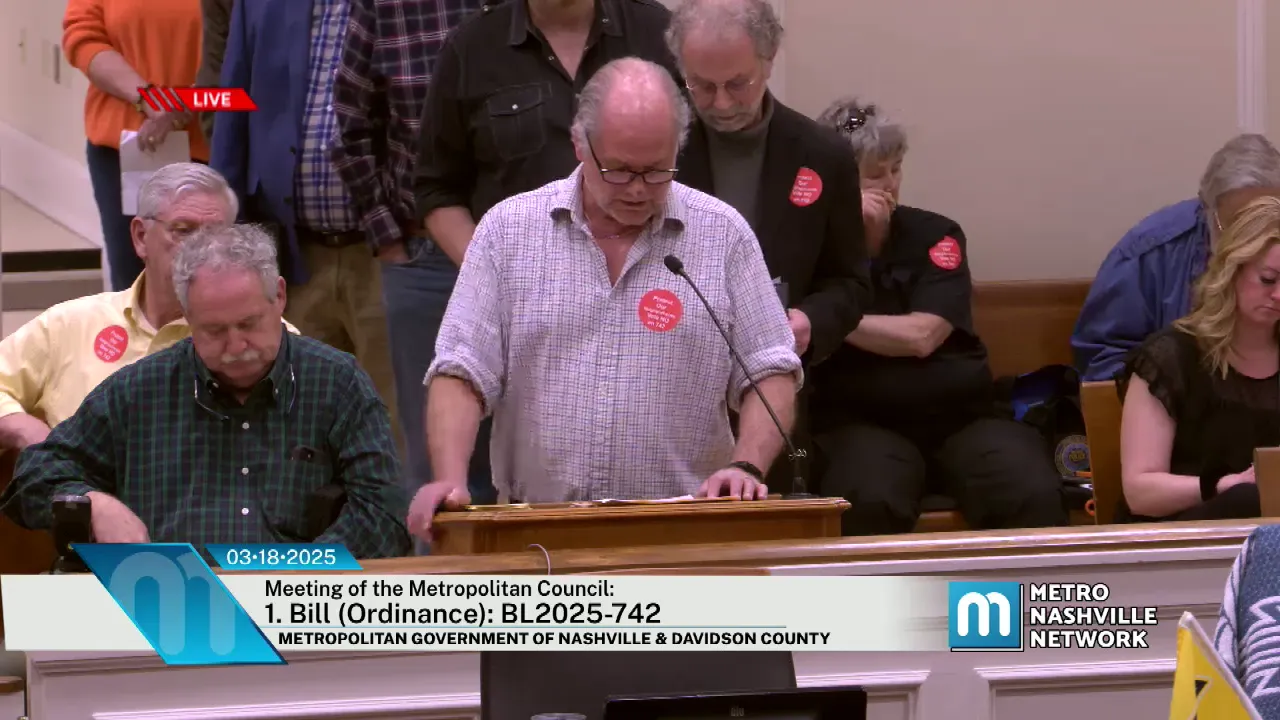
- BL2025-742 (Historic Zoning Reorganization): A lengthy public hearing featured both support and opposition. Supporters (e.g., Ben Simpson, Ron Carrier, Carter Vintage Guitars, preservationists) argued the bill would streamline processes, protect historic resources, and integrate preservation into city planning. Opponents (e.g., neighborhood association leaders, historians, commissioners) argued it was rushed, would weaken historic protections, and lacked community input. Many opposed the bill, stating it was driven by downtown business interests and state pressure.
Discussion Items
- Election to Advisory Committee on Transportation (Item E1): Nine nominees were considered for five vacancies. After eight rounds of voting, the council elected David Harris, Dr. Morgan Rehnberg, Dr. Claudio Mosse, John Wesley Smith, and Kalen Russell. Notable: multiple rounds were needed due to vote thresholds.
- Rules of Procedure Amendment (Rule 9.3): Adopted as amended, requiring two members to request a separate vote on first-reading ordinances. Effective May 6, 2025.
- BL2025-742 (Historic Zoning): After a public hearing, the council passed the bill on third reading 24-11-1, with an amendment from Council Member Allen restoring the title of executive director for the historic commission. The bill moved historic zoning staff under the planning department while maintaining the independent commission.
- BL2025-690 (Community Safety Camera Network): After extensive debate and multiple attempts to call the previous question, the council passed the bill on third reading 28-7-1. The ordinance establishes regulations for any future camera network, including restrictions on AI/facial recognition, privacy protections, and annual reporting.
- RS2025-1074 (Choose How You Move Funding): Approved 32-1-1, appropriating $59.3 million for transportation improvements.
- RS2025-1100 (Youth Policy Working Group): Deferred to July 1, 2025, to allow the new Office of Youth Safety director to be hired.
- RS2025-1103 (Transgender Day of Visibility): Approved unanimously after emotional remarks from Council Member Hill and others affirming support for the transgender community.
- BL2025-688 (Nashville Music, Entertainment, and Film Commission): Deferred indefinitely due to a fourth deferral, per Rule 43.
- BL2025-706 (Greenway Conservation Easements): Passed on second reading as amended.
- BL2025-725/726 (One Mile Parkway Zoning): Passed on third reading as amended (35-0).
- BL2025-731 (Clarksville Pike Zoning): Passed on third reading as substituted (34-0).
- BL2025-733/734 (Lavergne Couchville Pike): Deferred on third reading.
- BL2025-743 (Drag Racing): Withdrawn by sponsor.
Key Outcomes
- Advisory Committee on Transportation: Five seats filled after multiple rounds of voting.
- BL2025-742 (Historic Zoning Reorganization): Passed 24-11-1, effective upon adoption.
- BL2025-690 (Community Safety Camera Network Guardrails): Passed 28-7-1, establishing a legal framework for any future camera program.
- RS2025-1074 (Choose How You Move Funding): Approved $59.3 million for transportation.
- RS2025-1103 (Transgender Day of Visibility): Unanimously recognized March 31, 2025, as Transgender Day of Visibility.
- BL2025-688 (Music Commission): Deferred indefinitely, requiring a 60-day hiatus.
- Multiple zoning changes and infrastructure approvals: Passed on consent or individually.
Meeting Transcript
All right. Everyone, please move quickly. Yes, thanks. Good evening, everyone. Thank you so much. We are so excited to celebrate the 60th anniversary of the Metropolitan Human Relations Commission. I am joined today by the amazing commission. We've got staff and board members, and so I am going to present this. If anybody wants to join me, please feel free, and then I'll let them speak at the end. So a resolution recognizing the 60th anniversary of the Metropolitan Human Relations Commission, whereas the Metropolitan Government established the Metropolitan Human Relations Commission, MHRC in 1965 during a time of heightened racial tensions in Nashville and across the county. And whereas the MHRC was established pursuant to Bill No. 65-697, which sought the creation of a permanent organization to study the problems of human relations and to take positive action to eliminate discriminatory practices within Nashville and Davidson County. And whereas the MHRC was established with 15 members representing various social, economic, religious, cultural, ethnic, and racial backgrounds, and was the first official human rights agency in Tennessee. And whereas in 1967, the MHRC determined that a full-time staff was needed to the Commission to achieve its goals. Warren N. Moore was selected as executive director and Fred Cloud as assistant director. And whereas Fred Cloud became the executive director in 1970 and served in that role until 1990. Over the years, executive directors have included, please tell me if this is right. And whereas today, the board of now 17 members supports the MHRC staff's work, organized around a theme of one city for all people. This model guides all of MR MHRC's education, engagement, events, program building, policy development, system change, training, advocacy, and compliance services. And whereas in January 2015, the MHRC released its first inclusivity report, analyzing the demographic makeup of 50 metro departments. In 2020 and 2023, the MHRC released subsequent and more robust inclusivics reports looking at change over time while analyzing the race, gender, salaries, geographies, and other demographics of employees within and across Metro departments. And whereas the MHRC is responsible for a Metro's Title VI function, Title VI of the Civil Rights Act of 1964 is a federal law requiring the non-discriminatory delivery of services, supported by federal financial assistance. It prohibits discrimination on the basis of race, color, or national origin, including language access. And whereas the MHRC's modest and resourceful staff works with residents, nonprofit, and community-based organizations, neighborhood, multicultural, and faith groups, advocates and organizers, metro departments, and employees, and elected officials and policymakers to ensure to ensure it is delivering on its mission. And whereas the MHRC recently launched humans over hate to comprehensively confront the escalating hateful and discriminatory environments, rhetoric and actions experienced and witnessed by residents. And whereas it is fitting and proper that the Metropolitan Council recognizes the MHRC for its dedication to the personal dignity, peace, safety, security, health, and general welfare of all people in Nashville and Davidson County throughout its 60-year history. Now they're therefore be it resolved by the Council and the Metropolitan Government of Nashville and Davidson County. Thank you, Councilman, uh Councilwoman Vaughn for this proclamation. As a current chair, I want to extend my gratitude to all council members on behalf of MHRC Commissioners, past and present. As a current chair, I want to extend my gratitude to all council members on behalf of MHRC commissioners, past and present, as well as our executive director, David Tucker and our amazing staff. We are proud of the work that we have done in the past 60 years. We are proud of the work we are doing today, and we will continue to do in the future. Indeed, MHRC's purpose could not be more imperative today. Quote the commission shall protect and promote the personal dignity of all people by supporting their safety, health, security, peace, and general welfare. In our current historical moment, ethno nationalists are deciding the dignity, rights, and freedoms of certain groups of people. Who has the freedom of speech? Who is a citizen? Who is an alien? Who is to be caged? Who is expendable? Who belongs in our country, in our society, who belongs in history books? Why education at all? Who is part of a protected class? Who constitutes the public? This black and white bifurcation in our society prioritizes and privileges one group over the other. Such intolerance demonizes and punishes diversity. Justice and the facts of history. It cynically distorts equity as reverse discrimination. It is putting this country into existential strife.
openpublica.com