OPENPUBLICA · PUBLIC MEETING RECORD
Record of Proceedings
City of Newburgh Council Work Session – September 10, 2026
City Council — Thursday, September 10, 2026
BodyNewburgh, New York
SessionCity Council
DateThursday, September 10, 2026
StatusFILED
Video Record
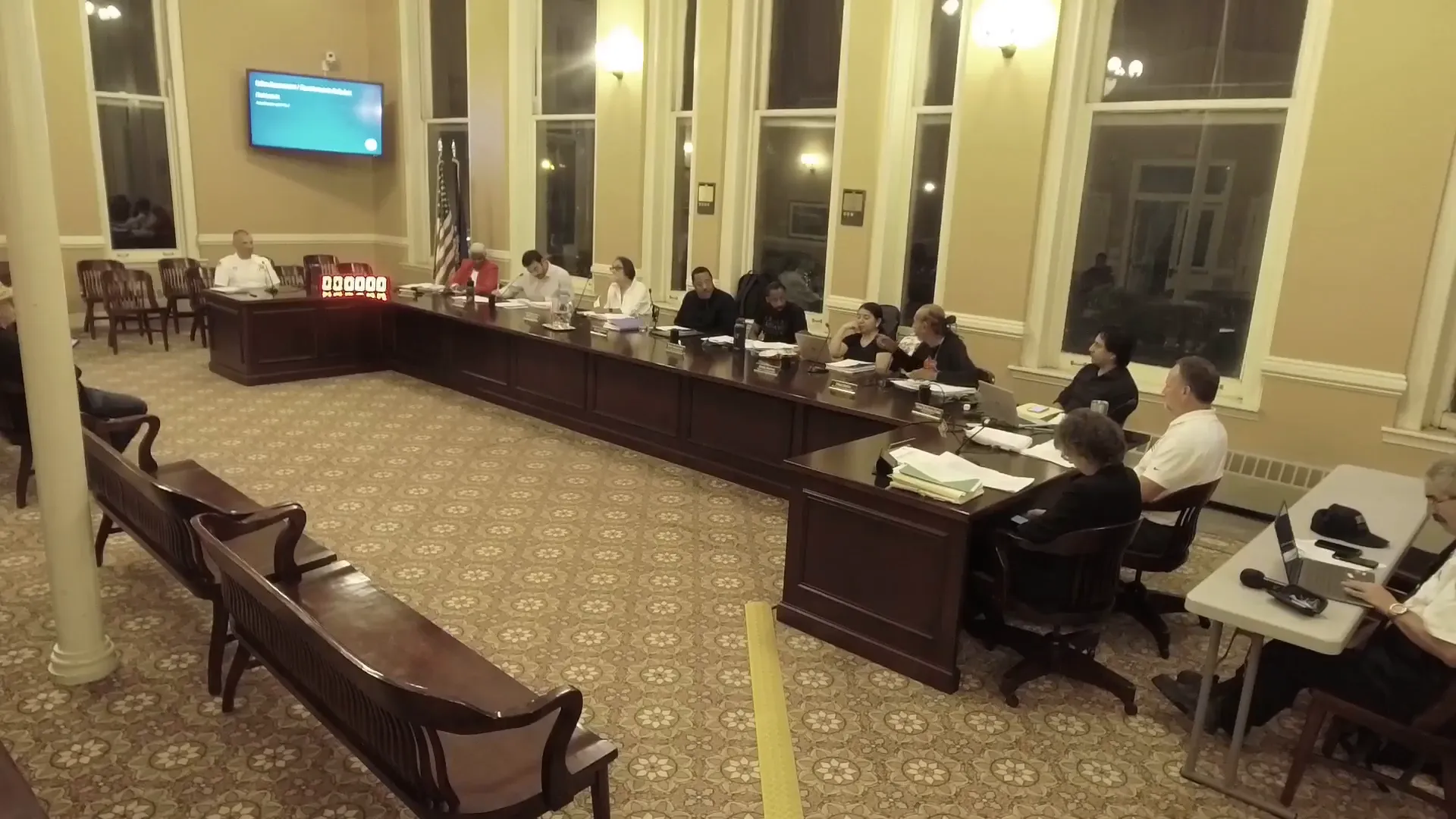
STREAMING COPY IN PREPARATION — RECORDING AVAILABLE FROM THE ORIGINAL SOURCE
Transcript — Verbatim
Speaker numbers apply only to this recording.
Discussion Breakdown — Share of Meeting
Public Safety23%
Environmental Protection18%
Technology and Innovation17%
Water And Wastewater Management8%
Historic Preservation5%
Public Relations5%
Public Engagement4%
Procedural3%
Engineering And Infrastructure3%
Summary of Proceedings
City of Newburgh Council Work Session – September 10, 2026
The City of Newburgh City Council held a work session on September 10, 2026, beginning at 6:11 PM. The agenda covered a broad range of items including the Natural Resources Inventory, street changes, construction contracts, property sales, recreation department updates, police technology grants, and resolutions of support. The council discussed the Flock automated license plate reader program at length, receiving an update from the police chief and debating potential resolutions. No formal votes were taken during the work session; resolutions are expected to be considered at subsequent meetings.
Natural Resources Inventory (NRI) Presentation
Richard Stevens, a biologist from Hudsonia, presented the draft Natural Resources Inventory (NRI) for Newburgh, funded by the Environmental Protection Fund via the Hudson River Estuary Program. The NRI includes 25 maps depicting watersheds, tree canopy, heat islands, flood zones, and more. Key recommendations include the "3-30-300" rule (three trees visible from every residence, 30% tree canopy cover in every neighborhood, and accessible green space within 300 meters). Stevens noted that the NRI is a one-time project and does not obligate the city to take any action.
Council members expressed support and asked questions. Councilmember Martinez highlighted the crime-reducing benefits of shade. Councilmember McElmore asked about cost savings from natural resource protection. Stevens explained that avoiding development in floodplains could reduce municipal costs but building in floodplains for any purpose is unwise. Councilmember Monteverde asked whether the NRI would affect property owners' ability to renovate; Stevens said no, as the NRI is not regulatory. Councilmember Shakur raised concerns about the heat index in Ward 3. Councilmember Zaria noted that PFAS contamination from Stewart Air National Guard is addressed in the NRI and praised ongoing city efforts such as the Crystal Lake park designation, hiring an arborist, and urban forest management planning. Mayor Harvey asked about funding sources to help homeowners maintain trees on private property. Stevens agreed to research the matter.
Department of Public Works
Designation of S. Johnston Street as One-Way Northbound (Agenda Item 2): Chad, Superintendent of Public Works, presented a proposal to extend the one-way northbound designation on S. Johnston Street from Ann Street to Broadway to allow parking on both sides. The change is part of the Broadway Pedestrian and Traffic Signal Improvement Project.
Stop Sign Updates (Agenda Item 3): An ordinance amendment removes the stop sign at Ann and Johnston (no longer necessary due to the one-way conversion) and adds stop signs that currently exist but were not codified.
Councilmember Monteverde asked about green space in the Broadway bump-out areas; Chad replied that at present they remain sidewalk. Councilmember Stewart asked about a narrow street in Ward 3 with snowplow and parking issues. Chad advised her to send an email to discuss.
Engineering
Asbestos Abatement at WWTP (Item 4): Jason (City Manager/Engineering) confirmed the emergency abatement contract with ACA Environmental for $8,450. The work was completed on August 26, 2026, funded from the wastewater treatment plant budget.
155 West Street Roof Replacement (Item 5): Bid award to MAK Group, LLC for $375,758 to replace the defective roof. Councilmember Monteverde asked about future use of the building; Jason said it is currently vacant and will be assessed after the roof is completed. Mayor Harvey provided context that the building was purchased with potential police relocation in mind but no decisions have been made.
Combined Sewer Control Facility Contracts (Items 6-9): Jason presented four contract awards for the Newburgh Combined Sewer Control Facility, part of the Long Term Control Plan (LTCP). The general construction contract with D.A. Collins Construction was $44,592,140; the plumbing contract with TM Brennan Service was $384,000; the HVAC contract with DJ Heating & Air Conditioning was $566,700. No bids were received for the electrical contract, which is being rebid. A bond resolution (Item 9) amends the previous amount from $44.9 million to $60,539,377 to capture current costs.
Councilmember Monteverde asked about the impact on the natural habitat near the rowing club; Jason confirmed it will disrupt the area but transplants are possible. Mayor Harvey asked about the relationship to the Liberty Street reconstruction project; Jason explained both are part of the LTCP, with this facility treating combined sewer flows before discharge to the Hudson River. Councilmember Zaria questioned cost escalation from $35 million to $60 million; Jason attributed it to moving from design estimates to 100% design and actual bids. The town of Newburgh will cover 42% of the debt service. Construction is required to begin by November 1, 2026, and be completed by March 2029.
Finance and Information Technology
Legal Shred Renewal (Item 10): A resolution authorizing a contract with HVShred, Inc. for document destruction services.
Auctions International Agreement (Item 11): A resolution authorizing a contract for liquidation services for surplus property.
Zayo Firewall Installation (Item 12): A service order for $1,294 to install a firewall and integrate the DPW storage building into the city’s wide area network.
Laserfiche 12 Upgrade (Item 13): A change order with ICC Community Development for $1,500 to upgrade the Laserfiche system. Councilmember Monteverde asked about the long-term plan for the KVS system; Jason said the city is interviewing replacement vendors.
Planning and Economic Development
Purchase of 252 Liberty Street (Item 14): Resolution to convey the property to Wesley Laidlaw for $180,000. Laidlaw, who intends to live there for ten years, provided the highest bid. Council members welcomed him.
Newburgh Colored Burial Ground Memorial – SEQRA (Item 15): Ellie, Director of Planning, presented the environmental review process for the memorial project. The city will declare its intent to be lead agency, classify the action as unlisted, and issue a negative declaration on October 26, 2026. Bid specifications are due November 15, 2026, with bid award expected in January 2027 and construction in 2027. Approximately $1.9 million has been set aside, but current estimates exceed that amount. Two grant applications have been submitted. Council members thanked the committee, especially acknowledging late members Dr. Benilda Jones and others. Councilmember Shakur urged the use of local contractors.
Property Covenants and Mortgage Satisfactions (Items 16-20): Corporation counsel presented releases of restrictive covenants for 82 Clinton Street, 367 First Street (mortgage satisfaction and covenant release), 161 North Miller Street, and 397 Grand Street. Councilmember Zaria caught a lot number discrepancy in Item 19, which counsel promised to correct.
Recreation
Aquatic Center Winterization (Item 21): Contract with Main Line Commercial Pools for winterization. Council members praised Wayne and his team for the successful season and beautification of the facility.
Blackline Safety Lone Worker Devices (Item 22): Contract for $4,035 for two safety devices that detect falls and alert emergency services. Wayne shared a story of an employee who fell and waited hours for help. Council members supported the safety initiative. Councilmember Zaria asked if the program will be mandatory; Wayne said it will become standard operating procedure.
Donation of ADA Wheelchair (Item 23): Resolution to accept a pool access wheelchair for the Aquatic Center, donated by a former Orange County resident.
Police Department
DCJS Law Enforcement Technology Grant (Item 24): Chief Rolle presented a grant of up to $250,000 with no city match. The funds would purchase interior drones ($158,000), a narcotics testing device ($45,900), and a mobile light tower with integrated camera. The chief confirmed the application aligns with the city’s Fair and Welcoming City policy and immigration resolution, noting New York State’s grant requirements prohibit use for civil immigration enforcement and preclude 287(g) agreements. Councilmember Shakur expressed support for the state’s immigration protections.
Body Worn Camera Contract Renewal (Item 25): The chief indicated that he will withdraw the previously-tabled five-year $811,000 contract and instead propose a reduced five-year contract for $697,030.92 covering only sworn officers, parking enforcement, and a security guard. The new contract will be presented at the first work session in October. Councilmembers appreciated the responsiveness.
Flock Automated License Plate Reader Update (Item 26): Chief Rolle provided an extensive update on the Flock program. He issued a memo to the council on August 27 detailing system audits and data-sharing restrictions. As of January 23, 2026, no outside agency has been able to include the City of Newburgh’s fixed LPR network in searches. A mobile LPR network inadvertently allowed two agencies to run searches, but no data was added because the mobile unit was never deployed. The chief has since restricted all outside access, and he will release both the memo and full audit reports publicly.
The chief also shared examples where LPRs assisted in high-profile investigations, including homicides, burglaries, hit-and-runs, and locating a suicidal individual.
Following the update, council members discussed potential resolutions. Councilmember Shakur introduced a resolution to terminate the Flock contract, citing national concerns about the company. Councilmember Monteverde presented an alternative resolution with more guardrails. Councilmember Zaria suggested using the budget process (non-appropriation) to end the contract without financial penalty. Councilmember Stewart proposed a local law for surveillance technology approval and reporting. The council agreed to work on a combined resolution and explore a local law, while using the upcoming budget cycle to defund Flock for 2027 consistent with the contract’s non-appropriation clause.
Resolutions of Support
Scarlet Oak Tree Nomination (Item 27): Resolution authorizing the nomination of a large scarlet oak at 123 Grand Street to the New York State Big Tree Register. Corporation counsel clarified that the tree is not associated with the historical lynching site on the other side of the courthouse.
Street Naming – La Amistad Bakery (Item 28): Resolution to designate the intersection of South William Street and Mill Street as “La Placita Amistad” in honor of La Amistad Bakery, a Mexican-American business and community pillar since 1997. Councilmember Martinez presented the item, noting the business’s community events and contributions. All council members expressed support.
Executive Session
The council moved into executive session to discuss litigation and personnel matters.
Meeting Transcript
Good evening. This is the City of Newburgh City Council work session for September 10th. The time is 6.11 p.m. We'll start tonight's work session with work session presentation on the City of Newburgh's natural resource inventory. And we'll hear it from Records from the Sodium. Thank you. My name's Richard Stevens. I'm a biologist with Hudson, which is an environmental research institute based in Dutchess County. We work all over the Hudson Valley. We study the plants and animals and habitats of the region, their ecology, their conservation. And for the last couple of years, we've been working on a natural resources for the city of Newburgh along with planners and green plan, affirmative basically. The project was been funded by the Environmental Protection Fund through the Hudson River Estuquay program to the city. But we now actually do have at least a draft of the laid-out version. It looks very nice. I'm in the midst of proofing it now. One part of the NRI is a series of maps. There are 25 maps depicting various aspects of the city landscape and of the watersheds of Lake Washington and Realms. But things like elevations, watersheds, and aquifers and red rock geology and wetlands and habitats and forests and scenic and cultural resources, protected lands, and many more maps. I've worked on NRIs in quite a few other communities and whole counties in the Hudson Valley, but mostly in rural areas. This is the first one that I've worked on in an urban area, and the focus has been quite different. We we did focus a lot on the uh on how natural resources are serving the human community here and how people are using the resources in the nearby city. This is a map, I probably can't see it very well. Um this is uh shows data from the 2015 tree survey of the city. I know that another survey is underway and we don't have those data yet, but the uh the dots on this map show the locations of individual trees and their color coded by their condition. Uh the um uh dark greens, dark green and lighter green uh show trees that are in good or fair condition, and the red uh dots show trees that were in poor conditions now. This was 11 years ago. Um so the map might look very different now, and I know there's been a fairly treatment. Um we're interested in trees because uh they're really great importance for the uh well-being of uh the people of New York. Um trees have a great deal of influence on the environment in the city. They help to cool the air in the city. They help to manage storm water. Many studies throughout the world have shown that they have a great deal of influence on the mental and physical well-being of urban dwellers. So in this city, you probably can't see it very well, but we we colored in yellow the areas that are with where at least two trees are visible within 100 meters. Just to show the parts of the city that are better served and less well served with trees. This map, the gray areas in this map are residential areas, either neighborhoods. The greens, the dark green and lighter green areas are publicly acceptable green spaces. That is considered a kind of reasonable distance to get to a place where you can be in nature in some way. But the western and northern parts of the city, the neighborhoods there do not have access to public to public spaces. And that's the kind of information that can help you think about planning in the future where you might want to develop new parks or new ways for people to get access to natural areas. You are probably all familiar with the notion of the urban heat island effect where the pavement and buildings of urban areas tend to make urban areas much hotter than rural
SUMMARIZED BY OPENPUBLICA AI
TRANSCRIPT VIA PUBLIC VIDEO
openpublica.com
openpublica.com