Criminal Justice Committee Meeting Summary – August 31, 2026
STREAMING COPY IN PREPARATION — RECORDING AVAILABLE FROM THE ORIGINAL SOURCE
Criminal Justice Committee Meeting Summary – August 31, 2026
The Criminal Justice Committee met on August 31, 2026, at 10:00 a.m. to discuss the withdrawal of the National Guard from New Orleans, a proposed carnival gap fee, contract renewals, and the New Orleans Police Department’s drone program. The meeting featured presentations from the Metropolitan Crime Commission, the NOPD, the Mayor’s Office, and the ACLU of Louisiana/Eye on Surveillance, with extensive public testimony on the fee and drone policies.
Consent Calendar
- Approval of Minutes: The committee unanimously approved the minutes of the July 27, 2026 meeting (3 ayes, no opposition).
- LeadsOnline Contract Amendment (Item 5a): Amendment No. 3 to the agency agreement with LeadsOnline, LLC for electronic reporting and criminal investigation software, extending the term by one year and increasing the maximum payable amount, was approved unanimously (4 ayes, 0 nays).
- CREST MOU (Item 5b): The Memorandum of Understanding with the State of Louisiana authorizing NOPD’s participation in the Critical Response Emergency Search Team (CREST) for endangered missing persons and mass-casualty events was approved unanimously (4 ayes, 0 nays).
Public Comments & Testimony
-
Carnival Gap Fee:
- James Clark (Magazine Street corridor resident): Proposed that all carnival krewes (except possibly one) be required to start parades at Magazine and Jefferson to increase sales tax revenue. He calculated that current routes provide about 16 hours of parade time past a single point on Magazine Street; expanding routes could increase that by 77%.
- Elizabeth Boudreau (lifelong resident, parade rider): Urged that the gap fee be applied to all parade permit holders (second-line parades, races, etc.) year-round, not just krewes with floats, and suggested allowing throws on Chapatula Street if Magazine Street is not feasible.
- Bruce Riley (French Quarter resident): Questioned the city’s deficit calculation, arguing that Mardi Gras generates substantial tax revenue (hotel/motel, sales) that benefits the city. He urged that the fee not be placed solely on parade participants and suggested looking at overall revenue rather than just policing costs.
- Val Cupett (online comment): Argued that the fee is a tax, not a fee, and questioned why the city targets Mardi Gras rather than other major events (Jazz Fest, Saints games, etc.), suggesting that the fee should be paid directly to cover specific services.
-
Drone Program:
- Nikki R. W. (community member): Opposed drones, citing over-surveillance of Black communities (second lines, protests, parades) and research showing drones are less accurate at identifying Black faces, risking wrongful arrests and racial profiling.
- Bruce Riley (VOTER): Called for a standing civil rights and technology task force, questioned the lack of transparency and accountability given NOPD’s consent decree history, and asked about cybersecurity risks (hacking) of drones.
- Alfred Marshall (VOTER organizer, formerly incarcerated): Warned that drones could trigger probation/parole violations for formerly incarcerated people simply by being surveilled, potentially increasing incarceration rates in a city with the highest incarceration rate in the world.
- Ethan Elstead (Music Culture Coalition): Raised concerns about process: at the April 16 council meeting, officials assured the public that the drone policy contained protections (e.g., requiring MOUs for federal partnerships). He noted that those protections were removed from the policy shortly after the vote, and questioned whether the change was known beforehand and why it wasn’t disclosed.
- Janice (last name unclear): Thanked council members who opposed the drone program, expressed frustration that two of the four council members who voted for the program were absent. She reiterated that the public’s concerns have been realized and called for suspension of the program, noting the lack of transparency.
- Jess Pinkham (French Quarter resident): Thanked presenters, connected drone technology (SkyDio) to its use in Palestine as an environmental and ethical concern, and questioned why NOPD did not stay for the presentation.
Discussion Items
-
National Guard Withdrawal and Public Safety (Item 3):
- Rafael Goyeneche (Metropolitan Crime Commission) presented crime statistics: homicides down 34%, nonfatal shootings down 24%, carjackings down 3%, armed robberies down 34% year-to-date versus 2025. He attributed these reductions partly to the National Guard deployment. The Guard conducted over 4,100 patrols (31,000+ hours) as a visible deterrent. He noted the deployment was federally authorized in March 2026 and was always intended to end in August, allowing NOPD and state police to plan.
- Superintendent Anne Kirkpatrick (NOPD) outlined the post-withdrawal plan: added 16 officers to the 8th District (French Quarter/CBD), increased Bourbon Promenade coverage from 10 to 15 officers, and strengthened platoons in surrounding districts. She highlighted the Downtown Enhancement Unit (focused on quality-of-life issues), continued partnerships with Louisiana State Police and OPSO, expansion of Harbor Police cooperation, use of reserve officers, and reliance on technology. She noted that 60 new recruits are in the academy and will be assigned to the 8th District.
- Councilmember Green thanked the presenters, noting he saw no constitutional issues with the Guard’s presence, and stressed that crime reductions are due to local, state, and federal cooperation. He expressed concern about the state’s decision to end the paid deployment despite a $47 billion state budget, but affirmed confidence in NOPD to maintain safety.
-
Carnival Gap Fee Ordinance and Amendment (Item 4):
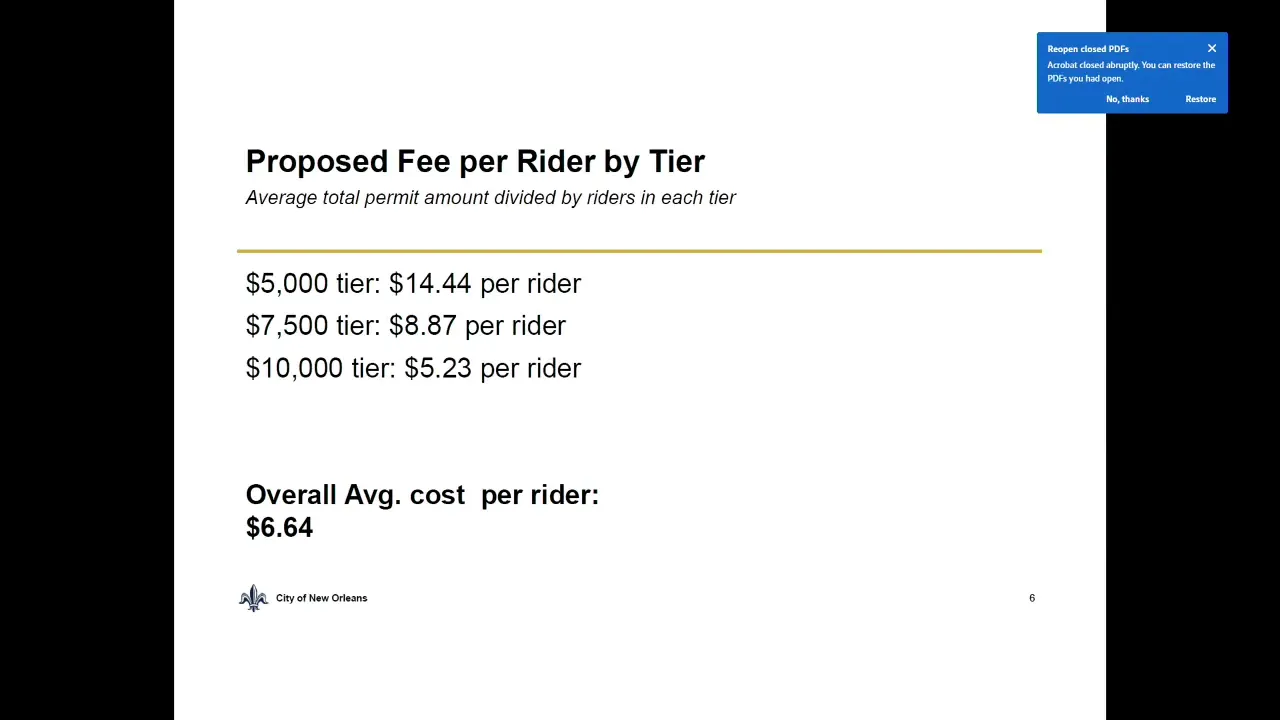
- Mr. Tony (Mayor’s Office) presented the revised fee structure: a three-tiered fee per krewe ($5,000 / $7,500 / $10,000) based on pull units, replacing the original per-float fee. This is projected to raise about $265,000 per year, applied only to the 2027–2031 carnival seasons. The fee is intended to offset the city’s Mardi Gras deficit (estimated at $3.75 million per year, given $10.62 million in costs versus $6.87 million in tax receipts).
- Councilmember King thanked the administration and noted the fee was developed in consultation with Mardi Gras krewes. He emphasized the fee is a compromise from an earlier $25-per-rider proposal, and that krewes found it fair.
- Councilmember Harris suggested that the fee should be indexed to CPI and that the city should also review fees for other parades exempted from this ordinance (e.g., St. Patrick’s Day). He noted that the city is looking at all permit fees.
- Councilmember Green observed that the city’s deficit is partly due to the state capturing the majority of hotel/motel tax revenue (city gets only 1.5% of the 15% tax), and urged a broader discussion of state revenue sharing.
- The amendment to Cal. No. 35,495 was approved 4-0; the ordinance as amended was approved 4-0, to go before the full council on September 3, 2026.
-
Drone Program Policy and Data (Item 6):
- Sarah Whittington (ACLU of Louisiana) and Edith Romero (Eye on Surveillance) presented an analysis of NOPD’s drone policy changes from 2024 to July 2026 and data from public records requests. Key concerns:
- The 2024 policy required MOUs with other agencies, supervisor approval before each flight, detailed logs, quarterly internal reviews, and an annual public report. These requirements were eliminated or gutted in the 2026 policy.
- A draft policy posted June 21, 2026, allowed weaponization of drones (later retracted as a draft, but no investigation into who wrote it).
- Data from 1,000 flights (2025) showed massive non-compliance: 78.7% missing incident type, 93.1% missing incident details, 94.1% missing activity summary, 94.1% missing supervisor approval, 98.9% missing whether the drone assisted officers. Data from 2026 (187 flights) showed even worse compliance (100% missing most fields).
- Known drone uses included monitoring a homeless person blocking a sidewalk, protests, second lines, festivals, and the Sugar Bowl, raising First and Fourth Amendment concerns. Some flights occurred outside Orleans Parish (Kenner, Chalmette) without evidence of required MOUs.
- Drones as First Responder (DFR) program approved April 16, 2026, was criticized for lacking transparency, independent evaluation, and meaningful data on effectiveness. They noted that Jefferson Parish reported 6,000 drone flights leading to 200 arrests (3.7% effectiveness).
- Recommendations: Suspend the drone program until enforceable accountability measures are in place; require quarterly independent reviews; create a public-facing dashboard; mandate demographic reporting; ensure data retention limits; and establish a mechanism for public reporting of drone sightings.
- Councilmember Harris thanked the presenters, requested the raw data and any best practices from other jurisdictions, and expressed concern about surveillance of private spaces, urging a hard look at suspension.
- Sarah Whittington (ACLU of Louisiana) and Edith Romero (Eye on Surveillance) presented an analysis of NOPD’s drone policy changes from 2024 to July 2026 and data from public records requests. Key concerns:
Key Outcomes
- National Guard Withdrawal: The committee received the presentation and plan; no vote was taken. NOPD’s plan will be implemented.
- Carnival Gap Fee: The amendment to Cal. No. 35,495 was approved 4-0, and the ordinance as amended was approved 4-0. It will be forwarded to the full council for the September 3, 2026 meeting.
- Contracts: Both the LeadsOnline amendment and the CREST MOU were approved unanimously (4-0).
- Drone Program: No immediate vote was taken. The committee heard extensive testimony and public comment. Councilmember Harris stated he would examine the data and consider suspension. The ACLU’s presentation and recommendations will be shared with all council members. NOPD was not present to answer questions.
Meeting Transcript
All right, Mr. Nita, you can uh get us started. Sure, roll call. Councilmember King. Councilmember Morel, Councilmember Harris, Councilmember Green, Councilmember Hughes. We have two members. We do not have a quorum, but if you want to go ahead with presentations, you may. Yes, yes. We'll go to item number three, a presentation from the Metropolitan Metropolitan Crime Commissioning being drawn by NOPD to discuss the removal of the National Guard from the City of New Orleans. Okay. One second, please. Do you have anyone else up here? I can for you? No, just me. Just you? Well you all coming up? Mr. Leader, we uh do have we have been joined by council member. Green. I'll take it. I was gonna taste another word the computer. Did you want to uh do approve over the minutes before we can? Yes. Make a motion to approve the minutes from last meeting council second by Councilmember Harris. All in favor. Aye. Three eyes, any opposed, hearing none. All right, so this is just uh commentary again by the presentation, not a voting item um by the Metropolitan Crime Commission and NOPD to discuss to give us some numbers and discuss, give us a bird's eye view of um the National Guard their presence and what to look forward to with them leaving. So I'll turn it over to Mr. Gordon. Okay. I'd like to begin my presentation uh by going over some of the numbers. What the crime commission has historically done is we track all the uh calls for service that come into the police department per year. We track the outcomes of those. We issue weekly reports on crime trends that document uh the uh year to date uh categories of crime based on uh comparing this year with previous years. And what we've seen is that as of last week, homicides are down thirty-four percent in twenty twenty-six versus the same period in time in twenty twenty-five. Nonfatal shootings are down twenty-four percent, carjackings down three percent, arm robberies down thirty-four percent. So I like to know why. And one of the things, one of the reasons as to the why is the fact that the National Guard were deployed in the city of New Orleans. So uh when the National, when this issue of deployment came up this year, uh it was a national issue, and there were certain communities around the country that didn't see the benefit of deploying the National Guard in their communities. But what has happened in New Orleans is very, very different than what has happened in other parts of the country because the National Guard for decades has been a continuing presence in the city of New Orleans. Uh people will remember Hurricane Katrina, and it was the National Guard that was deployed here. The National Guard provided a lot of assistance to the police department in the aftermath of the uh of Hurricane Katrina. They have been historically deployed here for special events. So uh keep in mind in 2024, I'm uh 2025, after the terror attack, the National Guard were deployed here in the aftermath of the terror attack. They remained through the Super Bowl, and they remained through Marty Gras. So they have been deployed here, and this year they were deployed again before this national policy was rolled out in December. So they arrived in December to assist with New Year's Eve and the Sugar Bowl. That's normally when we see them in this community. At some point in time in early 2026, the national policy came out that the federal government would pay for deployments of the National Guard.
openpublica.com