Newport City Council Workshop on Open Meetings Act - May 21, 2025
STREAMING COPY IN PREPARATION — RECORDING AVAILABLE FROM THE ORIGINAL SOURCE
Newport City Council Workshop on Open Meetings Act - May 21, 2025
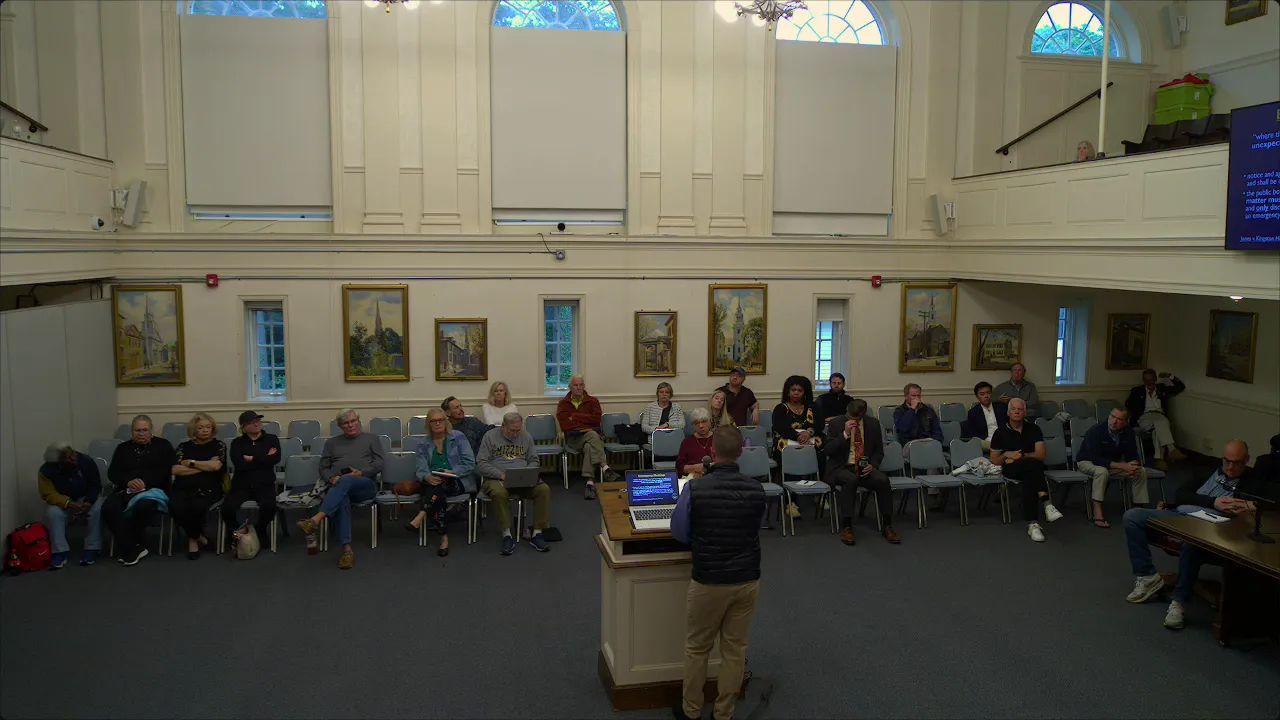
On May 21, 2025, at 10:45 AM, the Newport City Council held a workshop on the Open Meetings Act (OMA) led by Adam Roach from the Rhode Island Attorney General's Office, Open Government Unit. The session covered OMA requirements, common pitfalls, and best practices, followed by a question-and-answer period. No formal votes or decisions were taken; the meeting was educational in nature.
Presentation and Training
- Adam Roach explained the OMA policy statement emphasizing transparency and that public business must be conducted in open session.
- He outlined the minimal requirements for minutes: date, time, place, members present/absent, record of votes, and any other information requested by a member. Minutes must be posted within 35 days on the Secretary of State's website; draft minutes suffice.
- Roach noted that the OMA does not require public comment, but if public bodies allow it, members may only address the topic raised by the speaker.
- He discussed executive session rules: only proper agenda items (e.g., scheduling) may be discussed, and straying into substantive matters violates the OMA. He cited a recent finding where a chairperson discussed funding and direction beyond scheduling, constituting a violation.
- Roach addressed remote participation: a member may attend via Zoom only if they do not participate or engage; passive attendance is permissible.
- He covered site visits: a quorum visiting a site without notice and public access is a violation. Sending less than a quorum to investigate and reporting back in open session is a compliant alternative.
- Regarding email communications, Roach warned against collective discussions. Pushing out information unidirectionally (e.g., BCC) is allowed, but dynamic replies or chain comments constitute a violation. He cited a case where a reporter asked questions to a quorum individually, which was found not to be collective.
Questions and Answers
- Attendees asked about federal statutes superseding state law: Roach clarified they are complementary, not superseding, especially in the Access to Public Records Act (APRA).
- A question arose about the sufficiency of agenda descriptions: Roach said it is fact-specific, but attaching full reports is generally compliant. Voluminous documents may pose practical posting issues.
- Another attendee asked about alternate members and their authority: Roach noted it depends on creation documents and specific circumstances; he referenced past findings available on the AG's website.
- A question about using email for information dissemination: Roach confirmed that one-way communication is fine, but any interactive or collective discussion via email involving a quorum risks OMA violation.
- On enforcement: complaints are filed against the public body, not individuals. The AG's office reviews complaints and may issue findings requiring remedial action (e.g., redoing a decision in open session). Most violations are cured by the body holding a new compliant meeting.
Key Outcomes
- No formal decisions or votes were taken.
- The workshop provided training on OMA compliance, with resources available on the Attorney General's website (including past findings).
- Attendees were reminded to contact the AG's office for specific complaints or advisory opinions.
- Adam Roach emphasized that common sense and transparency should guide public body actions.
Meeting Transcript
This is the open meetings act uh workshop that we're doing. Um and I'm gonna introduce uh Adam Roach here. He's with the attorney general's office, and he's gonna uh do his presentation. Um and at the end of the presentation, we'll take some questions if you have them. So let's get through the presentation first and then we can address any any concerns or or questions after that. Um and in the meantime, Adam, come on up. Well, thanks very much for having me. Uh appreciate it. This is an important topic. Um, and it's nice to be in Newport. Um talking to Zy, I'm in Providence most of the time, so as an old friend. Um, so I'm I rarely get a chance to come down here, so it's nice. It is a school night though, so I don't think I can stick around uh much later after the presentation. But so I'm at the open government unit at the attorney general's office. Um we cover both the open meetings act and the access to public records act. This presentation will be the open meetings act portion of it. Um the APRA is kind of like a corollary to it, uh, but for public records. Difference between the APRA and the OMA is the APRA kind of has a federal equivalent, FOIA, that we can steal a lot of law from that from FOIA. The Open Meetings Act, there's not really a federal, there aren't federal meetings really, and to the extent that there are federal meetings, they're covered by regs and statutes and whatnot. Um so this presentation, I can kind of scale the speed of it depending on how much time's available to me. It can go as long as an hour and a half as short. I've done it in like 20 minutes before. I'll do something in between um so that you get your some bang for your buck, but I don't keep you here too long. So I'm gonna start with the basic policy statement of the OMA. Now it's important to know when you um, and by the way, look, some of you, I I know we've got attorneys here, we've got members of the council here, members of other public bodies. So some of you may be very well-versed in this, some not so much. That's okay. Oftentimes I work through it with this every day, and sometimes there's an area of the OMA or the APRA that I'm just not familiar with, and I'm encountering it for the first time. So this is kind of meant to be aimed at all levels. Um, and it's it's helpful. It's a helpful reminder for some who are more well-verse, and it it can also be kind of a new introduction to it. So this is just the policy statement of the statute, but it's important because it sets forth why we have the OMA. The OMA is just to promote transparency in government. Um this might be apocryphal, but I think that a lot of these laws that were why were either on the books, put on the books or uh bolstered um, you know, back in kind of Nixon administration when transparency is sort of became hiding in the public consciousness. Um, but there's an equivalent of the OMA for the most part in every state in the union. Some are very rigid, some are more flexible. The same with the APRA. And it's just basically so that uh the public business is conducted publicly and not behind closed doors. You there's not a really a cause of action uh that stems from a policy statement. So oftentimes I get folks who kind of reach out to me, they want to file a complaint against someone or an entity. And by the way, keep in mind you don't file complaints against individuals in a public body, you file it against the uh public body itself. And something I encounter sometimes is are members of a public body who are kind of infighting and they want to file complaints against specific members of the public body they're on. Well, in essence, that's filing a complaint against yourself because you're in that public body. Um so that's something um to keep in mind. Um but so the complaint is get against an entity itself. Um and you can't people sometimes are looking for causes of action, I'd say uh um just because um something you you perceive something didn't happen in an open manner, just kind of premising a complaint based on this the policy statement itself, uh you can't that's not really a cause of action. You need to point to a specific provision with the OMA. Um, and we'll get into those um as the presentation goes on here. So a lot of folks are scared by the OMA, but really if you look at it, this is all that the OMA requires. It's pretty spartan.
openpublica.com