Newport City Council Workshop on FY 2026-2027 Biennial Budget Overview - May 29, 2025
STREAMING COPY IN PREPARATION — RECORDING AVAILABLE FROM THE ORIGINAL SOURCE
Newport City Council Workshop on FY 2026-2027 Biennial Budget Overview - May 29, 2025
The Newport City Council held a workshop on May 29, 2025, at 5:30 PM in City Council Chambers to review the proposed FY 2026-2027 biennial budget. The administration presented a revised draft executive summary, proposed tax rates, capital improvement plan (CIP) adjustments, new positions, utility rate restructuring, and reallocation of unspent bond funds. Council members expressed divergent views on tax increases, new hiring, and funding priorities. No formal votes were taken; direction was provided for a clean budget document to be presented before the June 11, 2025 meeting.
Public Comments & Testimony
- A representative from the Aquidneck Island Planning Commission (AIPC) corrected a statement from the prior budget meeting, asserting that AIPC is not defunct and remains active, citing participation in the Naval Station Newport Collaborative Use Study and co-hosting a workshop on the Newport Tree Park and Open Space Master Plan.
Discussion Items
- Civic Support Restructuring: The administration explained a revised approach to civic support funding, splitting grants into two buckets: the Public Improvement Fund (Sears Trust, ~$163,000) for eligible organizations and general fund contract services (~$105,000) for programs like the Edward King House. The goal is to align with trust restrictions on aiding the needy and beautification while continuing community partnerships through purchase-service contracts. Councilor Seglie confirmed this reframing stays within trust boundaries. The average tax impact for an owner-occupied home is $8–$9.
- Transportation Master Plan (Keep Newport Moving): $500,000 was added to the FY26 CIP for implementation. Director Trish Reynolds specified that funds would go toward constructing the first priority infrastructure project on Narragansett Avenue (from Oka Point to Spring Street), estimated at $500,000 for a one-year build. Councilor Smythe questioned splitting the amount over two years to free up bond funds for other projects. The administration agreed to provide quarterly updates on progress. Additional CIP additions included dynamic parking signs and signal timing on Broadway ($50,000).
- New Positions: Nine new positions were proposed, with four general fund positions (deputy police chief, code enforcement officer, assistant building inspector, public services laborer) totaling $481,000 in salary and benefits, and five enterprise fund positions (utility GIS specialist, capital project engineer manager, parking superintendent, deputy harbormaster) totaling ~$528,000. Chief Duffy argued the deputy police chief is urgent due to administrative burdens and tourism demands. Councilor Carlin strongly opposed the positions, noting a 4% tax levy increase and that the code enforcement salary ($116,296) exceeds the highest teacher step. Councilor Seglie supported the positions but advocated offsetting costs through fee increases. Councilor Politano suggested shifting some positions to enterprise funds funded by visitor-derived revenues. The administration noted that code enforcement and building inspection positions are revenue-generating.
- Utility Rates and Stormwater: Rob (Director of Water Pollution Control) discussed the ongoing RAF Tellus rate study (about 50% complete, expected completion by fall 2025). He noted that stormwater comprises about one-third of the sewer budget and that current rates are structurally inequitable—the bottom 45% of customers pay ~$270/year versus a state average of $500–$700. The top 5% of customers contribute over 50% of revenue. He proposed considering a stormwater utility district or transitioning stormwater costs to the property tax base to better align costs with impervious surface and roadways. The council discussed the city's $9–10 million annual stormwater need and the challenge of funding only 10% of CIP projects.
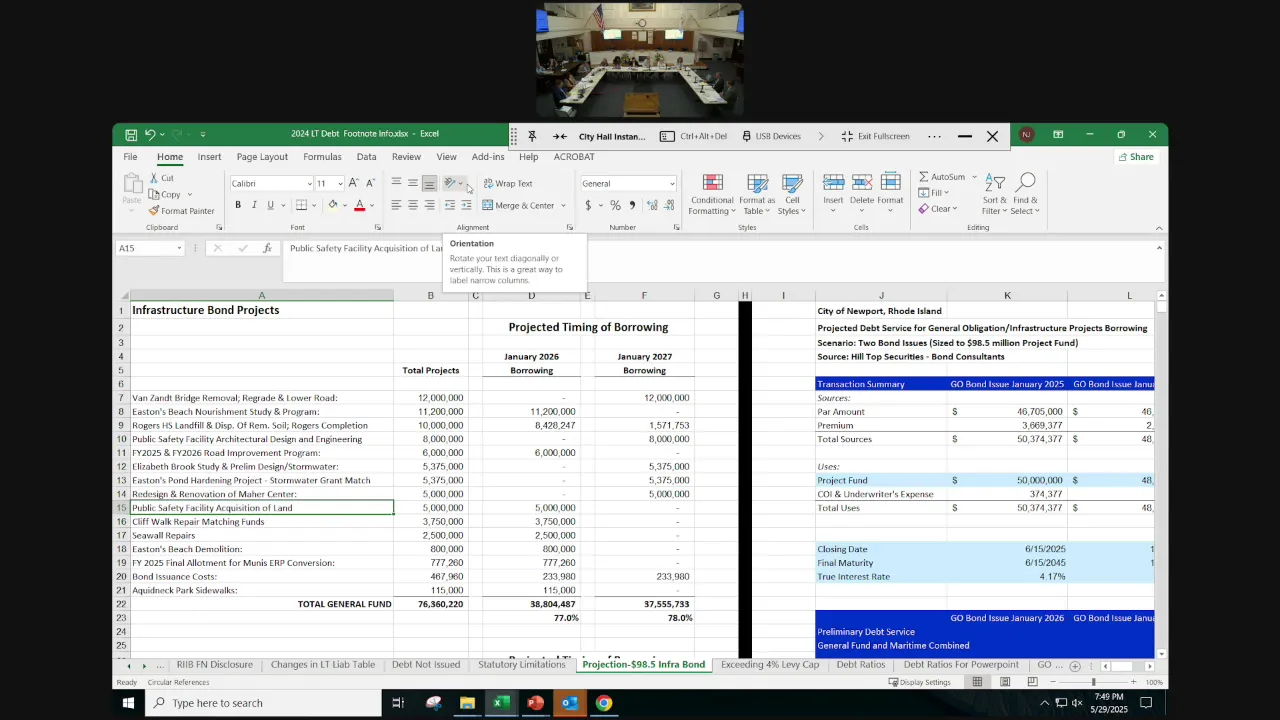
- Infrastructure Bond Reallocation: The administration recommended redirecting the $5 million originally allocated for the Maher Center (which would cost an estimated $13.2 million for renovation or rebuild) to other projects: city hall improvements ($1.25M), fire station building improvements ($59,000 for Station 2, $20,000 for Station 5), dynamic parking signs ($130,000?), library roof ($225,000, actual ~$163,000), and brick market geothermal HVAC ($500,000). Councilor Carlin opposed redirecting bond proceeds, arguing that if the Maher Center project is not pursued, the borrowing should be canceled to avoid burdening taxpayers. The administration cited the bond's generic authorization for infrastructure.
- North End Development: Councilor Seglie raised concerns about acquiring and developing former bridge realignment parcels and the Navy hospital. He noted the ad hoc Bridge Realignment Commission's findings that the area lacks infrastructure (sewer, water, gas) and that stormwater investment alone could exceed $70 million. He urged the administration to include funding for legal and planning staff to negotiate site control within the next 24 months. The administration acknowledged $2.8 million in a property acquisition fund (excluding Coxhall) and some flexibility from the public safety facility bond allocation. No specific budget line item exists for this effort.
- Debt Service Policy: Councilor Seglie proposed revisiting the city's policy that debt service not exceed 9% of general fund expenditures, suggesting a possible increase to 10% and clarification that state housing aid reimbursements be deducted from the calculation. He noted that without adjustment, the city would exceed the 9% cap in FY2028 when borrowing the full infrastructure bond.
Key Outcomes
- The administration will produce a clean, revised budget document incorporating all discussed changes before the June 11, 2025 council meeting.
- Council feedback indicated a desire to explore fee increases to offset costs of new positions, particularly for services used by visitors and part-time residents.
- Continued work on utility rate restructuring, with a formal presentation of rate study scenarios expected in October/November 2025.
- The council will receive the ad hoc Bridge Realignment Commission's final report on June 25, 2025, to inform long-term development strategy.
- No formal votes were taken; the workshop served as a discussion to guide budget amendments.
Meeting Transcript
Uh for our little budget workshop here. Well, we're just gonna jump right into it. So uh Mr. Nolan, if we want to start with the present through. Excellent. Thank you. Good evening, everyone. Uh appreciate everyone being here. Um, really just wanna really set a framework for for tonight's meeting. Uh and really the idea is to really have an open discussion. Any any questions, uh anything you would like to review, really it's it's open and um all the department heads are here. Um finance city manager, deputy um city managers here as well. So uh that's that's really just is kind of set the tone for the meeting. Um within this packet that uh is in front of everyone. I'll just go through what's included. Um there's a revised draft executive summary, uh, and what's what we are currently working on uh is a clean draft of this document here. So really what the pieces that are included here tonight are components, the major components of the of this larger document, and we'll have a nice clean document for everybody for the uh from the meeting on June 11th. Uh also included in this packet here is a revised org chart, uh budget review schedule, uh summary of proposed levy and proposed tax rates, um, the proposed general fund revenues, the proposed uh fiscal year 2026 expenditures for general fund, uh any new proposed positions, our CIP roll forward, which is really gonna take us from uh our CIP document to currently where where we are, as far as any changes that that have may have been suggested. Um we have uh civic support, detail on civic support, as well as the revenue and expenditures for water pollution control. Um I know that we have Peter is with us today. He spent an awful lot of work on on uh the civic support. So he's here to answer any questions, and uh we can go through any of those those schedules. Um so I'd certainly open it up to council for any questions or any direction as far as you what you'd like us to touch on. Yeah, anyone from the council want to go to start with the uh low-hanging fruit, which is the civic support and understanding that uh solicitor BN gave us a very helpful memo outlining the restrictions on the original trust revenues and how they could be distributed. I think the short form of this, and uh Mr. B and tell me if I'm wrong, is general welfare of the community helping the poor and the destitute in our community to use the kind of historic terms, and then secondarily beautification of the city itself. Um outside of that, I think some of the drift that we had over the years was when we would receive supplemental funding through things like ARPA, we use civic support as a distribution mechanism for that, occasionally wading into areas outside what the original trust intended. Can you talk to us about how the administration taking council feedback has reframed our approach to some of that civic support and how we are also making sure we continue supporting community partnerships that may not fall under those buckets but are still core parts of what helped make our city function with a relatively small staff? Absolutely. So really there's there's as uh counselor side just mentioned. Uh we really have two buckets. We have uh the buckets uh that really impact as far as our the offshoot of our sears trust, which is our public improvement fund. So what we have available in fiscal year 26 is uh roughly 163,000. Um we took council's direction um along with uh deputy city manager and Peter as far as really working on a uh a framework of a rubric of measurement to review those applications, make sure we had uh minimum requirements of documents that we received, and then it was reviewed by a subcommittee of I believe it was six members internal to the city. Um and they reviews reviewed all those applications, scored them, and um, and what we came up what we came across uh is gonna be what we have up here on the screen, uh, which is our proposed award funding. And we really have this broken down into two pieces. This top piece is going to be um funding that will come from our public improvement fund. And then as we work our way down, um it's then we identified a number of organizations that really we we feel can be supported with general fund um general fund funding. Uh so that that's gonna be like the Edward King House for for programs that are are really uh an offshoot of really personnel that the city currently does not have, and they're really picking up the ball um and and helping us with those services. And I would and I would note that we those those items that came out. There is one, two, three, three, there's ten of them. So then with some with some council guidance, we thought, well, let's put put together a proposal that says this is this is still valuable work that the community does, and we'd like to still contract with this, just as we do for all of our purchase services for uh around the city humanitarian and otherwise. And so essentially we can detach this from the Sears Trust, but still achieve the same desired end state through a purchase service program. And that's what we've accomplished through this division. It it's not 100% perfect. There are gray areas in each of these sum elements of Sears Trust applicability, but portions that do not, and vice versa. But we felt that this was the best division very conveniently and coincidentally, the dollar amounts uh worked out pretty well when we did that division. We were only a few thousand dollars off. That was just a lucky coincidence. It wasn't what we were we weren't driving off of that, but it turned out that way and it worked very well.
openpublica.com