OPENPUBLICA · PUBLIC MEETING RECORD
Record of Proceedings
North Bend City Council Workstudy: 2027-2028 Biennial Budget Discussion, October 27, 2026
City Council — Tuesday, October 27, 2026
BodyNorth Bend, Washington
SessionCity Council
DateTuesday, October 27, 2026
StatusNEW · FILED
Video Record
STREAMING COPY IN PREPARATION — RECORDING AVAILABLE FROM THE ORIGINAL SOURCE
Transcript — Verbatim
Speaker numbers apply only to this recording. Names come from transcript evidence. “Possibly” marks uncertain attribution.
Discussion Breakdown — Share of Meeting
Fiscal Sustainability25%
Public Safety13%
Technology and Innovation12%
Economic Development11%
Budget Equity Analysis10%
Workforce Development8%
Public Engagement6%
Water And Wastewater Management6%
Procedural5%
Summary of Proceedings
North Bend City Council Workstudy: 2027-2028 Biennial Budget Discussion, October 27, 2026
The North Bend City Council met in workstudy on October 27, 2026, at 7:00 p.m. at City Hall, 920 SE Cedar Falls Way, to continue the 2027-2028 biennial budget discussion. Mr. Chaw led the presentation, covering the General Fund, rainy day reserves, utility rates and debt, and the Capital Improvement Plan. No public comment was taken, consistent with the workstudy practice, and no formal votes were taken.
Discussion Items
General Fund: service levels and long-term context
- Mr. Chaw recapped the first workstudy, including General Fund forecasts, Regional Fire Authority options, and levy options, before moving into a deeper review of service levels.
- The city’s service area was described as about 8,700 residents inside North Bend plus about 8,400 residents in surrounding unincorporated areas, serving a total of about 17,000 people. Councilmembers noted that nonresidents use city roads, infrastructure, and emergency services without directly paying property taxes for them, and discussed the policy implications for annexation, use taxes, and levy decisions.
- From 2017 to 2026, the city’s population grew by 32 percent while city FTE grew by 9 percent. Councilmembers said this illustrated doing more with less, with one councilmember describing the city’s “check engine light” being on. Council asked staff to explore additional department-level service metrics, but directed that deeper analysis be brought back next year rather than during the current budget cycle.
- The General Fund budget is $33.5 million over the biennium, divided into six categories: mandatory/regulatory services 11 percent; life safety 50 percent; revenue-generating services 17 percent; community services 8 percent; internal policy support 6 percent; and remaining internal operations. Closing the projected gap with reductions only would require about $2.7 million per year, or $5.5 million over the biennium, and would fall first on community services and internal operations.
- East Side Fire & Rescue Chief Aho told the city that the original budget request for a new aid/ALS unit at Station 87, including 12 FTEs and costing about $2 million per year, was cut by the fire district board. As a result, the station is cross-staffed and simultaneous major incidents would require mutual aid.
- Police Chief Hall discussed pressures from I-90-related transient crime and from outlet mall corporate policies that delay calls to police. Councilmembers expressed interest in exploring a public safety sales tax and in holding large retailers more accountable for the public safety costs caused by delayed loss-prevention calls.
- Councilmembers also discussed the proposed community/economic development position. One councilmember argued that eliminating the new position would effectively eliminate sponsored events unless the city contracted them separately; another councilmember noted the city could choose to fund events as it did in 2026.
Rainy day reserves (Fund 002)
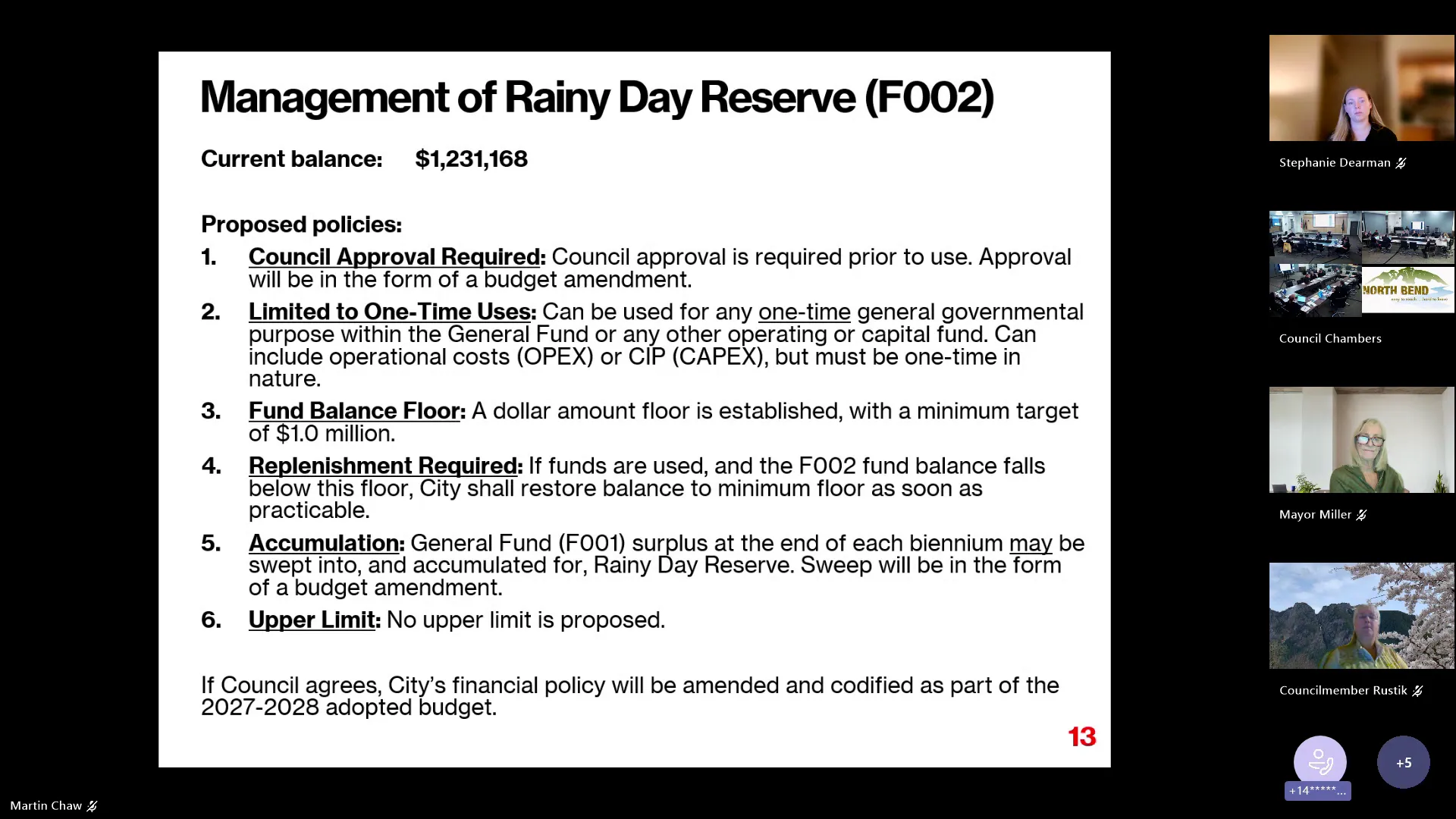
- Mr. Chaw proposed six policies for the General Fund operating reserve, Fund 002, which has a balance of about $1.2 million and was described as roughly 10 percent of the General Fund. The proposed policies were: council approval required; use limited to one-time expenses; a minimum fund balance floor of $1 million; a replenishment plan if the fund drops below the floor; sweeping excess General Fund balance into the reserve; and no upper limit on the reserve.
- Councilmembers supported council approval and one-time-use restrictions, but recommended that the floor be a percentage of the General Fund rather than a fixed $1 million amount. Several councilmembers opposed the no-upper-limit approach, saying every dollar should have a job and the reserve should not become a high-yield savings account. Staff planned to codify revised reserve policies as part of budget adoption.
Utilities
- Stormwater rates were adjusted through 2030 by Ordinance 1839, and water and sewer rates were adjusted through 2030 by Ordinances 1849 and 1850. All three utilities assume 2 to 2.5 percent annual growth. The rate studies include a new water field worker in 2027, a stormwater engineer in 2028, and two additional stormwater positions in 2029 and 2030.
- Staff recommended removing the 2028 stormwater engineer position from the budget assumptions until the city is closer to the 10,000-population threshold for federal NPDES/MS4 requirements, saying staff will bring it back if the Department of Ecology requires it earlier.
- The sewer utility carries revenue bonds for the treatment plant and CER improvements financed through a bond anticipation note; a refinancing ordinance will come to council on November 3. Mr. Chaw also gave a preview of ULID 7, involving about $9 million in revenue bonds for Mountain Park area sewer improvements, with assessments placed on improved properties after completion.
- Councilmembers discussed ongoing sewer rate pressure, the high cost of King County sewer rates, and the need to monitor bond repayment through 2050.
Capital Improvement Plan (CIP) dashboard
- Stephanie, the city’s senior GIS analyst, demonstrated a new interactive CIP dashboard for the 2027-2032 proposed CIP. It maps projects, filters by project type and year, shows budget amounts, and includes charts and detail pop-ups. The example shown included the South Fork levy setback project with $10 million proposed in 2032; the 2029 project list was estimated at $36.6 million.
- Councilmembers requested additions, including grant-funded amounts, a public-accessible version, project status/development timelines, and links to past council approvals. Staff said they would incorporate feedback and roll the tool out to council.
Key Outcomes
- No formal votes were taken; the workstudy provided direction for the budget adoption process.
- Council generally affirmed the service levels and spending in the proposed 2027-2028 budget book, with no consensus to cut major programs.
- Staff will refine the rainy day reserve policy using a percentage-based floor and an upper limit, with council approval and one-time-use restrictions.
- Staff will delay the 2028 stormwater FTE unless federal/state requirements force earlier action.
- The CIP dashboard will be updated with grant funding data and public access, and further layers will be explored.
- Mayor acknowledged remote participation problems and said the city’s meeting technology would be fixed.
Meeting Transcript
All council members except my council members Johnson is motion. Oh, we're not the joint idea. Okay. Seven o'clock. Let's start with Mr. Cha. Right. Are we starting with general fund or we're going through this whole discussion? We'll start with the general fund and then we'll just go right through the agenda. Well, welcome council. This is um the second work study of uh two. Everyone should have a copy of the presentation. Um we're gonna start with uh where we left off with the general fund discussion from last time, which was work study number one. Let me I'm gonna stand up and present. Do free stop me any time questions. So should we call um on the 13th, what we covered were the guiding principles for developing the budget. Uh and we went through a uh forecast of the general fund, heard about news for expenses as well as operational uh covered our long-term fiscal sustainability options. We talked a little bit about the RFA. We went to detail about what that would look like. Um RFA formed with a uh property tax antifire benefit charge option. Um we went through the bookends as you recall the uh 100% funded RFA using property taxes in the uh scenario rural 60% funded for a benefit charge and a proper tax. Remember that um then we also covered the levy options and what that would look like um if we funded the um the financial gap using uh uh we're going through a levy that lift what we want to cover tonight uh council is uh going over more of the expense side to do a deeper dive on um our levels of service and what we've done here is as you can see on screen, we've taken our general fund level of service and we stratified it uh through six um layers. And I'll go and we'll go over um each of the six in here in a second. Uh we'll talk about our strategic top priorities going into 2027, um, what some of those efforts look like and then um item D will uh talk about ramifications. We were to look at um closing the gap with um reductions only with expense reductions. Uh item E is um uh use of Green Day reserves, uh as you recall uh
SUMMARIZED BY OPENPUBLICA AI
TRANSCRIPT VIA PUBLIC VIDEO
openpublica.com
openpublica.com