Novato City Council Meeting – July 23, 2024: Consideration of Local Sales Tax Measure for November Ballot
STREAMING COPY IN PREPARATION — RECORDING AVAILABLE FROM THE ORIGINAL SOURCE
Novato City Council Meeting – July 23, 2024: Consideration of Local Sales Tax Measure for November Ballot
The Novato City Council met on July 23, 2024, to consider placing a 0.75% local sales tax increase (three‑quarter cent) on the November 5, 2024 general municipal election ballot. City Manager Amy Cunningham presented a detailed report on the city’s ongoing fiscal challenges, including chronic budget deficits, low property tax revenue, deferred infrastructure needs, and staffing shortages. She recommended that the council adopt a resolution to let voters decide on the measure.
Discussion Items
- Fiscal Overview and Need for New Revenue: City Manager Amy Cunningham presented historical context, noting that the city has faced systemic operating deficits for years, with a projected $4.3 million deficit in FY24/25. She highlighted the Marin County Grand Jury report titled “Novato’s Chronic Fiscal Deficits: A Call to Action,” which concluded that the council has not adequately pursued ongoing revenue sources and recommended increasing the sales tax. The city’s property tax share is only 7 cents of every dollar, the lowest in Marin County. The city’s current sales tax rate is 8.5%, but only 1.25% stays with Novato. Several neighboring cities are already at the state cap of 9.25%, while Novato has 0.75% cap space available.
- Infrastructure and Staffing: Over $51 million in deferred maintenance is identified for streets, roads ($38M), and parks ($13M). Staffing levels are at a 20‑year low (198 FTE), with nearly 98% turnover over the last decade. A consultant study indicated a need for an additional 19.5 positions to meet current service demands.
- Community Outreach and Survey: A May 2024 poll of likely voters showed 80% say life is good in Novato, 66% are satisfied with city services, and approximately 60% would support a local sales tax measure to preserve services. The city conducted extensive outreach including mailers, workshops, and presentations.
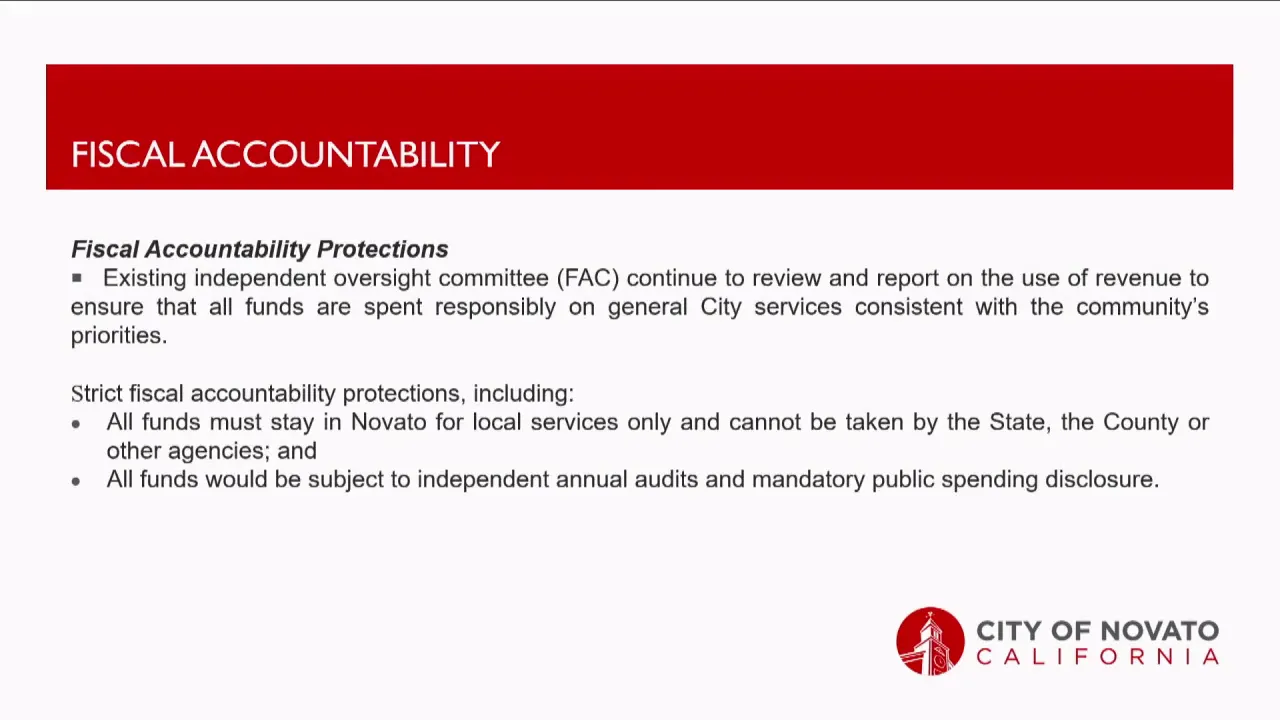
- Proposed Ballot Language: The measure would establish a 0.75% transactions and use tax for general government use, generating an estimated $10.3 million annually, until repealed by voters. It includes independent oversight by the Finance Advisory Commission, annual audits, and a requirement that all funds stay in Novato. Sales tax would not apply to groceries, medications, rent, or utilities.
- Staff Recommendation: Cunningham urged the council to adopt the resolution approving the ordinance and place the measure on the November 5, 2024 ballot. She emphasized that the sales tax is part of a larger needed fiscal sustainability plan.
Key Outcomes
- The council heard the staff presentation and the recommendation to adopt the resolution. No vote or further council discussion is recorded in the provided transcript; the meeting may have continued beyond the presentation. According to the agenda, the item was for consideration, and the meeting occurred as scheduled. The next steps described by staff include future development of a Fiscal Sustainability Plan detailing spending priorities, accountability provisions, and plans to address infrastructure backlogs and reserve replenishment.
Meeting Transcript
To item J2. And we are going to consider adopting a resolution, approving an ordinance and calling for giving notice of and establishing the policies and procedures for an election on a proposed ballot measure to establish a three quarter of one cent transactions in use, sales tax for general government use, and requesting that the County of Marin consolidate such an election with the established election to be held on Tuesday, November 5th, 2024, and directing the County of Marin to conduct the election on the city's behalf, placing a transaction in use sales tax measure on the November 5th, 2024 general municipal election ballot. So with that, I'm going to call on our city manager Amy Cunningham to present the item. Welcome again, Amy. Thank you. Thank you. I realized after we put this agenda together that everybody everyone would be listening to me all night long. So sorry. So good evening, Mayor and Council. Tonight we're presenting a report that addresses several items in your strategic plan and offers a solution to the city's systemic and growing budget deficits and deferred maintenance needs. As discussed in this report, we've spent several months. In fact, I've spent the four last four and a half years reviewing the city's finances, finding ways to cut or contain costs with limited impacts to the community, and reaching out to the community to explain the city's fiscal challenges and why we're not meeting their needs. The sales tax option we're presenting to you tonight encompasses work direction and decisions from council, staff, and the community. Placing the proposed sales tax measure on the ballot sets the table to improve services, find operating efficiencies, reduce chronic staff turnover, and address our failing infrastructure. This is our opportunity to make true and lasting change for the Novato community. I urge you to consider what Novato will look like, not just in the next three to five years, but you want what you want Novato's future to be. And by approving this carefully considered ballot language and putting the question to voters, you're allowing our residents to decide their future. Last summer, through a series of public meetings, the council adopted a new strategic plan that included a number of initiatives intended to foster fiscal strength and address ongoing systemic budget deficits. Three of those initiatives are listed here. You heard me talk give updates on them just a few minutes ago. Initiative 14 is about the backlog of deferred maintenance needs. Initiative 15 is modernization of the fiscal sustainability plan. And initiative 16 talks about the sales tax measure, which is really our primary focus here tonight. I think it's important to point out that looking at the feasibility of a sales tax measure wasn't a new concept just last year. In 2020, pre-pandemic, the council had asked that staff look into a sales tax measure as a means of improving the city's fiscal outlook and preventing deficits. Since that time, staff and council have proactively and very transparently shared information about the city's financial challenges with the community, implemented other revenue generating opportunities like the user fee study that improved cost recovery by over 1.2 million dollars a year, and continue to cut expense and find ways to more efficiently serve the community. Last Thursday, the Finance Advisory Commission reviewed the information in this report, including the sales tax proposal. They unanimously recommended the council approve placing a locally controlled sales tax on the November 24 ballot for Novato voters to decide. If they want to increase local sales tax by 0.75% to support critical services and the city's backlog of maintenance and infrastructure needs. So here's some background. Back in 2017, the council was presented with a five-year general fund forecast that identified that operating deficits could start as early as 1718 if new revenue sources or significant expenditure reductions were not made. Since that time, the council's implemented a number of short-term budget solutions intended to preserve critical services. These actions and unanticipated use of one-time monies helped delay the projected operating deficits, but the backlog of infrastructure maintenance and repairs has increased exponentially during that time. Councils discussed this in detail over the past several months, particularly as part of the budget development process. Those short term short-term solutions have caught up with us. As shown here, the city's experienced growing systemic deficits over the past five years, and going forward, as we'll see in a few minutes, we can expect to see multi-million multi-million dollar deficits each year for the next five years if we don't make major financial changes. Ultimately, these systemic deficits, including expense reduction and cost containment measures, have resulted in a failure to meet the community service delivery needs and a steady decline in the health of the city's infrastructure. The 2425 budget adopted just last month included a $4.3 million operating budget deficit and minimal and frankly insufficient investment in the city's capital assets and infrastructure. We're not the only ones who've seen this. Last summer, the Marin County Grand Jury completed a review of the city's fiscal challenges and released a report called Novato's Chronic Fiscal Desk Fiscal Deficits A Call to Action. The report correctly identified that for more than a decade, city staff have been warning the council and community that significant financial changes need to be made to resolve what they labeled as ongoing and chronic fiscal challenges. The report noted that the city's revenue structure, specifically Novato's low share of property tax, is a major obstacle to gaining financial stability. And among other findings, the report recognized that the city's continued cost cutting and expense reduction measures have led to declining service levels that have that are having a negative impact on the community. We'll touch again on this in a few minutes, but I think it's important to pause for a moment and point out the grand jury's conclusion. These cuts have had the unintended consequence of driving increased employee turnover, which reduces efficiency and increased costs over time. Ultimately, the grand jury concluded the council needs to pursue new revenue options and begin planning to increase the city's sales tax. One of the council's strategic plan initiatives mentioned before is to update and modernize the 2020 the 2013 fiscal sustainability plan. This and prior councils have recognized that the current financial situation is not sustainable and that the city cannot continue to use one-time funds and emergency reserves for daily operations. Even if the council wanted to, those monies are running out now. A new fiscal sustainability plan would outline how the city can achieve sustainability while meeting the community service delivery needs and invest in, maintain, and preserve capital assets and infrastructure.
openpublica.com