Novato City Council Meeting - October 22, 2024: Fiscal Sustainability Update and Measure M Presentation
STREAMING COPY IN PREPARATION — RECORDING AVAILABLE FROM THE ORIGINAL SOURCE
Novato City Council Meeting - October 22, 2024: Fiscal Sustainability Update and Measure M Presentation
The Novato City Council met on Tuesday, October 22, 2024, at 6:00 PM in the City Council Chambers. The meeting included ceremonial proclamations, consent calendar approvals, a public hearing for the Landing Court Apartments project, and general business items. The primary focus of available meeting records is the presentation on the city's fiscal sustainability planning efforts and the proposed Measure M local sales tax, which was presented by City Manager Amy Cunningham. Details of other agenda items were not recorded in the provided transcription.
Consent Calendar
The agenda listed six consent calendar items, which are typically approved by a single vote without separate discussion:
- Waiving reading and authorizing introduction of ordinances by title only.
- Approving the closed and open session minutes of September 24, 2024.
- Approving a ground lease amendment with Vero West 103 LLC for property at 501 Davidson Street.
- Adopting an updated City Council Policy Manual.
- Accepting work as complete and authorizing the Notice of Completion for the 2023 & 2024 Annual Pavement Rehabilitation Contract 2.
- Approving plans and specifications for the Josef Hoog Community Park playground replacement project.
No discussion or vote tallies were recorded for these items.
Public Comments & Testimony
No public comments were recorded in the provided materials.
Discussion Items
Fiscal Sustainability & Funding Priorities (Item J.1) City Manager Amy Cunningham delivered a presentation on the city's fiscal challenges and the proposed Measure M, a three-quarter cent local sales tax on the November 5, 2024 ballot. Key points from the presentation:
- Measure M is projected to generate over $10 million per year from all shoppers in Novato, with funds staying locally and subject to independent oversight and audits.
- The city faces a systemic operating deficit: $4 million in the current year, projected to drop slightly to $3.3 million next year.
- Without new revenue, reserves are projected to be exhausted by fiscal year 2026-27.
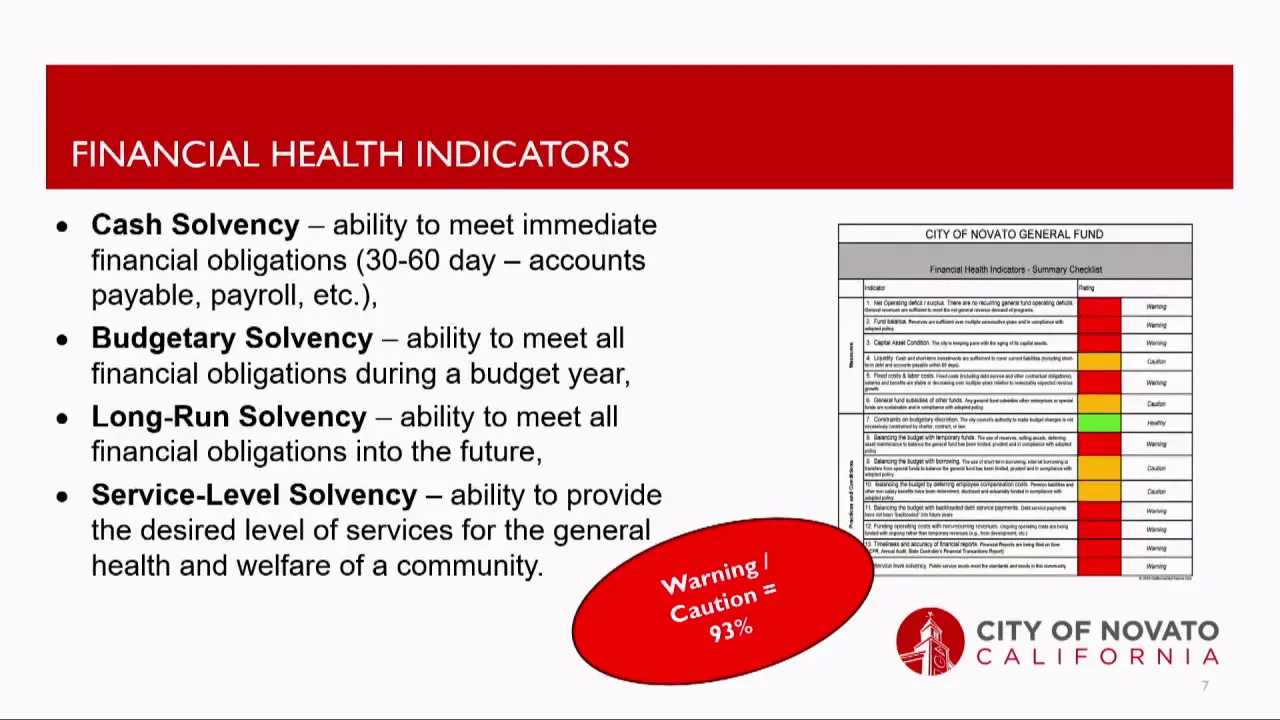
- A fiscal health diagnostic tool (by Michael Coleman of Cal Cities) showed 13 of 14 key indicators (93%) in the "warning" or "caution" categories.
- The city has eliminated over 30 full-time staff positions since 2002-2003, reducing from 234 to 198 employees, contributing to service delivery challenges and over 100% turnover in seven years (including eight police officer departures so far in 2024).
- Staff recommended five priority uses for Measure M revenue if approved: (1) preserve current services and address the deficit, (2) replenish emergency reserves, (3) proactively mitigate liabilities (pension trust, OPEB trust), (4) address known safety concerns, and (5) invest in innovation and economic development.
- If Measure M is not approved, staff will return to the council in early 2025 with options for further cost reductions.
Key Outcomes
- The council received the fiscal sustainability update and presentation on Measure M. No vote or formal action was taken on the presentation itself; any decisions on funding priorities or future reductions would be part of the annual budget process.
- The public hearing for Landing Court Apartments (Item I.1) and the Downtown Novato BID assessment (Item J.2) were listed on the agenda but no discussion or outcome was recorded in the provided transcript.
- Commission appointments (Item K.1) were on the agenda but not discussed in the available records.
Meeting Transcript
At the September 24th council meeting, you requested a presentation on fiscal sustainability planning efforts and funding priorities. If Measure M, the three quarter cent local sales tax proposed on the November ballot is successful. Much of this information was presented on July 23rd at the council meeting then, and tonight I'll recap that information and share more details about our continued fiscal accountability efforts. After several years of discussing the city's ongoing and systemic fiscal challenges, attempts to align revenue with expense and preserve service levels, continued actions to increase fiscal accountability, and in-depth review by the Marin County Civil Grand Jury and significant community input. On July 23rd, you, the City Council, unanimously recommended a three quarter cent local sales tax measure, now Measure M, be placed on the November 5th general election ballot. The measure allows Novato voters to decide if they want to preserve existing services and their quality of life. The ballot language shown on the slide here, identifies services that would be preserved and outline some of the oversight and accountability measures that would be enacted if a majority of Novato voters approve the measure. Ballot language is strictly regulated and includes a legal word count limit. So that means that everything you want to put into the ballot language just can't be there. Those limitations don't allow space for all the regulations to be listed in detail, so more details around transparency, oversight, and accountability are typically listed in the accompanying resolution and ordinance. In this case, with Measure M, in addition to the ballot language, resolution 2024-071 and ordinance 1717 provide more detail about public accountability. On this slide, I've highlighted some of the fiscal accountability oversight and review requirements if Measure M is approved. Funds will stay in Novato for Novato services. They can't be taken by the county, state, or other agencies. Sales tax does not apply to certain essential goods like groceries, prescription medications, medical and dental services, rent or education services. An independent oversight committee will review annual annual use of the funds with a report to the public. Use of the funds are subject to audits by the city's independent auditors. All spending reports are available to the public to enhance transparency. And this also includes at year 10 and every five years thereafter, council review of the tax to consider whether it's still needed. If changes or elimination of the sales tax are recommended, the council would place a measure on the ballot for voters to consider the proposed change. If approved, measure M is projected to generate over 10 million dollars per year. The monies would be paid by anyone shopping in Novato, not just residents. So people coming from out of town to shop at Costco or Target or downtown at some of our DMBA folks left, at some of our downtown shops. Or just stopping to buy gas would also pay the local sales tax, and those monies would support local services and infrastructure. Measure M would preserve those service areas the community has said are most important, police parks and potholes. Funding would be used to address deferred infrastructure needs like roads and streets, aging storm drains, parks and facilities, and preserve critical services like maintaining 911 response, recreation programs for seniors and youth and adults, and wildfire prevention efforts. So next I'll review some of our recent fiscal sustainability planning efforts. The council has been concerned about the need to improve the city's fiscal health and address the ongoing and growing systemic deficit for several years. The adopted 2325 strategic plan outlines a number of efforts, including exploration of a local sales tax to address these concerns. The strategic plan also included an initiative to modernize the 2013 fiscal sustainability plan, including an interactive model. The model's been developed and is now available on the city's website for community use. While understanding the city's short-term fiscal outlook is necessary to develop a fiscal sustainability plan that's useful, if the plan is intended to be a document that serves as a guide for future fiscal and budgetary decision making, several areas should be considered to ensure the city's overall long-term fiscal health. At a recent finance advisory commission meeting, staff reviewed a fiscal health diagnostic tool with commissioners. This tool helps to identify specific areas that we recommend be covered in the fiscal sustainability plan. The tool was created by Michael Coleman, the principal fiscal policy advisor for Cal Cities, formerly League of California Cities. Mr. Coleman is considered the subject matter expert on California municipal finances. The tool poses in-depth questions about key financial areas that ultimately provide indicators about an agency's fiscal health. A state or local government is financially healthy if it can deliver the services its citizens expect with the resources its citizens provide now and in the future. Financial health is examined in four contexts as shown on this slide. Cash solvency, budgetary solvency, long-run solvency, and service level solvency. After applying Novato's information, 13 of the 14 key areas or 93% fall into the warning or caution categories on this fiscal indicator. Staff is suggesting that consideration of these areas be included in the new fiscal sustainability plan. Next, I'll talk a little bit about the funding priorities, which reflect the areas the community has said are most important to them. If Measure M is approved by voters, staff recommends that the five areas below shown on this slide be considered as priority uses for the new revenue. Number one, preserve current priority services. We first need to bridge our systemic operating deficit. This year's deficit is over 4 million. Next year it's anticipated to drop slightly to about 3.3 million. Meeting the community's demand for services is critical, and this means adding back positions urgently needed to meet existing service level demands.
openpublica.com