OPENPUBLICA · PUBLIC MEETING RECORD
Record of Proceedings
Park City Council Meeting: August 13, 2026 - Regional EOC, Bonanza Project Public Comment, Little Kate Road Design Approval, and Land Management Code Amendments
City Council — Thursday, August 13, 2026
BodyPark City, Utah
SessionCity Council
DateThursday, August 13, 2026
StatusFILED
Video Record
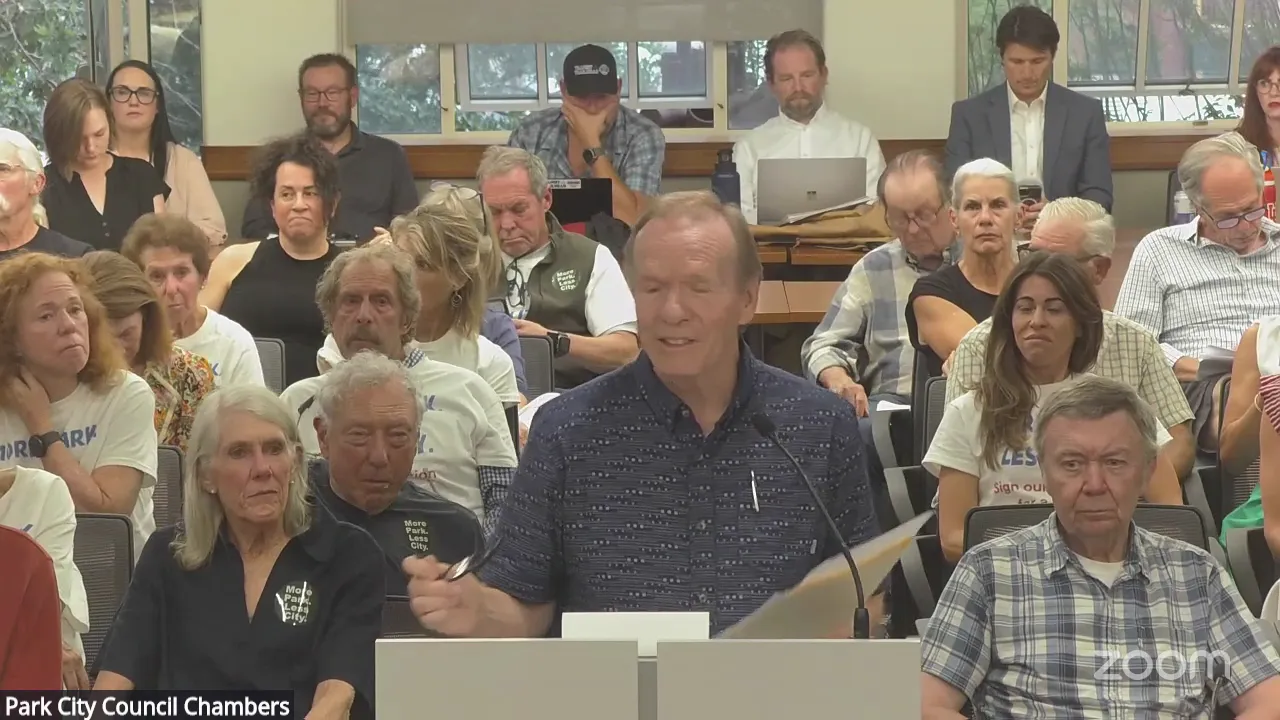
STREAMING COPY IN PREPARATION — RECORDING AVAILABLE FROM THE ORIGINAL SOURCE
Transcript — Verbatim
Speaker numbers apply only to this recording. Names come from transcript evidence. “Possibly” marks uncertain attribution.
Discussion Breakdown — Share of Meeting
Transportation Safety31%
Affordable Housing15%
Community Engagement13%
Engineering And Infrastructure7%
Public Safety6%
Procedural6%
Public Engagement6%
Parks and Recreation4%
Olympic Planning3%
Summary of Proceedings
Park City Council Meeting: August 13, 2026
The Park City Council met on August 13, 2026, in a regular session at the Marsac Municipal Building, following a closed session from 2:30 p.m. to 5:21 p.m. The regular meeting began at 5:30 p.m. and included a presentation on a future Regional Emergency Operations Center, extensive public comment on the Bonanza 5-acre development project, approval of the Little Kate Road project into final design, and adoption of Ordinance No. 2026-19 amending the Land Management Code. The meeting adjourned at approximately 9:15 p.m.
Consent Calendar
- Approved the City Council meeting minutes from July 16, 2026, unanimously.
- Approved Consent Agenda Items 1, 3, 4, 5, and 6: (1) Professional Services Agreement with Park City Senior Citizens Inc. not to exceed $100,000 for two years; (3) Purchase of eight previously leased 35-foot low-floor diesel buses and spare engine/transmission assembly for $339,500; (4) Amendment to agreement with Ineo Systrans USA Inc. for CAD/AVL technology, increasing contract value by $180,000 to a revised not-to-exceed amount of $1,380,000; (5) Temporary Construction and Perpetual Easement Agreements at an appraised value of $970,600 for the Citywide Bus Stop Improvement Project; (6) Resolution 15-2026 adopting revised procurement rules.
- Item 2 (Emergent Community Needs Grant Awards totaling $27,500 to Park City Community Foundation, Peace House, Inc., and Bridge21 Park City, Corp.) was pulled from the Consent Agenda and approved separately by a vote of 3-1 (Council Member Toly voted no, Council Member Zegarra recused due to a conflict of interest).
Public Comments & Testimony
- Bonanza 5-Acre Development Project: Over 20 residents spoke during public input, nearly all expressing opposition to the current Brinshore proposal. Key points included:
- Petition: Sara Milligan reported that 2,399 petition signatures were gathered in six weeks opposing the project, more than the highest vote-getter in the last city council election (1,800+ votes). The petition was submitted to the council.
- Traffic and Emergency Access: Multiple speakers (Allison Cook, Patricia Kipp, Maria Reinhart, others) argued the Bonanza/Kearns intersection is already failing (receiving an "F" grade) and that adding density would worsen congestion, delay emergency vehicles, and compromise access to the hospital and schools.
- Building Height: Speakers (Dick Grannis, Richard Ford via eComment) noted the proposed 55-foot height exceeds the 35-foot limit in the Bonanza Park Small Area Plan and that height variances were denied for other projects like DoubleTree.
- Financial Concerns: Chelsea Strong and others questioned the city's capital contribution of $38.6 million plus land costs, tax credit equity of $60 million, and subsidies for unrestricted units. Jimmy May estimated total public cost could exceed $90 million, making each affordable unit cost over $1 million.
- Arts and Culture: Rich Wyman urged preserving the original 2017 vision of an arts and culture district, suggesting a redesigned project with less density and more public space.
- Process: Several speakers asked the council to pause or cancel the project, citing a termination agreement option with a $75,000 fee and up to $1 million in expenses.
- Other Comments: Steve Onysko challenged the council's meeting ground rules prohibiting applause and addressing the audience, citing the Utah Open Meetings Act. City Attorney Margaret Plane responded that Resolution 01-2023 establishes rules of order to create a safe space.
- Little Kate Road Project: Katherine Fagin supported the preferred alternative and thanked staff and resident leaders. Melissa Janssen requested preserving fruit trees during sidewalk widening. Donald Seibert (eComment) favored speed bumps over curb extensions for traffic calming.
- Land Management Code Amendments: No public comments were offered during the public hearing.
Discussion Items
- Regional Emergency Operations Center (EOC) Update: Police Chief Wade Carpenter presented a concept for a future regional EOC, potentially located on city and fire district property in Round Valley (east of Peace House). The facility would serve as a multi-jurisdictional command center, FEMA distribution point, dispatch/IT backup, and triage center. No funding or design approval was requested. Council members expressed support and suggested using the recent evacuation alert during Arts Fest (thousands of tourists on Main Street) as evidence of tourism impact for grant applications. The city and county plan a joint meeting on emergency management on October 9, 2026.
- Little Kate Road Project - Advance to Final Design: Transportation Planning staff (Alex Roy, Anna Maki) presented the preferred alternative: painted buffered bike lanes (4-5 feet plus buffer) and widened sidewalks (to 7 feet where possible) along Little Kate Road from Holiday Ranch Loop to Lucky John, with connections to McPolin Elementary. Community feedback from 92 survey responses and 80 attendees at an open house showed strong support for this option. Traffic calming options discussed included curb extensions, median islands, traffic circles, raised crosswalks/speed tables, and raised intersections. Trade-offs included potential roadway widening, more complex snow removal, and minimal emergency response delays (2-3 seconds for raised features, as noted by Fire Marshal Mike Owens). Council direction: unanimously supported advancing the preferred alternative into final design. Council members favored curb extensions and raised crosswalks but emphasized maintaining emergency response times. Staff will conduct another open house with Park Meadows residents before final design. Construction is slated for summer 2027, aligned with the bus stop improvement project.
- Land Management Code Amendments - Ordinance No. 2026-19: Planning staff (Alec Barton, Rebecca Ward, Meredith Covey, John Robertson) presented amendments to:
- Streamline condominium plat amendments by allowing administrative review for minor changes (e.g., attic/crawl space conversion, deck enclosure under 100 sq ft, combining two units). Over the past three years, 39% of condominium plat amendments would have qualified.
- Align with Senate Bill 284: update planning commissioner recusal/training, clarify council authority if Planning Commission delays, revise business license review process, and clarify burden of proof for land use appeals.
- Amend fence regulations in residential historic districts: prohibit solid front-yard fences, allowing only metal, woven wire, or picket fences.
- Update Transportation Impact Study (TIS) guidelines and establish a Transportation Demand Management (TDM) Toolbox. The new process requires projects generating 10 or more net new peak-hour trips to apply TDM strategies to achieve a 50% minimum credit. TIS remains required for projects generating 25+ net peak-hour trips, but if a project achieves a TDM credit of 100% (i.e., offsetting all trips up to 75 peak-hour trips), the TIS may be waived. Projects above 75 peak-hour trips always require a TIS. The TDM credit values are in engineering standards and can be adjusted annually. Council discussed the need to consider cumulative traffic from regional developments (e.g., Wasatch Back). Staff confirmed that the toolbox is flexible and will be reviewed regularly.
Key Outcomes
- Consent Agenda: Approved Items 1, 3, 4, 5, 6 unanimously. Item 2 approved 3-1 (Council Member Toly opposed; Council Member Zegarra recused).
- Little Kate Road Project: Council directed staff to proceed with final design of the preferred alternative (painted buffered bike lanes and widened sidewalks) and to incorporate traffic calming measures (curb extensions and/or raised crosswalks) with consideration for emergency response times. Construction anticipated summer 2027.
- Ordinance No. 2026-19: Approved unanimously (5-0) to amend the Land Management Code, including condominium plat amendments, SB 284 alignment, fence regulations, and updated TIS/TDM guidelines. The TDM Toolbox will be implemented on new projects immediately; credit values can be adjusted through annual engineering standard updates.
- Regional EOC: No formal action taken; council expressed support for continued planning and interagency coordination. The joint city-county meeting on emergency management is scheduled for October 9, 2026.
- Staff Communications: Accepted the May 2026 Sales Tax Report (noting timing distortions), the Arts Council annual contract report, FY26 Revised Budget Refinements, and Citywide Transportation Demand Management Programs for the 2026 winter season.
Meeting Transcript
Ahead and call the meeting to order. This is the August 13th, 2026 meeting of the Park City Council. We'll begin with a closed session. And I'm looking for a motion for personnel and property. So moved. Second. And we have a uh requirement under the law to um actually do a roll call vote to enter and leave closed. So I'm gonna go ahead and go down the row here and ask for your vote aye or nay to enter a closed session. Uh part of the motion, Dana. Yay. If that's an I. I think okay. All right, the motion carries, so we'll turn closed. And continue on with our regular meeting. We'll start with a roll call. All members of council, our president and chambers, uh, with the exception of council member Miller, who is online, and we'll go ahead and start with a presentation by uh Chief Carpenter on our regional emergency operations center update. Every time we have the ESC on the agenda, the room is full. I was gonna thank everybody for being here with this. That's awesome. Thank you, Mayor and Council. I appreciate the opportunity to be here tonight. I am Wade Carpenter, the police chief from our Park City. Um tonight, um, we're gonna talk about the future regional emergency response operations center. Tonight's discussion is is really information only. We're not requesting funding, project approval, or design direction at this time. The police department has begun early planning around the concept of a future regional emergency operations center or substation. We would like to have um a discussion to raise awareness uh with the potential regional partners such as Summit County Sheriff's Office and Park City Fire District to determine the best location for uh this future operations center. And we've had some of those. Uh but there's obviously different views of where that should take place. But tonight I'd like to talk about the potential functions of an emergency operations center or substation. The emergency operations and incident command, this was a uh really an area that we would meet during major incidents. It's also a place that we could secure uh points of distribution for FEMA. An idea what this looks like is if we had a major fire like we have going right now, and they deliver food, water, and other materials. They have to drop those in unsecure areas. And if you remember about four years ago, three or four years ago, the major fires we had in the county. Uh, we had a tent city out on the 40 acres of where the ball fields were, and we actually had upwards of 300 tents in that area. And we actually had to take over the ice arena during that. We also had to take over the ice arena and part of the hospital during COVID vaccinations, and so that really put uh these other areas in a in a tight spot. We had to actually uh move them out of those locations so we could take over that. Um we look at this uh potential area as a multi-jurisdictional training coordination area. We could also be backup um for redundant communications for dispatch, uh, dispatch communications. You want interoperability and interconnectivity that are separated. Separation is good because if you lose interoperability and you have like a huge chemical plume that goes over an area and have to evacuate, it's nice to have those decentralized and located in different places. That being said, I also think that it would be a great idea for IT backup so we could have that offline in another area. So we had the ability to do that. Uh hazardous materials decontamination capabilities. Um, this could be used ideally. The city all currently has two parcels of property at 700 Ground Valley.
SUMMARIZED BY OPENPUBLICA AI
TRANSCRIPT VIA PUBLIC VIDEO
openpublica.com
openpublica.com