OPENPUBLICA · PUBLIC MEETING RECORD
Record of Proceedings
Park City Council Meeting – September 17, 2026: Housing, Golf, and Park Facilities
City Council — Thursday, September 17, 2026
BodyPark City, Utah
SessionCity Council
DateThursday, September 17, 2026
StatusFILED
Video Record
STREAMING COPY IN PREPARATION — RECORDING AVAILABLE FROM THE ORIGINAL SOURCE
Transcript — Verbatim
Speaker numbers apply only to this recording.
Discussion Breakdown — Share of Meeting
Parks and Recreation34%
Affordable Housing23%
Engineering And Infrastructure11%
Community Engagement6%
Fiscal Sustainability6%
Workforce Development5%
Public Engagement5%
Budget Equity Analysis3%
Procedural2%
Summary of Proceedings
Park City Council Meeting – September 17, 2026
The Park City Council met on September 17, 2026, for a closed session, a study session on housing, work sessions on the Golf Master Plan, rental fees for The MINE, Park City Library, and Miner’s Hospital, the basketball court wall at The MINE, and a regular meeting with public input and consent agenda approvals. Key discussions centered on workforce housing goals, a $15 million golf course renovation, and the future of a controversial wall at City Park.
Closed Session (1:03–1:48 PM)
- Council voted to enter closed session to discuss property, with Council Members Miller, Parigian, and Zegarra voting aye; Members Ciraco and Toly initially excused but later joined. The meeting adjourned at 1:48 PM.
Housing Study Session (1:30–3:00 PM)
- Staff presented the current housing goal: 15% of Park City’s workforce living within city limits by 2032, requiring 1,864 total units. As of end of 2025, 731 units were in operation (56% of the original 2026 goal). With 829 units currently operational and 172 under construction, an additional 863 units are needed.
- Council positions:
- Council Member Ciraco expressed concern that setting a specific number constraints the city and suggested incorporating seasonal workforce (e.g., J1 visa holders) into projections. He advocated for reaching out to resort and lodging employers.
- Council Member Toly noted a seasonal workforce committee and proposed including worker characterization and earnings types in the next Housing Needs Assessment.
- Council Member Parigian opposed redefining the “missing middle” category, arguing the lowest-income workforce (≤80% AMI) should be prioritized. He did not support lowering the 15% goal but doubted the city could achieve it due to community opposition.
- Council Member Miller emphasized the stakes: school enrollment decline, traffic congestion, emergency services staffing, and employee retention.
- Council Member Zegarra asked for data on who currently resides in affordable units and requested analysis of nightly rental impacts.
- Mayor Dickey suggested a community survey to gauge public sentiment and called for quantifying regional competition from Deer Valley East Village and other developments.
- Outcomes: Staff will expand the Housing Needs Assessment scope to include seasonal workforce, regional conditions, a worker-to-unit ratio discussion, and an inventory of city-owned parcels. Council agreed to focus on current projects (Bonanza 5-Acre, Clark Ranch, Woodside Phase II) rather than revisiting previously evaluated parcels.
Golf Master Plan Work Session (3:00–4:30 PM)
- Vaughn Robinson (Golf Department) and David Boyden (golf architect) presented a $15 million master plan, including $6 million for irrigation replacement, $2 million for greens and tees reconstruction, $4 million for bunker/fairway improvements, and $3 million in soft costs. The irrigation system is past its 30-year lifespan, and 40% of greens contain the invasive POA grass.
- Council positions:
- Council Member Parigian supported moving forward, noting the golf course currently operates at a profit but will degrade without investment.
- Council Member Ciraco requested a business case showing revenue increases or cost savings (e.g., water efficiency, potential for 10–20% water savings) before committing funds. He also questioned the enterprise fund’s ability to self-finance.
- Council Member Miller and Toly echoed the need for a financial model, including snowmaking for Nordic skiing (estimated at ~$3 million for separate water lines). They asked for options (e.g., a $10 million plan) and a plan to self-fund future maintenance.
- Council Member Zegarra asked about trade-offs with other recreation capital projects.
- Outcome: Council directed staff to return with a detailed business case, cost options, a conceptual design review of selected holes, and clarification on funding models (enterprise vs. recreation fund). No contract for design phase was authorized.
Rental Fees and Policies Work Session (4:30–5:00 PM)
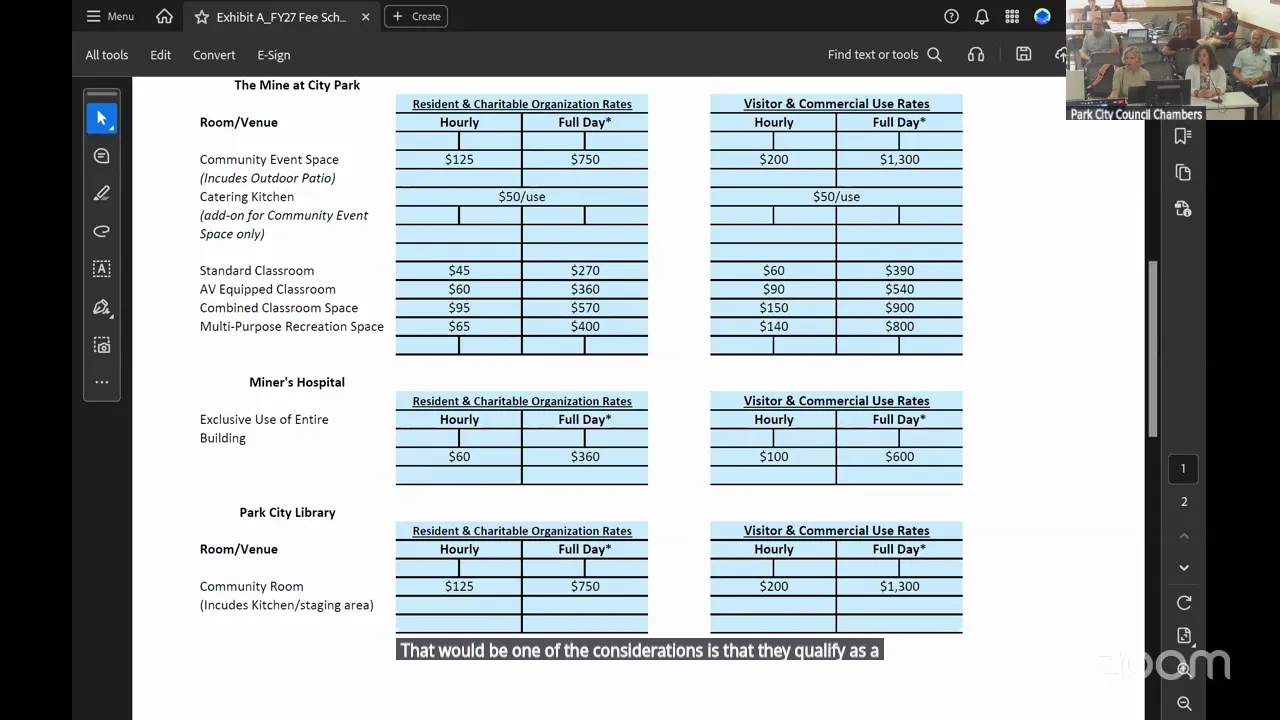
- Jessica Moran and Angela Dohanos proposed a unified fee structure for The MINE, Park City Library, and Miner’s Hospital, with resident/charitable and visitor/commercial rates. Example: The MINE Community Event Room: $125/hour (resident/charitable) or $200/hour (visitor/commercial). Full-day rates are less than eight hourly charges.
- Council positions:
- Council Member Toly recommended higher corporate rates, citing demand from destination groups, and asked for comparisons with local hotels and ski-town venues.
- Council Member Parigian supported the approach but wanted clarity on nonprofit vs. charitable classification (HOAs would not qualify).
- Council Member Miller endorsed the proposed focus on recreation and city-sponsored uses first.
- Outcome: Council generally supported the framework but asked staff to refine the commercial/corporate rate tier and return on October 1 for formal adoption.
Basketball Court Wall Work Session (5:00–5:15 PM)
- Jessica Moran presented three options: keep the wall, re-evaluate after project completion, or remove now (cost $112,996). The wall was designed as an acoustical barrier between the basketball court and playground.
- Council positions:
- Council Member Parigian strongly favored removal, stating the wall “cuts the park in half” and is “inappropriate for this setting.” He argued the cost is insignificant over 50 years.
- Council Members Ciraco, Miller, Toly, and Zegarra preferred to wait until The MINE is fully completed (December 2026) before making a final decision. They cited cost ($112,996), construction risk, and potential for a future mural.
- Outcome: Council directed staff to postpone a decision and re-evaluate after project completion.
Public Input (Regular Meeting, 5:30 PM)
- Katherine Fagin expressed concern that project renderings (e.g., the Bonanza 5-Acre development) may lead to misunderstandings, similar to the basketball court wall. She also noted that City Park is becoming overbuilt and suggested a small park at the Bonanza 5-Acre site.
- Two eComments were read: Jonathan Warden urged measurement of workers housed and stability, not just unit counts; Jan Jones-Schenk raised safety concerns about traffic at the Kearns & Bonanza intersection, arguing the planned development will increase congestion and threaten emergency access.
Consent Agenda (5:30 PM)
- Council unanimously approved:
- A professional services agreement with Raftelis, not to exceed $89,850, for a water rate study.
- A construction agreement with Envision Mechanical, not to exceed $259,353.36, for HVAC modifications at the 3Kings Water Treatment Plant.
Key Outcomes
- Housing: Staff will broaden the Housing Needs Assessment to include seasonal workforce, regional data, and a refined worker-to-unit ratio. Council will not revisit previously evaluated city-owned parcels but will proceed with current projects (Bonanza 5-Acre, Clark Ranch, Woodside Phase II).
- Golf Course: No design contract approved. Council requested a business case, cost options (including a $10 million plan), snowmaking feasibility, and a funding model discussion before further action.
- Rental Fees: Staff will refine the commercial rate category for The MINE and return October 1 for adoption of policies and amended FY27 Fee Schedule.
- Basketball Court Wall: Decision deferred until The MINE is complete; staff will then reassess with Council input.
- Minutes and Consents: Approved as presented.
Meeting Transcript
Okay, this is the September 17th, 2026 meeting of the Park City Council. We'll call the meeting to order and begin with a closed session. And I'm looking for a motion to enter into closed for property. So moved. Second, do a roll call vote. I do Tana Stan on yet. Yeah. We've got votes. Let's go ahead and go on closed. Where is she coming from? Are we back live? All right, good. All right. We'll continue on with the meeting. Start with our work session. Uh actually a study session. This is a housing study session. That's why we're in the back of the room. So you know, looking for directions more than decision in a study session. And so just um learn a lot from our staff members who are here to present to us today. So Sarah, are you leading off? So Sarah, women, housing manager joined by Ian Joyce, um, economic development analyst, and also Chris Eggleton, economic development and housing director. Um so with this study session, council had identified workforce housing or affordable housing as a priority at the May 2026 strategic planning retreat. And so this is further discussion than that, and also Molly's request that she had um with council direction. So we're proposing this as a series of work sessions just because it's very dense and heavy, and we also need more direction from council to proceed and make sure we're aligned. Um and so this first one is really setting the stage for what we've done in the past, what we're currently doing, and direction and discussion on what council would like to proceed with in the future. So starting with that, we're starting with what have we done. So our housing resolution, this starts back in 1991, where we adopted our first housing resolution and it established our inclusionary zoning request requirements or housing obligations. So just to note Park City is grandfathered in the state for housing obligations. Um so our current resolution 12-2025 was adopted June 12th, 2025. And so this is requiring master plan developments to satisfy housing obligations, which is equivalent to 20% of the project's total residential unit equivalents or RUEs as affordable workforce housing or housing for at least 20% of the employees generated by new commercial development. And there's a handful of different options for producing these on site or paying an in-loop fee or money in between, we'll say elsewhere. So going into that, the housing goal. Um, so in 2026, council um sorry, in 2016, council had set a tenure goal for 2026 that we'd provide 15% of park city's workforce to be living in the city limits. So that was 800 new units for a total of 1,305 by 2026. By the end of 2025, um, we had 731 units in operation, which was only 56% of the way towards that goal. So at the 2025 February council retreat, we had a housing discussion where council reaffirmed the goal of having 15% of the workforce living within city limits by 2032. So just extending that out. And we used um a production benchmark for a one-to-one worker to unit ratio, which Ian will go into more here on how we're estimating that full-time workforce by 2032. Sweet.
SUMMARIZED BY OPENPUBLICA AI
TRANSCRIPT VIA PUBLIC VIDEO
openpublica.com
openpublica.com