Transportation, Infrastructure, and Planning Subcommittee Meeting - June 20, 2024
STREAMING COPY IN PREPARATION — RECORDING AVAILABLE FROM THE ORIGINAL SOURCE
Transportation, Infrastructure, and Planning Subcommittee Meeting - June 20, 2024
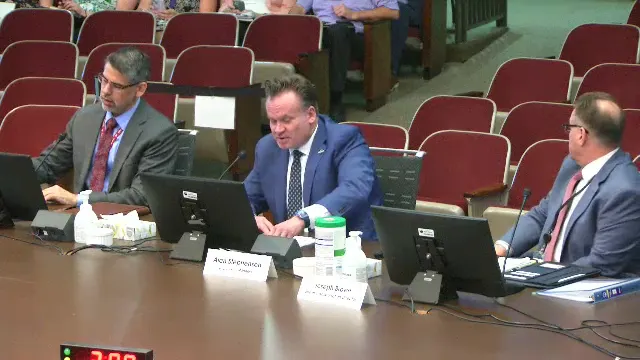
The Transportation, Infrastructure, and Planning (TIP) Subcommittee of the Phoenix City Council met on June 20, 2024, at 10:05 AM to discuss consent agenda items, a financial update on the solid waste utility, and a proposed fiber-to-home licensing framework. The subcommittee also heard public comments on illegal dumping at South Mountain Park and police consent decree negotiations.
Consent Calendar
- Items 2 and 4: Approved unanimously via a motion and second. No speakers or opposition.
- Item 3: Also approved unanimously. A member of the public, Eric Nielsen, commented before the vote, expressing support for preserving historic buildings via partial demolition and facade retention. His comments did not pertain to item 3 but were heard as public input.
Public Comments & Testimony
- Jessica Dobbs (first speaker) raised concerns about an unauthorized dumping of approximately 150 loads of unfiltered rock and debris at South Mountain Park in March 2020 by homebuilder Meritage. She stated that testing by the city’s Office of Environmental Programs was conducted after the dumping and on material not representative of what was deposited. She called the process “sloppy or criminal” and urged the subcommittee to investigate.
- Tim Sirikowski (second speaker) continued on the same issue, demanding records of who authorized the gate opening and communications between Meritage and the Parks Department. He warned that illegal dumping in a preserve could lead to EPA involvement and fines assessed per dump truck load over four years.
- Eric Nielsen (third speaker, different from earlier Eric Nielsen) addressed police department negotiations, recommending that Councilwoman O’Brien lead consent decree negotiations with the federal government. He advised the city to “take its chance with the justices” rather than show weakness.
Discussion Items
- Solid Waste Financial Update (Item 5): Presented by Director Felipe Mot. Moreno and Deputy Director Brandy Barrett. The utility serves over 420,000 residential customers, processes over a million tons of material annually, and faces rising costs. Key financial data:
- Current fiscal year revenues estimated at $204 million; expenses at $173.8 million (O&M).
- Six-year Capital Improvement Plan (CIP): $202.1 million, with $134.9 million currently unfunded.
- A structural imbalance begins in FY 2025-26, with projected deficits of $81 million, leading to a negative fund balance of $61.6 million and depletion of operating reserves.
- Cost drivers: 32% labor increase (class/comp adjustments), 49% increase in truck costs, 20% infrastructure inflation, 24% equipment maintenance increase, and a 132% ADEQ permit fee hike.
- Mitigations to date: deferred vehicle purchases (leading to fleet health decline from 66% to projected 31% by 2026), deferred capital projects, increased commercial gate rate ($44 to $55/ton), and renewable natural gas partnership yielding $2 million over five years.
- Next step: Work with finance and a rate advisory committee to present strategies to council next fiscal year.
- Councilwoman O’Brien and Councilwoman Hodge Washington asked clarifying questions about reserve policies and consequences of unfunded CIP projects (closure of landfill/transfer stations).
- Fiber-to-Home Network Infrastructure (Item 6): Presented by Deputy City Manager Alan Stevenson, Street Transportation Director Joe Brown, and Special Projects Administrator Kevin Sonoda. Proposed new city code chapter for fiber optic cable installation by “overbuilder” companies (e.g., Google Fiber, GigaPower). Key issues discussed:
- Microtrenching: Companies want to use a 2-inch-wide, 10-inch-deep saw cut every 200-300 feet across local streets. Staff expressed concerns about pavement integrity, water intrusion, and bicycle safety. The city’s standard restoration (slurry seal and 24-inch mill/inlay) is opposed by industry due to cost.
- Alternative methods: Horizontal directional drilling and aerial fiber are currently allowed and preferred by staff.
- License fee structure: Proposed 3% of gross revenues or $9 per residential unit passed (annual minimum) for retail providers; 6% for wholesale. Comparable to Cox’s current 5% of cable TV revenue, but other telecoms (Lumen) are exempt by state law.
- Joint trenching: Not feasible as companies do not wish to share conduits. In Mesa, multiple microtrenches require 3-foot separation.
- Council members expressed strong support for preserving street quality given the city’s $200 million accelerated pavement program. They requested staff work with industry over summer on joint trenching and new development coordination, and return with a final proposal in September.
Key Outcomes
- Consent agenda items 2, 3, and 4 were approved unanimously (3-0).
- No votes were taken on items 5 and 6; they were presented for information and discussion.
- Staff will continue stakeholder engagement on fiber-to-home (including meeting with all council members) and plan to present a revised ordinance to TIP in September, then to full council.
- Councilwoman O’Brien requested a future agenda item on infrastructure for state land areas for the September meeting.
Meeting Transcript
Good morning. Good morning. I'll have to call the subcommittee uh transportation infrastructure and plan and subcommittee to order. It is 1005. I will ask the city attorney um to ent to explain public comment. Thank you, Madam Chair. Members of the public may speak for up to two minutes to comment on agenda items to be discussed. Comments must be related to the agenda item and the action being considered by the subcommittee. The city council and staff cannot discuss or comment on matters related to pending investigations, claims, or litigation. Additionally, any member of the public who appears before the subcommittee in their capacity as a lobbyist must have required by Phoenix City Code disclose this fact before addressing the subcommittee. The city code requires speakers to present their comments in a respectful and courteous manner. Profane language threats or personal attacks on members of the public council members or staff are not allowed. A person who violates these rules will lose their opportunity to continue to speak. Thank you so much for that. I move to approve. Second. Thank you. All in favor? Aye. Aye. Aye. The vote the chair votes aye as well. Motion carries a vote of three. I give to approve. Oh, I'm sorry. Vice Mayor, couldn't hear you very well. Sorry, I didn't hear now. I can hear. Sorry about that. I second if it's if it was moved, you'd be approved. Thank you. Okay. All in favor? Aye. Aye. Motion. Motion carries unanimously. We have a few things on the agenda. Sorry, the consent agenda. I know we have a speaker on item number three. So if unless there's some questions for item number two and four, I would move I would entertain a motion on those. Move to approve items two and four. Second. Thank you. Second. All in favor. Aye. Aye. Thank you so much. Um motion carries.
openpublica.com