Transportation Infrastructure and Planning Subcommittee Meeting - November 20, 2024
STREAMING COPY IN PREPARATION — RECORDING AVAILABLE FROM THE ORIGINAL SOURCE
Transportation Infrastructure and Planning Subcommittee Meeting - November 20, 2024
The Transportation Infrastructure and Planning Subcommittee met on November 20, 2024, to discuss two major items: an update on the regional transit fare collection system and a proposed new city code chapter to license fiber optic network infrastructure providers. The meeting also included a consent agenda item, public comment, and a call to the public.
Consent Calendar
- Item 2 – Approval of Route 27 service change: Moved and seconded, passed unanimously with a voice vote.
Public Comments & Testimony
- John Hines (public comment on fare collection system): Expressed grave concerns about the new fare system, stating he does not own a cell phone or use the internet, and objected to required registration and data collection, citing privacy and data breach worries. He noted he is a senior citizen and prefers paper tickets.
- Jeremiah Davis (registered lobbyist for CWA Local 7050, on fiber license item): Disclosed his lobbying status and spoke about tracking Gigapower fiber deployment in Mesa, where over a dozen subcontractors were used. He asked the subcommittee to include contractor transparency, verification of licensure, and training requirements in the city code changes.
- Chad Eckenbach (CWA staff representative, registered lobbyist, on fiber license item): Cited public records showing 40 underground utility hits by Gigapower contractors in 18 months in Mesa, with over $135,000 in damages. He referenced an incident in Gilbert where a contractor drilling into a sewage line displaced a family. He urged adding contractor transparency and safety disclosure to the code.
- William Cody (CWA area vice president, on fiber license item): A 26-year broadband technician with CenturyLink/Lumen, he described the negative impacts of low-road subcontracting on work quality, safety, and wages. He called for codified contractor disclosure requirements.
- Edward Zinks (call to public): Asked about the study on automated traffic flow management along Glendale Avenue, inquiring about its availability and conclusions. Staff indicated they would connect with him.
- Jerry Van Gess (call to public): Reported massive illegal dumping of construction earthen materials in South Mountain Park discovered four years ago, stating a 78-page criminal complaint was filed with the Arizona Attorney General's Office. He offered tours of the dump sites and said no city officials had taken the offer.
- Harry Whitesell (call to public): Raised concerns about fiber optic installation in his HOA with private streets, noting unmarked CenturyLink trucks digging trenches and holes on private property without HOA board permission. He asked how citizens can track fiber installation locations and permits.
Discussion Items
-
Item 5 – Regional Transit Fare Collection System Improvement Project Update:
- Presentation: Valley Metro staff (Public Transit Director Jesus Sapien, Fair Programs Manager Dane Riles, CFO Kevin Kessler) provided an overview. The new system (SmartFare/fare capping) began rolling out in phases. Fare pricing remains unchanged. Customers can use a Copper Card or Valley Metro app; fares are capped at $4 daily, $20 weekly, and $64 monthly for full-fare local service. Cash options remain available on buses and at light rail stations. Over 850 retail locations sell and reload Copper Cards. Reduced fare qualifications unchanged; online application added. Outreach included over 50 community events and 19 pop-up events. Old magstripe passes can be credited through end of 2024; extended timeline for program organizations.
- Council Questions & Concerns: Councilwoman Laura Pastor raised issues about seniors and people with disabilities who lack IDs, smartphones, or internet access. She noted that reduced fare online applications cannot accept medical disability documentation. She expressed concern about reliance on Copper Card registration and app, citing burdens on older adults and people experiencing homelessness. Valley Metro staff clarified that in-person options exist and accounts are not required for reduced fare. Councilman mentioned potential partnerships with nonprofits and senior centers for assistance.
- Councilmember Hodge Washington asked about cash options and reduced fare with cash, which staff confirmed is available with ID. Also asked about system failures (server/connection issues); staff explained buses have offline mode with an accept list.
- Public comment from John Hines was heard.
-
Item 6 – Establish Network Infrastructure License (New Chapter 5D of Phoenix City Code):
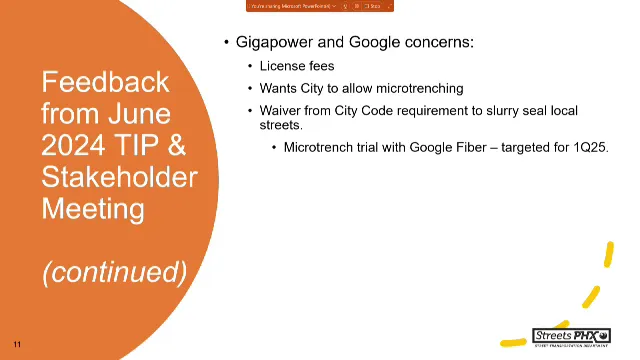
- Presentation: Deputy City Manager Alan Stevenson, City Engineer Eric Froberg, and Special Projects Administrator Kevin Sonoda presented. The ordinance would allow fiber-to-the-home providers (e.g., Gigapower, Google Fiber, Desert INET, Zoom, BAM) to install fiber optic networks in city rights-of-way. Key proposed fees: 3% of gross revenues for internet service providers (ISPs), 6% for wholesalers, plus permitting/inspection fees. A $6 per home passed annual minimum fee (AMF) was set after stakeholder negotiations (down from $12). Micro-trenching (shallow cuts) was not recommended by Streets Department due to pavement damage concerns; a pilot program was offered but details pending. The city's pavement restoration policy (slurry seal for cuts) would apply to fiber companies, consistent with other utilities. Staff noted 99% of Phoenix already has high-speed broadband access per FCC maps.
- Council Questions & Concerns: Councilwoman Laura Pastor expressed concern about moving items to full council without full subcommittee resolution; she wanted clear language on any changes. Councilman sought clarity on contractor certification and training assurances. Vice Mayor requested that if discussions with CWA and law department are not complete by December 18, the item be continued. Staff agreed to present a memo outlining changes and legal constraints, and suggested the motion could include direction to continue work with CWA.
- Public comment from three CWA representatives was heard.
- The subcommittee voted to move the item to the December 18 full council meeting with the caveat that staff continue discussions with CWA and the law department, and that any agreed-upon changes be incorporated into the ordinance or license agreement. The motion passed unanimously.
Key Outcomes
- Consent agenda approved unanimously.
- Fare collection system update: No vote required; subcommittee received the update and discussed concerns. Staff will follow up on data security information for riders and consider extending the deadline for program organizations' ticket credit processing.
- Fiber license ordinance (Chapter 5D): Moved to December 18 full council formal agenda (with a 30-day effective period). The motion included direction that staff continue working with CWA and the law department, and bring forward additional language changes as appropriate. If unresolved, a continuance memo may be issued. The subcommittee expects contractor transparency, training, and licensure verification to be addressed in the final proposal.
Meeting Transcript
Good morning and welcome to the November 20th Transportation Infrastructure and Planning Subcommittee. I call the meeting to order. And Alyssa, could you explain public comment? Thank you. Good morning. Members of the public may speak for up to two minutes to comment on agenda items to be discussed. Comments must be related to the agenda item and the action being considered by the subcommittee. General comments that go beyond the scope of the agenda item must be made in the call to the public session at the end of the agenda. The city council and staff cannot discuss or comment on matters related to pending investigations, claims, or litigation. Additionally, any member of the public who appears before the subcommittee in their capacity as a lobbyist must, as required by Phoenix City Code, disclose this fact before addressing the subcommittee. The city code requires speakers to present their comments in a respectful and courteous manner. Profane language, threats, or personal attacks on members of the public, council members, or staff are not allowed. A person who violates these rules will lose their opportunity to continue to speak. Thank you. And we do have an interpreter, Daniel Feliciano. I know he's invisible, but that's because he's downstairs. Daniel. Thank you, Chairman. Uh, my name is Stanny Feliciano, and I'll be serving as Spanish interpreter for today's subcommittee meeting. And I'll take a moment to introduce myself to the Spanish speaking audience. Thank you. Second. Thank you. All in favor, please say aye. Aye. Aye. It passes unanimously. Next, we have our consent agenda. Item two approval of Route 27 service change. Can we get a motion? I so move. Second. Thank you. All in favor, please say aye. Aye. Aye. Next, we have two information items. Number three, number four. Is there any uh requests to get additional information? Hearing no, okay. Hearing none, we'll move on to item five. Regional transit fare collection system improvement project update. Yes, madam chair. Happy to introduce uh public transit director Jesus Sapien, and uh he will introduce our partners from Valley Metro to discuss an update on the regional transit fare collection system. Good morning, madam chair, uh members of the subcommittee. Thank you for having us today. Um, just a little background background and uh reminder information. In January 2019, following approval by the Phoenix City Council and uh Valley Metro Board, the public transit department in a parallel effort with Valley Metro issued request for proposal to solicit a new regional fare collection system. The project is focused on providing passengers with a multitude of options, including cash and mobile-based options, a trip planning function that incorporates real-time vehicle data, and establishing a more efficient and expandable system for the region. As outlined in the REST staff report at that time, the project objectives were determined primarily from the needs and shortcomings of the current system, regional transit staff workshops, and most of all, public input over the years.
openpublica.com