Phoenix City Council Policy Meeting – February 25, 2025
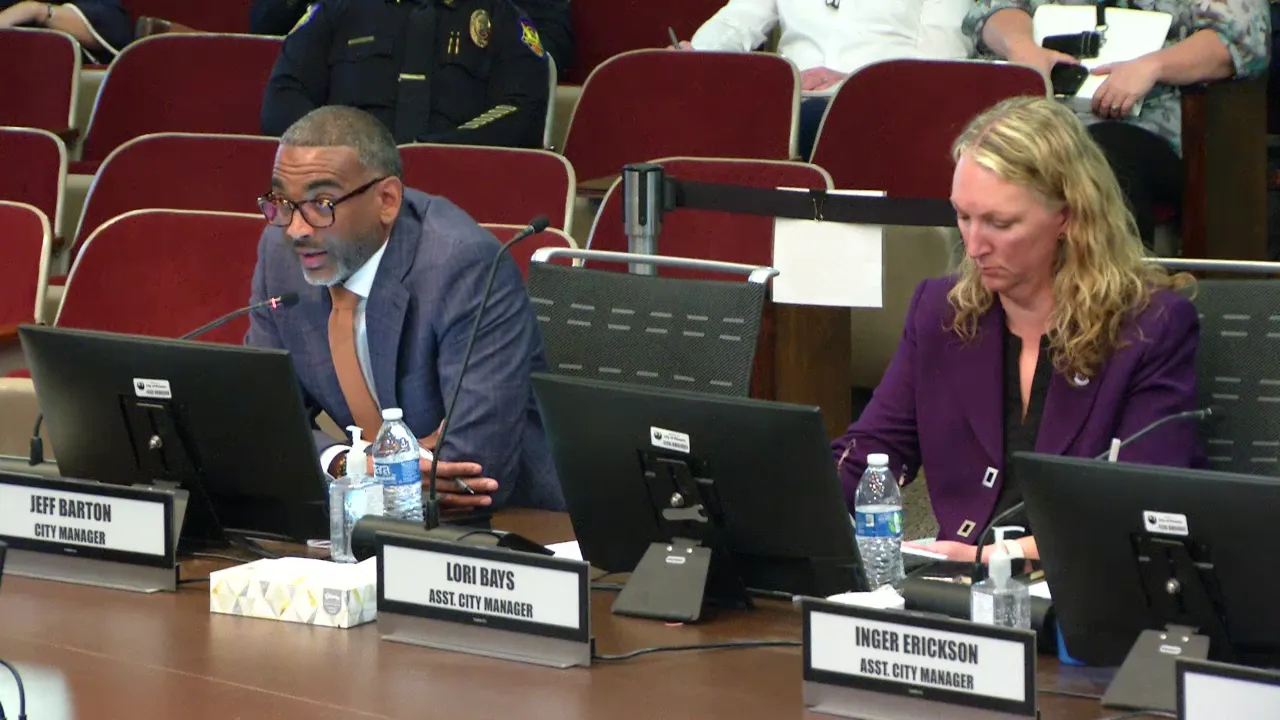
STREAMING COPY IN PREPARATION — RECORDING AVAILABLE FROM THE ORIGINAL SOURCE
Phoenix City Council Policy Meeting – February 25, 2025
The Phoenix City Council held a policy meeting on February 25, 2025, beginning at 9:30 AM. The meeting opened with the Pledge of Allegiance led by Cub Scouts, followed by councilmember reports on community events. The main agenda items were the presentation of the General Fund Forecast and Multi-Year Budget, and a briefing on Wildland Urban Interface Fire Preparedness. Public comment and extensive council discussion focused on the city's projected budget deficits, the need for a potential Transaction Privilege Tax (TPT) increase, and the city's readiness for wildfires.
Public Comments & Testimony
- Madi Yepes (Unite Here Local 11) spoke in favor of the proposed tax increase, citing the importance of city-funded programs like Parks and Rec soccer for her son.
- Jason (president of local union representing blue-collar city employees) expressed strong support for a TPT increase to prevent service cuts, layoffs, and wage stagnation.
- Andrea Ramirez (teacher, mom, neighborhood association member) urged the council to maintain the Phoenix PAC after-school program and expressed support for the tax increase.
- Tim Jenkins (Camelback Community Neighborhood Association) voiced concern about cuts to community programs like the Gated Alley, Speed Hump, and Shade Tree programs, urging their preservation.
- Teresa (resident) thanked the budget team and asked the legislature to consider people's needs rather than cutting taxes.
- Elizabeth Aguilar (30-year resident, police assistant) supported the tax increase and emphasized the importance of community programs, stating she would vote yes.
- Rebecca Jenkins (Camelback Community Neighborhood Association) shared concerns about budget cuts affecting safety initiatives like the Gated Alley and Speed Hump programs.
Discussion Items
-
General Fund Forecast and Multi-Year Budget (February 25, 2025):
- Budget and Research Director Amber presented a multi-year forecast showing a $36 million deficit for FY 2025-26, growing to $83 million in FY 2026-27 and $60 million in FY 2027-28 under the baseline scenario. The deficits are driven by state actions: the elimination of the residential rental tax and the flat tax, which together will cost the city $47.4 million in general fund revenue in FY 2025-26 and $90.7 million across all funds, with a cumulative loss of over $320 million by FY 2028.
- The city's general fund TPT rate has not been increased since 1986 (1.2% of the current 2.3% rate allocated to the general fund). The administration proposed increasing the TPT rate from 2.3% to 2.8% (a 0.5% increase) effective July 1, 2025, to offset the revenue losses and fund priorities. The proposed increase would generate sufficient revenue to cover the deficit and provide $25 million for fire department response time improvements, $5 million for homeless services (with $26 million ongoing need in FY 2026-27), and support for fire station staffing and equipment.
- The city manager also committed to $24 million in budget reductions, primarily from vacant positions (18.2) and non-personnel spending, to be detailed in the March 18 trial budget.
- Councilmembers expressed support for the TPT increase, noting that the budget shortfall is not of the city's making but due to state legislative actions. Councilman Robinson asked if the proposed increase was sufficient, citing a recent fire tragedy in District 6. The city manager stated that the fire department would receive $43 million in ongoing funding, including two new fire stations funded by excise tax bonds, and that response times could be cut nearly in half (EMS from 8:36 to 4:31 minutes, ambulance from 10:44 to 4:51 minutes).
- Councilwoman Hodge Washington highlighted that the city's per capita sales tax revenue is lower than in 1980-81, and the city's employee-to-population ratio is a third lower, indicating efficient service delivery.
- Councilwoman Pastor asked about the impact of potential additional state legislation (e.g., further income tax cuts) and the need to communicate these risks to the public. The budget director noted that such bills could add $176 million in additional losses.
-
Wildland Urban Interface Fire Preparedness:
- Executive Assistant Chief Tim Crace, Water Services Director Hayes, and Emergency Management Director Lee presented the city's wildland fire preparedness. The city manages 41,000 acres of desert parks and mountain preserves (10% of Rhode Island's land mass). The fire department has a community risk reduction program since 2019, including pre-identified wildland-urban interface (WUI) zones, a WUI deployment program that sends five engines and multiple brush trucks on initial brush fire calls, and partnerships with state/federal agencies and the police department's air unit for Bambi bucket operations.
- Water Services Director Hayes explained that the city's water system has 57 storage reservoirs providing 480 million gallons of storage, and the treatment plants can produce up to 610 million gallons per day (50% more than peak summer demand). Over 99% of the city's 57,000 fire hydrants are operational, and the department coordinates with fire on water supply during emergencies.
- Emergency Management Director Lee outlined the city's all-hazards response plan, including activation of the Emergency Operations Center, unified messaging, traffic management, and coordination with county and state agencies for evacuations and shelter.
- Councilmembers asked about communication redundancy (addressed by Lee), partnerships with utilities (APS, SRP), and hydrant maintenance. Councilwoman Pastor referenced a past fire on South Mountain where she first alerted the fire department, and noted that the city's water management is a key difference from the Los Angeles fires.
Key Outcomes
- No formal votes were taken at this policy meeting. The council is scheduled to consider the proposed TPT increase (to 2.8%) at the March 18, 2025 meeting, along with the city manager's trial budget.
- The council expressed broad support for the TPT increase, with Councilman Galindo Elvira calling for a unanimous vote. Councilwoman Stark and others noted their support based on the need to maintain public safety and avoid cuts reminiscent of the Great Recession.
- The administration will present the detailed list of $24 million in budget reductions and the supplemental requests for fire and homelessness at the March 18 meeting.
- The Wildland Urban Interface Fire Preparedness presentation was informational; no action items were identified, but councilmembers thanked staff for their ongoing work and coordination.
Meeting Transcript
Associated with growth, but especially in the early 60s, we just reached a point where we're almost about 500,000 people. So it was really growing like crazy. Um the downtown had shifted, shopping and moved from downtown. Places like Biltmore, where the Cine Capri was, were really booming the whole Arcadia area. All of that was really growing at a very rapid pace. Um movie theaters in town with a just on the leading edge of what were called multiplexes, where they're very common now, where you go and there's 10 or 12 theaters in one shopping mall or something, and you have all kinds of choices. Well, that was just beginning. Uh, the majority of the theaters were still the single screen, like the Fox Theater, uh, the Orpheum, the Palms Theater. They were single screen theaters. Paramount, Arizona hired a guy named Ralph Haver to design the uh Cine Capri Theater. They really wanted a one-of-a-kind, massive, um very ornate, luxurious theater uh that rivaled theaters anywhere in the country, and that's what they wanted. They hired Ralph Haver, who at that time was a very prominent architect in Phoenix. He was primarily known for designing homes and residences and different kinds of retail buildings. He wasn't really known for designing and uh drawing uh theater, and so they hired him and building it starting in about 1964, and uh the building itself, when it was finished, 16,000 square feet, 17,000 square foot theater, had a big arc, uh curved entryway, a portico. As you came into the lobby, there was Italian tile everywhere, there was a 24-foot-high stained glass window that it the stained glass that had been imported from New York. One of the things that the when you talk about people who went to the Cine Capri on a regular basis in those years, they remembered this the curtain, and the curtain was just a massive piece of material, and it was gold, and it swept back and opened up and and just to display and present the movie theater, but there was four thousand inches of gold metallic material that were purchased to create this massive gorgeous curtain. So on uh March 31st of 1966, the theater opened, and the following day, Charlton Heston, who was a star of the first film there, The Agony and the Ecsty, he came in person and did a little workshop for high school kids in the theater and introduced the first movie at the Cine Capri, and he was it was a big hit. And the thing about the Cine Capri, which rivaled a lot of the other theaters, and I can remember as a kid, would you decide which movie you're gonna going go to, and then you would go see which theater uh was showing it. Well, with the Cine Capri, the Cine Capri just going there was an event in itself. People went to the Cine Capri just to experience the luxury of it and the beauty of it. It was a destination in itself. Um people go there for celebrations or first dates or some special kind of event. Um, the Cine Capri primarily in the early years, anyway, ran uh just big movies, movies like Agon Agony and the afternoon, and welcome to the February 25th policy meeting of the Phoenix City Council. Good afternoon and welcome to the February twenty-fifth policy meeting of the Phoenix City Council. I will now call the meeting to order. We're beginning with a very special treat today, one that we don't always have. We have Cub Scout Pac Six from Den two here with us to do the Pledge of Allegiance. These scouts joining us today have just completed their arrow of light rank in Cub Scouts, the highest and most involved level. Each of them has learned and modeled the values of the Scout Law and Oath over the years, which shapes them into our future leaders. They are challenged to be and feel free to help me with this part. Trustworthy, loyal, full, friendly, courteous, kind, obedient, cheerful, thrifty, brave, clean, and reverend. Wow. Good job. That was a very impressive and equally impressive. Councilman Robinson knew the words. And that they act on that oath every single day. And now I would invite them to come forward to help us start the formal meeting. After they help us with the Pledge of Allegiance, they're gonna come back behind and say hello to the city council. All right. All right, Connor, the floor is yours. Please rise for the Pledge of Allegiance. Please join me in the Pledge of Allegiance. I pledge allegiance to the flag of the United States of America into the Republic for Rich, one nation, under God, indivisible with liberty and justice for all. Wonderful job. Thank you. Great job. Thank you. Thank you. Thank you for being here. Thank you for being here.
openpublica.com