OPENPUBLICA · PUBLIC MEETING RECORD
Record of Proceedings
Pittsburgh City Council Public Hearing on Bill 714 (Oakland UC-E Zoning Amendment) - November 4, 2026
City Council — Wednesday, November 4, 2026
BodyPittsburgh, Pennsylvania
SessionCity Council
DateWednesday, November 4, 2026
StatusNEW · FILED
Video Record
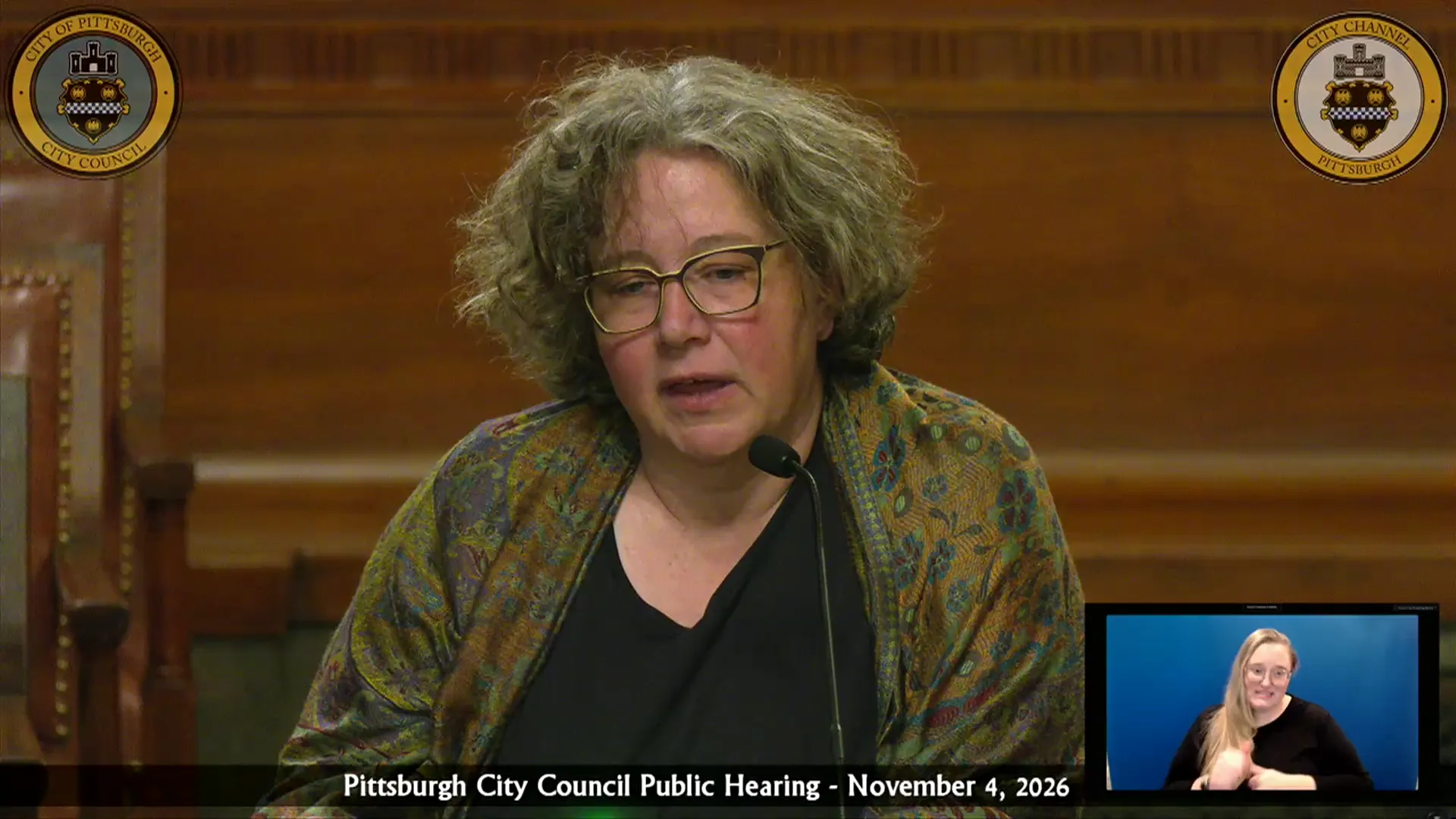
STREAMING COPY IN PREPARATION — RECORDING AVAILABLE FROM THE ORIGINAL SOURCE
Transcript — Verbatim
Speaker numbers apply only to this recording.
Discussion Breakdown — Share of Meeting
Zoning Code64%
City Planning36%
Summary of Proceedings
Pittsburgh City Council Public Hearing on Bill 714 (Oakland UC-E Zoning Amendment)
On Wednesday, November 4, 2026, at 12:00 PM, Pittsburgh City Council held a public hearing in Council Chambers regarding Bill 2026-0714, which proposes to amend the UC-E (Urban Center Employment) District zoning to allow increased residential development on parcels within 100 feet of an EMI (Educational Medical Institutional) district. The hearing included a presentation from the Department of City Planning and opposition from one speaker.
Presentation by Department of City Planning
- Kate Ruckus presented the timeline: the bill was introduced by Council Member Lavelle on July 7, 2026; amended by substitute and sent to the Planning Commission on July 22; the Planning Commission held a public hearing on September 22 and made a positive recommendation to Council.
- The current UC-E district (only located in Oakland) permits residential development only if it is 100% affordable or if the residential portion is less than 50% of gross floor area.
- The proposed amendment would allow 50–100% of gross floor area to be multi-suite residential on parcels wholly or partially within 100 feet of an EMI district, provided the rooms are rented monthly or longer.
- Ruckus stated the amendment complies with the Oakland Neighborhood Plan, citing vision, land use, goals (D1B, D4A, D4C), and policies supporting housing diversity and transit-oriented/student housing.
Opposition from a Speaker
- One speaker (likely a council member or stakeholder) expressed strong opposition, arguing that the amendment contradicts the Oakland Plan's intent to preserve the Forbes-Fifth Corridor for commercial and employment uses.
- The speaker noted that the exclusion of housing was deliberate to prevent commercial displacement; market forces (e.g., post-COVID) have stalled commercial projects like the Wexford Technology Center, but the speaker argued amending the base zone is the wrong approach—comparing it to using a screwdriver as a hammer, rendering it unusable for its original purpose elsewhere.
- The speaker asserted that the amendment would remove a tool from city planning for other future needs.
Key Outcomes
- No public comments were made from chambers attendees after the opposition speaker.
- No further discussion or vote was held by Council members.
- The public hearing was closed, and the bill was referred to the Committee on Land Use and Economic Development for further consideration (as noted in the meeting minutes).
Meeting Transcript
Good afternoon, and welcome to Pittsburgh City Council's Cablecast Public Hearing for Wednesday, November 4th, 2026, relative to Bill O seven one four. Would a clerk please read the title of the bill? Bill 714, ordinance amending the supplement and supplementing the Pittsburgh Code of Ordinances, Title IX, Zoning Code, Article Five, Use Regulations, Chapter 911, Primary Uses, Section 911.04 Use Standards, Subsection A point Four One B six, Multi-Suite Residential in the UCE District is hereby amended to add a new subsection A point four one B six C. First order business will be a brief presentation by Kate Ruckus from the Department of City Planning. And then just want to note for the record, we do have Councilman Charlotte on line with us. Thank you. I'm gonna go ahead to our agenda. So we're just gonna walk through the timeline of the legislation. How this relates to the adopted Oakland neighborhood plan, and then the uh actually should say planning commission recommendation and next steps. Uh so this was introduced uh by Councilman Laval uh back in council in July 7th of this past summer. Um then on July 22nd, it was amended by substitute and sent to the planning commission for report and recommendation. Planning commission held a public hearing on September 22nd of this year and made a positive recommendation to council, and so then we are here today for the public hearing. All right. Uh so the Urban Center Employment District, also known as the UCE, uh is a relatively new base zoning district, uh, but right now it is currently located only in Oakland. Uh so currently in the UCE, residential development is only permitted if it's a hundred percent affordable residential project, or if the residential portion of the project is less than fifty percent of the gross floor area. So this legislation would make an amendment to that to say that uh in uh areas where that are on development parcels that are wholly or partially within a hundred feet of an EMI zoning district. Uh 50 to 100% of the gross floor area may be multi-suite residential, provided the rooms are rented on a monthly basis or longer. Uh and for context, the EMI is the educational medical institutional district. So this is the district that houses uh our generally our universities and our hospitals in Oakland. And then just taking a look at the map. Uh so the lighter green is the current UCE district. Uh, and then the parcels nearby that are within that 100 feet buffer are the darker green. Uh and then those parcels are specifically highlighted uh with the sort of teal blue there. Uh and then just some background on the Oakland plan. Uh so the intent of the land use strategy in the UCE, which was the innovation district, was to limit residential uh to preserve spaces for employment uses. This was to support life sciences, health care, and other sectors that provide jobs to a greater variety of workers and educational levels that also benefit from locating in Oakland. Uh, but it did so, and then under the mixed uses, it says prohibit or limit residential to affordable housing or a minority of gross floor area, other uses allowed. And then if we take a look at the compliance with the Oakland plan, which was put together uh by our uh Oakland neighborhood plan, they did determine that this proposed amendment does comply with the Oakland plan based on the analysis of the following items. The vision statement, the land use, the uh goal D1B for land use, it addresses uh community needs, uh goal D4A, jobs and housing for all, goal D4C, housing diversity, policy D1 manage diversity, uh, and policy D for frontline and low-income work care housing, transit-oriented housing and student housing. Uh so uh we made we did our required notice as per the zoning code 21 days advance of this hearing. Uh and then it just as a reminder at the planning commission hearing, they voted to make a positive recommendation to City Council, and as such, it'll just need a simple majority of council members to vote for it. And I believe that is the end of my presentation. Yes. Very much. Uh that uh created the UCE, well, created the land use plan, and then created the UCE as part of it. Um I do not agree with what it is that city planning has been directed to produce here, which is a justification for uh this uh piece of legislation as being compliant or congruent with the aims of the Oakland plan. Uh because the the choice here is to be able to say yes, because this would permit more housing to be built close to campus, which is, it's true, a big stated goal uh of the plan, uh it is omitting the fact that the plan also wanted to make sure that there would be space in Oakland in the business district in the innovation district uh where commercial development uh could take place. And the reason why uh housing was excluded from the Forbes Fifth Corridor uh for this purpose uh is precisely because if there were no such restriction, if there were no such exclusion, uh it that housing would be the only thing that would get built in the Forbes Fifth Corridor. And acknowledging that fact is the reason why city planning had created in consultation with the business improvement district uh with Innovate PGH uh with the University of Pittsburgh with UPMC had created this vision for the UCE, which would prioritize this kind of commercial development. This zoning has been in place in Oakland for four years.
SUMMARIZED BY OPENPUBLICA AI
TRANSCRIPT VIA PUBLIC VIDEO
openpublica.com
openpublica.com