OPENPUBLICA · PUBLIC MEETING RECORD
Record of Proceedings
Powell Operations Committee Discusses Sign Inventory and E-Bike Policy on October 20, 2026
City Council & Boards — Tuesday, October 20, 2026
BodyPowell, Ohio
SessionCity Council & Boards
DateTuesday, October 20, 2026
StatusNEW · FILED
Video Record
STREAMING COPY IN PREPARATION — RECORDING AVAILABLE FROM THE ORIGINAL SOURCE
Transcript — Verbatim
Speaker numbers apply only to this recording.
Discussion Breakdown — Share of Meeting
Transportation Safety30%
Signage Management25%
Public Safety16%
Active Transportation13%
Procedural10%
Public Engagement4%
Facilities Management2%
Summary of Proceedings
Powell Operations Committee Discusses Sign Inventory and E-Bike Policy on October 20, 2026
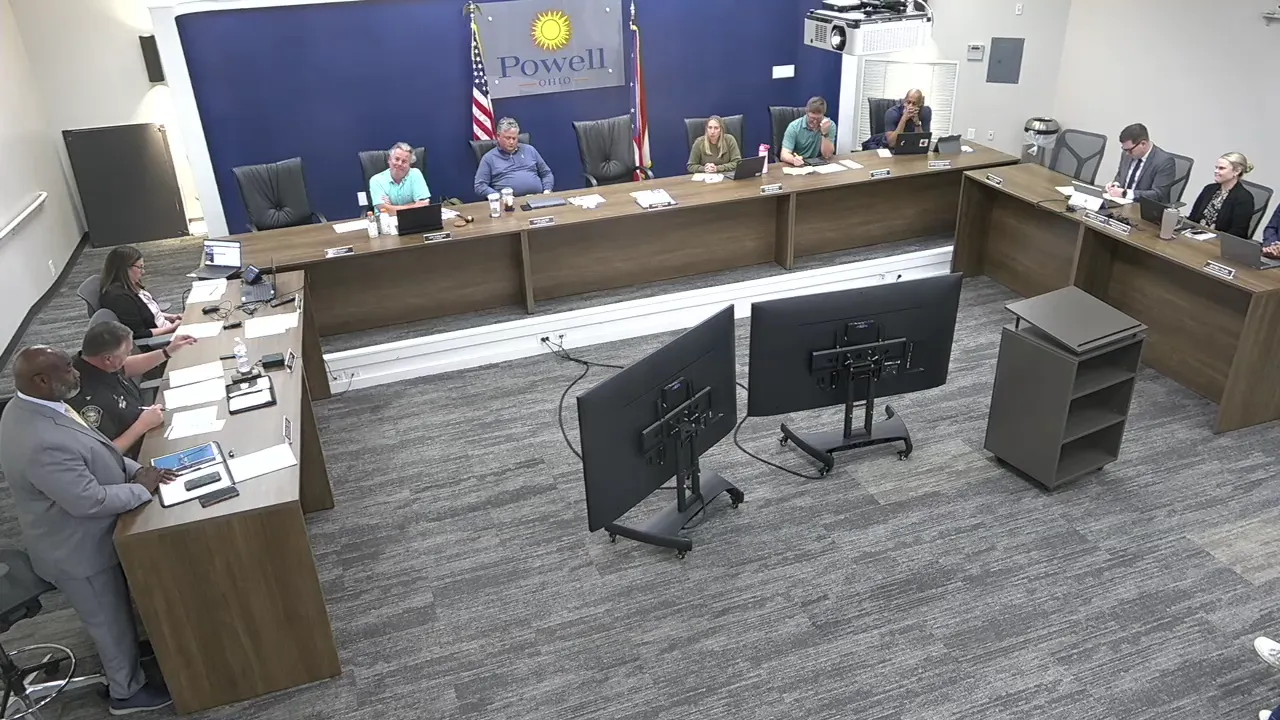
The Powell Operations Committee met on Tuesday, October 20, 2026, at 6:30 PM in Council Chambers, 47 Hall Street, Powell, OH. Chair Carlson presided; members Crawford, Harvey, and Lester were present. The committee approved the September minutes, heard a consultant-led citywide sign inventory update, and held a working-session discussion on e-bikes and micromobility without adopting final legislation.
Consent Calendar
- The committee approved the minutes from the September 15, 2026 Operations Committee meeting by consensus, with no amendments.
Public Comments & Testimony
- No formal public comments were heard. The chair cited time constraints, asked residents to send comments to Andy or the Chief, and noted that a future council review would create another public comment opportunity.
Discussion Items
Private to Public Sign Inventory
- City staff member Charles and Doug Bender of EP Ferris presented a citywide sign inventory. The project began after subdivisions such as The Chase and Greenshire asked the city to consider taking over their signs.
- Using a Gamma 922 retroreflectometer on loan through ODOT LTAP, EP Ferris measured sign backing and legend reflectivity, took photos, and built a GIS database with geolocation and condition ratings. Signs mounted on signal supports were not evaluated.
- Of 3,133 ground-mounted signs inventoried, 1,835 were compliant, 286 were non-compliant, and 859 street-name signs were not classified for compliance because many were wood, decorative, or otherwise nonstandard and did not produce reflectivity readings. Among non-compliant signs, 96 needed replacement and 23 were listed for repair; many signs and just over 2,000 supports were otherwise in good condition or only needed monitoring.
- EP Ferris recommended a systematic replacement plan, prioritizing regulatory signs, then warning signs, then guide signs, rather than replacing every non-compliant sign immediately.
- Committee members raised questions about replacement costs versus creating an in-house sign shop, storage capacity for different sign types, HOA cost-sharing, and preserving vintage or decorative signs. Staff said those policy questions are still unresolved and a new sign policy will come back in 2027.
E-Bikes/Micromobility Discussion
- Police department staff presented a working session on e-bikes, powered scooters, electric skateboards, hoverboards, and similar devices, asking for direction on device definitions, permitted locations, equipment and conduct rules, parental responsibility, and enforcement.
- A community survey conducted in August 2026 received 306 responses, 233 from verified residents. The chief reported that 97.4% expressed moderate concern and a little over 78% expressed significant concern; leading concerns were unsafe operation, pedestrian safety, and lack of safety equipment. Half of respondents favored restrictions, 24.1% favored another form of action, and education and signage alone drew smaller shares. The chief cautioned that the survey was voluntary and not a statistically valid poll.
- The chief showed a dashcam video of a late-September crash near Rutherford Road and Trail Lake Drive involving a 13-year-old rider. The device was a 1,200-watt electric motorcycle, above Ohio's 750-watt class 3 e-bike limit; the rider was cited for failing to yield. The chief noted that bicycle riders are not pedestrians and do not have the same crosswalk privileges, illustrating gaps between how devices are marketed, their legal classification, and riders' understanding of traffic rules.
- Staff reviewed approaches from New Albany, Columbus, Dublin, Delaware, and Upper Arlington, including class-based rules, street speed thresholds, sidewalk restrictions, shared-use path speed caps, helmet ages, parental responsibility, registration and safety classes, and impoundment tools. Staff recommended a Powell-specific framework combining state e-bike classes with a local micromobility definition, location-based access rules, pedestrian-priority conduct standards, safety and helmet requirements, parental responsibility, and graduated enforcement.
- Committee members expressed support for a comprehensive ordinance covering all micromobility devices rather than e-bikes alone, and agreed that helmets should be required for riders under 18. They did not finalize sidewalk, shared-use path speed, enforcement, or parental-responsibility details, and asked staff to prepare draft language.
Key Outcomes
- Minutes approved by consensus.
- The sign inventory data will be used to build a prioritized work plan and cost estimate; a new sign policy is expected to return to the committee in 2027.
- No e-bike/micromobility ordinance was adopted. Staff will prepare a comprehensive draft ordinance and implementation estimate for a future Operations Committee meeting, likely on the November agenda, with additional public input to be sought.
- The committee noted November may be the final Operations Committee meeting of the year, possibly with no December meeting, and that November's agenda may include sign-related provisions and the draft micromobility ordinance.
Meeting Transcript
Good evening. I'd like to bring the uh Tuesday, October 20th, 2026 meeting of the operations committee to order. Uh Elaine, could you please call the poll? Leave Carlson. Present. Carlos Crawford. Present Matthew Harvey. Present David Lester. Great. First item on our agenda is the approval of last month's minutes. They were included in your packet. Are there any suggestions or addendums for those? Seeing none, can we approve those by consensus? Aye. Second item on today's business is uh private to public sign inventory. Recognize uh Charles has led us. We were just talking about he reminded me that he's been at it for just about a year when we initiated the conversation. So it's uh programming we're here tonight to finish it off. Um we'll take questions after he finishes the presentation. If you have any questions along the way, please feel free to interject. Thanks, Andy. Cheer committee. Yeah, so yeah, just looking back, it's been a whole year. Tomorrow will be a year since we presented the uh private to public uh policy that we brought to operations. So here we are now. Um so last year that was that. Um the chase contacted us to kind of reach out to kind of see what it would look like for us to take over their signs. Um prior to that, Grand Shire. We're working in Greenshire to get them implemented into this process. Um there's different types of signs that were discussed from previous um committee. Uh the concerns was storage capacity, um, looking at we wanted to represent it the standard two by two breakaway. Um merged up the chase. Um I think the committee, some of the committee wanted us to give different options out there for the committee to look at. So, in doing that, uh, we looked at we weren't able to get that data. We reached out to an outside consultant, EP Fares, who's in the audience today, um, to capture all that information, and it was very valuable information that they were able to obtain. So, tonight we just want to kind of give a high-level overview that's going to help us uh in 27 to kind of come back to the committee to have a new policy that we'll present to the committee. So, I want to introduce uh Doug Bender from EP Fairs. Thanks, Charles. And so again, Doug Bender with EP Ferris, uh professional engineer and professional traffic operations engineer. So Charles reached out, and uh he and his team were looking for the help that we have since provided by going out and doing a full sign inventory for the citywide um database. Uh Logan, I believe it is, is your GIS database uh person, and so he was able to share with us, and then we also just physically drove and walked all the streets to basically make sure we captured all the signs. The um and again, let me let me page through. I got a couple things here. Um real quick, uh, we were looking to measure retro reflectivity. Charles and I have talked, there's one way to do it, which is just to drive around at night and flash your brakes and make sure it's bouncing back, uh, which gives you one piece of information that yep, looks like that's good.
SUMMARIZED BY OPENPUBLICA AI
TRANSCRIPT VIA PUBLIC VIDEO
openpublica.com
openpublica.com