Prince George's County Education and Workforce Development Committee Budget Work Session - April 27, 2026
STREAMING COPY IN PREPARATION — RECORDING AVAILABLE FROM THE ORIGINAL SOURCE
Education and Workforce Development Committee Budget Work Session
On Monday, April 27, 2026, at 2:30 PM, the Prince George's County Council Education and Workforce Development Committee, chaired by Councilmember Shayla Adams-Stafford, held two budget work sessions: one for the Board of Education (BOE) operating budget and one for Employ Prince George's, Inc. (EPG). Both sessions focused on fiscal challenges, funding requests, and strategic priorities.
Board of Education (BOE) Operating Budget
-
Committee staff (Caleb Callender) presented highlights: the county contribution is projected at $968,737,900, but excluding $42 million for alternative construction financing and $18.7 million for teacher retirement, bringing the total to $1,029,438,000. Federal funding declined by over $24 million due to termination of grants (Title I, Medicaid, discretionary funds). Overall expenditures increase due to negotiated salary adjustments; operating expenses decrease, with increased spending on special education. PGCPS is recruiting for special education positions via targeted hiring, advanced contracts, and early hiring. The budget would not eliminate emergent programs but would only save a small portion. Transportation funding decreased due to a switch from two routing systems to one, improving efficiency, reducing overtime, and cutting about 2,000 bus stops. Staffing lost 188 FTEs (170 teachers, 76 paraprofessionals). Enrollment is anticipated to decrease by 1,109 students, while preschool population increases by 240 to 4,863. Cost per pupil is projected at $22,841 for K-12 and $22,352 including pre-K.
-
Superintendent Dr. Sean Joseph and CFO Lisa Howell presented: the district faces one of the most challenging financial environments in over a decade due to declining enrollment, shrinking fund balance, rising costs (negotiated compensation, special education). Funded enrollment is flat, but the composition shifts toward higher-cost students (free/reduced meals, special education). Pre-K funding is tied to eligibility tiers; a legislative change caps Tier 2 at 450% of federal poverty level. Per-pupil amounts increase for most state aid programs, but foundation funding only grows 2.38%, insufficient to cover negotiated agreements. The proposed budget of $2.7 billion in unrestricted revenue includes a request for $50 million additional county contribution above the minimum, which is only increasing by about $1 million. The county executive has committed $20 million, leaving a $30 million shortfall. To date, the district cut nearly $147 million; further cuts would impact safety, security, and the AI literacy accelerant. Special education requires $27.2 million for corrective action, including contracted services (speech, nursing, sign language) and autism support. $33 million in accelerants include special education, academic achievement ($1.2M for literacy), safety and security ($2.3M for staffing and devices), and professional development ($1.1M). 87% of funding goes directly to students; further cuts will impact schools.
-
Discussion: Councilmember Harrison compared to Montgomery County, which has $700 million more for a similar-sized system, citing a 70% residential vs. 30% commercial tax base imbalance. He expressed concern about future years; Superintendent Joseph responded that next year will require at least another $100 million cut if collective action is not taken, and that the district has established a cross-functional committee to explore new revenue. Councilmember Olson noted the state's effort index shows Prince George's County in the top five in contribution based on wealth, but the tax base imbalance means high taxes with lower dollar return. He cautioned against simply raising taxes on working families. Chair Adams-Stafford noted ongoing efforts to connect K-12 with workforce through partnerships with park and planning, library, and community college. Councilmember Burroughs asked about college and career readiness cuts; Superintendent Joseph said no impact on curriculum, with career counselors covering functions. Burroughs also raised transportation and sidewalk safety concerns; Director Baldwin explained the non-transportation zone policy (elementary up to 1 mile, secondary 2 miles) and noted that expanding transportation would require more buses and staff. Burroughs expressed interest in collaborative solutions for safe passage.
Employ Prince George's (EPG) Budget
-
Committee staff (Caleb Callender) presented: EPG's mission is workforce development with core services including career exploration and opportunities for youth and returning citizens. The FY2027 budget increases by $331,000 due to compensation and fringe, partially offset by operating decreases. Staffing lost 15 full-time and 3 part-time positions. EPG faces retention concerns due to non-competitive salaries; they hope to offset with better benefits and hybrid positions. Revenue increases $331,000 from all county grant funding, with an additional $850,000 from a U.S. Department of Labor Pathways grant. Challenges include termination of ARPA grants, delaying lease renewal with Tanger Outlets (now month-to-month), and the county's reentry employment incentive program not attracting businesses because grants are disbursed after 12 months; EPG is requesting a 90-day disbursement.
-
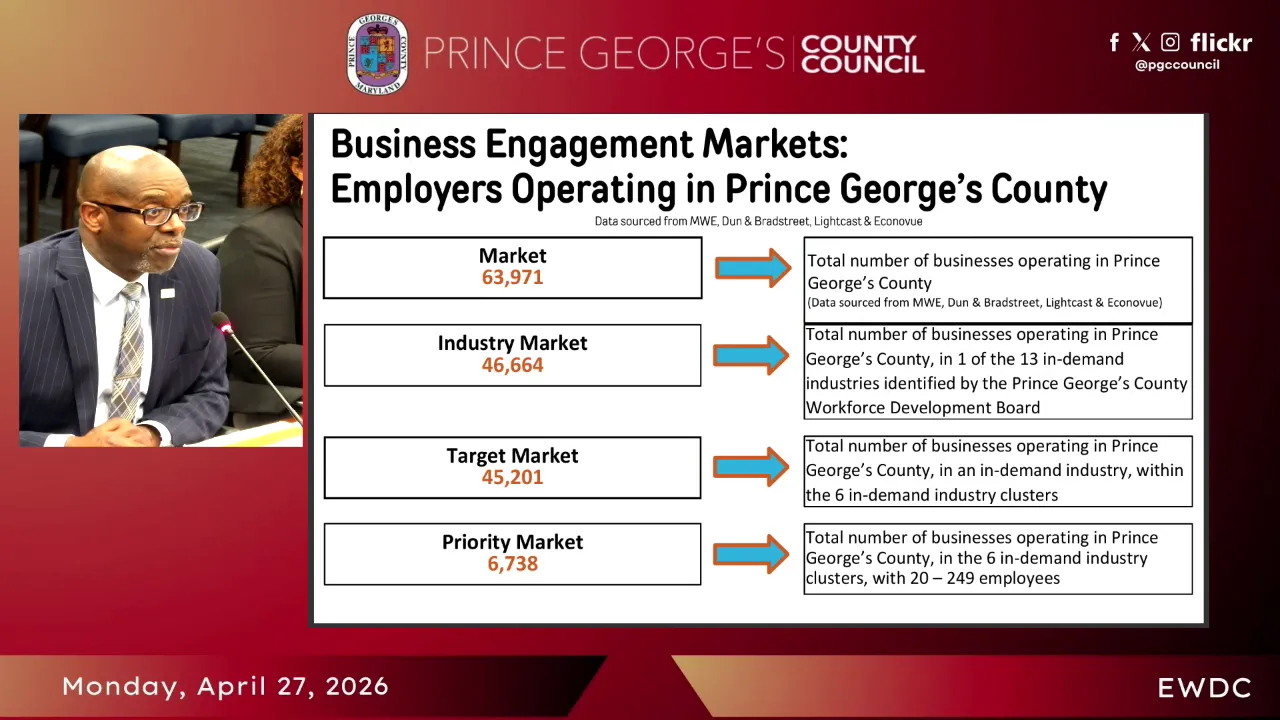
Interim President/CEO Jeffrey Swilly and team presented: EPG administers 10 workforce development programs, targeting six high-demand sectors (transportation, technology/AI/cybersecurity, healthcare, retail/accommodations, financial services, professional services). They have a network of over 300 members (America's Job Center Community Network) with three service centers (Largo, National Harbor, Suitland) and community access points in six municipalities. Youth Career Connections program places 50 career coaches in 26 middle schools and 24 high schools across 70+ sites, funded through Blueprint for Maryland's Future. Career coaches provide career exploration, connect to CTE programs, and support dual enrollment. A pipeline analysis shows 3,000 individuals engaged at the community level, 22% transition to basic services, 38% to program enrollment, 122 receive skills upgrades, 88 earn credentials (72% credential attainment). Placement outcomes: 8,500 placements in PY24; current year (PY25 mid-point) shows about 3,000 placements. Key challenge is converting early engagement into active participation.
-
Discussion: Councilmember Harrison asked about the New Carrollton community access point; data for FY25 showed 64 individuals served, 2 moved to intensive services, 1 placed. He also asked about the reentry program delays; CEO Swilly cited a change in administration and the 12-month grant disbursement rule, requesting modification for early payment after 90 days. Councilmember Olson asked about the pipeline; EPG acknowledged the low conversion (88 out of 3,000, about 2.9%) and noted strategies like VIP enrollment days. Councilmember Olson also asked about the Laurel Multi-Service Center (open 6 months), which serves cross-county traffic but skills training only for Prince George's residents. Chair Adams-Stafford asked about the mobile unit; it provides Wi-Fi, registration, and job matching at community events. She also asked about budget and staffing: EPG is considering salary adjustments to be competitive; not filling positions reduces capacity. Councilmember Burroughs asked about the Tanger Outlets lease; EPG is exploring alternatives, possibly a community access point if closure is unavoidable.
Key Outcomes
- No formal votes were taken; the committee received presentations and discussed budget requests and operational challenges.
- The Board of Education's request for $50 million additional county funding (with $20 million committed) leaves a $30 million shortfall that will require further cuts, primarily affecting special education, safety, and technology.
- Employ Prince George's will continue to seek alternative lease arrangements for the National Harbor center and modifications to the reentry incentive program disbursement schedule.
- Committee members expressed commitment to collaborative efforts on workforce development alignment, transportation safety, and sustainable funding solutions for both entities.
- The committee will continue discussions in subsequent work sessions.
Meeting Transcript
Hello. All right. Good afternoon. And thank you, everyone, for joining the Education and Workforce Development Committee. My name is Councilmember Shayla Adam Stafford, and I serve as the chair. Today is Monday, April 27th, 2026, and we will start off with a roll call. Please call it roll. Chair Adam Stafford. Present. Councilmember Harrison. Councilmember Olson. Here. Thank you. So for today's agenda, we have two budget work sessions. Um to all of our presenters. We're so appreciative of you taking your time to be here today, and we look forward to some productive discussions. Our first item on the agenda will be the operating budget work session for the board of education. And I'll turn it over to our committee director, Dr. Arun Perakin, for an overview and introduction. Good afternoon, Madam Chair and Council members. I'm Dr. Arun Parakan, Director of the Education and Workforce Development Committee. Our first budget work session today will be regarding the FYI 2027 proposed operating budget for the Board of Education. Again, this is only regarding the operating budget, the Board of Education's Capital Improvement Program or CIP budget work session will be will occur tomorrow, April 28th, during committee of the whole. With us today, our superintendent of the Persian George County Public School System, Dr. Sean Joseph, Chief Financial Officer Lisa Howell, and the Director of Office of Management and Budget, Shabon Smith. We will start with a presentation on the proposed budget from Caleb Calendar, budget and policy analysts for the EWD committee, followed by a presentation from our school system and then a committee discussion. Both presentations can be found in your revised virtual binder. That was emailed this morning at 8 a.m. The council's budget overview presentation can be found on page three of the virtual binder, and the school systems presentation can be found on page 74. I will now turn it over to Mr. Callender. Thank you, Dr. Paraken. Wait for those slides. So these are some of the highlights from the budget report. The county contribution, if you look at the Board of Ed budget book, is projected at 968,737,900. Um, but however, this doesn't include the 42 million dollars towards the alternative alternative construction financing and 18.7 million towards teacher retirement. So this brings the total contribution of the county up to 1,029,438,000. Next, this gives this slide gives some historical context, which I want to highlight the little bar on uh each of these on the left side. Um this gonna be the dark blue bar, uh, which represents the federal funding. So the federal funding has continuously gone down this year uh compared to FY 2026, it went down by over 2020 by over 24 million. Uh this decrease reflects termination of grants related to Title I, Medicaid, and other discretionary funds. Next, we'll look at overall expenditures. Uh overall expenditures are projected to increase slightly due to compensation increase for negotiated salary adjustments. Operating expenses are expected to decrease, although you will see an increase in spending towards special education. Uh PGCPS is ramping up their recruitment strategies for special education special education positions, which includes hosting targeted hiring events, offering advanced contracts, and early hiring for high priority schools. Additionally, as currently constructed, the budget wouldn't totally wipe out the emergent programs, would but would only save a small portion. Uh, I will let the superintendent and and his staff get more into those, get more into those details uh during their presentation. Um, also, some eyes may have been drawn to the decrease in transportation funding given the butt given the problem busing has been.
openpublica.com