The Prince George's County Council held a special virtual meeting on November 2, 2026, to consider a proposed letter confirming the appointment of Marcel Emerson as County Auditor. The item was the sole agenda point, following a closed session vote on October 20 and approval of minutes on October 27. Staff presented the letter and a legal memorandum confirming no prohibition to the appointment. Councilmembers debated the adequacy of public notice and allegations of a conflict of interest, with the motion ultimately passing 6–1. Discussion Items - Proposed Appointment of County Auditor: The council considered a letter to Council Administrator David Murray formalizing the appointment of Marcel Emerson, CPA, to a five-year term as County Auditor, as required by the charter. The council had previously voted 9–0 in closed session on October 20 to appoint him. Legal counsel Raj Kumar provided a memorandum stating there was no legal prohibition under Maryland law, the county charter, or code, and that Emerson would be subject to conflict-of-interest rules and recusal requirements. - Councilmember Ivey's Objections: Councilmember Jolene Ivey raised two concerns: (1) that the meeting did not meet the Open Meetings Act’s notice requirements, as she received notice at 2:49 PM for a 3:30 PM meeting, which she argued was not justified for a position that had been vacant for a year; and (2) that she had evidence that Emerson was friends with Councilmember Edward Burroughs III, calling into question impartiality. She voted no. - Responses to Conflict Allegations: Councilmember Thomas Dernoga challenged Ivey to provide evidence, stating it was inappropriate to make such claims without proof. Chair Krystal Oriadha emphasized the seriousness of accusations and noted that unsubstantiated social media claims should not be treated as fact. Councilmember Timothy Adams argued the vacancy was an emergency requiring immediate good governance. Councilmember Danielle Hunter initially passed but later voted aye, citing the county's need for an auditor and the ability for recusal in case of conflict. Raj Kumar clarified that a personal relationship does not automatically disqualify someone and that guardrails such as recusal exist. Councilmember Shayla Adams-Stafford supported the appointment, echoing the need for an auditor. - Procedural Note: The meeting experienced a 40-minute delay prior to start, and roll call began after technical issues. Key Outcomes - Motion and Vote: Councilmember Timothy Adams made a motion to approve the letter, seconded by Councilmember Wanika Fisher. The motion carried 6–1 (with Councilmember Ivey voting no). The vote was: yes – Chair Oriadha, Adams, Adams-Stafford, Dernoga, Fisher, Hunter; no – Ivey. - Next Steps: The letter to David Murray appointing Marcel Emerson as County Auditor will be sent, consummating the appointment. - No Further Business: The meeting adjourned immediately following the vote.
Public Meetings - Prince Georges County, Maryland
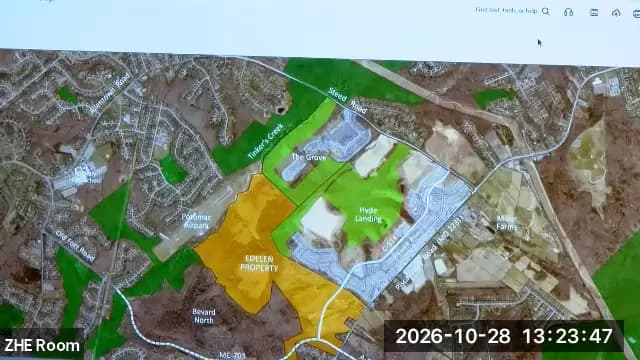
Public Meetings - Prince Georges County, MarylandOn October 28, 2026, Zoning Hearing Examiner Maureen McNeil held a hybrid public hearing on ZMA-2025-004, an application by DRB Group Mid Atlantic LLC, contract purchaser of the 254.14-acre Edelen Property at 10755 Piscataway Road in Clinton, Maryland. The applicant requested rezoning from the RE (Residential Estate) Zone to the R-PD (Residential Planned Development) Zone to permit approximately 530 single-family detached dwellings. The applicant emphasized that the proposed density is below the Subregion 5 Master Plan's recommended residential-low density of 3.5 units per acre. The Prince George's County Planning Board recommended approval. No opposition appeared in the room or online. Public Comments & Testimony - No members of the public testified in opposition, and no public comment session was requested. At the start of the hearing, the examiner asked for opponents in the room or online; none were identified. Discussion Items - Preliminary matters: Applicant's attorney Thomas Haller requested the record be held open to submit a formal application form because the county's DARTS filing system does not collect all information required by Section 27-3602 A5. He also substituted a signed boundary survey, marked as revised Exhibit 54, for the unsigned version transmitted by planning staff. - DRB acquisition witness: Keita Sinyapanya, DRB Homes director of land acquisitions, testified that DRB is the contract purchaser and is in good standing. He said Prince George's County accounts for about 45% of DRB's closings, with about 201 closings anticipated there in 2026. He stated that the R-PD zone allows the project to preserve environmental features, concentrate homes in previously cleared areas, and provide public benefits that would not be feasible under the RE zone. He said the community consistently opposed additional townhouses and wanted traffic improvements, so the application is exclusively single-family detached homes. He agreed to all Planning Board conditions, including the revised 60% maximum lot coverage condition. - Site planning and trails: Daniel Schlegel of Dewberry Engineers described the property's constraints, including Tinkers Creek, stream valleys, steep slopes, about 103 wooded acres, and a previously mined 37-acre area. The basic plan shows 530 lots on a 216.45-acre net tract, a density of 2.44 dwelling units per acre, with the actual yield expected to be below 500 units. He described public benefits including a 30-acre stream-valley dedication, an approximately one-acre public trailhead off Piscataway Road, enhanced stormwater facilities, a doubled historic buffer along Piscataway Road, and trail connections. Revised trail costs were $171,000 for 3,700 linear feet in the dedication, $351,000 for 7,600 linear feet of neighborhood connectors, and $69,000 for a 2,300-linear-foot shared-use path along C518. The applicant also agreed to a $39,000 improvement at Clearwater Nature Center after staff did not initially credit the stream-valley dedication as a public benefit. - Civil engineering: Adam Blau, a Maryland licensed professional engineer with Dewberry, testified that the R-PD clustering allows development to avoid floodplain, wetlands, steep slopes, and Marlborough clay soils. The property is in mixed water/sewer categories, with a portion in Category 5 requiring a future legislative amendment. He stated the rezoning would not adversely affect surrounding properties and that stormwater management would be designed to prevent adverse impacts. He identified one requested modification: three residential gateway signs instead of the one normally allowed, at the three project access points. - Traffic and transportation: Mike Lenhart, accepted as an expert in traffic engineering and transportation planning, testified that development under the existing RE zone would yield about 255 units, while the proposed R-PD would yield about 530 units; the additional density would not require any additional roadway improvements beyond those already needed. He quantified transportation public benefits: construction of a second southbound lane on MD-223 from north of Temple Hill Road to Glenview Drive, estimated at about $1.8 million and roughly $150,000 above the CIP contribution; a substituted $520,000 off-site improvement in lieu of accelerated Brandywine Road/MD-223 CIP funding; $225,000 in bike lanes; $69,000 for the C518 shared-use path; and $479,000 for off-site improvements at DeLancey Street. He explained the applicant will still satisfy road adequacy through CIP payments at preliminary plan. - Land use planning: Mark Ferguson, accepted as an expert in land use planning, testified the project is consistent with the Subregion 5 Master Plan, which recommends residential-low density and has already found this land use compatible with the surrounding area. He said the single-family detached layout creates a transition from denser Hyde Landing development to existing suburban subdivisions to the south. He identified deficiencies in the basic plan: it should list permitted principal, accessory, and temporary uses; include the accessory dimensional standards requested by staff; and reconcile the stated density, since the basic plan says 2.50 units per acre while other documents use 2.45. He also suggested the 60% lot-coverage condition could be 68% once driveways are counted, but noted the applicant had agreed to 60%. Key Outcomes - The hearing was not closed; the examiner held the record open for the applicant to submit: a completed application form; revised Exhibit 6 reflecting corrected trail footage and costs; revised basic plan/open-space sheets updating trail alignments and showing the owner's proposed residential lot; a list of permitted principal, accessory, and temporary uses on the basic plan; accessory dimensional standards; and an illustrative example of an entrance sign size. - The signed boundary survey was substituted into the record as revised Exhibit 54. - The applicant affirmed agreement with all Planning Board conditions, including the 60% maximum lot coverage and the accessory-use dimensional standards. - No opposition was presented, and no vote was taken by the hearing examiner. The examiner stated a decision would be issued shortly after the record closes.
On Wednesday, October 28, 2026, at 2:03 p.m., the Prince George's County Child Care Improvement Work Group met virtually. Dr. Run Perakan, director of the education workforce development committee, convened the meeting; Chair Oriada was absent. The meeting began without a quorum as an informational session, so the agenda was shifted to allow discussion of recommendations and the DPIE presentation before formal action. Quorum was reached later in the meeting. Quorum and Agenda - Roll call was taken, with several members joining after the start. The agenda included consideration of the October 14, 2026 meeting minutes, a presentation from the Department of Permitting Inspection and Enforcement (DPIE), and prioritization of the work group's recommendations. - Because quorum was not initially present, the minutes vote was deferred until later. DPIE Presentation: Child Care Permitting and County Review - DPIE Deputy Director Henson and Chief of Staff Lori Paris presented the county and state permitting process for child care facilities. They described a dual-track process with state requirements and local review, and varying rules for family child care homes (8 and under), large family child care homes (9–12), and commercial child care centers (12 or more). - Presenters emphasized use-and-occupancy permits, licensed contractors, floor and site plans, sprinkler and fire-protection requirements, and early zoning due diligence before purchasing or leasing space. They said a zoning certification letter from the Maryland-National Capital Park and Planning Commission can be obtained for $50, $75, or $100 and typically returns within five business days. - DPIE noted customer-service improvements, a fast-track program for projects 5,000 square feet and below, and willingness to revisit a prior use-and-occupancy work group with Prince George's County Public Schools (PGCPS). - In response to a question about sprinkler-system costs quoted at $20,000–$30,000 for a family child care home, DPIE said costs depend on the building and referred providers to the Prince George's Economic Development Corporation and the Small Business Administration for possible grants or loans. PGCPS Before and After-School Care Recommendation - Dr. Searcy, joined by PGCPS staff Otis Dupree and Sandy Osborne, presented a new recommendation. PGCPS does not operate before- and after-care programs itself; it currently partners with four vendors serving 65 schools. A new RFP to expand vendor-managed child care is expected to be released in the first or second week of November. - The concern is that vendors must wait for PGCPS to receive documentation and approvals from DPIE and other agencies, sometimes as late as July, before starting a licensing process that can take up to 90 days. That delay can prevent programs from being ready for the first day of school. - Dr. Searcy recommended allowing vendors to pursue MSDE licensing concurrently, or allowing vendors to use PGCPS's use-and-occupancy and fire inspection certificates for the same buildings and children. The goal is for families to have before- and after-care available when school starts. - DPIE Chief of Staff Lori Paris said the suggestions could be reviewed for possible code amendments, and Henson noted that an earlier DPIE work group had examined use-and-occupancy issues with PGCPS. Work Group Discussion and Prioritization - Dr. Searcy urged prioritizing the PGCPS facility-approval recommendation, with a goal of being in place by April or May 2027 at the latest for the 2027–2028 school year. She also said PGCPS has grant-writing support for providers seeking to participate in mixed-delivery pre-K, so that may not need to be a work group recommendation. - Brianna Meadows, a new family child care provider, described difficulties finding buildings zoned for child care and expressed interest in expanding and in becoming a mixed-delivery pre-K provider. PGCPS said an MSDE grant is typically released in January or February and that support is available for eligible providers. - Alejandra urged the group to treat county-level initiatives, such as the child care facility grant and the scholarship for Prince George's County families passed earlier in the year, as priority work and to accelerate their rollout. - A participant with licensing experience advised school-based providers to notify regional offices early and begin MSDE applications in January rather than waiting until late summer, noting that licensing specialists face heavy caseloads and required inspections in August and September. - Caleb described CB 35 as legislation promoted by Chair Oriada that increases child care access by eliminating special-exception approval for day care centers in all zones, removing minimum parking requirements in transit-oriented zones, and allowing alternative parking compliance in other zones. Key Outcomes - The October 14, 2026 meeting minutes were approved by roll-call vote after quorum was reached; no nays were heard. - The work group agreed to continue refining and narrowing its recommendations, with attention to implementation steps, resources and costs, success measures, and county-level actions. Staff will reach out to individual members for input before the next group discussion. - The next Child Care Improvement Work Group meeting is scheduled for Thursday, November 12, 2026, at 2:00 p.m., instead of the usual Wednesday because of the November 11 holiday. - The meeting was adjourned by voice vote after a motion and second.
On October 27, 2026, the Prince George's County Emergency Room Wait Times Reduction Task Force convened at approximately 3:30 PM and voted to approve its final report after nearly three years of work. Chair Blagay opened the meeting by thanking members, noted that she is leaving the council, and said she wanted the task force to pass something so that stakeholders could be held accountable. Attendance and Quorum - The task force has 19 members and needs 10 for a quorum. A roll call was conducted after late arrivals, and quorum was confirmed. - Member Bill Miller was absent but expressed support for the report. Member Jeffrey Cooper reviewed the final draft and provided extensive feedback. Discussion Items - Anya, the staff lead, reported that she and Dr. Ballard worked directly with the Health Services Cost Review Commission (HSCRC) since the last meeting, focusing on pages 37 through 39 of the draft report. - HSCRC feedback was incorporated mainly to avoid implying a causal relationship that the data could not fully support. Anya stated that HSCRC was fully receptive to the changes. - Technical corrections, enhancements, and refinements were made, including standardizing footnotes and updating data. A revised draft and a document summarizing changes were provided for transparency. Anya stated that every observation, finding, and recommendation was preserved. - Anya acknowledged Mr. Eubanks' interest in additional findings on staffing concerns. She noted that a deep dive into staffing matters related to emergency room wait times was not possible and is acknowledged in the report as a suggested next step. - Anya noted Mr. Cooper's concern that the report does not include an implementation plan. She stated that the task force's purpose was to assemble recommendations, and an implementation plan could be handled separately through a chair's transmittal letter requesting a coordinated post-adoption implementation and evaluation plan. - Chair Blagay said she will follow up on implementation, announce the report next week, hold a roundtable about it, and request a meeting to present the report to the full council next year. Key Outcomes - A motion to approve the report was made, seconded, and passed with 7 ayes, 0 noes, and 2 abstentions. - Carmen Brown abstained because she could not open the encrypted and coded final report due to firewall and security protocols. Staff said they would provide her with a version she can open and noted that OIT had been engaged to address file distribution challenges. - The meeting adjourned by motion and second.
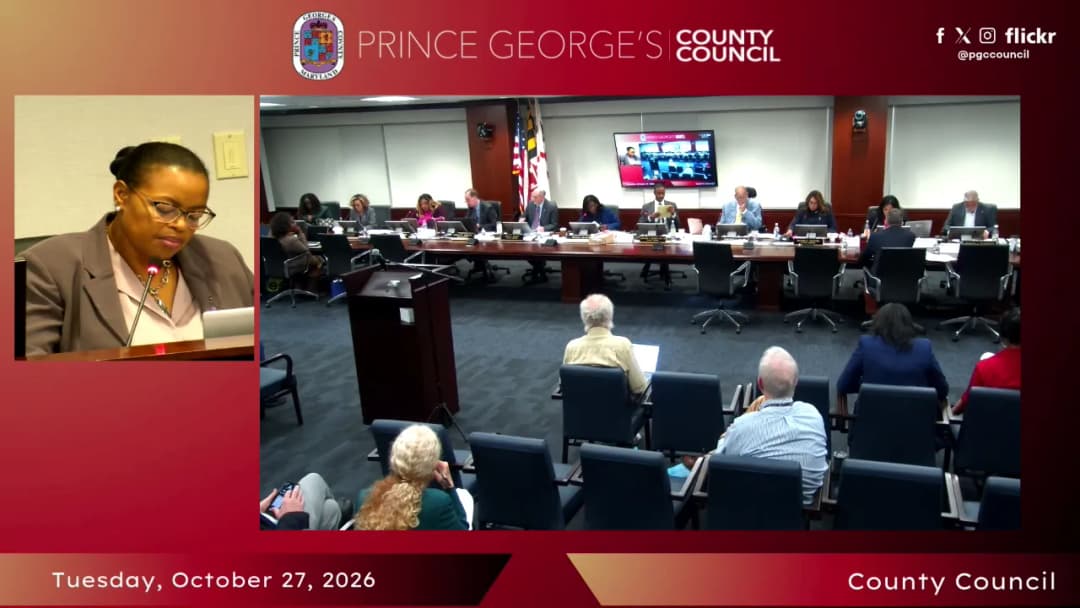
The Prince George's County Council met at 10:00 a.m. on Tuesday, October 27, 2026, in the County Hearing Room of the Wayne K. Curry Administration Building in Largo, Maryland, for Legislative Day No. 37. Chair Krystal Oriadha presided. The Council approved routine items, took extensive public testimony, enacted numerous land-use and housing bills, and completed the National Harbor "Sphere" financing package. Votes are shown as yes-no-abstaining where the transcript provided a tally. Consent Calendar - Approved the October 20, 2026 County Council minutes (9-0). - Authorized the chair's signature on a letter to PGCPS Superintendent Dr. Shawn Joseph supporting the FY 2026 Final Financial Review and Transfer Request, which reallocates $32,949,683 among Board of Education appropriation categories (motion carried 10-0). - Later approved a joint FY 2028 capital-improvement priorities letter to the Maryland Interagency Commission on School Construction (11-0). Public Comments & Testimony - Greg Smith, speaking in the general public comment period, urged the Council to take climate change seriously, citing European Union projections of 3 degrees Celsius warming and 50,000 European heat-related deaths, and said resolutions and summits alone are insufficient. - Data-center bill CB-019 drew broad support from Janet Gringle, Beth Landry (CCAN Action Fund), Greg Smith, Henry Wixon (Glendale Citizens Association), Taylor Frazier-McCollum, and Kevin, a District 2 resident. Speakers called for detailed site-plan review, no grandfathering, clean energy, and stronger comprehensive data-center rules; Taylor Frazier-McCollum cited a 25,000-signature petition opposing the Landover data center. Alexander Austin (Prince George's Chamber of Commerce) opposed CB-019, saying a two-year moratorium already exists and the bill is regulatory overreach. - Tenant-protection bills CB-113, CB-114, and CB-115 were supported by Martin Michaels (We Are Casa) and Lisa Saro (Community Legal Services). They emphasized that tenants need relocation-rights notices at lease signing, plain-language multilingual resources, and timely access to inspection reports and enforcement information. - CB-111, the Sphere special-obligation bond bill, drew opposition from Christopher Goans, who called the economic analysis's construction-job numbers misleading, and from Dan Smith, who associated himself with Greater Capital Heights Improvement Corporation testimony questioning the use of public financing at National Harbor while transit-oriented corridors remain incomplete. - CB-076, CB-084, and CB-090 were opposed by Henry Wixon (Glendale Citizens Association), Greg Smith, and Dan Smith, who argued shortened appeal timelines and simultaneous approvals would erode due process, public participation, and the legal functions of sequential reviews. - CB-077 was opposed by Greg Smith for being too broad. CB-081 drew support from Edward Gibbs (Judah Temple AME Zion Church), Jacqueline Smith, Kelly Shim Andrews, Vincent Lizaire, and Dr. Aku Tabeta, and opposition from Henry Wixon and Greg Smith, who called it spot zoning. CB-082 was supported by Taylor Frazier-McCollum as overdue implementation of state cannabis law. - CB-083 drew extensive opposition from convenience-store owners, franchisees, wholesalers, and the Prince George's Chamber of Commerce. Speakers said tobacco sales account for 20-30% of revenue at some stores, would push sales to neighboring jurisdictions, and could close community stores. Bruce Barriano argued the bill is unconstitutional and preempted by state law. Greg Smith supported the bill's public-health intent; Taylor Frazier-McCollum opposed it as ineffective and harmful to food access. - CB-112 drew supportive testimony from Dan Smith, a former Fair Election Fund Commission member, who urged steady future funding for public campaign financing. Discussion Items - CB-019-2026 (qualified data centers): Councilmember Fisher offered a last-minute amendment to create an interim council-review process for data-center applications. Council staff and the Office of Law advised that the amendment was substantive and would require another public hearing; Councilmember Adams-Stafford said she had not been given time to review it. The amendment was not voted on after the second was withdrawn, and the clean bill was enacted. - Sphere/National Harbor package: The Council approved a supplier-diversity letter amendment requiring concurrence from the director and purchasing agent of the Office of Procurement before any construction-package threshold falls below $130 million. It then enacted CB-111-2026 authorizing up to $215 million in special obligation bonds for the immersive entertainment venue and refunding of the Series 2022 National Harbor bonds; enacted CB-132-2026 creating the Sphere Community Impact Fund for communities within six miles; adopted CR-121-2026 approving the TIF proposal and certifications; and adopted CR-090-2026 amending the National Harbor Development District formation resolution and dissolving the National Harbor Special Taxing District. - CB-077-2026 (community service and commercial uses in RSF-A zones) initially failed on a 5-0-2 vote. Vice Chair Olson moved reconsideration, and the Council then enacted it 8-0-2. - CB-083-2026 (convenience store tobacco sales): An amendment exempting establishments licensed to sell alcoholic beverages passed 7-0-3; the bill as amended was enacted 6-3-2, with members citing legal concerns about state preemption. - CB-084-2026 and CB-090-2026 (streamlining site plan and subdivision review) were amended in committee; the Council enacted them 8-0-2 and 9-0-1 respectively after members noted simultaneous reviews were already common practice and the bills had been narrowed. - CR-098-2026 (energy infrastructure planning) was substituted with a draft that removes the planning department as administrator of an energy-district framework, adds consultation with the Maryland Energy Administration, and requires recommendations through the Plan 2050 update; the substitute, amendment, and final adoption all carried, with final adoption 11-0. - CR-107-2026 and CR-108-2026 (Subregion 5 master plan and sectional map amendment) were added to the agenda by a 7-2-1 vote, but later motions to suspend the rules failed, so the Council did not adopt them. - CB-076-2026 had a public hearing with opposition testimony, but no final roll-call vote appears in the transcript; the Council moved to other agenda items. Key Outcomes - Enacted CB-019-2026, CB-035-2026, CB-082-2026, CB-084-2026, CB-090-2026, CB-112-2026, CB-113-2026, CB-114-2026, CB-115-2026, CB-116-2026, CB-118-2026, CB-121-2026, CB-122-2026, CB-123-2026, CB-124-2026, CB-125-2026, CB-126-2026, CB-127-2026, CB-128-2026, CB-129-2026, CB-130-2026, CB-132-2026, and, after reconsideration, CB-077-2026. CB-083-2026 was enacted as amended. - Enacted CB-130-2026, authorizing $788,587,000 in general obligation bonds, $161,463,000 in stormwater management bonds, and up to $950,050,000 in bond anticipation notes for FY 2027 capital projects. - Authorized up to $38,500,000 in MWIFA loan revenue obligations for stormwater and watershed projects (CB-116-2026). - Adopted resolutions CR-080-2026 (Social Housing Task Force), CR-082-2026 (Universal Design fees), CR-090-2026 (National Harbor TIF and formation amendment), CR-097-2026 (Water and Sewer Plan amendments), CR-098-2026 (energy infrastructure planning), CR-100-2026 (State's Attorney salary schedule), CR-101-2026 (climate action leadership), CR-103-2026 (Local Impact Grant multiyear plan), CR-104-2026 and CR-105-2026 (Flats at Glenridge Station surcharge waivers), CR-115-2026 (county-owned grocery store implementation plan), CR-116-2026 (WSSC refunding plan), CR-117-2026, CR-118-2026, CR-119-2026, CR-120-2026 (Subregion 1 and Central Branch Avenue plan/SMA approvals), and CR-122-2026 (grant-making transparency task force). - Authorized a letter to the County Executive and Police Chief regarding Flock safety cameras and similar surveillance technologies (11-0). - Approved an executive session under Maryland Code General Provisions Article §3-305(b)(7)-(8) regarding pending litigation (11-0), then adjourned.
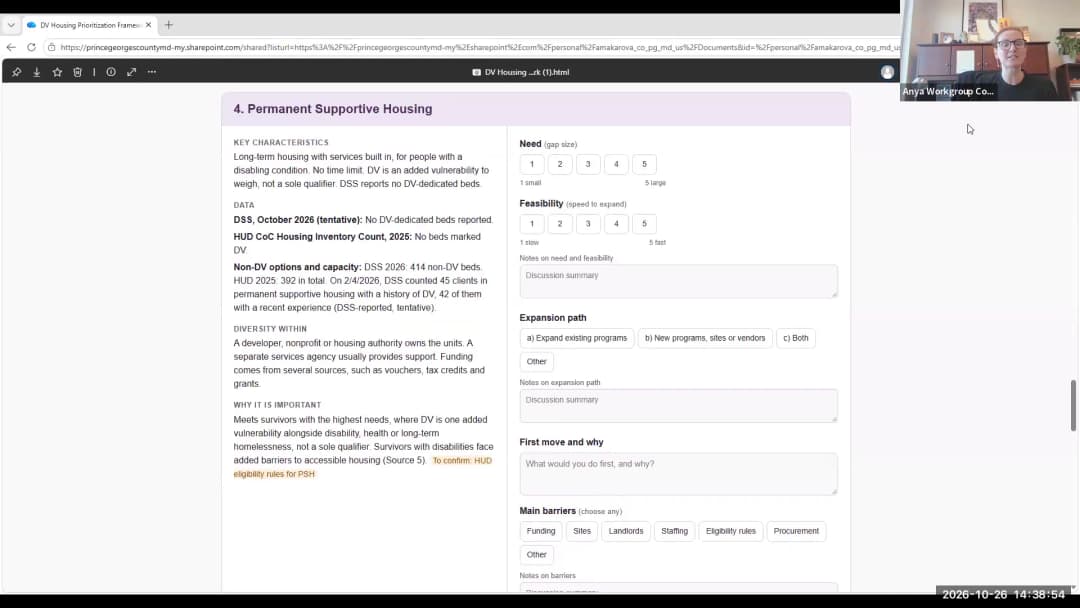
The Domestic Violence Housing Work Group met on October 27, 2026, to continue its examination of housing for survivors of domestic violence in Prince George’s County. Led by Anya McCarva, committee director and task force coordinator, in place of Chair Miss Fisher, the group reviewed updated capacity data, prioritized housing types, and discussed next steps for policy recommendations. Participants included county agency representatives, domestic violence service providers, and community partners. Note: the transcript records a speaker saying “October 26th,” but the supplied meeting timestamp is October 27, 2026; this summary uses the supplied date. Consent Calendar - Quorum was confirmed with 11 members present after roll call. - The minutes from the September meeting had been distributed in advance; no corrections were offered, and the minutes were approved as presented. Housing Capacity Update - Approximately 9% of the county’s housing continuum beds are dedicated to domestic violence survivors, with rapid rehousing having the highest share. - CCSI’s Safe Passage was identified as the sole dedicated domestic violence emergency shelter; the bed count was corrected during the meeting from 44 to 43. - The county has 486 non-domestic-violence emergency shelter beds. - Department of Social Services data show 9 dedicated domestic violence transitional housing beds (5 at CCSI and 4 at Ladies of Hope), while HUD’s 2025 data marked 0. - DSS data show 79 dedicated domestic violence rapid rehousing beds (House of Ruth, CCSI, and Ladies of Hope), while HUD’s 2025 data flagged only 14 House of Ruth beds. - No dedicated domestic violence permanent supportive housing beds were identified; non-dedicated counts differed between HUD and DSS reporting. - A new state-funded voucher program lists domestic violence survivors as a priority group. - Informational gaps remain, including waitlist, turnaway, and time-to-placement data; hotel and motel emergency placements are not currently counted. - A survey on demand and capacity was distributed to providers and experts; it closes on November 6, 2026. Discussion Items - Emergency Shelter: Michelle from CCSI cautioned that expanding shelter capacity alone will not help if survivors cannot move into affordable housing. She noted CCSI operates a no-turn-away policy using privately funded hotel and motel placements, but that hotels are not ideal for families. Dr. Denise McCain expressed concern about homeless shelters being used for domestic violence victims; David from CCSI clarified that when domestic violence is identified, survivors are not referred to non-domestic-violence homeless shelters. Tasha Jones asked about recruiting private homeowners and realtors; Michelle responded that most survivors prefer returning to their own or private space rather than sharing a home. The group generally viewed emergency shelter expansion as a lower priority than other housing types. - Transitional Housing: Michelle reported that HUD’s most recent Notice of Funding Opportunity prioritizes transitional housing. Because of this, CCSI gave up its rapid rehousing program to apply for a new larger domestic violence transitional housing program, approximately three times the size of the current joint transitional/rapid rehousing program. She noted that HUD-funded transitional housing may carry stricter service participation requirements. The group saw this category as driven largely by federal funding changes rather than by survivor preference, with rapid rehousing considered more flexible. - Rapid Rehousing: This emerged as the top priority for expansion. Jackie Rowe from the Sheriff’s Office supported focusing on rapid rehousing and wraparound services rather than expanding shelter capacity. Yolanda Burgess, speaking from a realtor perspective, said rapid rehousing works but inspections must be prioritized promptly for domestic violence survivors and that landlord partnerships are needed. Michelle said the key constraint is rental subsidy dollars, not a particular landlord sector, and mentioned local jurisdictions using dedicated local funds, including Dallas, Texas, and Kalamazoo County, Michigan. - Permanent Supportive Housing: Monique Willis, deputy director of the Prince George’s County Family Justice Center, recommended prioritizing domestic violence survivors for permanent supportive housing, especially those caring for children with disabilities. A participant speaking from the criminal justice perspective said survivors sometimes want to drop charges because they have nowhere else to go. The group leaned toward recommending prioritization for domestic violence survivors in this housing type. - Mainstream Affordable Housing: Several participants noted that the broader affordable housing shortage affects domestic violence survivors. Jackie Rowe and Yolanda Burgess said affordability is the underlying issue. A representative from the Department of Family Services emphasized that, with limited funding, the county should focus on the most significant gaps and use available data to guide decisions. The group recognized that successful exits from all other housing types depend on the availability of mainstream affordable housing. Key Outcomes - Rapid rehousing was identified as the top housing type for potential expansion and investment. - The group expressed support for prioritizing domestic violence survivors in permanent supportive housing. - Emergency shelter expansion was viewed as a lower priority, with hotel and motel placements considered an emergency, not long-term, solution. - Transitional housing may need continued attention because of federal funding priorities, despite being less preferred from a survivor-service perspective. - The survey on demand and capacity remains open until November 6, 2026; members were urged to complete and share it. - The next work group topic will likely be wraparound services, with public safety and criminal justice to be explored in future sessions. - A motion to adjourn was made and seconded, and the meeting was adjourned.
The Prince George's County Council convened at 10:30 a.m. on Monday, October 26, 2026, for Legislative Day No. 36 in Committee Room 2027. The meeting included a consent agenda item, multiple public hearings, and enactment of numerous bills addressing illegal vending, street vending pilot, quiet landscaping equipment, affordable housing, property tax relief for seniors, returning citizen employment, and economic development streamlining. The council also held a public hearing on a court-ordered remand for land use designations in Subregion 5 and 6 Master Plans. Votes were recorded on all items. Consent Calendar - CR-121-2026: A resolution concerning Tax Increment Financing (TIF) for the National Harbor Development District and National Harbor Extraordinary Development District. Introduced by the Chair (by request of the County Executive) and referred to the Committee of the Whole. No additional sponsors. Public Comments & Testimony - Court Order Remand (Subregion 5 & 6): Thomas Haller (attorney for Christmas Farm), Carol Drewyer and Corinne Crispus Sullivan (Christmas family members), Arthur Horn (attorney for Robindale LLC), Daniel Cassidy (for Christmas Farm), and Edward Gibbs (attorney for MCQ Auto Service Center) testified. All urged the council to reaffirm the 2009 zoning approvals (RR zone for Christmas Farm and Robindale; CM zone for MCQ Auto). They argued the remand was solely to correct a procedural error (missing ethics affidavits) and that the council must not make substantive changes. The attorney for MCQ Auto noted his client’s case did not involve ethics affidavits; the Supreme Court found errors in the 2009 downzoning. - CB-003-2026 (Illegal Vending Penalties): Testimony was sharply divided. Supporters (e.g., Latrice, Minnie L. Alexander, Rita Miles, Ebony Brooks) cited safety, traffic, noise, trash, and property value concerns. Opponents (e.g., John Clark of DSA PG, Lindolfo Carvalho of We Are Casa, multiple street vendors including Alba and Sarah Mark) argued the bill targets Latino and immigrant communities, lacks a clear path to licensing, and would devastate livelihoods. Many called for a pilot program first. - CB-013-2026 (Street Vending Pilot Program): Only one speaker (Caroline Edwards) signed up, no testimony given. - CB-093-2026 (Cannabis Reinvestment Board): Board members Dr. Rachel Jordan, Crystal Carpenter, and Natalie Doris, along with community advocates Don Dalton, Yannetta Manual (ACLU of MD), and Tamara McKinney, opposed the bill. They argued it would strip the board of its authority, impose unrealistic deadlines (January 1, 2027), and mischaracterize the fund. They requested retaining board authority, extending the timeline, and ensuring adequate administrative support. Discussion Items - CB-003-2026 (Illegal Vending Penalties): Councilmember Fisher, the sponsor, offered amendments after hearing concerns: (1) removal of the prohibition on private property vending (by Councilmember Dernoga), (2) extending implementation from 6 months to 1 year, and (3) reducing fines to a mandatory warning, then $500, $1,000, and $2,000 for subsequent offenses. Fisher emphasized the companion bill (CB-013) creates a legal vending pathway. After debate, the amendments passed 11-0. On final enactment, Councilmembers Olson, Ivey, Adams-Stafford, and Blegay voted no, while Chair Oriadha, Adams, Burroughs, Dernoga, Fisher, Harrison, and Hunter voted yes. Motion carried 7-4. - CB-013-2026 (Street Vending Pilot Program): Councilmember Fisher moved an amendment to change the implementation timeline from 6 months to 1 year, to align with CB-003. Amendment passed 9-0. Enactment passed 9-0 (Fisher passed on the vote). - CB-048-2026 (Prohibited Home Businesses): No speakers. Enacted 9-0. - CB-061-2026 (Surplus Property): No speakers. Enacted 9-0. - CB-065-2026 (Senior Co-Housing Expansion): Councilmember Blegay was added as a sponsor. Enacted 9-0. - CB-075-2026 (Quiet and Clean Landscaping Equipment): Greg Smith (Sustainable Hyattsville) testified in support, citing health and quality of life benefits. Enacted 9-0. - CB-079-2026 (Housing and Property Standards): No speakers. Enacted 9-0. - CB-080-2026 (Universal Design for Housing): No speakers. Enacted 9-0. - CB-086-2026 (Community Safe Spaces Act): Greg Smith testified in support. Enacted 9-0. - CB-087-2026 (Electrical Code): No speakers. Enacted 8-0 (one member absent). - CB-088-2026 (Concurrent Development Review): Greg Smith testified in opposition, citing concerns about obsolete precipitation data and broken tracking systems. Councilmember Adams offered a technical amendment requiring an approved Natural Resources Inventory (NRI) plan prior to stormwater concept plan approval. Amendment passed 8-0. Enacted as amended 8-0. - CB-091-2026 (Development Ombudsman): Greg Smith testified with concerns about lack of clarity and potential pressure on staff. Enacted 8-0. - CB-092-2026 (Accessory Dwelling Units): No speakers. Enacted 8-0. - CB-094-2026 (Property Tax Credit for Elderly): No speakers. Discussion: Councilmember Adams-Stafford asked about funding; Chair Oriadha explained it was negotiated with the County Executive. Enacted 8-1. - CB-095-2026 (Property Tax Deferral for Elderly/Disabled): No speakers. Enacted 7-1. - CB-096-2026 (Residential Parking on Unpaved Areas): No speakers. Enacted 9-0. - CB-097-2026 (Affordable Housing Opportunity Sites): No speakers. Enacted 9-0. - CB-098-2026 (Property Tax Credit for Reduced Rent): No speakers. Councilmember Adams-Stafford asked about funding and percentage; Chair Oriadha clarified the waiver provision allows modification. Enacted 8-1. - CB-099-2026 (Small Housing Provider Financing): No speakers. Enacted 8-1. - CB-100-2026 (Surplus County Property for Affordable Housing): Discussion on percentage (one-third) and waiver. Councilmember Adams-Stafford expressed concerns about retroactivity and impact on current projects. Motion carried 7-0-2 (Burroughs and Harrison abstained). - CB-101-2026 (Returning Citizen Employment): No speakers. Enacted 9-0. - CB-102-2026 (Re-entry Employment Incentive Modifications): No speakers. Enacted 9-0. - CB-105-2026 (High-Wage Employer Fast Track): Greg Smith testified in opposition, citing undefined process and overburdened agencies. Councilmember Dernoga moved an amendment to add a reporting requirement; passed 9-0. Enacted as amended 9-0. - CB-106-2026 (Economic Development Incentive Fund): No speakers. Enacted 9-0. - CB-107-2026 (Shovel-Ready Employment Sites): Greg Smith testified in opposition. Councilmember Dernoga moved to add a community input requirement; passed 10-0. Enacted as amended 10-0. - CB-108-2026 (Public Land First for Affordable Housing): No speakers. Enacted 7-0 (some members absent). - CB-109-2026 (Public Land Affordability Requirement): No speakers. Enacted 8-0. - CB-093-2026 (Cannabis Reinvestment Board): After public testimony, council debated amendments. Councilmember Blegay moved to extend the deadline for recommendations from January 1, 2027 to April 1, 2027; passed 7-1-2 (Hunter voted no, Harrison passed). Discussion on administrative support, board authority, and appointment process. Councilmember Harrison moved to table, but lacked a second. Final enactment passed 7-2-1 (Harrison and Hunter voted no, Adams-Stafford abstained). - CR-115-2026 (County-Owned Grocery Store): Introduced by Chair Oriadha. A motion to suspend rules for immediate adoption failed to get eight votes; referred to Committee of the Whole. Key Outcomes - CR-121-2026: Introduced and referred to Committee of the Whole. - CB-003-2026 (Illegal Vending): Enacted as amended (7-4). Effective in one year; fines: warning, $500, $1,000, $2,000; private property vending exempted. - CB-013-2026 (Street Vending Pilot): Enacted (9-0). Requires OHS, EDC, Health Dept to develop pilot program within one year. - CB-048, 061, 065, 075, 079, 080, 086, 087, 092, 094, 095, 096, 097, 098, 099, 101, 102, 106, 108, 109: Enacted with broad support. - CB-088, 091, 105, 107: Enacted with amendments (reporting, community input, technical clarity). - CB-093 (Cannabis Board): Enacted (7-2-1). Board name changed; council staff to provide support; $5,000 minimum appropriation; terms expire 45 days after effective date with reappointment possible; deadline for recommendations extended to April 1, 2027. - CB-100 (Surplus Property for Affordable Housing): Enacted (7-0-2). Requires evaluation of surplus property for affordability; one-third affordable units required on residential projects of 10+ units, with waiver authority. - Public Hearing on Subregion 5 & 6 Remand: Concluded; record remains open until November 10, 2026. Staff to prepare resolution for later action. - Meeting adjourned at approximately [time not given], followed by Committee of the Whole.
The Prince George's County Council, sitting as the District Council, convened at 10:00 AM in Committee Room 2027 of the Wayne K. Curry Administration Building in Largo, MD. Chair Krystal Oriadha presided; six members were present at roll call: Councilmembers Adams, Dernoga, Fisher, Hunter, and Vice Chair Olson. The council approved the prior meeting minutes and acted unanimously on three Council District 6 zoning items, all by 6-0 votes. No public testimony was taken during this session. Consent Calendar - District Council Minutes – October 20, 2026: Approved 6-0 on a motion by Councilmember Dernoga, seconded by Vice Chair Olson. Discussion Items - SDP-2025-0014 Oakwood Preserve (Richmond American Homes of Maryland, Inc.): The council adopted the approving order for a Specific Design Plan for 112 single-family detached dwelling units with associated infrastructure improvements on 167.7 acres along MD 202 (Largo Road), about 2,220 feet south of Kent Drive. The Maryland-National Capital Park and Planning Commission (M-NCPPC) Technical Staff approved the plan with conditions on June 11, 2026, and the Planning Board approved it with conditions on July 2, 2026. Geoffrey Collins and Greg Smith, persons of record, filed an appeal on August 7, 2026. At the September 29, 2026 oral argument hearing, Collins, Smith, and Judith Artman spoke in opposition, while applicant's attorney Robert Antonetti spoke in support; after the hearing, staff was directed to prepare an approving document with conditions. Councilmember Hunter moved to adopt the order, seconded by Vice Chair Olson; the vote was 6-0. - DSP-2026-0013 Westphalia Town Center – Retail (Walton Westphalia Europe, LP): The council voted 6-0 to waive its election to review the M-NCPPC Planning Board's October 15, 2026 approval with conditions. Councilmember Hunter moved the waiver, seconded by Councilmembers Adams and Fisher. The application covers 65.88 acres at the northwest corner of MD 4 (Pennsylvania Avenue) and MD 373 (Woodyard Road) and would include 276 two-family attached dwelling units and a 139,607-square-foot integrated shopping center for commercial/retail and institutional uses. It also seeks amendments to Conceptual Site Plan CSP-07004-01 to add residential and institutional uses, reduce minimum retail square footage, revise conditions, and change the circulation network and building layout. - SDP-2026-0018 Locust Hill, Phase 3 (WBLH, LLC): The council voted 6-0 to waive its election to review the M-NCPPC Planning Board's October 15, 2026 approval with conditions. Councilmember Hunter moved the waiver, seconded by Councilmember Fisher. The Specific Design Plan covers 50.09 acres on the north and south sides of Oak Grove Road, west of Leeland Road, between Church Road and Collington Branch, and proposes 161 single-family attached homes, including 20 carriage homes, with associated infrastructure improvements. Phase 1, approved in 2024, includes 285 single-family detached homes and 50 single-family attached carriage homes; Phase 2, approved in 2025, includes 210 single-family detached homes. Key Outcomes - Approved the October 20, 2026 District Council minutes by a vote of 6-0. - Adopted the Oakwood Preserve SDP-2025-0014 approving order by a vote of 6-0. - Waived council review of Westphalia Town Center – Retail DSP-2026-0013 by a vote of 6-0. - Waived council review of Locust Hill Phase 3 SDP-2026-0018 by a vote of 6-0. - Adjourned the District Council session after completing the zoning agenda; a separate County Council agenda was scheduled for 10:30 AM.
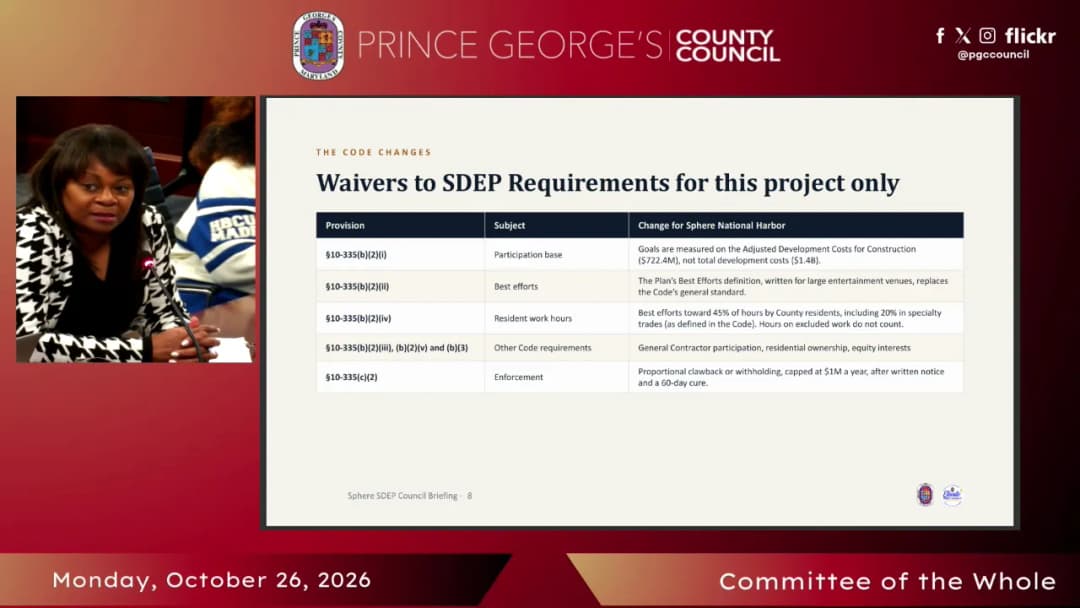
The Prince George's County Council met as the Committee of the Whole on Monday, October 26, 2026, at 2:00 PM in the Council Hearing Room in Largo, Maryland. Seven members were present for roll call: Chair Oriada, Vice Chair Olson, and Councilmembers Adams, Blay, Burroughs, Fisher, and Hunter. The committee reviewed the Supplier Diversity and Equity Plan for Sphere National Harbor, considered CR-121-2026 approving a tax increment financing proposal, endorsed the FY 2028 joint school construction priorities letter, and advanced CR-115-2026 on a county-owned grocery store pilot. The printed agenda listed only the first two items; the school construction letter and CR-115 were also taken up during the meeting. No minutes were available. Sphere National Harbor Supplier Diversity and Equity Plan Staff from the County Executive's Office and the Office of Procurement presented the Supplier Diversity and Equity Plan for the proposed Sphere at National Harbor. The plan, executed on October 19, 2026, applies to a $1.4 billion construction program. The venue would seat about 6,000 people, stand roughly 302 feet tall, sit next to MGM National Harbor, and is targeted to open in 2030, with site work beginning this winter. The county subsidy plan would attach $130 million in net tax increment financing proceeds under CR-121-2026. The plan measures requirements against a $722.4 million adjusted construction base rather than the full $1.4 billion. About $683.8 million in specialized costs are excluded, including proprietary Sphere show systems, the exterior LED display, ELV systems, immersive interior surfaces, bowl audio and show software, 4D systems, rigging, seating, and $88.3 million in design fees already issued. Staff stated that further exclusions are not automatic and require documented approval. Key commitments include: - At least 50% of the adjusted base, about $361.2 million, paid to county-based small businesses and locally owned and operated businesses. Staff described this as a requirement, not a goal. - Best efforts to reach 40% county-based minority business enterprise participation, about $289 million. - A combined local and minority spend minimum equal to the lesser of $280 million or 50% of the adjusted base, with a $130 million floor. - A best-efforts goal that 45% of construction hours go to county residents, including 20% in specialty trades. - County firms must perform a commercially useful function; pass-through arrangements do not count. Monitoring and enforcement were also outlined. The developer must file a preliminary report within 45 days, advertise solicitations at least 14 days before bids are due, report monthly and quarterly, pay county firms within 45 days, and face potential clawbacks or withholding of up to $1 million per year after written notice and a 60-day cure period. Waivers of participation goals require documentation and council approval. Councilmembers raised several concerns. One councilmember asked about penalties and was told the community benefits agreement has not been finalized, while SDEP penalties are up to $1 million. Councilmember Adams stressed the need for experienced staff on the ground to help county businesses build capacity, not just monitor reports, and urged that exclusions not become off-the-shelf opportunities. Chair Oriada expressed concern about having no hard local-hiring minimum and called the $1 million clawback cap low for a $1 billion project. Staff clarified that CR-21-2019 had a 40% resident minimum, while the plan negotiated 45% as a best-efforts target with documented outreach required. CR-121-2026 – Tax Increment Financing for National Harbor Staff explained that CR-121-2026 is required under CR-21-2019 before tax increment financing bonds can be issued for the National Harbor Development District and National Harbor Extraordinary Development District. The resolution approves the TIF proposal and certifications from the developer, the County Executive, and bond counsel. The developer requested waivers of CR-21-2019 requirements related to the trigger mechanism/lookback, equity participation and ownership, and delivery of a minority business enterprise plan. All remaining CR-21-2019 requirements would apply to bonds authorized under CB-111-2026. The County Executive certification and Bond Counsel certification were dated October 20, 2026. During discussion, a councilmember questioned the local and minority spend floor in the plan. Staff responded that the $280 million combined minimum represented a 100% success scenario, the $130 million floor was added so the developer could not reduce obligations if exclusions shrink the base, and any lower threshold would require extensive documentation and compliance-manager approval. The committee voted 7-0 to move CR-121-2026 favorably. Chair Oriada voted with the majority but said she felt uncomfortable with the absence of hard confirmed penalties for MBE participation and with the $1 million clawback cap, and asked to continue working on those concerns offline before the next day's session. A separate motion to accept the additions package also carried 7-0, though its specific contents were not identified in the transcript. FY 2028 Joint Capital Improvement Priorities Letter PGCPS and county officials presented the joint capital improvement priorities letter to the Maryland Interagency Commission on School Construction. The Board of Education's FY 2028 request is $51.9 million. It includes continuation of multi-year modernizations, including the Cool Spring regional special education therapy pool annex, High Point High School, and New Northern planning; planning approvals for Crossland High School and southern-area elementary and middle school analysis; and envelope replacement projects, including nine roof replacements and four window and door replacements previously excluded from state funding requests. The letter is intended to demonstrate alignment among PGCPS, the County Executive, and the County Council and to maximize potential state CIP funding. A councilmember asked about New Northern and the absence of a county match. Staff explained that High Point is further along in design and is receiving initial construction funding, while New Northern is still in the planning phase and does not yet require the county match. Another councilmember raised long-term possibilities for Lewisdale Elementary and its surrounding land; staff responded that district-wide facility and enrollment data is being updated to guide future priorities. Staff also confirmed that parking-lot projects would be funded through countywide categories in the spring budget rather than through this state request. The committee voted 6-0 to recommend chair signature on the joint letter. The item was expected to return for authorization the following day. CR-115-2026 – County-Owned Grocery Store Implementation Plan The committee reviewed CR-115-2026, sponsored by Chair Oriada. The resolution directs the Council Administrator to designate legislative branch staff to coordinate with executive agencies and outside entities on a pilot proposal for a county-owned grocery store. The intent is to expand access to affordable, healthy food in underserved neighborhoods. The proposal must address sites, community needs, ownership models, fiscal scenarios, operator selection, and success measures, and is due within 180 days of adoption. Chair Oriada moved favorable, Councilmember Hunter seconded, and the motion carried 6-0. Key Outcomes - CR-121-2026 was reported favorably by a 7-0 vote, with Chair Oriada requesting follow-up on MBE penalties and the clawback cap. - A motion to accept the additions package passed 7-0. - The FY 2028 joint school construction priorities letter was recommended for chair signature by a 6-0 vote and will return for authorization. - CR-115-2026 was reported favorably by a 6-0 vote. - The meeting adjourned following the CR-115 vote.
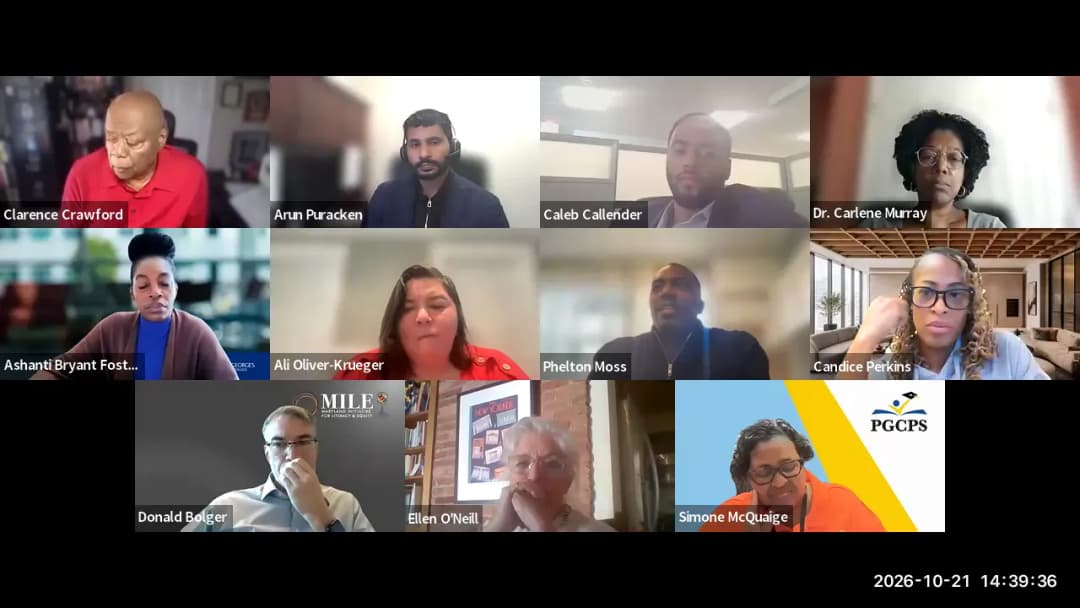
The Prince George's County Literacy Commission convened to review its high-leverage recommendations for improving literacy outcomes across the county. The meeting included an update on the MSDE Pre-K-through-12 literacy policy, feedback from the council's EWD committee, and a deep-dive discussion on eight draft recommendations spanning early childhood through adult workforce literacy. Note: The meeting transcription begins with the Chair calling the meeting to order on "Wednesday, October 21st, 2026, 2:00 PM", but the official metadata provided for this record dates the session as October 22, 2026. Consent Calendar - The September 16th, 2026 meeting minutes were approved by unanimous consent without objection. Discussion Items 1. MSDE Literacy Policy & Council Feedback Caleb Callender provided a follow-up on the state's updated literacy policy, including the approval of universal screeners (Amira ISIP, Amplified mClass, Renaissance Star Reading) and the creation of a K-3 student reading improvement plan. Dr. Parakin then shared feedback from Council Chair Adam Stafford emphasizing literacy incentives (award ceremonies, partnerships with local businesses). Chair Dr. Moss voiced strong support for creating a culture of reading through community-based rewards, sharing a personal example of earning pizzas for AR reading points. Candace Perkins suggested using council-member district funding to support these incentives equitably across the county. 2. Preliminary Recommendations Overview Dr. Parakin presented eight recommendations derived from the commission's prior work, structured around five themes: instructional coherence, consistent implementation, coordination among literacy organizations, access and equity, and accountability. The recommendations are: - Strengthen evidence-based core instruction, target intervention, and educator capacity. - Strengthen the birth-to-third-grade literacy continuum (including establishing a Maryland Book Bank in Prince George's County and a five-year goal of two-thirds of third graders reading at grade level). - Develop a coordinated family and community literacy strategy. - Establish a sustained countywide literacy coordination framework (permanent literacy steering committee). - Create a centralized literacy resource and navigation system. - Map existing literacy programs and participation. - Build a continuous literacy pathway from adolescence to adulthood and workforce preparation. - Establish shared measures, implementation accountability, and public transparency. 3. Commission Feedback on Draft Recommendations - Dr. Collins praised the ecosystem approach but cautioned against overloading the school system with new initiatives. She requested a crosswalk with current PGCPS work and state mandates to avoid duplication. - Dr. Bulger supported a full crosswalk with the MSDE Pre-K-12 policy and the Blueprint for Maryland's Future. He suggested refining metrics from "percentage of classrooms implementing with fidelity" to "effectiveness" to reflect genuine instructional impact. - Pastor Clarence Crawford stressed that the Board of Education and Superintendent must take a visible leadership role to drive culture change. He strongly advocated for standard, periodic public reporting to ensure accountability and allow the community to celebrate progress. - Allie Krueger emphasized the need for clear communication throughout the literacy ecosystem and for partners in the nonprofit and faith-based sectors to be invited to training to align their practices with the commission's goals. - Ellen O'Neill noted the county's existing data capacities (student reading improvement plans, dashboard, end-of-year testing) and posed the question of how to use this data to plan out-of-school-time interventions—for example, if a school has 14% ELA proficiency, how do districts plan for 70% of students needing interventions? - Candace Perkins requested that the recommendations be cross-referenced with the PGCPS strategic plan and suggested that council members allocate their district funding toward literacy incentives to ensure equitable access. - Chair Dr. Moss argued for elevating the recommendation to establish a permanent literacy steering committee as a top priority. He requested that the recommendations be ordered by priority (first, next, last) with target dates to aid implementation. - Simone (PGCPS) cautioned that the new draft Pre-K-through-12 state policy will add additional reporting requirements, reinforcing the need for a crosswalk. Key Outcomes - Vote: No formal vote was taken on the recommendations. The commission provided substantive feedback to refine them further. - Action Items: - Staff will create a crosswalk aligning the recommendations with PGCPS strategic plans, MSDE's Pre-K-12 policy, the Ready to Read Act, and Blueprint requirements. - The recommendations will be refined to be more action-oriented (ownership, metrics, timeline, priority order). - Members were asked to submit quotes for the final report and to send additional comments or materials to staff. - Next Meeting: November 18th, 2026, at 2:00 PM (virtual). - Future Steps: Chair Moss and Dr. Parakin will discuss whether additional meetings beyond the two remaining sessions are needed to finalize the recommendations for a formal vote. The final report will be submitted to the Prince George's County Council. - Closing: Chair Moss highlighted the upcoming PGCPS Board of Education meeting for literacy updates and encouraged members to attend. The meeting adjourned at 2:50 PM.