Prince George's County Council Public Safety, Health and Human Services Committee Budget Worksession - April 30, 2026
STREAMING COPY IN PREPARATION — RECORDING AVAILABLE FROM THE ORIGINAL SOURCE
Prince George's County Council Public Safety, Health and Human Services Committee Budget Worksession - April 30, 2026
The Public Safety, Health and Human Services Committee of the Prince George's County Council convened on Thursday, April 30, 2026 at 1:42 PM and adjourned at 3:49 PM. The committee held a worksession on the Fiscal Year 2027 proposed budgets for the Administrative Charging Committee, the Fire/EMS Department (including the Volunteer Fire Commission), and the Department of Social Services. No votes were taken on any of the budget items.
Public Comments & Testimony
- Donald Wells, President of the Prince George's County Volunteer Fire Rescue Association, expressed support for the current fire chief, stating she has been receptive and willing to work with volunteers. He noted that volunteers were overlooked in past administrations.
- Chief Janet Tamaran, of Volunteer Marine Fire Rescue, echoed support for the chief and urged the council to address barriers to volunteer recruitment, such as limited evening physicals and insufficient station funding. She emphasized that volunteers need to feel valued.
- Grant Walker, President of the Prince George's County Professional Firefighters and Paramedics Association (Local 1619), stated that the budget does not go far enough to hire enough personnel. He noted that roughly 10 firehouses are out of service daily due to staffing shortages, and called for significant investment in personnel, facilities, and apparatus to address the county's growing call volume.
Discussion Items
BU 2026-46 Administrative Charging Committee (ACC)
- The proposed FY2027 budget for ACC is $1.4 million, a 7% decrease from FY2026. The general fund portion is $1.3 million (a 3.4% increase), funding 8 full-time positions. Grant funding compensation decreased 50% due to reductions in violence intervention programs.
- Key concerns include vacancies awaiting approval, insufficient funding for administrative law judges, expiring grants, increasing case volume, and cases resulting in reduced penalties.
- Director Isabel Williams requested assistance with IT interns to support a new case management system (federal funding sunsets in 2027) and expressed a long-term need for a full-time analyst to identify trends in police misconduct.
- The committee noted that one investigator position is vacant and several citizen committee appointments are expiring.
BU 2026-48 Fire/EMS Department (including Volunteer Fire Commission)
- The proposed FY2027 budget is $325.9 million, a 12.1% increase. 96.8% of funds are from the general fund. The department anticipates a supplemental request of approximately $1.5 million. Staffing increases include 22 civilian positions and 46 sworn positions. There are currently 149 general fund vacancies.
- Fire Chief Michelle Liddell highlighted accomplishments including reducing mandatory overtime by shifting 35% of sworn personnel from civilian roles, launching a driver risk intervention program, and increasing recruiting. She emphasized the need for more civilian employees to return sworn personnel to fire stations.
- Discussion focused on cross-training for firefighter/paramedics, hiring timelines (currently about nine months), retention through salary and deferred retirement options, and recruitment of volunteers. Chief Deputy BJ Harris noted that 71 members are retirement-eligible in the next 12 months.
- Volunteer Fire Commission: The proposed budget is $20.5 million (1.5% increase). There are 36 volunteer corporations with 1,168 volunteer personnel. Concerns include aging facilities, declining volunteer numbers, and equipment replacement. Assistant Fire Chief Michael White noted the LOSAP (Length of Service Award Program) had setbacks but a new administrator was hired.
- Council members expressed interest in increasing the sworn complement and addressing disparities in pay and benefits.
BU 2026-47 Department of Social Services (DSS)
- The proposed FY2027 budget is $27.9 million, a 6.8% decrease primarily due to reduced grants in the Community Services Division. Only 4% of the department's 685 authorized positions are county-funded.
- Director Jennifer Omaña Thompson outlined strategic priorities: improving culture, using data, and enhancing partnerships. The department serves about 350,000 residents, with 500 staff across five locations.
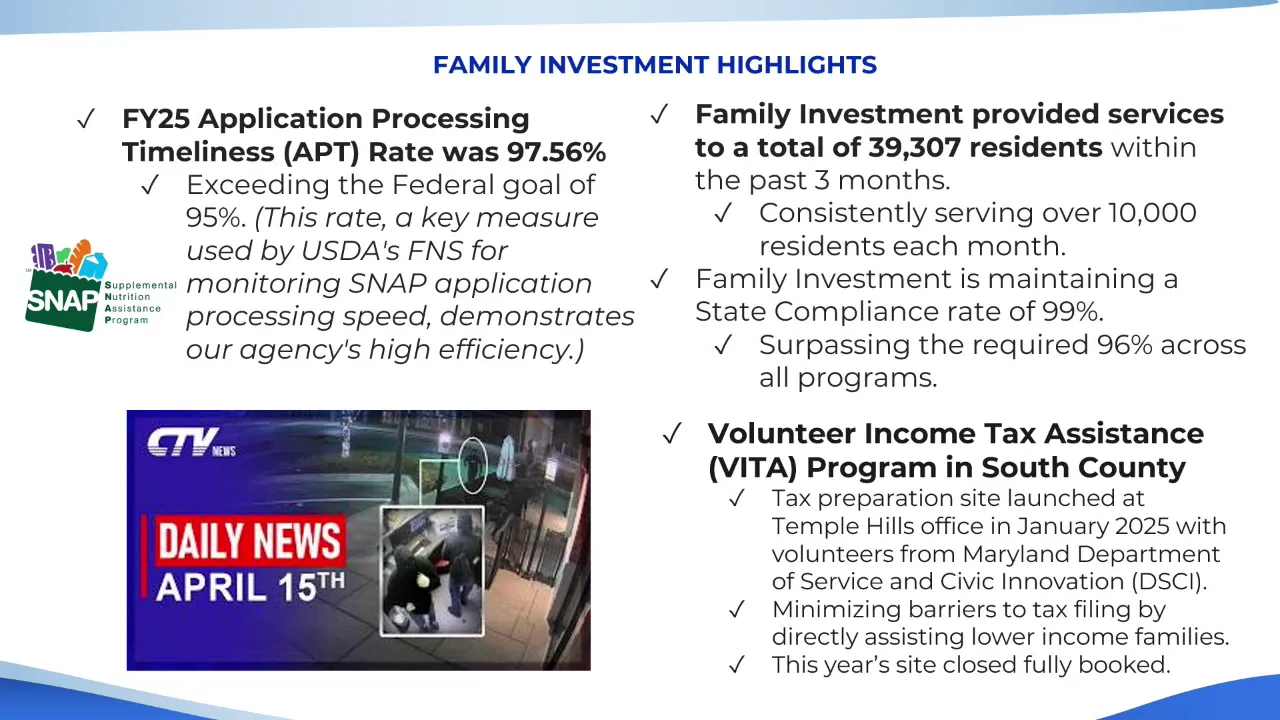
- Key achievements include exceeding 95% payment timeliness for SNAP, launching an after-hours unit for child/adult protective services, and increasing internship programs.
- Vacancies dropped from 39% to 18% in FY2025. Risks from vacancies included staff burnout and quality concerns.
- Discussion covered coordination with schools (community advocates in 20 middle schools), services for unsheltered residents, and the impact of federal changes from a "housing first" to a "treatment first" model for HUD funding. The committee urged DSS to provide direct contact for constituent services and to address drug addiction and homelessness on University Boulevard before the Purple Line opens.
- The Community Services Division (including homeless shelters and food pantries) is transitioning to the County Executive's Office.
Key Outcomes
- No votes were taken on any of the three budget items; discussions will inform the full Council's budget deliberations.
- The committee will follow up on: an advertisement for citizen committee vacancies for ACC; details on the Volunteer Fire Commission appointments; a strategic plan from DSS regarding changes in federal funding; and a site visit to address homelessness on University Boulevard within 30 days.
- The committee expressed interest in increasing the sworn complement for Fire/EMS and exploring parity with the police department on deferred retirement options.
Meeting Transcript
Good afternoon, everyone. Good afternoon. My name is Wenika Fisher, and I have the honor of chairing public safety health and human services for the Prince Georges County Council. Today we continue with our budget hearing sessions for fiscal year 2027. And today we'll be going over the I'm changing the order a little bit. Uh the budgets for the administrative charging committee, our fire emergency medical services department, and then our department of social services. First, we'll start with our administrative charging committee. Um, but before I continue, I forgot I got a call to order to the committee. So, madam clerk, if you can call the role. Councilmember Fisher present. Councilmember Hunter present councilmember Oyada. Councilmember Burroughs. We have four at present. We are acting in full committee. And now I will turn to Mr. Nathaniel Tutt, who is our amazing committee director to introduce our first agency, the administrative charging committee, and you can come to the table, those that will be presenting. Thank you, madam sheriff. First, as you said, the administrative charging committee, and that's led by director, Miss Isabel Williams, who's joined us at the table. And on page 12, you'll find the report uh for the from the agency. And uh next will be Mr. Malcolm Moody, who will provide an overview. Uh good afternoon, uh Chair Fisher and the rest of the council. My name is Malcolm Moody, budget and policy analyst. Uh, and then I'm going to start with the administrative charging committee uh committees uh presentation. And then uh on the okay, there we go. And then uh on this slide, I'm just going uh to highlight the organizational structure, which is on the left, and then the uh top right, which uh shows the main mission for the ACC, and then the bottom right, which also shows the uh core services. This information is in the budget book. This next slide is on the strategic focus for the ACC, and then uh some of the strategic focuses for fiscal year 27 uh 2027 for the ACC are uh improving turnaround times for findings, streamlining the review process, and strengthening collaboration with key stakeholders. This slide is uh focusing on the fiscal year 2020 2027 budget for the ACC, and they at the top is a multi-year chart of the expenditures by fund type, and then below is the uh fiscal year 2027 proposed budget, which is broken down, and you see it's proposed at 1.4 million, and then the proposed budget is a uh it's decreased from the fiscal year 2026 budget by uh seven percent. The next slide is covering the general funds for this uh for the proposed fiscal year 2027, and then uh the amount proposed is uh 1.3 million, and then this is an increase of 3.4 percent or 42,300 from the fiscal year 2026 budget, and the uh general fund compensation is proposed at 700 745,500, and this is an increase of 41,500 from the fiscal year 2026 budget, and this helps fund uh eight full-time positions. And you'll also see on this chart uh this slide that the um operating has decreased in the uh net decreases due to revised projections for trial staff in case hearings, and then the operating expenses uh also the operating expenses help support trial prep trial board uh judges, stipends, and community awareness events, and then uh fringe benefits have also increased. This next slide is uh highlighting the staffing and grant funding for the uh ACC. And you'll see the grant funding compensation is uh proposed at 150,000, which is a 50, it's a 50 percent decrease from the fiscal year 2026 budget, and this is due to a reduction in the violence intervention and prevention program in the uh operating grant expenses or use of support program operational expenses. Uh and I already uh noted the full full-time uh eight full-time positions in the previous slide. And then this slide is going over state legislation. Uh none of the state legislation uh made it to the governor's desks, but it was potentially going to affect the ACC if it did. Uh I just wanted to include it in the slide. And then on this uh last slide is just highlighting the uh these are essentially the biggest concerns for the ACC. Uh the top one I wanted to note was the uh vacancies, which are awaiting necessary approvals, and then the also funding. Uh funding is not fully accommodating the growing costs for the administrative law judges. Uh funding is not fully accommodating the growing costs for the administrative law judges, and you also see additional uh concerns such as grant funding expiring, uh case load volume, which is increasing every year, and then there's a strain on resources uh during the administrative hearing board process as funding levels tied in. And then finally, there's also reviewed cases that have resulted in reduced penalties. That ends my presentation. Thank you. Thank you, Mr. Moody. Now we'll turn to Ms. Williams, uh, our program manager for the administrative car charging committee. Thank you, Chair Fisher. Um, Mr.
openpublica.com