Prince George's County Council Holds M-NCPPC FY 2026-2027 Budget Hearing, May 11, 2026
STREAMING COPY IN PREPARATION — RECORDING AVAILABLE FROM THE ORIGINAL SOURCE
Prince George's County Council M-NCPPC FY 2026-2027 Budget Public Hearing - May 11, 2026
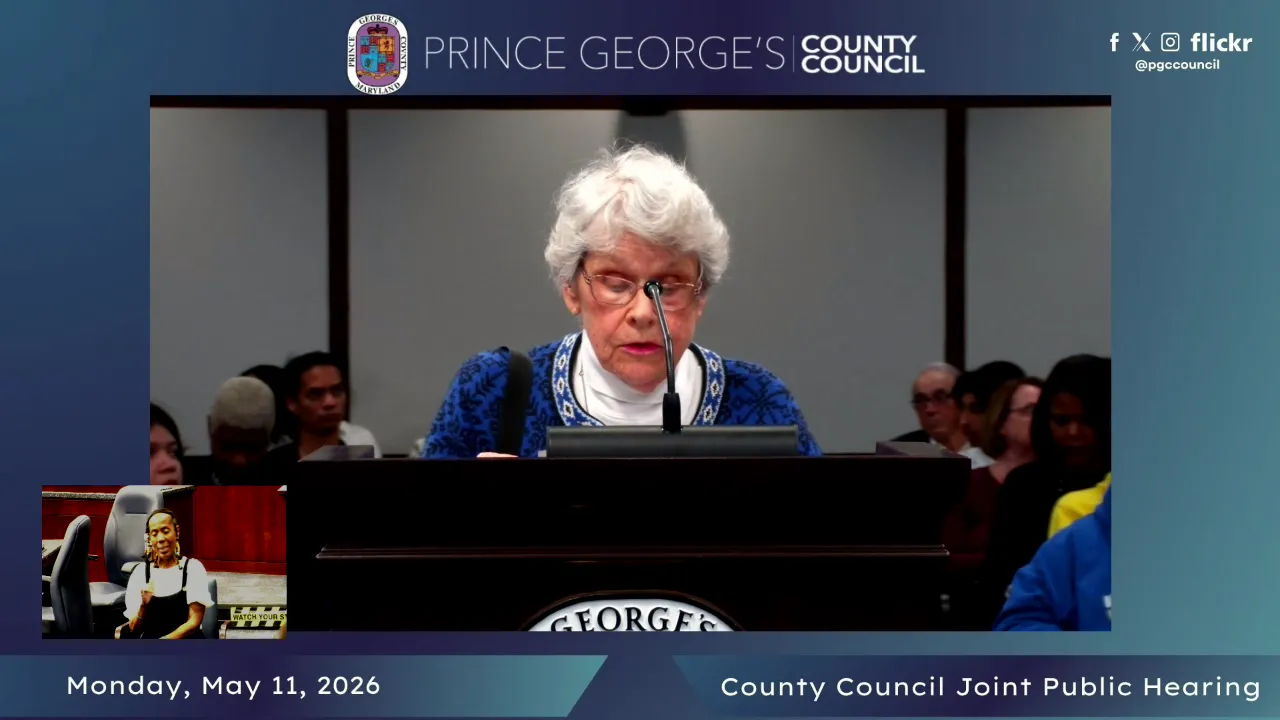
The Prince George's County Council reconvened its business meeting on Monday, May 11, 2026, at 7:16 p.m. in the Council Hearing Room in Largo, Maryland, to hold a joint public hearing on the Maryland-National Capital Park and Planning Commission (M-NCPPC) proposed fiscal year 2026-2027 operating and capital budgets and the M-NCPPC Capital Improvement Program for fiscal years 2027-2032. Chair Krystal Oriadha presided; seven members were present at roll call, with Thomas Dernoga and Timothy Adams participating remotely and on camera; Sydney Harrison and Danielle Hunter were absent. Council Members Fisher and Adams-Stafford arrived later. The public hearing concluded at 9:10 p.m., and the council adjourned at 10:00 p.m.
Staff Budget Analysis
- Arian Albear, Director of Legislative Impact, presented a budget analysis prepared with Karen Zavakos. General trends: revenue is usually under-budgeted and finishes higher than budgeted; expenditures are usually over-budgeted and finish lower.
- For the administrative fund, revenues trend about $4.5 million higher than budget; for parks, about $7 million higher; for recreation, about $5 million higher. FY 2026 year-to-date still includes six months of unrealized revenues.
- Expenditures trend about $15 million lower for administration, $10 million lower for parks, and $13 million lower for recreation, with about three months of FY 2026 spending not yet included.
- Fund-balance use correlated with M-NCPPC headquarters construction in FY 2022 and FY 2024; fund balance increased in FY 2021, FY 2023, and FY 2026 year-to-date.
- Council Member Burroughs asked for the total spent on the headquarters. Staff said the original building was $155 million, a requested increase was lowered from $300 million to $85 million, and the total was about $195 million, to be verified for the record. Chair Oriadha criticized the headquarters as a vanity project and referenced a '$495 million dollar building' in the transcript; the discrepancy with the $195 million estimate was not resolved on the record.
Public Comments & Testimony
- Student Leadership Academy (SLA): Dozens of District 8 SLA students, parents, success coaches, and program staff testified in support of continued and increased funding. Program director Jonathan Harris said SLA grew from 75 students last year to 300 this year. Students described workshops, mock interviews, CPR certification, travel experiences, and gains in confidence, public speaking, and career readiness. Many explicitly asked the council to continue or increase funding. Chair Oriadha noted that more than a hundred additional students were present but had to leave before testifying.
- Landover Data Center: Taylor Frazier McCollum, on behalf of more than 60 local organizations, small businesses, and elected officials, opposed the proposed Landover Data Center. She said more than 23,000 people signed her petition, that tax waivers for hyperscale data centers would cost the county and state money, and that residents want a permanent ban on AI data centers. She also said SLA should be countywide, not limited to District 8.
- University of Maryland Extension and Project Charge: Matt Parker requested restoring and strengthening extension funding for FY 2027, citing a core county allocation of $208,000 that leverages over $1 million in programming, more than 8,500 direct participants, and outreach to over 14,000 residents. He asked for an additional $95,000 to replace youth nutrition education capacity after losing SNAP-Ed, which served more than 2,600 participants, including over 2,500 youth. Daniel Donahue, president of the PG County Farm Bureau, said the Farm Bureau supports 100 percent of the University of Maryland Extension budget request.
- Project Charge access: Mel Johnson, executive director of The Storehouse, said the reimbursement model hurts small minority-led organizations that cannot front costs. Megan Baco, executive director of Anacostia Trails Heritage Area, requested an increase in Project Charge funding to support countywide cultural tourism and match up to $200,000 in state funding. Susan Pearl of the Prince George's Philharmonic asked for continued Project Charge support, citing the orchestra's 61st season and student music lessons. A Lake Arbor Foundation representative asked for continued and increased support to expand its summer camp and hire a program director.
- Parks, trails, and facilities: Mayor Fazlul Kabir of College Park requested trail maintenance after winter storms, winterizing a restroom at Acredale Community Park (transcribed as 'Arkville'), and a water fountain/filling station. Melissa Schweisguth requested more trail investment, South County and east-west connections, lighting and cameras at Chillham Park, invasive-species work, and dog parks. Halley Fernando of MORE urged funding for natural-surface trails, citing about $30,000 per dirt-trail mile versus $1 million per paved-trail mile and offering 17,000 volunteer hours annually. Rory Lehman asked M-NCPPC to buy a used Wurlitzer 153 band organ for the Watkins Park Carousel. Henry Wixon of the Glendale Citizens Association requested funding for historic Glendale Hospital stabilization, adaptive reuse, and a regional park master plan, and objected to bond funding for a multi-generational facility at the Glendale Community Center. Brian Willis requested upgrades to the Sports and Learning Complex, citing 5,000 youth athletes, an annual international meet with 2,500 athletes, and events lost because of inadequate facilities. Janet Gingold urged more programming for natural places and reported student calls for safer parks, lighting, ranger presence, and better transit access. Jocelyn Alexander, chair of the Parks and Recreation Advisory Board, encouraged asset stewardship, safety, and capital planning and highlighted needs at the Sugar Ray Leonard Boxing Center.
- Community support for M-NCPPC and specific services: Tyrone Patterson, Robert Pettis, Terry Cotton, and Wilbert Nicholson spoke in support of M-NCPPC funding and Boys and Girls Club partnerships. Belinda Queen Cunningham requested completion of a regional park and investment in the Wilburn community, which she said lacks basic park amenities despite decades of tax payments. Elise Thompson, a District 2 parent, praised M-NCPPC disability services after her child with complex disabilities was welcomed, and Chair Oriadha said the budget will direct more money to disability services. Renee Gibbons asked the council to preserve and expand senior programs; Chair Oriadha said senior services will expand. Dr. George Hodge requested support for Community Kinship Coalition's violence intervention and Hoops for Peace programs.
Key Outcomes
- The joint public hearing was declared held after registered speakers testified; no budget vote was taken.
- Chair Oriadha stated the council will not increase taxes, will balance the budget without drawing down fund balance, and will shift spending from headquarters and top-heavy overhead to direct services such as rec centers, seniors, and disability programs.
- Council staff committed to providing the exact M-NCPPC headquarters project cost for the record.
- The council adjourned at 10:00 p.m. by unanimous vote on a motion by Council Member Dernoga, seconded by Council Member Adams.
Meeting Transcript
And get started. All right. Good evening. We have now reconvened. Again, today is Monday 11th, 2026. This is a business meeting. We are having a public hearing on Maryland National Capital Park and Planning Commission. Proposed fiscal year 26-27 operating and capital budget and the MNC PPC Capital Improvement Program for Fiscal Year 27 through 32. I'm Councilman Crystal Orieta. I have the pleasure of representing District 7 and also serving as the chair of the county council for this year. And members of the Planning Board to introduce themselves, starting with my vice chair. Good evening, Eric Olson, Vice Chair representative District 3. Good evening, Walla Plaquet, Councilmember at Large. Jolene Ivey, Council Member at Large. Edward Burroughs, this for Kate. And we do have Councilmember Tim Adams and Councilmember Denoga online. Good evening, Count Dunaga Council District 1. Good evening. Timothy Adams, Council District 4. Thank you. Now I'll allow the planning board to introduce themselves. Good evening, Lori Matthews, Commissioner. Good evening, Manuel Giraldo. Commissioner. Good evening, Brittany Jenkins, Commissioner. Good evening, Billy O'Coy, Commissioner Park and Blue. Thank you. So if this is your first time joining us, there is a clock that's at the front, and it'll be two minutes on the clock. But if you don't hear it, I will gently uh remind you that your time is up. Written statements may be submitted for the record in addition to or in lieu of any verbal testimony that's given today. Written testimony or comments will be accepted in electronic format rather than by US mail via the council's e-comment portal. For those unable to use the portal, comments, written correspondence may be emailed or faxed to 301-9525-178. And comments should be addressed to the Honorable Crystal Oriella Chair, Prince George's County Council, Wayne K. Curry Administration Building, 1301 McCormick Drive, Largo, Maryland, 2077 4. Uh for today's agenda. We'll have a brief analysis presentation by our staff, and then we'll open up to the public hearing and hear from the comments. Now I'd like to pass it on to our staff for a brief orientation. There you go. Good evening, Councilmember, staff, and residents. My name is Ariana Albear, Director of Legislative Impact for the County Council. And together with Karen Savacos, Associate Council Administrator, we were tasked with analyzing a high-level uh providing a high-level budget analysis for the past few fiscal years of the Maryland National Capital Park and Planning Commission. The general trends that we found looking at their uh budget and actual comparisons was that general revenues are generally under budgeted uh and come higher in the fiscal year actual uh totals. Expenditures are generally over budgeted and come in lower in fiscal year actual. Sorry to stop you. I just didn't see those slides. They're on our stream. Oh, okay. I didn't know if they were on for the public, but you can continue as they're working to put those up. Budgeted use of fund balance is rarely used in the fixture fixed fiscal year actual uh totals for operating expenditures. Uh overspending is only budgeted when taking into consideration capital fund and debt fund expenditures, and even when accounting for those two that uh the use of fund balance is generally lower than the budgeted amount.
openpublica.com