FY2026 Budget Work Session – February 17, 2025: Resident Engagement, CIP Preview, and Long-Term Planning
STREAMING COPY IN PREPARATION — RECORDING AVAILABLE FROM THE ORIGINAL SOURCE
FY2026 Budget Work Session – February 17, 2025
The Raleigh City Council held its first FY2026 budget work session on February 17, 2025, at 4:00 PM in the City Council Chamber. Staff presented results from resident engagement, a preview of the five-year Capital Improvement Program (CIP), and a long-term financial planning model for a "steady state" bond approach. Council members discussed priorities, requested district-specific data, and raised concerns about communication and operational costs related to future bond referendums.
Resident Engagement Results
- Sadia Sitar, Budget Director, reported on outreach efforts including social media, digital ads, radio (English and Spanish), bus ads, water bills, and in-person sessions at five community centers plus a "Budget and Brews" event at Clouds Brewing on Front Street.
- Five targeted questions were asked using Slido live polling. Key findings: over half of respondents valued parks, greenways, trails, and pools; residents wanted more sidewalks, street maintenance, bus frequency/shelters, traffic calming, and affordable housing. When asked what to cut, "leaf" (seasonal loose leaf collection) was the top response.
- 121 people participated across sessions, with multiple responses per person. 35% were aware of the budget dashboard, and 11% had used it.
- Council member Jones noted that employee pay was raised in her district, and she praised increased attendance (from 5 to 19–23 people in District E).
Capital Improvement Program Preview
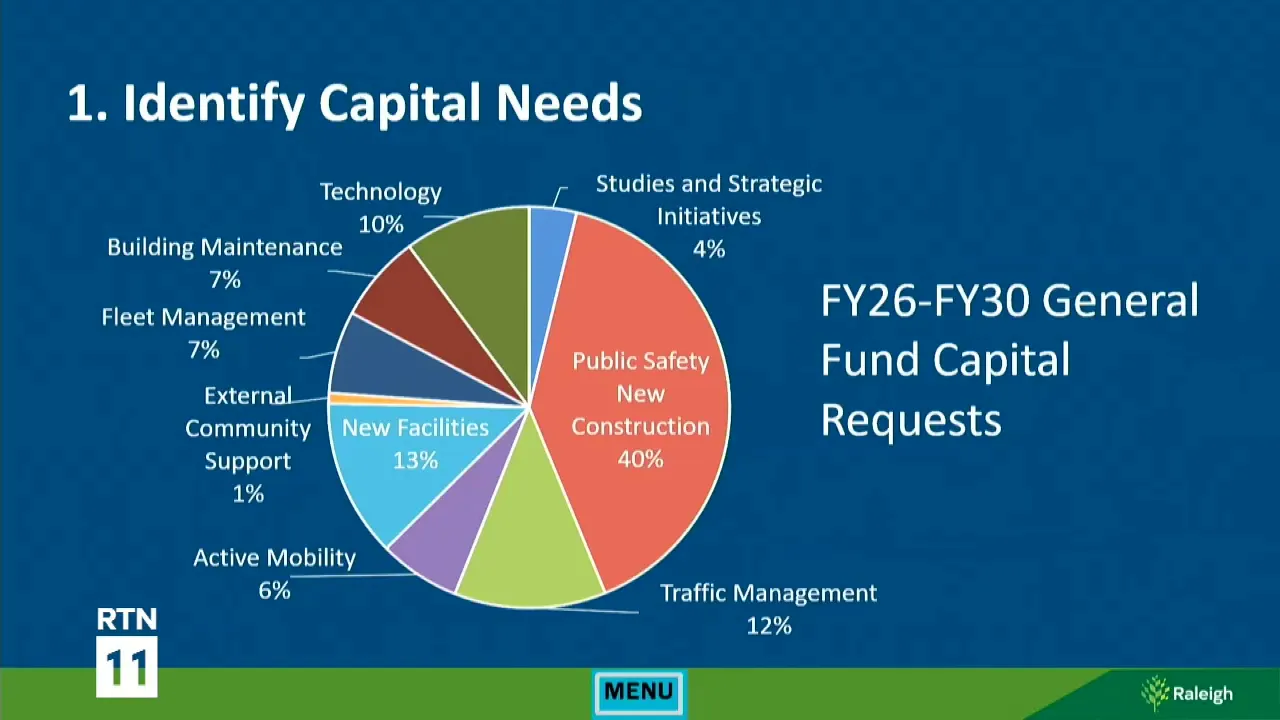
- Hannah Osborne, Senior Capital Programs Analyst, defined capital budgeting terms and presented requested capital needs for FY2026-2030: 40% public safety construction (fire stations), followed by transportation, traffic management, active mobility, external community support, building maintenance, and technology.
- Evaluation criteria weight safety, urgency, and regulatory compliance by a factor of three over other criteria. Council member Silver asked for a breakdown of transportation bond spending (roads vs. sidewalks/bikes).
- Council member Branch asked about equipment costs for new fire stations; staff confirmed operating impacts are captured separately.
- City manager stated that the city is testing shared facilities (police, fire, ECC) at Station One and headquarters to reduce costs.
Long-Term Financial Planning
- Alison Bradford, Finance Director, presented a "steady state" model with dedicated funding allocation from property and sales tax, advanced capital planning (two-step approval process), and regular bond referendums every four years.
- Estimated debt capacity: $90 million every four years with no tax increase; $210 million with a 1-cent property tax increase; $330 million with a 2-cent increase. Any tax increase would occur in FY28.
- Council members raised concerns about voter understanding of mixed-purpose bonds, operational costs of new facilities, and potential bond fatigue. Council member Patton requested sample ballot language and examples from other cities.
- Council member Jones noted that more frequent bonds (every two years) could lead to more frequent tax increases and resident confusion.
Key Outcomes
- Council requested district-level engagement data and a breakdown of transportation bond spending by mode.
- Council requested that staff provide sample ballot language and research other cities' experiences with steady state models.
- Budget work session dates set: March 10 (HR, compensation study, benefits), April 7 (annual grants, enterprise departments), and May 20 (proposed FY26 operating budget and five-year CIP presented).
- Staff will coordinate with county partners on bond schedules to avoid voter fatigue.
Meeting Transcript
We will start the budget workshop and I will turn it over to our city manager. Good afternoon, Mayor and Council. This is the most favorite time of the year for many of us in local government. And so today we will present our first budget work session in the budget development process of our FY26 budget. So I will turn it over to Sadia Sitar, who is really smiling because it is really her favorite time of the year to present the two items we have today. Yes. It really is our favorite time of the year. So good afternoon, Mayor and City Council members. I'm Sadia Sitar, Director of Budget and Management Services here in the City of Raleigh. And as the city manager mentioned, this is the kickstart to the fiscal year 26 budget development process. Delighted to be here in front of all of you. My third year in a row talking to you all about budgets. But what I am here to talk about today is the engagement that myself and my team conducted as part of the fiscal year 26 budget process. We have a ton of highlights to share with you all today. And then in your second session, um, later after myself, um, you'll hear from our senior capital programs analyst Hannah Osborne about giving you a preview of the Capital Improvement Program as well as our CFO, Alison Bradford talking to you all about the long-term financial planning here in the city of Raleigh. So as the city manager mentioned, I am here to chit chat with all of you this afternoon about the engagement that we conducted as part of our budget process here. Uh my uh goal this afternoon is to chat with you all about the outreach that we conducted as part of the process, uh go into how we conducted our listening sessions and how they've differed from prior years, and then really spend a lot of time on the feedback that we heard from our community members, and then talk to you all about some next steps as part of not only what we've heard, but also what's to look forward to as part of these budget work sessions moving forward. So let's get started about talking about fiscal year 26 budget engagement. So we have um, and as I said, this is my third year of doing this here with the city of Raleigh. So the budget efforts that we conducted as part of fiscal year 26 really benefited from the critical lessons that we've learned in prior engagement cycles. Um, in particular, we worked diligently with our communications department to expand outreach efforts through social media, digital advertising, email marketing, and as you can see, print um and radio as well. Uh you might have seen us on W O R A L in the mornings as you're getting ready for work. Um I also did a less than two minute stint uh on Despierta Raleigh. Um we were on the radio in both Spanish and English. Uh we were also on these Ike kiosks, as you can see to the right of your screens here in downtown. We were advertised in Go Raleigh buses, we were in the Carolinian, and we were also in Go Raleigh, sorry, uh we were also in Raleigh Water Bills. Um, again, trying to get the word out as much as possible and trying to reach diverse audiences as part of this effort. So our listening sessions again were a little bit different this year. Um, unlike prior years where we've done, you know, we started with three sessions, we then expanded to 15. But what we really learned as part of the process was that it wasn't the quantity, it was the quality. It was the questions that we were asking our residents to give them the feedback. So we did two virtual sessions. We actually started in December. Um, and why December? Just like I've said in the past, we didn't just have a municipal election, we had a presidential election in November. So a lot of our uh community centers were occupied um as early voting sites. And then we also did our very popular budget and brews event. We brought it back this year. This year we took the feedback that we received from residents and we left downtown. We went to Clouds Brewing on Front Street, got a fantastic viewing, even though it was a very cold and rainy evening. Um, so that was a plus. Um and then we also held five in-person sessions. Again, uh, I did want to highlight that we again focused on accessibility through the provision of essential accommodations that included providing interpreters, should anybody need any. We provided folks the option to ask for interpreters during the sign-in process. And then we also uh offer childcare services to our personnel at parks, recreation, and cultural resources. So huge shout out to both communications and PRCR for assisting us for a third year in a row as we did engagement. You'll also see in the slide in front of you that we visited all of your districts here. We held in-person sessions in the evening, on weekdays, on weeknights, sorry, at Abbots Creek, Millbrook, Laurel Hills, Poland Park, as well as Barrow Road. So again, trying to make sure that we hit all these different sites just like we've done in prior years as well. So what was the purpose of our listening sessions?
openpublica.com