Browse by city
Date range
Search help

Search titles, summaries, topics and stored transcripts together. Keywords may match separately; put the whole query in double quotes for a phrase. Matching follows word analysis, so punctuation is not exact. Both dates are included. Documents are not searched.

SHOWING 1–10 ENTRIES
01
SEP 15, 2026 · RALEIGH, NORTH CAROLINA · CITY COUNCIL
Raleigh City Council Regular Meeting - September 15, 2026

The Raleigh City Council held its regular meeting on September 15, 2026, opening with the Pledge of Allegiance led by Councilor Silver and a recognition of special awards. The agenda included a consent calendar, public comments from 22 speakers, multiple zoning and text amendment items, a public art ordinance update, a Police Advisory Board report, a revenue and budget outlook, pedestrian safety and micromobility discussions, public nuisance lien confirmations, and board nominations. Consent Calendar - The consent agenda was approved unanimously with no items pulled. Public Comments & Testimony - Twenty-two speakers addressed the Council under a two-minute limit. Topics and positions included: - A request for dog parent training classes for residents interested in adopting a dog in the city. - Opposition to a teen curfew ordinance; one speaker said the Council is "punishing our city's teenagers for something they are not responsible for." - A comment on income tax and North Carolina being business friendly. - A Guatemalan American Raleigh resident who spoke with pride about their culture. - A District C resident voiced opposition to both the teen curfew ordinance and AI data center infrastructure being cited in and around the city. Discussion Items - Z-15 - 7600 Falls of Neuse Road: The Council reviewed a zoning item. Members voting in opposition were supporting retention of the neighborhood conservation overlay district. - Custom Signage Plan / Billboard Policy: Councilor Silver requested a map of potential impacts and benchmarking of other cities' policies. Mitigation ideas included caps on total square footage or total number of signs to avoid an unlimited number of 300-square-foot signs. - Public Art Ordinance Update: Staff proposed allowing more members on panels where needed, removing written examples of eligible capital projects that have caused confusion for 20 years, engaging artists at the advanced planning stage, and increasing public art funding to one percent. The ordinance change with strike-throughs will return October 6, 2026, for final approval. A council member asked whether it would apply only to two projects at inception or also to incomplete projects like New City Hall. - Police Advisory Board Report: Chair Cole McMullen reported on the board's liaison work between the community and City Council, including community events, the community police academy, RPD ride-alongs, and safeguards for the Connect Raleigh doorbell camera program (RPD follows a process to request footage). A motion to codify what one council member described as "a very informal relationship that's currently existing" passed 6-2. - Revenue and Budget Outlook: Staff reviewed the FY28 budget outlook, emphasizing economic uncertainty. - Pedestrian Safety: Council members discussed the public right of way as the largest continuous public space and the need for accessibility for people not in vehicles. One member, a bicycle commuter, called for more focus on the pedestrian landscape, noting that "tragic outcomes do often bring us to action." - Public Nuisance Lien Confirmations: The Council confirmed liens, including a second abatement on one property. - Z-81: The review included the least brook lamprey, an endangered species in North Carolina identified in a stream on the site, a requested additional story of height, and sod stabilization around stormwater control measures. The public hearing closed with no one signed up in opposition. - Affordable Housing Rezoning (City-Initiated): Staff presented a city-initiated rezoning of city-owned property for a subsidized affordable housing project with good access to BRT (Bus Rapid Transit). Language will prioritize retaining trees between the site and townhomes on Bradford Pair Court if those trees belong to the city. - Z-1826: The Council reviewed a consistency statement dated September 15, 2026, and an associated zoning amendment. - Subdivision Regulations Text Change: Discussion covered a provision allowing tracts no greater than two acres to be split into no more than three lots without new street dedication. Eight speakers signed up in support; none in opposition. One speaker urged the Council to help build homes in Raleigh by supporting the text change. A land surveying company representative stated that under current standards, their company "will not do minor small subdivisions in City of Raleigh." - Parking Enforcement: Staff reported more than 300 parking-related reports since February 2025; after a second warning, users are cited, and about 40 users have been fined. - Micromobility and Accessibility: Discussion covered scooter and bike parking, riding on sidewalks versus streets, and the need to keep paths clear for elderly and disabled residents using wheelchairs or other mobility devices. - Parks, Recreation and Greenway Advisory Board Nominations: Two regular vacancies were considered; two members with expiring terms sought reappointment. Key Outcomes - Consent calendar approved unanimously. - Z-15 zoning amendment approved; opposition votes supported retaining the neighborhood conservation overlay district. - Motion related to the Police Advisory Board passed 6-2. - Public nuisance lien confirmations approved unanimously. - Z-81 zoning amendment approved with the consistency statement dated September 15, 2026. - City-initiated affordable housing rezoning approved with the consistency statement dated September 15, 2026. - Z-1826 zoning amendment approved with the consistency statement dated September 15, 2026. - Subdivision regulations text change approved with the consistency statement dated September 15, 2026, as required by North Carolina law. - Public art ordinance change scheduled for final approval on October 6, 2026. - Parks, Recreation and Greenway Advisory Board reappointments approved unanimously.
PROCEDURAL 37% · LAND USE AND ZONING 11% · PUBLIC SAFETY 6% · PUBLIC ENGAGEMENT 6%
02
SEP 15, 2026 · RALEIGH, NORTH CAROLINA · CITY COUNCIL
Raleigh City Council Work Session on Water Supply – September 15, 2026

The Raleigh City Council held a work session on September 15, 2026 to receive updates on the current drought status, water usage statistics, and long-term water supply alternatives. Presenters included Ed Bucken and Whit Wheeler from Raleigh Water. Councilor Jonathan Lambert Melton was absent and excused. The session included detailed presentations on drought recovery, water demand, conservation, and future supply projects. Discussion Items - Drought Update: Ed Bucken reported that most of North Carolina remains in some level of drought, but conditions have dramatically improved since June when the Falls Lake Basin experienced D5 (exceptional) drought. Heavy rainfall on July 23 provided 4–5 inches in the basin, raising the lake about 2 feet. The water supply pool is currently at 79%, well above the Stage 1 drought trigger of 45%. Pumpage is stable around 66 million gallons per day (MGD). A statistical model (Oasis) shows a very low probability (≤10%) of reaching 50% supply pool in the coming months, and a strong chance of recovery through winter due to a shift to El Niño conditions. - Water Usage & Conservation: Residential accounts constitute 61% of demand. The gallons per capita day has steadily declined over 25 years, partly due to tiered rates and efficient appliances. During the Stage 1 restrictions (April 20–August 3), compliance was initially good but declined in late May/June. Staff monitored 11,000 irrigation meters and cited those using over 748 gallons on non-permitted days. This enforcement improved compliance. Future revisions to the water shortage response plan will evaluate triggers, discretionary uses (e.g., athletic fields, drip irrigation), and the spacing of permitted irrigation days to reduce peak demand. - Long-Term Water Supply Alternatives: Whit Wheeler presented the Triangle Water Supply Partnership’s regional plan, projecting demand growth from 170 MGD (2022) to over 400 MGD by 2070. For Raleigh, near-term options include upgrading Lake Benson and Lake Wheeler dams with crest gates (adding 2.5 MGD for $3.5 million) and studying potable reuse via reclaimed water at the Benton plant (potential 3.5 MGD). Major alternatives analyzed: Carr Lake (38–45 MGD, high cost $1.8–2.4 billion, interbasin transfer complications), Neuse River intake (15–45 MGD in phases, cost $540–890 million, lower per-gallon cost), and Little River Reservoir (12–18 MGD, high mitigation cost due to threatened species, over $1 billion). Staff are focusing further study on the Neuse River intake option, with water quality modeling ongoing through summer 2027. - Council Questions & Comments: - Councilor Harrison asked about the water quality pool (40% level) and opportunities for conservation to extend supply. Staff noted that year-round restrictions (like Cary’s) and a communication campaign are being considered. A follow-up report on policy options was promised. - Councilor Branch inquired about the Neuse River intake location (near Poplar Creek on city property near the shooting range) and the timeline (target online by 2040). He also asked about the Little River Reservoir environmental impact study; staff confirmed it is public. - Councilor Patton commented on improving the water shortage plan: closing the drip irrigation loophole, strengthening economic disincentives, improving public communication (e.g., smart meter apps), and reducing non-functional lawns. She also requested clarity on the long-term supply decision timeline; staff indicated a decision may come in summer 2027 after water quality modeling is complete. Key Outcomes - Water Shortage Response Plan Revisions: Staff aim to complete updates by the end of 2026, incorporating lessons from the 2025–2026 drought, including La Niña triggers, irrigation day spacing, and revised reduction targets. - Future Water Supply Direction: Staff will continue studying the Neuse River intake option, conducting water quality modeling and sampling through summer 2027. An application for withdrawal permits will follow once data are sufficient. - Conservation Policy Review: Staff will provide a future report to council on potential year-round conservation measures and policy tools, including possible rate structure changes and educational campaigns. - Regional Coordination: The Triangle Water Supply Partnership will present its final regional water supply plan to Division Water Resources in October 2026, with Raleigh’s alternatives incorporated.

WATER AND WASTEWATER MANAGEMENT 72% · ENVIRONMENTAL PROTECTION 16% · PUBLIC-PRIVATE PARTNERSHIPS 7% · ECONOMIC DEVELOPMENT 3%
03
SEP 8, 2026 · RALEIGH, NORTH CAROLINA · CITY COUNCIL
Raleigh City Council Public Comment Session - September 8, 2026

The Raleigh City Council held a public comment session on September 8, 2026, hearing from over 40 speakers on several controversial topics. The majority of speakers addressed proposed data center development, rezoning case Z4325, a proposed juvenile curfew, and police surveillance technology. No votes were taken during this session. Public Comments & Testimony Data Center Moratorium Numerous speakers urged the council to pass a 32-month moratorium on new data center development in Raleigh. Many cited environmental concerns, including water usage during a drought, increased electricity demand, heat pollution (a peer-reviewed study found data centers can raise surrounding temperatures by up to 4°F), and the risk of diesel generator emissions. Speakers argued that data centers provide few permanent jobs (e.g., one speaker noted Meta's $10 billion center employs approximately 300 permanent workers) and disproportionately burden historically Black and brown communities, specifically the proposed Radius DC project on Jones Sausage Road in Southeast Raleigh. They noted that Durham, Charlotte, Greensboro, and other municipalities have already passed moratoriums. Speakers from Sunrise Movement, Party for Socialism and Liberation, Democracy Green, and other groups voiced opposition. Rezoning Case Z4325 (6309 Lichford Road) Several residents of the Lichford Forest neighborhood and surrounding areas spoke in opposition to the rezoning request for 47 units on 6309 Lichford Road. Larissa Green cited Raleigh's 2030 Comprehensive Plan (Section 3.16) and UDO (Section 2.2.7) to argue that the density is incompatible with existing infrastructure and community character. Jen Lawson described dangerous traffic conditions on Johnsdale Road (no sidewalks, no curbs, no painted lines), and her family's previous flooding during construction. TJ Lansbury highlighted student pedestrian safety and the historical significance of the 1903 Lichford House. Jeff Sabawa recounted a near-miss with pedestrians on the road where one woman used an adult mobility scooter on the roadway. All urged denial of the rezoning. Juvenile Curfew Multiple speakers opposed the proposed citywide juvenile curfew. Josh Bradley argued it would penalize parents who work and give teens a record. Professor Lametia Whittington of Democracy Green suggested alternatives: extending Raleigh Teen Connect (RTC) programs beyond the current weekday schedule to weekends and high-risk periods, establishing supervised "Teen Zones" with 11 p.m. closings that include music, performing arts, and food trucks, and investing in youth programs. Isaiah Allen cited data showing a 4.2% decrease in Wake County juvenile crime year-over-year and a 22% decrease in downtown Raleigh crime, and noted that at least 27 of the 4th of July incident arrestees were adults aged 18-24. He argued the curfew is a reaction to a seasonal event and would restrict all Raleigh youth. Other speakers called the curfew a "control tactic" that would increase police contact and disproportionately affect Black and immigrant youth. Flock Cameras and Surveillance Justin Clifton discussed Raleigh Police Department's operating instruction 11007 for ALPR technology, noting discrepancies: the policy allows 90-day data retention (not 30 as the chief stated) and does not mention immigration (though the chief said RPD does not share with ICE). He noted that in other jurisdictions Flock has shared data without authorization. He requested that the council put the Flock contract to a recorded vote and require audits to come to the council, not just the chief. Josh Bradley also opposed the cameras, citing privacy concerns and noting other cities have ended contracts. Other Testimony - Octavia Rainey thanked the council for the Fourth Ward Entertainment District, thanking city manager Dr. Jane Harrison and Councilor Painter. - Tim Niles argued that Raleigh's Comprehensive Plan can handle growth to 580,000 by 2030, but the council has added capacity for 35,000 more units via upzonings and missing middle, while population may reach only 530,000. He criticized the council for ignoring the plan and rubber-stamping density without infrastructure. - Mamakai Sanders asked for a focus group to convert community centers into enterprise models and for considering a festival at Dix Park. - Naya requested transparency on tax breaks and incentives (e.g., Pendo's $590,000, Lenovo Center renovations) and urged a data center moratorium and publishing incentive deal costs. - Eugene Meyer criticized the rezoning of New Bern Avenue and the lack of a master plan for Shaw University 1,176 days after its rezoning; he also asked about vibrational studies for Estey Hall during Omni Hotel construction. - Athena Wallen discussed stormwater management, noting Raleigh has nearly 1,200 miles of waterways but fewer than 200 miles maintained by the city, and called for policy changes to protect riparian buffers. - Several speakers also addressed environmental justice and the need to prioritize people over tech companies. Key Outcomes - No council votes were taken during the public comment session. - Speakers made clear requests: deny rezoning Z4325, pass a 32-month moratorium on data centers, reject the juvenile curfew, end the Flock camera contract and require public audits, and improve transparency on corporate incentives. - The council heard testimony that will inform future decisions.

YOUTH PROGRAMS 16% · DATA CENTER MORATORIUM 16% · ENVIRONMENTAL PROTECTION 14% · LAND USE AND ZONING 13%
04
SEP 8, 2026 · RALEIGH, NORTH CAROLINA · CITY COUNCIL
Raleigh City Council Work Session: Nash Square Public Realm and Glenwood South Updates, September 8, 2026

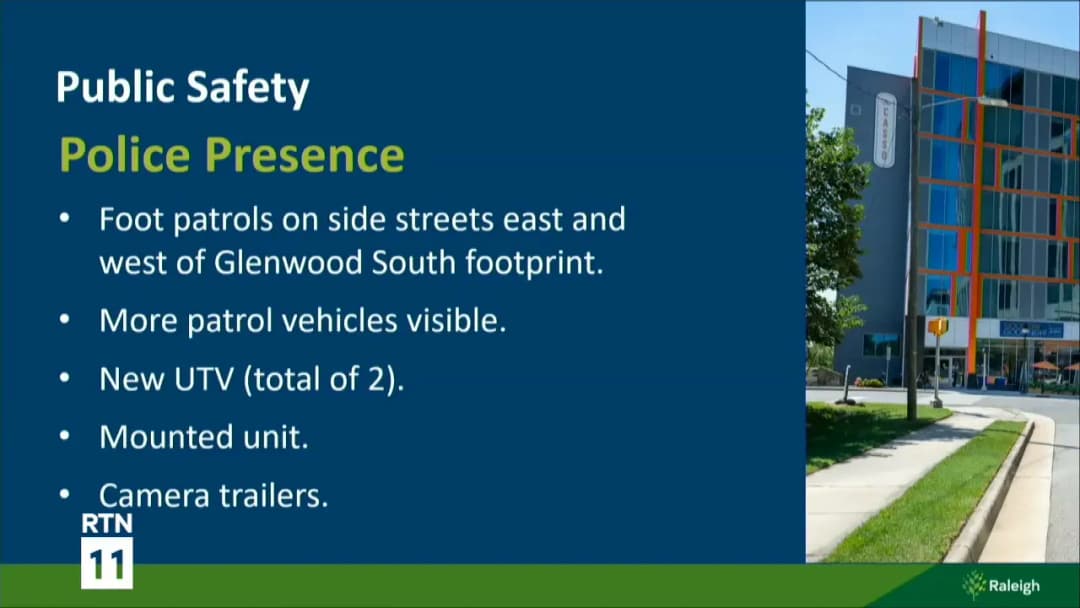
The Raleigh City Council met in a work session on September 8, 2026, to receive two staff updates: the draft Nash Square Public Realm master plan and a multi-departmental update on Glenwood South covering the noise ordinance, zoning, public safety, and transportation. Councilor Jonathan Lambert Melton was absent and excused; Councilor Silver arrived late. Brandon Poole filled in for the city attorney and Evan Raleigh filled in for the city manager. Nash Square Public Realm Plan - TJ McCord presented the draft master plan, described as a public realm plan covering the park and surrounding streets and sidewalks. The project began in early 2026. - Community engagement included a kickoff event with nearly 200 attendees, a “Tuesdays in the Square” tabling series, a “Nash Bash” block party on Martin Street with food trucks and vendors, site tours, online engagement, and focus groups with subject matter experts, community partners, the Downtown Raleigh Alliance, and advisory boards. - Community priorities reported by staff included protecting and renewing the tree canopy, honoring historic character, extending the square’s identity into the surrounding streets and sidewalks, reimagining Hargett Street adjacent to the new City Hall, and supporting flexible everyday use rather than large event programming. - The draft concept proposes a new mid-block crossing on Hargett Street; corner bump-outs; an opened-up Hargett/McDowell corner with plaza seating; widened interior walkways with planted and seating islands on the southeastern side; and a reconfigured central plaza that would remove the brick walls around the North Carolina Fallen Firefighters Memorial. - On stormwater, staff said full daylighting of a historic stream on the northwest corner may not be feasible; the plan more likely will use planted green stormwater infrastructure with interpretive signage. - Staff noted about 15–20 feet of elevation change across the square and said terraced seat walls are planned along Martin Street to handle grade changes. - Staff said recent tree removals at Nash Square were public-safety removals of high-hazard trees, not part of the plan; the plan includes succession planting to maintain the canopy. - The plan is subject to State Historic Preservation Office review because Nash Square is within the National Register Depot District; staff said that review is underway. - Councilor Silver expressed support for the Hargett Street treatment but asked about lifting and limbing lower canopy branches to improve sight lines and safety. He also asked whether relocating the state-owned Fallen Firefighters Memorial had been considered. Staff replied the North Carolina Fallen Firefighters Foundation is not supportive of moving it off-site. - Councilor Jones asked about Explorers Middle School students who use the square for recess; staff said the central plaza reconfiguration would support outdoor learning and group lunch seating. - Councilor Ford asked about the timeline. Staff said they are waiting to settle the memorial issue before public review, anticipate taking the draft concept to the public within about two months, and plan to return to council in spring 2027 with cost estimates and recommendations. - Several council members asked about funding; staff confirmed no construction funding is currently identified, and implementation funding options will be part of the future recommendation. Glenwood South: District Status and Noise Ordinance - Assistant City Manager Nikki Jones introduced the update, framing Glenwood South as an evolving urban center with both vibrancy and challenges. - Whitney Schoenfeld explained that the official hospitality district designation ended in 2024 when the amplified entertainment permit was repealed. “Entertainment district” is a descriptive term, not an official designation, and Glenwood South is not a social district under North Carolina law. - The noise ordinance moved from permit-based decibel regulation to a “reasonable person” standard in 2024, and in January 2026 implemented new objective decibel standards developed with consultant Brian Block. Higher limits apply in Glenwood South. - Noise data through mid-August: 120 amplified sound complaints in Glenwood South (89 via 911, 31 via Ask Raleigh); five citywide citations since January, none in Glenwood South; 911 loud noise calls down 22% year-over-year; one caller accounts for 75% of Glenwood South 911 loud noise calls. - Staff reported that four new noise ordinance compliance officers (NOCOs) provide seven-day coverage and focus on education and voluntary compliance. - Councilor Ford questioned inconsistent operating hours for food trucks and push carts, saying she would like all categories to stop at 1:15 a.m. to help RPD clear the area. Staff said inconsistencies reflect separate council decisions and committed to bringing back options through a text amendment or overlay. Councilor Jones noted prior discussions about allowing late-night food service to help people absorb alcohol before driving. Glenwood South: Zoning and Land Use - Planning and Development Director Pat Young described the 2030 Comprehensive Plan’s future land use map, which places Glenwood South in the central business district, with office/residential mixed-use and neighborhood mixed-use areas to the west and north. - Young said the area’s success has caused spillover from Glenwood South into the neighborhood mixed-use area near Peace Street, attracting visitors from at least two dozen counties on weekend nights. - Staff recommended zoning tools such as separation requirements, use authorization, and operational standards, targeted at the neighborhood mixed-use area. State law would not allow applying new standards to existing businesses; they would apply to new uses, conversions, or substantial expansions. - Zoning enforcement is complaint-based, with six active cases in the area. Staff committed to increasing nights/weekends enforcement on food trucks and push carts through the NetForces multi-departmental enforcement team. - Councilor Patton asked about the types of zoning complaints; Young cited illegal signage, food trucks operating outside permitted requirements, and unpermitted construction, with detailed reports to come. Glenwood South: Public Safety - Raleigh Fire Department Assistant Chief Charles Williams said NetForces (Nightlife Entertainment Task Force) inspected 10 randomly selected Glenwood South locations; violations included occupancy load postings, electrical violations, obstructed means of egress, and change-of-occupancy issues. All violations were corrected by August reinspection; three businesses require building safety approval for occupancy changes. - Police Chief Boyce reported that Glenwood South is a regional destination and that many arrests involve people who do not live in Raleigh. - RPD changes include a one-way southbound traffic diversion on Glenwood Avenue between Peace and Lane streets to improve emergency response; geofencing of ride-share pickups and e-bikes/scooters during late-night hours; increased foot patrols and vehicle placement on side corridors; two utility terrain vehicles assigned to the hospitality area on Fridays and Saturdays; mounted unit presence; and two live-feed camera trailers feeding the Real-Time Crime Center. - RPD now mandates patrols through private parking decks every 30 minutes on weekend nights, resulting in firearm and drug recoveries and arrests of people with active warrants. - Chief Boyce said RPD encourages bar and club owners to invest in magnetometers, citing three incidents where private security alerted officers to individuals carrying legally possessed firearms near clubs. He also referenced a Fayetteville Street incident inside a club and suggested magnetometers might have prevented it. The program is voluntary; Councilor Patton asked about possible grants or incentives and flagged that magnetometers could be considered as a condition in future special use permits. Glenwood South: Transportation, Parking, and Micromobility - Transportation Director Kenneth Ritchie described the city’s Municipal Service District partnership with the Downtown Raleigh Alliance (DRA) and DRA’s ambassador program. - Parking: four residential permit zones border Glenwood South; fines were raised to $200 in 2023. This year, about 2,600 citations were issued, with only 6.5% repeat violations. There are 115 metered spaces in Glenwood South; 74 spaces in the Peace-to-Lane section are now no-parking/towaway zones on Friday and Saturday nights following council approval on August 18, 2026. - Micromobility: Lime and Spin units are geofenced off during 10 p.m.–5 a.m. on weekends; 13 pilot corrals achieved roughly 72% compliance, and 70 new downtown corral locations are planned. - Pedestrian safety: The Glenwood South Safety Pilot found 92% of participants said walking is the most common transportation mode. Painted curb extensions are completed at Johnson and North streets; Tucker Street is expected before the end of 2026. A Lane Street signal is part of a three-signal package expected operational by the end of 2027. - A DRA representative said ambassador presence exists in Glenwood South throughout the week and weekends, with layers including outreach, Royal Blue ambassadors, and enhanced security ambassadors; presence is concentrated near the transit center. Key Outcomes - No formal votes were taken, as this was a work session; Councilor Branch reminded presenters that motions cannot be made in a work session. - City staff will bring back options for a zoning text amendment or overlay for Glenwood South in approximately six to nine months, including a review of food truck/push-cart hours for possible consistency at a 1:15 a.m. cutoff. - Staff will continue work on Nash Square: resolve the Fallen Firefighters Memorial configuration with the Foundation, complete interim Hargett Street improvement plans, and return to council in spring 2027. - The Nash Square draft concept will go out for public review within approximately two months. - RPD will maintain and expand patrols, continue the voluntary magnetometer outreach, and establish a more frequent NetForces inspection cadence within two months. - Councilor Patton requested a future presentation on crime statistics comparing Glenwood South over time and against peer-city nightlife districts. - The Mayor Pro Tem said Raleigh should not be known as the party destination for Eastern North Carolina and called for a new vision for the district, while Councilor Brown cautioned against displacing problems to other parts of the city.

PUBLIC SAFETY 31% · PARKS AND RECREATION 24% · ZONING 9% · TRANSPORTATION SAFETY 8%
05
SEP 1, 2026 · RALEIGH, NORTH CAROLINA · CITY COUNCIL
Raleigh City Council Meeting – September 1, 2026

The meeting opened with a ceremonial presentation of the Stanley Cup by Brian Fork, CEO of Carolina Hurricanes Holdings, who thanked the city for its long‑standing support. After the Pledge of Allegiance, the council addressed a pulled consent‑agenda item, received reports from the Planning Commission and City Manager, conducted public hearings on two rezoning cases, heard council member reports, and approved routine items. Consent Calendar - CiveB – Funding Transfer: Councilor Silver pulled this item, which moves $5 million from the Old Wake Forest Road widening project to the Lake Wheeler Road project. Staff (Byron Sanders, Engineering Services; Kenneth Ritchie, Transportation) assured the council that the Old Wake Forest project would not be delayed: the funds can be replaced through a 50‑50 federal‑matching request to the Capital Area Metropolitan Planning Organization (CAMPO) within 60–90 days after bidding in early 2027. Councilor Silver asked for a written commitment that the city would exhaust all options to fully fund the project. Staff confirmed that commitment. The council then voted unanimously to approve the consent agenda, including this item. - Other Consent Items: Including additional ADA parking spaces downtown, master service agreements for invasive species removal, and routine approvals – all passed unanimously. Public Hearings Zoning Case Z 826 – Rock Quarry Road (Carried Over) - The applicant (represented by Hunter Winstead, Morningstar Law Group) added a condition limiting hours of operation for non‑residential uses to 6 a.m. – 11 p.m. and provided an illustration of neighborhood transition buffers. No opposition speakers appeared. Councilor Branch noted that he had requested the applicant meet with residents and thanked them for the added condition. The council voted unanimously to approve the rezoning. Zoning Case Z 5125 – Spring Forest Road (Carried Over) - The applicant added further prohibited uses (payday lending, internet sweepstakes, vehicle‑oriented uses) and an hours‑of‑operation condition (6 a.m. – 11 p.m.). Hunter Winstead spoke in support, highlighting the walkable, mixed‑use design. Opposition speakers included: - Scott Ayers – expressed belief that the community does not want commercial; argued it would decrease property values, increase crime, and cause environmental problems. - David Bender – noted the city’s stated housing shortage and urged that the site remain residential (R‑6) as per the future land‑use map. - Councilor Patton stated the constraints made the proposal reasonable and in the public interest, and asked staff to explore mid‑block crosswalks. Councilor Silver noted that the transition zones in the comprehensive plan effectively protect nearby residential areas. The motion to approve carried 7‑1 (one opposed). Discussion Items Planning Commission Report - Bynam Walters (Planning & Development) and Chair Dwight Otwell presented upcoming rezoning cases and recommended public‑hearing dates (September 15 and October 6). Notable discussion: - Z 43 (Lichford Road): Planning Commission recommended denial 4‑3 over concerns about rural character and safety. The applicant reduced density from R‑10 to R‑6 and added a gate condition. Councilor Silver and Chair Otwell clarified the vote and reasoning. - Z 50 (Capitol Boulevard): Recommended approval despite inconsistency with the future‑land‑use map. Council set public hearing dates as staff suggested. The motion passed unanimously. City Manager Report - Fourth Ward Entertainment District: Carrie Painter (Complex) announced the new branding (purple and gold colors) and 44 street signs going up starting September 2, marking the entertainment district that arose from community input. Council members praised the intentional place‑making and atonement for past harm. - Convention Center Naming: The facility is now the Atlantic Union Bank Convention Center. The bank also tripled its initial donation to $15,000 for Meals on Wheels/Wake County Caring Center. - Youth Engagement Forum: Taisha Mosley (Community Engagement) announced a community forum on October 12 at the Five Point Center to discuss curfew, youth resources, and gaps. Councilors Ford and Silver stressed the need to reach at‑risk and marginalized youth who may not attend typical programs, and to work with the school system to identify them. Councilor Jones inquired about cross‑jurisdictional police collaboration. - Federal Grant: Raleigh Water received a $38.7 million federal grant (from the Buy Your Energy project). A spending plan will be brought forward. - Police Collaboration: Chief Boyce updated that ongoing discussions with Durham and Morrisville police address juvenile crime and vehicle break‑ins; a Wake County chiefs meeting is scheduled. Mayor and Council Reports - Councilor Patton: Highlighted ADA parking and invasive‑species removal approvals; announced community office hours September 16 at Bedford Food and Drink. - Councilor Ford: Thanked the mayor for a Haitian‑of‑the‑Triangle proclamation; raised concerns about low‑hanging branches ("branch slapping") obstructing sidewalks and asked for review of landscaping standards. - Councilor Silver: Announced district E community conversation on September 9 (location changed to Laurel Hills) and a "Decoding Democracy" book club on September 12. - Councilor Jones: Reminded of Labor Day weekend and the African American Cultural Festival. Key Outcomes - Consent Agenda (including CiveB funding transfer) – Approved unanimously. - Public hearing dates set for September 15 and October 6 – Approved unanimously. - Zoning Z 826 (Rock Quarry Road) – Approved unanimously. - Zoning Z 5125 (Spring Forest Road) – Approved 7‑1. - Annexation AX 0626 – Withdrawn by applicant, no hearing needed. - Minutes from August 18 meeting – Approved unanimously. - Sale of 1115 S. Wilmington Street for $17,500 – Approved unanimously (no upset bids). - Appointments: Arts Commission and Design Review Commission vacancies carried over; Councilor Silver nominated Andrew Osterlund for Design Review (late submission, to be revisited); Bicycle & Pedestrian Advisory Commission vacancy carried over. - Closed session held; no reportable action.

PROCEDURAL 78% · PUBLIC ENGAGEMENT 4% · ARTS AND CULTURE 3% · LAND USE AND ZONING 3%
06
SEP 1, 2026 · RALEIGH, NORTH CAROLINA · CITY COUNCIL
Raleigh City Council Public Hearings and Rezonings Summary – September 1, 2026

This summary is based solely on the supplied transcript; no agenda or minutes were available. The meeting included public hearings and votes on a historic landmark designation, a HOME-ARP amendment, three rezoning cases, and a continuation to September 1, 2026. Landmark Designation – Lustron House - Colette Canaan of Planning and Development presented the request to designate the 1949 George and Jesse Morris Lustron House, a two-bedroom all-steel post-World War II manufactured dwelling at 314 Haywood Street. The house was relocated about seven miles from Buffalo Road to Haywood Street in 2017 and restored with authentic Lustron parts. - She said process changes under TC 373? No, TC 324: the Raleigh Historic Development Commission now sends designation reports directly to the State Historic Preservation Office, the joint public hearing was replaced by separate hearings, and City Council can adopt the ordinance immediately after the public hearing. - No member of the public signed up for or against the designation. - The designation was approved unanimously. HOME Investment Partnerships Amendment - Will Hardy of Housing and Community Development reported the city received approximately $5.3 million through the Home American Rescue Plan Program. HUD accepted the city’s allocation plan in April 2023, and staff now propose moving $3.6 million from non-congregate shelter acquisition and development to HOME-ARP supportive services, primarily rental assistance. - Eligibility would remain for people experiencing homelessness, people at risk of homelessness, people fleeing domestic violence or human trafficking, and others at greatest risk of housing instability. A new preference would prioritize people experiencing homelessness, with referrals based on vulnerability and service needs. - The public hearing was opened and closed. Max Pollard was signed up but was not present. - Council took no approval action; staff will return the final amendment for consideration on September 15, 2026. Rezoning Z1925 – Heritage Park - Matthew Burns with Planning and Development described a request to rezone just under 12 acres from residential mixed-use three stories with transit overlay to downtown mixed-use 12 stories with conditions and transit overlay. The site is owned by Raleigh Housing Authority and includes Heritage Park. Planning Commission recommended unanimous approval. - Proposed conditions would prohibit payday lending, vape and tobacco shops, and electronic sweepstakes cafes; require 122 affordable units for households earning 50 percent AMI for at least 30 years after issuance of a certificate of occupancy for the 700th unit; and cap peak-hour trips. - Jason Barron of Morningstar Law Group spoke in support on behalf of the Raleigh Housing Authority, citing comprehensive plan consistency and an opportunity to provide affordable housing near transit and downtown. - Jeff Durkin spoke in support, urging continued investment in affordable housing and praising Raleigh Housing Authority's care in relocating existing residents. - A community supporter, Jen Truman, said the increased density and height made sense near downtown, Dix Park, and transit connections. - Will Choi spoke in support, stating land is finite and this is how to connect downtown to Dix Park and support affordable housing. - Asked about the 700th-unit trigger, Kenya Pleasant of the Housing Authority said HUD requires one-for-one replacement, is part of the approved HUD Section 18 application, and is required regardless of the rezoning. - Council approved the rezoning unanimously. Rezoning Z1926 – Glenwood Avenue - Matthew Clem presented a request to rezone a rear 0.43-acre portion of a 2.02-acre split-zoned site on Glenwood Avenue to community mixed-use three stories with parking limits and frontage, matching the rest of the site. The front portion is about 1.59 acres; the rear is currently zoned R-4 and wooded. Planning Commission recommended approval 6-1? No, 6-3. - Will Quick, attorney for JDV Commercial, said the applicant initially sought to extend the parking lot, heard neighborhood concerns, and now no parking expansion is planned. He said the blood connection tenant had leased another space in Cary. - Tim Martin spoke in opposition on behalf of Glen Forest, Oak Park, and Crabtree Swim and Tennis Club. He opposed removing the residential buffer, opposed general, no-condition rezoning, raised stormwater concerns, and requested denial unless conditions included enforceable protections, completed stormwater studies, bus-operation limits, buffer preservation, and real transitions. - Council discussion addressed stormwater treatment, split-zoned history, setbacks, and neighborhood transition standards. Councilmember Jones expressed concerns about whether removing the residential zoning was not in the public interest. Councilmember Silver supported the case as consistent with the comprehensive plan, noting required neighborhood transitions protect residential uses. - The rezoning was approved by a 7-1 vote; the transcript records one no vote but does not identify the dissenting council member. Rezoning Z1426 – Gorman Street Assemblage - Matthew Clem presented a request to rezone about 3.5 acres from RX-3 with transit and special residential parking overlays to RX-7 with conditions, increasing height from three to seven stories. The site currently has 48 occupied residential units and is near NC State with access to future bus rapid transit. Planning Commission recommended approval 6-0. - Applicant representative Colin Marsh of Parker Poe said the comprehensive plan supports higher residential density and height here, with conditions: additional prohibited uses, a high-visibility crosswalk with a rectangular rapid-flashing beacon at Sherman Avenue, tenant notice and relocation assistance, and an affordable housing payment of $40,000 per unit for one percent of units above 187 units. Proposed redevelopment would be about 300 units. - Discussion included Councilmember Patton questioning whether the one percent affordable housing contribution should apply to all units, not only the overbuild, and whether relocation assistance amounts based on staff data ranged from about $1,400 to $4,500. - Councilmember Lambert Melton said redevelopment could occur without rezoning, and the conditions help displaced residents while adding more housing in a transit-rich area. - The rezoning was approved unanimously. Rezoning Z1826 – Pool Road - Staff noted the consent agenda scheduled the related annexation for September 15, but the concurrent rezoning was scheduled for tonight, so council needed to open and continue the hearing to September 15. - Council voted unanimously to continue Z1826 to September 15, 2026. Key Outcomes - Landmark designation for the Lustron House/George and Jesse Morris House: approved unanimously. - HOME-ARP substantial amendment: public hearing held; no council vote; final amendment scheduled for September 15, 2026. - Z1925 Heritage Park rezoning: approved unanimously. - Z1926 Glenwood Avenue rezoning: approved 7-1. - Z1426 Gorman Street Assemblage rezoning: approved unanimously. - Z1826 Pool Road rezoning: continued unanimously to September 15, 2026.

REZONING 47% · AFFORDABLE HOUSING 19% · LAND USE AND ZONING 16% · STORMWATER MANAGEMENT 6%
07
AUG 18, 2026 · RALEIGH, NORTH CAROLINA · CITY COUNCIL
Raleigh City Council Meeting: Curfew Debate, Flock Cameras, and Rezonings – August 18, 2026

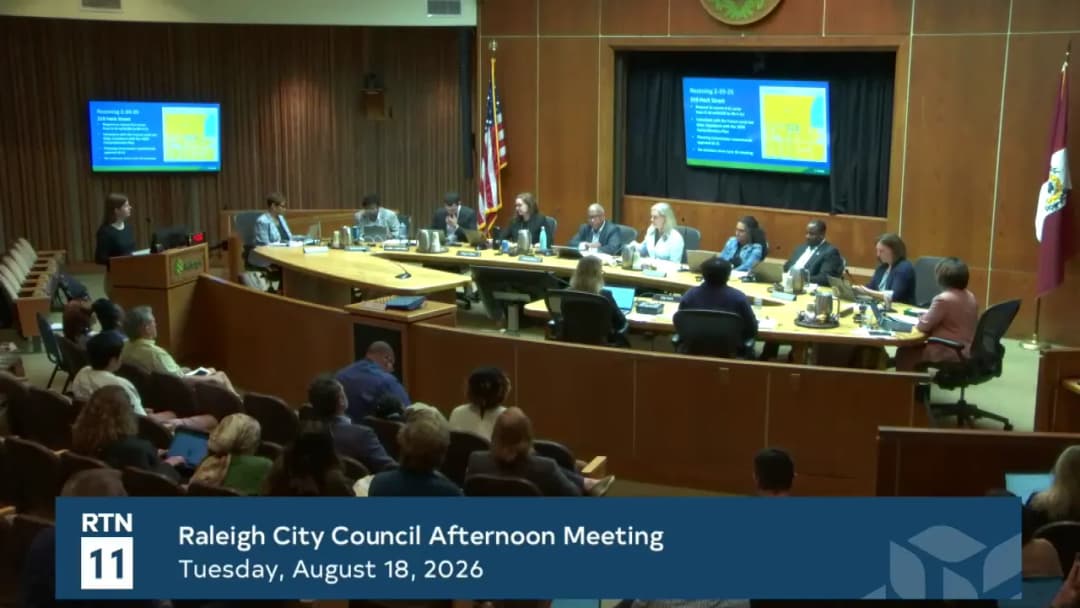
The Raleigh City Council met on August 18, 2026, at 6:00 PM. The meeting began with a continuation of a work session on a proposed youth curfew ordinance, followed by the Pledge of Allegiance and the recognition of the city's inaugural Poet Laureate, Johnny Lee Chapman III. The agenda included extensive public comment, a presentation on Flock automated license plate readers, a discussion of a curfew proposal, and votes on several rezoning and annexation cases. The meeting also addressed text amendments, historic preservation reports, and a range of community concerns. Consent Calendar - The council approved the consent agenda unanimously. No items were pulled. - Items included: conferring retirement of police dog Udo, a $700,000 contribution to the Tar River Land Conservancy for watershed protection, and approval of a mini-pitch at Green Road Park. Public Comments & Testimony - Justin Clifton spoke against automated license plate readers (ALPRs), citing a lack of council oversight and a case in Mooresville where an officer misused the system. - Tatiana Cooper (Saving Adolescent Girls Everywhere – SAGE) requested a 3–5 year contract grandfathering after Raleigh Parks ended their partnership, noting a waitlist of 386 girls. - Shane Stanley (Glenwood South resident) argued that the July 4th incident was not a "teen takeover" but involved adults, and that a curfew would not address gun violence. - Jane Hubbard and Robert Hubbard opposed the Big Branch Greenway Connector project through Anderson Forest, citing deception, cost overruns, environmental concerns, and condemnation of a conservation easement. - Horace Clemens complained about Pratt Industries' 24-hour operation, saying the Noise Ordinance had not solved his complaints. - Jonathan Garland criticized the city's watering restriction enforcement, stating that publicly reported violation rates were inflated due to misinterpretation of drip irrigation flow rates. - Zina Bala highlighted a lack of trust in police, noting that black residents are arrested at five times the rate of white residents, and opposed the curfew. - Jeremy Gilchrist connected the discovery of a black man hanging from a tree in downtown Raleigh to systemic racism, arguing curfews deepen harm. - Octavia Raney urged the council to follow former Chief Dolan's process for community engagement. - Emma Hughes (renter, South Bloodworth Street) asked for reforms to the residential parking permit program, citing barriers for renters. - Chris Crew spoke in favor of neighborhood preservation under the UDO. - Ramiah Robinson (youth organizer, Education Justice Alliance) cited 12 studies showing curfews have no meaningful impact on juvenile offending, and increase criminalization of black youth. - Karen Brown and Pace Brown opposed rezoning Z-4325, citing planning commission inconsistencies and traffic safety concerns. - Phillip Brown argued that the planning commission membership change affected the vote on Z-4325. - Larissa Green raised concerns about inadequate public notice for rezoning cases, especially for renters. - Ashley Heath Armstrong noted community centers like Chavis Center are underused for youth programs. - Alex Bursett and Athena Wallen called for stronger development regulations along creeks. - Kimberly McTarian spoke about the historical displacement of Lincolnville by NC State and its facilities. - Jorge Ramos refuted the narrative of a "teen takeover," noting adults were involved and that curfews punish teens for normal activities. - Drew Washington (youth organizer, Education Justice Alliance) opposed curfews, arguing they diminish creativity and trust. - Mike Figueras (parent organizer, Education Justice Alliance) stated curfews violate young people's rights and are applied discriminatorily. - Shanice Green (stage four cancer patient) commended the council and offered her home as a community space. - Mary Black (former councilmember) called for deeper community engagement and co-governance. Discussion Items - Curfew Proposal (Continued from Work Session): - Chief Boyce presented the draft ordinance, which would apply to individuals under 18 between 11:00 PM and 6:00 AM on weekdays and 12:00 AM to 6:00 AM on weekends, with exceptions for work, school, and religious activities. - Councilmember Patton asked about peer cities: Winston-Salem's pilot is a few months old and under review. No data on results was available. - Councilmember Ford questioned the age of 18 (other cities cap at 15–17) and enforcement. Chief Boyce said enforcement is complaint-based, not proactive. - Councilmember Jones requested quarterly public data on juvenile arrests. Chief Boyce agreed to include it in his quarterly report. - Councilmember Branch asked about parental support resources. Chief Boyce said it's part of the conversation but no answer yet. - Councilmember Silver emphasized a balanced approach including youth programming and safe spaces. - Mayor pro tem Harrison highlighted the emergency curfew tool and asked about pros/cons of a permanent curfew. Chief Boyce cited faster response time in emergencies. - Councilmember Patton expressed concerns about the focus on law-abiding children and the exceptions favoring wealthier youth. - The council directed staff to bring the ordinance back on September 15, 2026, to allow for two public comment sessions. - Flock (ALPR) Presentation: - Chief Boyce explained that Raleigh has 29 cameras since March 2022, costing $75,000 annually, with 414 authorized users. Data is stored for 30 days (state allows 90), and is not shared with ICE. - Monthly audits are now conducted. From January 1, 2025, to July 15, 2026, the system helped recover 154 stolen vehicles, clear 244 criminal cases, and recover $1.8 million in stolen property, and located six missing adults. - Councilmember Ford asked about private cameras; the city has no control over them. - Councilmember Jones inquired about audit transparency; Chief Boyce said Flock also cross-checks misuse. - Daycare Text Amendments: - Staff presented options to increase home daycare capacity from 8 to 15 children, allow non-family employees, and make commercial daycare centers a limited use in residential districts. - Councilmember Patton supported the changes, citing affordability and flexibility. Council unanimously approved moving forward with all three options. - Rezonings and Annexations: - Z-3925 (319 Hex Street): Motion to deny failed 4-4; motion to approve also failed 4-4. No change in zoning. - Z-5125 (4804 & 4808 Spring Forest Road): Motion to approve failed; council voted to hold the case open until September 1, 2026, for further conditions. - AX-4425 and Z-5425 (Leesville Road area): Council approved the annexation (6-2) and the rezoning (6-2) after debate. The block perimeter exemption was a key concern, but the council supported the project to add housing and move the TW Alexander extension forward. - Z-0826 (Rock Quarry Road): Council voted to hold the case open until September 1, 2026, to allow the applicant to consider adding hours-of-operation conditions. - Z-1626 (North Boylan Avenue): Unanimously approved, allowing a theater use and increasing height to 12 stories. - Comprehensive Plan Amendment CP-0126 (Old Crews Road): Unanimously approved, downgrading the road from 4-lane to 2-lane divided. - Text Change TC-126 (School Lot Amendment): Approved 6-2, waiving the 500 sq ft per enrollee lot size requirement for schools in mixed-use districts not adjacent to R-1, R-2, R-4, or R-6 zoning. Key Outcomes - Curfew Proposal: To be brought back on September 15, 2026, with two public comment sessions before the vote. - Flock ALPRs: Council acknowledged the presentation; no vote taken. - Daycare Text Amendments: Unanimously approved to move forward with all three options. - Rezonings: - Z-3925: No change; split vote (4-4) on both motions. - Z-5125: Held for two weeks (September 1, 2026). - AX-4425 & Z-5425: Approved (6-2). - Z-0826: Held for two weeks (September 1, 2026). - Z-1626: Approved unanimously. - CP-0126: Approved unanimously. - TC-126: Approved (6-2). - Closed Session: Council entered closed session to discuss legal and property matters; nothing to report upon adjournment.

LAND USE AND ZONING 27% · PUBLIC SAFETY 13% · PENDING LITIGATION 7% · REZONING 6%
08
AUG 18, 2026 · RALEIGH, NORTH CAROLINA · CITY COUNCIL
Raleigh City Council Work Session on Youth Engagement and Curfew – August 18, 2026

The August 18, 2026 work session focused on two main topics: a review of current youth engagement programs across city departments and a proposed youth protection curfew ordinance. The meeting began at 4:30 PM and was recessed for lunch at 12:36 PM, with plans to resume the curfew discussion at 1:00 PM. Presentations were given by representatives from the Community Engagement Department, Raleigh Parks, and the Raleigh Police Department. Youth Engagement Programs Presentation - Taisha Mosley (Community Engagement) introduced the session, outlining programs such as the Raleigh Summer Youth Employment Program, which includes a virtual pathway where teens work with local businesses and propose solutions. The program has grown since its 1983 inception. - Ken Histler (Raleigh Parks) highlighted out-of-school time programs, including camps, after-school programs, and the Raleigh Teen Connect program. He noted 1,200 part-time staff ages 15–25, with 650 of those ages 15–19. The parks department also runs a federal work study program with NC State and other colleges, and has hired 12 full-time employees from its internship program. - Amanda Roll (Raleigh Police Department) described youth-facing programs: a cadet program for ages 14–20 (24 cadets in three years), a paid college internship, and a community impact division created in October 2025. She reported that 18% of police recruits come from the internship program, and 19 interns have been hired in the past three years. (Note: the transcript contains an apparent inconsistency: "19 of our 14 interns".) - Summer engagement efforts included Raleigh Hoop Nights (309 teens engaged), a "Something to Say" teen hall (55 teens), and a survey with 15 touchpoints (8 group discussions, 7 tabling events). Key survey findings: teens want more unstructured hangout spaces, later hours, increased awareness of city offerings, and a voice in decision-making. Barriers cited included programs not being close by, lack of transportation, and not knowing what is available. Teens requested more opportunities to be heard and lead initiatives. - Council discussion included questions about centralized communication with Wake County schools, use of TikTok (city policy prohibits it; alternatives via influencers or Instagram were discussed), tracking of youth not served by city programs, and the potential for reimagining the Raleigh Youth Council (currently 60 students, self-governing). Councilmember Branch suggested continuing Hoop Nights year-round, and the police department confirmed plans for future events at Islamic Association of Raleigh and Jewish Federation of Raleigh. Curfew Ordinance Discussion - Karen McDonald (City Attorney’s Office) introduced the proposed Youth Protection and Curfew Ordinance, drafted per council direction from the July 7 meeting. The ordinance is intended to protect juveniles from victimization and reduce late-night crime. - Chief Boyce (Raleigh Police Department) presented juvenile crime data: in 2025, there were 821 cases where a juvenile was a suspect; in 2026 (year-to-date as of August 18), that number is 894, a 9% increase. He highlighted a rise in serious offenses: assaults/aggravated assaults (50 in 2026 vs. 30 in 2025), person shots (7 in 2025, 14 in 2026), and shots fired into vehicles/dwellings (5 in 2025, 12 in 2026). The number of rounds discharged increased from 15 to 190. The July 4–5, 2026 incidents involved six shootings, four cleared by arrest, two still active. Juveniles were involved in the majority of those shootings. Chief Boyce emphasized that a curfew is a tool, not a fix, and noted that many juveniles obtain guns from late-night car break-ins. - Proposed ordinance details: applies to persons under 18 (not married, serving in armed forces, or emancipated) from 11:00 PM to 5:00 AM daily. Exceptions include being accompanied by a parent or adult 21+, lawful employment, emergencies, school/religious/recreational/civic/governmental activities, First Amendment activity, private events or errands, college/university students, U.S. armed forces, and public events (e.g., State Fair, concerts, sporting events). Enforcement requires officers to verify age and determine if an exception applies before taking action. Violations: juveniles enter juvenile court process; parents/guardians, aiding adults, and establishments may face a Class III misdemeanor with a fine up to $500. - Council questions included clarification on the age of attendees at the July 4–5 events (Chief Boyce could not confirm exact numbers but noted many were young adults). Councilmember Silver noted the majority of Raleigh’s youth are law-abiding. The discussion was recessed at 12:36 PM, with the plan to resume at 1:00 PM after a lunch break. Key Outcomes - No formal votes were taken during the session. The council directed staff to continue gathering feedback on youth needs and to explore operational adjustments, enhanced partnerships, and improved communication. - The curfew discussion was paused and scheduled to continue after the lunch recess, with the possibility of being carried over to a later agenda if needed.

YOUTH PROGRAMS 43% · PUBLIC SAFETY 33% · JUVENILE JUSTICE 9% · PARKS AND RECREATION 5%
09
JUL 14, 2026 · RALEIGH, NORTH CAROLINA · CITY COUNCIL
Raleigh City Council and Planning Commission Joint Meeting - July 14, 2026: Budget, Rezonings, and Bond Referendums

This joint meeting of the Raleigh City Council and Planning Commission covered a wide range of topics, including the approval of several zoning cases, a detailed work session on the Fiscal Year 2027 operating and capital budget, public hearings on housing and transportation bond referendums, and other business such as endorsing Bus Rapid Transit corridors and the Arts Commission work plan. Consent Calendar - The Planning Commission approved the minutes from the previous meeting unanimously. Public Comments & Testimony - Octavia Rainey (College Park resident) expressed concerns about infill development changing neighborhood character and increasing property taxes, questioned the rental rehab program, and later during the transportation bond hearing worried that Bus Rapid Transit would displace Black riders and that stroller access on buses is inadequate. - Mamakai Sanders argued that affordable housing alone does not solve poverty and that the city should focus on upward mobility; she stated that there is enough housing to eliminate homelessness if infrastructure were in place. - Athena Wallen (bicycle safety advocate) discussed the vulnerability of non-drivers, shared her personal experience of being hit by a car, and urged the city to invest in protected infrastructure for cyclists and pedestrians. - Chris Crewe urged the city to maintain water restrictions and review the Wake County Hazard Mitigation Plan. - Dave Klemp (Trees for the Triangle) advocated for the leaf out program and highlighted the benefits of native tree planting, offering partnership with the city. Discussion Items Planning Commission Rezoning Cases - Z4825 (Rex Hospital Campus Master Plan): The Commission heard an update on the rezoning to a Campus Master Plan district (CMP) with heights from 7 to 20 stories, a density cap, and a voluntary traffic impact analysis. The applicant added a micromobility hub and pedestrian/bike intent statement. The Commission voted 6-1 to approve. - Z5725 (8020 Lichford Road): A rezoning from residential to R6 with conditions, including a density cap of 6 units per acre and prohibition of certain uses. Staff noted consistency with the comprehensive plan. The Commission voted unanimously to approve. - Z4625 (523 South West Street): A request to rezone from Downtown Mixed Use 5 stories to 7 stories to allow a community room in the Fairweather condominiums. The existing building is already five stories; the extra height would allow finishing a mezzanine room. The Commission voted unanimously to approve. - Z926 (5925 Glenwood Avenue): A request to rezone from split zoning (CX3 and R4) to unified CX3 with parking limited frontage to allow parking lot expansion for a blood donation center. Neighbors opposed citing loss of residential buffer, stormwater concerns, and noise from buses. The Commission deferred the case to June 9 after the applicant agreed to consider conditions (buffer, screening, stormwater). - Z1126 (3901 Stratford Court): A request to rezone from R2 to R4 to allow a single-family home on a vacant lot. Neighbors requested conditions but the applicant declined, citing precedent. The Commission voted unanimously to approve. City Council Budget Work Session - Permanent Band Stage and Public Art at City Plaza: Staff presented cost options ($1.85M uncovered stage/low art to $3.6M covered stage/high art). Council agreed to defer the band stage to FY2028 and directed staff to explore funding for public art at the pedestals, with further details to return in the fall. - Leaf Out Urban Tree Program: Staff requested $650,000 for the first year of a community-based tree planting program to support the goal of 24,000 trees by 2032. Council discussed a $1M state grant with limitations, the need for dedicated staffing, and possible funding offsets. Council initiated but withdrew a motion pending further analysis; staff will report back with funding options. - Solid Waste Services Comparable Analysis: Staff presented a survey of other NC cities showing Raleigh’s fee structure is competitive. Councillors asked about compost programs and the split between user fees and general fund (Raleigh at 99% user fees). No action taken. FY2027 Budget Presentation - City Manager Marshall and Budget Director Sadia Satar presented the proposed $1.765 billion budget, including a property tax increase of 1.7 cents (to 37.2 cents per $100 valuation) – a $67 annual increase for the median home – and increases in water, stormwater, and solid waste fees (total $122/year). Key investments: 23 new police officers, 12 firefighters, 6 call takers, 3 fire marshals, 6 building safety staff, enhanced weekly yard waste collection (starting September), downtown parking subsidies ($2M), and cybersecurity. The budget closes a $13.1M gap through internal cost savings and revenue re-estimates. The proposed tax rate is the second lowest in the Triangle. Council commended the presentation; no vote was taken, with work sessions scheduled through June. Bus Rapid Transit Northern Corridor - Staff presented final recommendations for the BRT Northern Corridor: Alignment 6 (downtown to Midtown via Capital/Atlantic/Six Forks/Wake Forest) and Alignment 3 (downtown to Triangle Town Center via Capital Boulevard). The Raleigh Transit Authority unanimously endorsed them. Council approved a motion to endorse the locally preferred alternatives, allowing progression toward preliminary engineering and federal funding applications. Raleigh Arts Commission Annual Work Plan - Chair Tony Gadston presented the work plan for the Arts Commission and Public Art & Design Board, highlighting the new Poet Laureate program, 18 new artworks, and 29 active public art projects. Council unanimously approved the work plan. Bond Referendums for November 2026 - Finance Director Allison Bradshire presented public hearings for two general obligation bonds: $101.5 million for affordable housing and $101.5 million for transportation. Both bonds are designed to be funded without a property tax increase due to the city’s debt affordability model. Council approved resolutions calling for the referendums (unanimous votes). Key Outcomes - Planning Commission approved: Z4825 (6-1), Z5725 (unanimous), Z4625 (unanimous), Z1126 (unanimous). Deferred Z926 to June 9, 2026. - City Council set public hearings for June 16 for two rezoning cases recommended by the Planning Commission. - City Council endorsed BRT Northern Corridor alignments and authorized next steps. - City Council approved the Arts Commission annual work plan. - City Council approved resolutions to place affordable housing ($101.5M) and transportation ($101.5M) bond referendums on the November 3, 2026 ballot. - No final budget vote occurred; budget work sessions will continue in June with adoption required by June 30.

REZONING 17% · COMMUNITY ENGAGEMENT 12% · PARKS AND RECREATION 11% · FISCAL SUSTAINABILITY 10%
10
JUL 7, 2026 · RALEIGH, NORTH CAROLINA · CITY COUNCIL
Raleigh City Council Meeting - July 7, 2026: Curfew, Water Restrictions, Rezonings

The Raleigh City Council met on July 7, 2026, to address a wide range of issues including a proposed youth curfew following a violent July 4th incident, stage two water restrictions due to drought, approval of several rezonings and annexations, and updates on e-bike regulations. The meeting also included recognition of Partnership Raleigh, approval of consent agenda items, and reports from the planning commission and city manager. Consent Calendar - Approved the consent agenda with two items pulled: Quail Hollow Drive Green Street project and City Hall renovations. All remaining items were approved unanimously. Discussion Items - Quail Hollow Drive Green Street Project: Transportation staff presented a phased project including a two-way cycle track, traffic calming, and a speed limit reduction to 25 mph. Council discussed parking impacts (loss of about 13 spaces on the west side) and community engagement. The project was approved unanimously. - City Hall Renovations: Staff clarified that the three unfinished floors were part of a prior commitment to build out as resources became available. The funding comes from project savings and capital reserves. Council approved the item unanimously. - Planning Commission Report: Several rezoning and annexation items were scheduled for public hearings. Council moved one item (Z926 on Glenwood Avenue) from August 18 to September 1 to allow more community attendance. Three items were held for later scheduling. The rest were set as recommended. - Text Change Authorization for Subdivision Regulations: Staff presented two options to streamline small-lot subdivisions. Council approved Option 2, which includes both an exempt process for 1-3 lots and a minor subdivision process for 3-10 lots, to encourage more attainable housing. The vote was unanimous. - Water Restrictions Update: Staff reported that despite stage one restrictions, water demand has increased due to drought. Council authorized the city manager to implement stage two restrictions if demand does not decrease, including limiting athletic field irrigation to one day per week. The vote was unanimous. - July 4th Incident and Curfew Proposal: Police Chief Rico Boyce reported on a violent incident on July 4th involving large crowds of juveniles, multiple shootings, and 11 firearms recovered. He proposed a citywide curfew for those 17 and younger from 11 p.m. to 6 a.m., along with a backpack restriction. Council directed the city attorney to draft an ordinance for consideration on August 18, and also requested a report on broader youth engagement strategies. The motion passed unanimously. - Parks and Recreation Advisory Board Work Plan: The board presented its annual work plan focusing on recreation, health, wellness, greenways, sustainability, and organizational excellence. Council approved the plan unanimously. - Rezonings and Annexations: Several annexation and rezoning cases were approved, including the Fertile Ground Food Cooperative grocery store rezoning (Z5024) on Garner Road (approved 7-0), and the Fairweather Condos rezoning (Z4625) to allow a community room (approved). Other items included Z4425 (annexation and rezoning with conditions), Z5725 on Litchford Road, and text change TCZ026 on Creedmoor Road. All were approved with varying votes. - E-Bike Presentation: The city attorney's office presented on the classification and regulation of e-bikes, mopeds, and electric motorcycles. Council discussed enforcement challenges and requested a more robust education and enforcement plan to be presented after the summer break. Key Outcomes - Curfew Ordinance: Council directed the city attorney to draft a citywide curfew for those 17 and younger from 11 p.m. to 6 a.m., to be presented on August 18. An emergency order may be issued if needed before then. - Water Restrictions: Council authorized the city manager to implement stage two water restrictions if demand does not decrease, including limiting athletic field irrigation to one day per week. - Subdivision Text Amendment: Approved Option 2, which creates an exempt process for 1-3 lots and a minor subdivision process for 3-10 lots, to encourage smaller, more attainable housing. - Rezonings and Annexations: Multiple cases were approved, including the Fertile Ground Food Cooperative grocery store rezoning (Z5024) on Garner Road (7-0), the Fairweather Condos rezoning (Z4625) to allow a community room, and the Litchford Road rezoning (Z5725) for a 130-unit residential development. The annexation and rezoning for 27 acres near Forestville (Z4425) was approved with two dissenting votes. - Curfew Ordinance: Council directed the city attorney to draft a citywide curfew ordinance for those 17 and younger from 11 p.m. to 6 a.m., with a report back on August 18. An emergency order may be used if needed before then. - E-Bike Education: Council requested a more robust education and enforcement plan for e-bikes and electric motorcycles, including partnerships with schools and retailers, to be presented after the summer break.

PUBLIC SAFETY 17% · PROCEDURAL 13% · MISCELLANEOUS 12% · TRANSPORTATION SAFETY 10%
0102
NEXT →
OPENPUBLICA · PUBLIC MEETING INDEXUPDATED DAILY · openpublica.com