FY2026 Budget Work Session on Human Resources and Separation Allowance - March 10, 2025
STREAMING COPY IN PREPARATION — RECORDING AVAILABLE FROM THE ORIGINAL SOURCE
FY2026 Budget Work Session on Human Resources and Separation Allowance
On March 10, 2025, at 4:00 PM, the Raleigh City Council convened a budget work session focused on human resources and separation allowance. The meeting covered two main agenda items: an update on FY2026 employee benefits, compensation, and the ongoing classification and compensation study, and an actuarial analysis of a proposed separation allowance for fire/emergency communications and select operating departments. Council members discussed the significant financial implications and equity considerations, with no formal votes taken.
Discussion Items
FY2026 Human Resources Update
Sharnell Jones, Human Resources Director, presented on total rewards, employee benefits, and the classification and compensation study. Key points:
- Medical benefits cost over $58.7 million for active employees; health care costs are expected to rise 7-7.9% in 2025, but Raleigh's trend is 0.9% below that average.
- No premium increases are proposed for medical, dental, vision, or voluntary benefits for FY2026.
- A tuition reimbursement increase and expansion to workshops and certifications is proposed, requiring a policy change.
- The classification and compensation study by Siegel consulting firm is 95% complete on job description questionnaires. The study recommends expanding from 350 to 485 job classifications and establishing 37 job families.
- Market analysis: Raleigh's pay range minimums are 86% of the overall market average (85% for public sector peers, 92% for private sector). Midpoints are 91% and maximums 93% of market. Pay range width is 70% vs. 57% market average.
- Implementation costs: a 1% increase equals $3.75 million; 5% equals $18.75 million; 15% equals $56.25 million. To close the 9-14% gap to market, an estimated $33.76 million to $52.5 million is needed, excluding benefits.
- Vacancy rate dropped from 14.9% in March 2022 to 10.7% as of March 7, 2025, representing 456 full-time and 36 part-time vacancies.
- The city has $20-21 million available from last year's penny for pay ($11.4 million) and merit increases (~$9 million), but this is separate from the comp study implementation.
- Council member Jones asked about prior salary studies; the 2017 study was phased in during 2018-2019.
- Sadia Sattar (Budget and Management Services) clarified that the general fund does not carry over unspent balances; the $20-21 million is for the current year only.
- Council member Forte emphasized the need for more frequent market adjustments to avoid large catch-up investments.
Separation Allowance Update
Alison Bradshire (Finance) and Gregory Stump (BCG actuary) presented actuarial analysis for a separation allowance (temporary benefit from retirement to age 62) for fire/emergency communications (ECC) and five operating departments (parks, transportation, Raleigh Water, engineering, solid waste). Key details:
- Benefit formula: 0.85% × years of service × final pay, with eligibility at age 60 with 25 years or 30 years at any age.
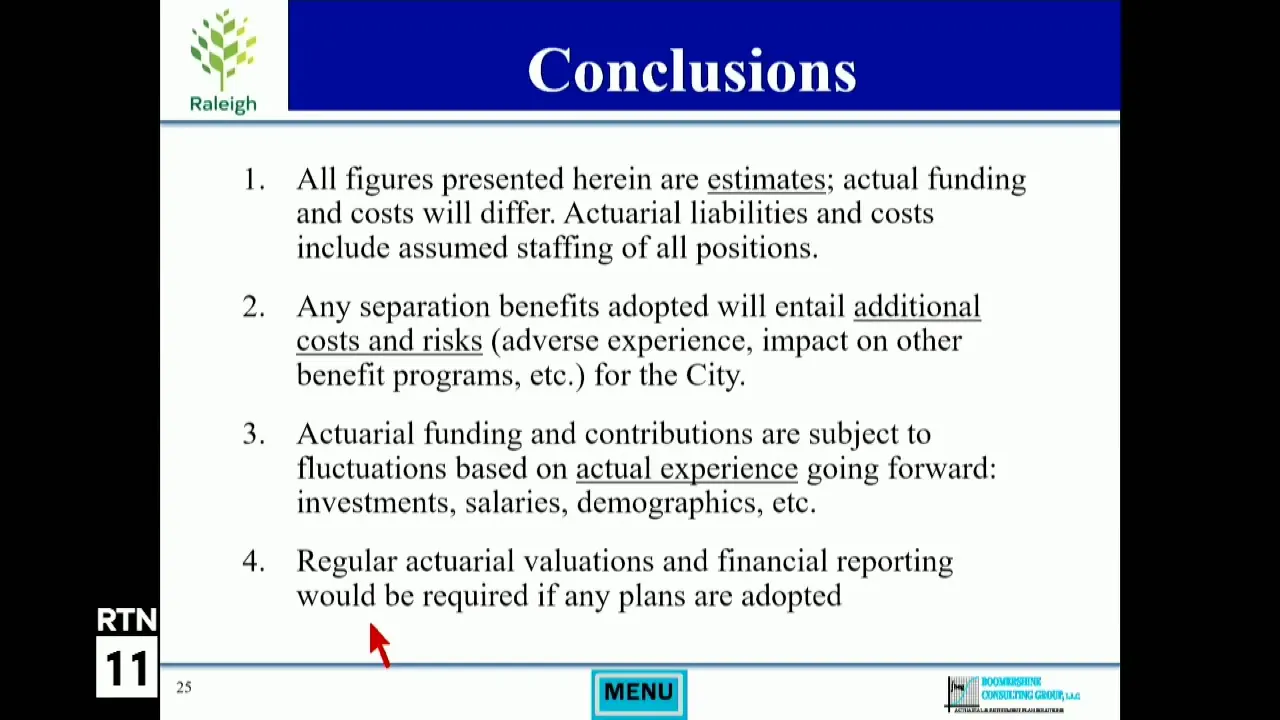
- Fire/ECC: 654 employees (550 fire, 104 ECC). Normal cost is 4.2% of payroll ($2.1 million); total year-one contribution is 9.6% of payroll ($5 million) including 20-year amortization of the $33.2 million initial unfunded liability. Projected fund reaches $92 million and 100% funded after 20 years; ongoing cost would drop to 4.2% of payroll.
- Five operating departments: present value of benefits is $66 million; normal cost is 1.8% of payroll; total year-one contribution is $4.7 million. Projected fund reaches $100 million after 20 years.
- Combined: total city contributions over 20 years estimated at $227 million, with $129 million in benefit payments and $44-50 million in investment earnings.
- Initial total pension liability for financial reporting is $61 million.
- Key assumptions: 5.5% investment earnings, 5% annual salary increases.
- Council member Lambert-Melton requested separate fire-only data; Bradshire agreed to provide department-level breakdowns.
- Fire Chief Herbert Griffin reported that the last academy (2023) started with 45 recruits and graduated 23; the current academy started with 41, and 5 quit in the first week. Retention issues are acute at 3-5 years of service. Top reasons for leaving: career change, compensation, and burnout.
- Council member Patton expressed strong support for including separation allowance in the budget, citing firefighter cancer risks and lower life expectancy. Council member Jones noted equity concerns but supported targeted benefits for physically demanding jobs. Council member Forte highlighted that police have separation allowance but still face retention problems, suggesting compensation may be more critical for younger recruits.
- Council member Branch raised concerns about potential inequities if eligibility is limited to Raleigh service.
- Ryan Bergman (City Manager's Office) noted that the analysis does not cover all city departments; a citywide plan would be more expensive.
- Unfunded liabilities: Law enforcement separation allowance is 14% funded ($60 million liability); other post-employment benefits (OPEB) are 28% funded ($300 million liability); pension plan is 82.5% funded.
Key Outcomes
- Staff will return in April/May 2025 with final recommendations on the classification and compensation study implementation for the FY2026 budget.
- The separation allowance data will be disaggregated by department (fire, ECC, solid waste, parks, transportation, engineering, Raleigh Water) for further council consideration.
- Council members expressed interest in exploring alternative retention tools beyond separation allowance, and in understanding how to balance compensation and retirement benefits for different age groups.
- No formal votes were taken; the work session served as a discussion to inform budget decisions.
Meeting Transcript
Welcome to the work session where we will be covering a lot of compensation and human resource issues. I am going to uh well, first off, Jane Harrison is excused and on the road, and I believe Mayor Pro Temp Fort is walking in, making a grand entrance. Um I'm gonna turn it over to uh Sharnell Jones Human Resources to present the first uh item. Good afternoon, Mayor and City Council. Um we are here to provide a update on benefits and compensation for FY 26. In today's agenda, we will cover total rewards. Um, we will also provide an update for employee benefits, the classification and compensation study will give an update, employee compensation, and then talk about next steps. We understand and know that our employees are our greatest asset, and so it's important that we provide a competitive total rewards package that helps us to be able to attract and retain employees. So when we think about total rewards, it's just not paying benefits, but it also includes our employee development, employee recognition, and also work life balance. For today's purposes, we will be focusing on employee compensation, employee benefits, and also an aspect of employee development. So let's get started with employee benefits. Our medical benefits are our largest expense. Um, if you include the city's portion as well as the employee portion, it is roughly over 58.7 million. And that's just for active employees. The city is self-funded, and so we are responsible for all claims up to that $375,000. Medical benefits, however, are on the rise and are expected to arise between seven and seven point nine percent in 2025. But according to Understand Service and Innovate Insurance Services, which is USI, the city's broker, the civic, the city on average is trending below that by point nine percent. And this has contributed to the enhancements in our program design, our plan design, and also offering additional benefits and wellness offerings, which has guided our multi-year health, been guided by our multi-year health and benefit strategy. And so if you look on here, this is our multi-year health benefit strategy. All of the check marks shows the things that we implemented thus far at FY25. We will also be launching a benefit survey this summer and also looking at a doing a request for proposal for our broker. So for FY26 and 27, we will focus on continuing to look at our program design, how to enhance plan A, also looking at our employee health center, reviewing our employee premiums, and also our wellness incentives. So for FY25, you can see all the things that we implemented. We enhanced our program designs for medical, dental, as well as wellness. We also added a host of benefits and incentives, such as leave. Um we added a part-time benefit 30 package, we added pet insurance, the North Carolina 529 savings plan. We also implemented the continuance service incentive, and we did a parking incentive as well for our downtown employees. Last year there was no increase to employee premiums. So, what are we proposing for FY26? I mean, for the 26th calendar year. There will be no changes in regards to our dental plan and our vision, but as always, we're continuing to look for ways to enhance Plan A to differentiate that from plan B. We will also have no changes as it relates to our wellness assessment, annual wellness assessment that will stay the same as the previous year. No premium increases for employees for medical, dental, or vision, or our voluntary benefits. We are proposing one plan change, which will be our tuition reimbursement assistance program. We are wanting to increase that reimbursement and also expand that to cover workshops and certification programs as well. As you know, that is a policy change, so that we'll have to go to Civil Service Commission and then we'll bring the policy back to you for final review. So what we all have been waiting for classification and compensation study update. Our goal with this comprehensive classification and compensation study update has been to make sure that we have classifications that accurately reflect the work that our employees do, and that we also have pay structures that are competitive in the market to help us to be able to attract and retain employees. Back in 2024, we kicked off this comprehensive classification and compensation study, and we're almost not quite at the point of implementation for FY26, beginning to phase that in. So without further ado, I do have our consultants here today to give us an update on where we are with the classification and compensation study from Siegel, and I will bring up Patrick Bracken to kick that off. Good afternoon. My name is Patrick Bracken. I'm a senior vice president with Siegel. For those that don't know, SEGL is a national human resources consulting firm. We've been privileged to be partnering with the city over the last 14 months now on the comprehensive classification and compensation study. And my aim here today is to brief you on partly where we've been, um, what we found and what the next steps are. For today's agenda, we have a couple items. Um first, we want to orient you to the overall project plan, then talk with you in a little more detail about the job classification structure, um, our market assessment methodology, which is the compensation study, um, the findings that come from that compensation analysis, uh, the salary structure design and the guiding principles around those, and then close out with next steps. So this project in totality was multi-phased. We put together this graphic just to give you a sense of what the path has looked like over the last 14 months or so.
openpublica.com