Raleigh City Council Budget Work Session: June 2, 2025 – FY26 Budget Notes and Follow-Up Discussion
STREAMING COPY IN PREPARATION — RECORDING AVAILABLE FROM THE ORIGINAL SOURCE
Raleigh City Council Budget Work Session – June 2, 2025
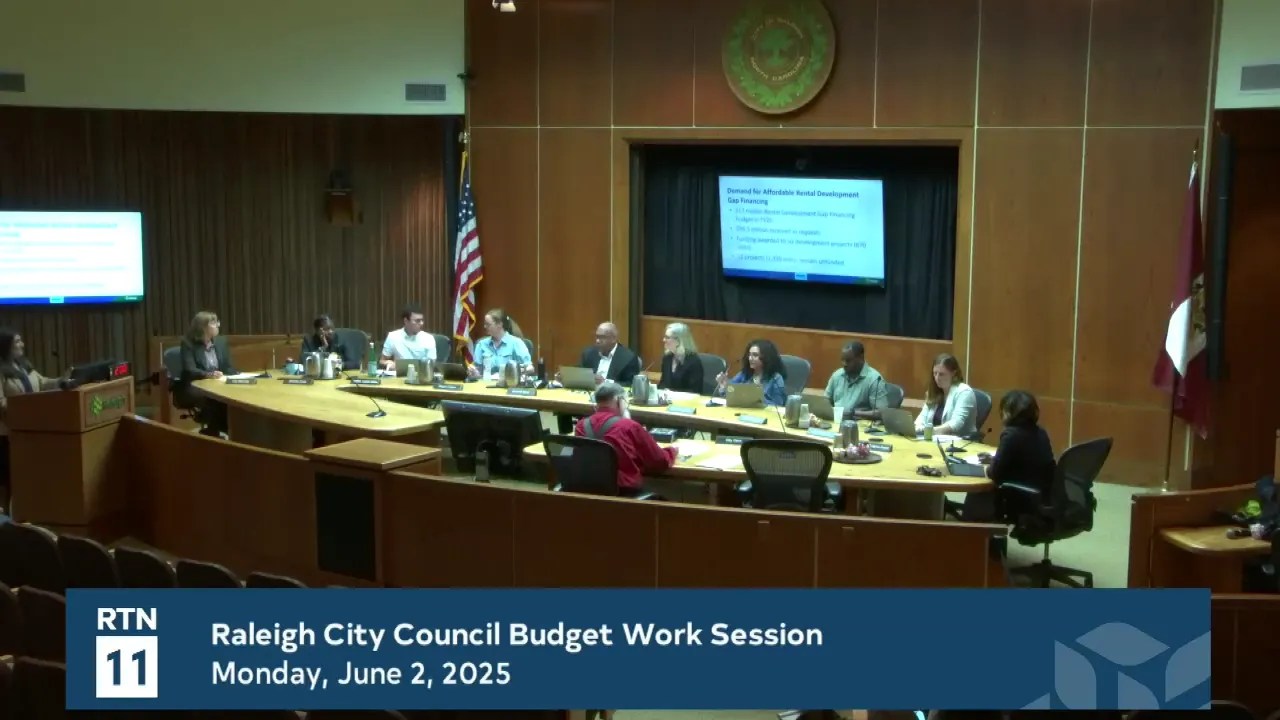
The Raleigh City Council held a budget work session on Monday, June 2, 2025, at 4:00 PM in the City Council Chamber to discuss FY26 budget notes and follow-up items from the May 20th budget proposal. Staff presented three budget notes (city historian, intersection safety improvements, and separation allowance for firefighters and other operating departments) and two follow-ups (property tax rate and affordable housing gap financing). Council members discussed the implications of funding separation allowance, potential property tax increases, and trade-offs with salary increases. No formal votes were taken; direction was given for further analysis and a staff‑administered survey of firefighters.
Discussion Items
Budget Note 1: City Historian – Sadia Sitar (Budget & Management Services) reported that the request for a city historian, made in September 2024, was not funded in the proposed FY26 budget. A benchmarking survey found no other North Carolina municipality has such a position; the city’s museum programs (e.g., City Museum, Mordecai House, Tucker House) fulfill the cultural role. The estimated cost to create the position was approximately $118,000. Council took no action, with Councilmember Lambert‑Melton noting no motion was needed.
Budget Note 2: Intersection Safety Improvements – A joint request by Councilmembers Harrison and Lambert‑Melton for three intersections with safety concerns. Staff confirmed these are funded through the Vision Zero safety program in the capital budget at a cost of approximately $1.3 million, covering sidewalk updates, wheelchair ramps, and other improvements.
Budget Note 3: Separation Allowance – The most extensive discussion. The actuarial study (Boomershine Consulting, March 10, 2025) showed the unfunded liability for separation allowance (a temporary benefit payable until age 62, calculated as 85% of final pay times years of service) for all operating departments is $9.726 million in year one, with 48% ($4.6 million) attributable to the fire department. The benefit is not included in the FY26 proposed budget. Council members debated the merits:
- Councilmember Jones proposed a “penny for public safety” tax increase to fund the benefit, noting strong public support from firefighters.
- Councilmember Branch opposed a tax increase, citing the original goal of no tax increase and the upcoming Wake County tax increase.
- Councilmember Harrison highlighted the trade-off: using the $6 million allocated for firefighter salary increases (part of the 11% market adjustment) to fund separation allowance would leave only about $1.3 million for raises, translating to a roughly 2.5% salary increase instead of 11%. She emphasized the need to hear directly from firefighters.
- Councilmember Lambert‑Melton noted that the 11% salary increase equates to ~$700/month for the average firefighter; funding separation allowance from that pool would reduce the monthly increase to ~$100. He supported a staff‑administered flash poll to gauge employee preferences.
- Mayor Cowell expressed concern about creating a new long‑term liability ($32 million unfunded over 20 years) and noted that the actuarial mortality tables showed no significant difference between public safety and general employees, undermining the justification for a differentiated benefit. She also cautioned that a one‑year trade‑off could lead to chronic under‑market pay in future years.
- Mayor Pro Tem Forte raised the question of other operating departments, noting that they had also expressed interest in separation allowance. Council members disagreed on whether to include them: Councilmember Jones wanted to proceed only with fire; Councilmember Branch and Mayor Pro Tem Forte argued for an inclusive approach. Staff requested clear direction to avoid future HR issues.
Follow-Up: Property Tax Rate – Staff clarified that the median home assessed value remains $391,495 (same as last year, as Wake County has not updated values). The current property tax rate is 35.5 cents per $100, and combined with fees (water, stormwater, solid waste) the total for a median home is approximately $1,479. No increase proposed.
Follow-Up: Affordable Housing Gap Financing – Emily Sutton (Housing & Neighborhoods) presented that the city has $17 million available for rental development gap financing but received $55.5 million in requests. This funded 6 projects (670 units), leaving 11 projects (1,335 units) unfunded. Councilmember Harrison noted that covering the gap would require either a property tax increase or a bond.
Key Outcomes
- No action taken on the city historian or intersection safety budget notes (both already addressed or deemed not necessary).
- Separation allowance: Council directed staff to:
- Calculate the exact percentage salary increase for firefighters if the $4.7 million separation allowance cost is deducted from the $6 million salary adjustment pool, and the resulting average monthly salary impact.
- Conduct an impartial, HR‑administered flash poll of all firefighters to determine their preference between immediate wage increases (near‑term) and separation allowance (long‑term benefit).
- Provide clarity on whether to include other operating departments in the separation allowance discussion; staff to seek direction before the next work session.
- Next steps: The public budget hearing is scheduled for June 3, 2025 at 7 PM. Additional budget work sessions will occur every Monday in June, with the earliest adoption date being June 9, 2025. Council will revisit the separation allowance issue after receiving the requested data and survey results.
Meeting Transcript
And I will hand it over to Sadia. Sitar to speak to those. Yes. So good afternoon. Mayor and members of City Council. I'm Sadia Sitar with budget and management services. And welcome to your very first budget work session of June. As a reminder, we do have a public budget hearing scheduled for tomorrow evening at 7 on June the 3rd. And then, as is our practice, we continue to have budget work sessions every Monday during the month of month of June till the budget is adopted. And the first earliest uh date uh for adoption is the Monday after the public budget hearing, which would be June 9th. So with that, I'll get started. Um Mayor, we actually have not two but three uh budget notes uh that we will be presenting um as part of this budget work session, um, as well as some follow-ups that we received after our May 20th budget proposal. So as a reminder to council and those watching at home, uh we did receive three budget notes from City Council this year. The first included the creation of a city historian, the second related to funding opportunities for some intersections around the city of Raleigh with some safety concerns, and the third being separation allowance for not just the fire department, but other operating departments here in the city of Raleigh. And then as a f two follow-ups from May 20th, Councilmember Harrison, you had asked uh what that property tax rate would be, and of course, I totally blanked out in the moment, should have known that off the top of my head, but I'm bringing it back to you this afternoon. And then, of course, you also had questions regarding the demand versus the actual funding opportunities that we have for rehab um here in the city as well. So housing staffs worked on that, and um happy to present that later um as well. So with that, um, in the interest of time, I'll get us started and talking about our budget notes. Um the first was, as I mentioned, um just a little while ago, was related to a city historian. Um this request was made in September of last year. In May of this year, uh, the city clerk provided a explanation um of this um in a city manager's update. Um and in it, um, I think our city clerk mentioned that there was a survey or benchmarking done with other municipalities here in the state. And no jurisdiction has a position of this nature. Uh, but they do have a locally provided, let's say, local museum program. So we do have the city museum here in the city of Raleigh. We have Mordequay House, we have the Tucker House, we have lots of other opportunities here that fulfill that cultural role here for the City of Raleigh. So it was not funded in the proposed budget for fiscal year 2026. However, uh, our park staff did some uh analyses and um told us that, and the cost is uh written here for you as well, that it would be about 118,000 ish uh if we were to bring a um city historian on board for the upcoming budget. Again, just wanted to reiterate that it is not funded currently in the proposal uh that we brought forward on May 20th. So the second budget note that we received uh was a joint ask again by council members Harrison and Lambert Melton about these uh three intersections around the city that had some safety concerns, and I'm happy to report that they are budgeted through our vision zero uh vision zero safety program as part of our capital budget. So you will see that these three intersections and any you know can concerns as it relates to uh updates to the sidewalks, you know, wheelchair ramps and any um such uh uh you know improvements, those are all funded for a cost of approximately 1.3 million dollars. Um so that is included, as I said, and then going on to our last uh budget note, which relates to separation allowance, not just for our firefighters, but also for operational departments of solid waste services, um, emergency communications, transportation, water, parks. Um so on March the 10th, when we had our second uh manager uh budget work session, we had Boomershine consulting who did the actuarial study for us, bring that information to all of you. So I'm kind of bringing it back. Don't want to go a lot into detail about what is separation allowances. I've got it up here, but we've been talking about this a lot. We all know what it is, which is um it is a temporary benefit payable at retirement till the age of 62, and of course it's calculated by looking at an individual's years of service and their final pay multiplied by 85 percent. So if I was employed with the city of Raleigh for 20 years, let's say my final pay was 100,000, I'd get a temporary benefit about 17 grand a year, just to put it simply. So we went back and we did some work for you all because you really wanted to see us kind of show the benefit in for Raleigh Fire and then for the other operating departments. And this next slide shows that. So what um you will see here are two columns, the unfunded um as well as the actuarily determined, and I'm not an actuary and I'm not an accountant, so backing up to my finance folks if I've got this right. But the unfunded is the value needed to pay out all benefits that have already incurred, uh, whereas the actuarily determined is the annual cost in year one necessary to reach full plan funding over a period of yours. And those periods of yours in the city is let's say 20 years, right? So you can see if you look at the column to your right, what the cost would be for fire for ECC for solid risk services. I'm not gonna go down the line, but you will see there are a big number here, which is 9.726 million dollars. It is not included in the fiscal year 26 budget. And just to reiterate, this uh data was provided by our consultant looking at salary data from October of 2024. Since then, we've been going through a class and comm study, which we knock on wood will implement, fully implement as part of this upcoming budget. So these numbers are will actually will be a little smaller than what they could be. So I don't know that.
openpublica.com