Redmond City Council Study Session – October 28, 2025: Capital Facilities, Short-Term Rentals, Transportation Plan
STREAMING COPY IN PREPARATION — RECORDING AVAILABLE FROM THE ORIGINAL SOURCE
Redmond City Council Study Session – October 28, 2025
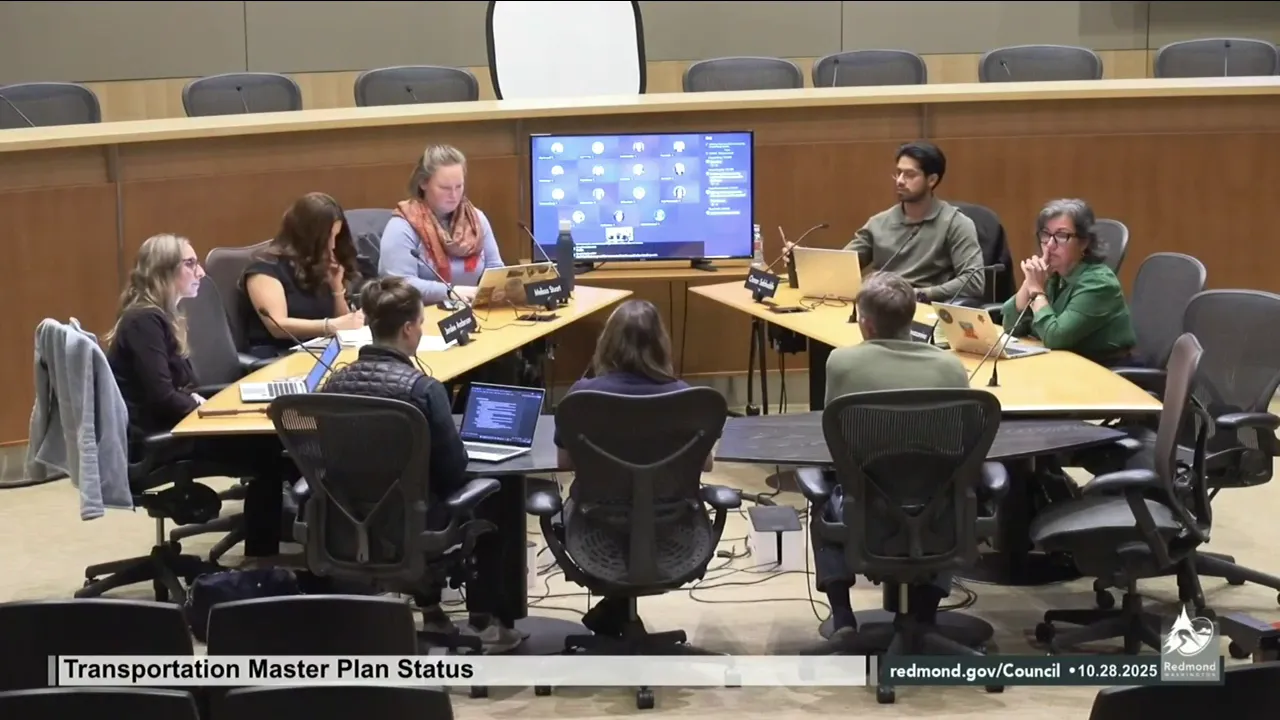
The Redmond City Council held a study session on Tuesday, October 28, 2025, beginning at 7:00 PM. The agenda included updates on the Capital Facilities Plan 2050, a Short-Term Rental Code Update, the Transportation Master Plan (TMP) status, and council talk time. No formal votes were taken; the meeting provided direction for future council actions.
Capital Facilities Plan 2050 – General Government
- Parks and Recreation Director Laureen Hamilton, Senior Planner Cameron Zapata, and Finance Director Kelly Cochran presented the draft Capital Facilities Plan. The plan forecasts facility needs based on 2050 growth targets and includes a financial strategy using bonds and other sources.
- Councilmember Stewart requested additional narrative explaining the financial assumptions, particularly the reliance on bonds in early years and general fund/REET later. Finance Director Cochran confirmed a comprehensive financial strategy is being developed, aiming to combine bond issuances across functional areas by late 2027 or early 2028, saving an estimated $3–5 million in issuance costs.
- Councilmember Nueva Camina highlighted strengthened language on climate resiliency, adopting Planning Commission recommendations to add policies on climate vulnerability assessments, sustainable building materials, and extreme heat hazards.
- Councilmember Fields asked about flexibility in construction methods (e.g., 3D printing) under bond financing; Cochran said no constraints are expected.
- Council President Kritzer confirmed the Planning Commission's recommendations are accepted. The plan will return to the Committee of the Whole on November 18, 2025, with a goal of adoption at the December 2 business meeting.
Short-Term Rental Code Update
- Deputy Director of Planning Serafie Allen, Economic Development Manager Kim Deeds, and Philly Marsh presented amendments to define and regulate short-term rentals (STRs). The definition follows state law: rentals of fewer than 30 consecutive nights, excluding owner-occupied units renting fewer than three rooms for at least six months per year.
- Data showed 237 STR listings across platforms, representing 0.6% of total housing units. Most were entire-home rentals, averaging 113 nights per year. A map displayed STRs spread throughout the city.
- Councilmember Nueva Camina asked about the owner-occupied exemption; staff confirmed it aligns with state law. Council Vice President Forsythe asked about impacts on caregivers; staff noted that caregivers typically do not pay a fee, so they are not covered.
- Councilmember Stewart raised Issue #19 on the issues matrix, integrating tenant-rights posting requirements for all rentals. Staff confirmed they will develop materials to be posted in accessible locations.
- The registration fee is $153 per year. Council plans to place the ordinance on the December 2 business meeting consent agenda for approval.
Transportation Master Plan Status Update – E-Mobility, Technology, Maintenance, Performance Metrics, and Transportation Facilities Plan
- Transportation Planning Manager Michael Hince and Senior Planner Francesca Liberti reviewed the remaining TMP chapters. The TMP adoption is on track for early February 2026. A public review draft will be published November 12, with a public comment period and Planning Commission hearing on December 3.
- The technology chapter emphasizes data privacy via the city's data governance process. The e-mobility chapter includes actions to expand EV charging at multifamily housing, using incentives from Puget Sound Energy and the state.
- Discussion on e-motorcycles: speeds up to 50+ mph make them inappropriate for bike lanes; staff will add references for education and enforcement. A potential retail delivery fee (35 cents, generating $70 million statewide) was noted as complementary to the city's low-emission delivery vehicle strategy.
- Maintenance section: it would cost approximately $63 million to fill sidewalk gaps and $38 million for sidewalk maintenance (replacing poor/failing sidewalks). The city may explore alternative maintenance approaches beyond adjacent property owner responsibility.
- Performance metrics monitor network completion, mode share, vehicle ownership, VMT, transit ridership, safety, and street/sidewalk condition.
- Transportation Facilities Plan (TFP): fiscally constrained, updated with new projects. Notable: removal of Avondale Road school bus pull-outs in favor of a comprehensive corridor study (priority for 2026); addition of Redmond-Woodinville Road spot widening to relieve congestion on Willows Road.
- Councilmember Stewart requested a holistic view of the completed TMP before adoption. A final council study session is planned for January 2026.
Council Talk Time
- Council President Kritzer noted schedule changes: no meeting on November 4 (Election Day), meeting moved to Monday, November 3; no meeting on November 11 (Veterans Day), meeting moved to Wednesday, November 12; meeting of November 25 canceled for Thanksgiving.
- Council Vice President Forsythe raised a request from Eastside for All to add direct language to the legislative agenda supporting protection of residents' civil liberties amid federal actions. Councilmembers debated whether existing language covering vulnerable populations is sufficient. Council President Kritzer will follow up with staff to explore amendments.
- Councilmember Fields reiterated a call for the council and mayor to plan for potential federal funding cuts, noting the $250,000 reserve may be insufficient.
- Councilmember Stewart highlighted the regional utility rate summit on November 14 and a letter from Puget Sound Regional Council regarding continuum of care funding.
- Councilmember Salahuddin announced his resignation from the council, effective after the next meeting. Council will have up to 90 days to appoint a replacement.
Key Outcomes
- Capital Facilities Plan: Accepted Planning Commission recommendations; staff to add financial narrative and return November 18; adoption target December 2.
- Short-Term Rental Code: Council direction to place ordinance on December 2 consent agenda for approval.
- Transportation Master Plan: Public review draft due November 12; final adoption expected February 2026.
- Council will explore amendments to the legislative agenda and discuss contingency planning for federal funding changes.
Meeting Transcript
I'm calling this meeting to order. This is a Redmond City Council study session held on Tuesday, October 28th, commencing at 7 p.m. Council members in attendance are Council Member Nueva Camina, Councilmember Salahouden, Councilmember Stewart online. We have Council Vice President Forsyth and Council Member Fields. We also have Mayor Burney with us tonight. And myself, Council President Kritzer. I will note Councilmember Anderson if and when she arrives. There are four items on our agenda tonight. The Capital Facilities Plan 2050 General Government, a short-term rental code update, transportation master plan status update, e-mobility technology maintenance, performance metrics chapters, and transportation facilities plan, and council talk time. So the first item on our agenda is the Capital Facilities Plan 2050 General Government. And we have Laureen Hamilton, our Parks and Recreation Director here to introduce this item. Go ahead. Good evening, City Council. I'm Lorene Hamilton, the Parks and Recreation Director here for the City of Redmond. This evening we are bringing forward the Capital Facilities Plan 2050 General Government. As you'll recall, we had a previous study session in which we brought this item to you. This item has also gone through the planning commission, and I sent to you earlier today the planning commission's recommendation for adoption of this plan. In our last study session with you all, the request was to dig a little bit more into the financial strategy behind the capital facilities plan. And so that's the presentation and information we've prepared prepared for you this evening. I'm joined by Kelly Cochran, our finance director to help dig into that, and then Cameron Zapata, our parks uh senior planner who really has shepherded this process throughout the city, and um honestly publicly just want to give her and Glenn Coyle from the planning department um huge props for the hard work that they've done with our consultants and um Quinn Kuhnhausen, our facilities manager. So at this time I'm gonna hand it off to Cameron to start our presentation. All right, good evening all. Uh, my name is Cameron Zapata, a senior park planner. Also joined here with some city staff members. We have Quinn Kunhausen and Glenn Coyle, and we also have our consultant Scott from Makers. Um we're here to bring back the Capital Facilities Facilities 2050 General Government Plan. As a reminder, the purpose and goals for this project are to update the 2025 to 2030 Capital Facilities Plan, which was adopted as part of Redmond 2050. This plan forecasts the future need of capital facilities based on the 2050 uh growth targets. It'll identify potential locations and expansions for facilities, and it provides an analysis of how the city will finance capital facilities projects within its funding capacity and identifies as potential funding sources. And lastly, it updates facility conditions and department needs from the 2019 Capital Facilities Plan. The Capital Facilities Plan is considered an amendment to Redmond 2050 as it's a reference to the capital facilities element. The draft plan, like Lorreen mentioned, uh went to the Planning Commission on its October 22nd meeting where they recommended approval with the following recommendations to City Council. So the first recommendation is to add climate resiliency policies to section one, and this shows consistency with Redmond 2050 and the broader sustainability goals. Second, uh to add a statement to the city's commitment to using resilient and sustainable building materials with an emphasis on long-term durability and sustainability. Third is to add language to conduct climate vulnerability assessments during the design phase of new facility construction. Um additionally, expanding the list of hazards to explicitly include extreme heat, which has become a more frequent and relevant risk to our community. The revenue source uh source charts are to be updated with additional text to provide clearer context on how funding sources align with current budget allocations. And then lastly, an added reference to the water system plan, especially as it relates to campus planning coordination. So here's a cost summary graph of the projects, and they're color-coded by the different functional areas. You can see that throughout the different time frames. A bulk of the spending isn't focused on just one functional area and that it's spread throughout. And then here's the revenue sources based on time frames. The capital facilities plan, it doesn't commit specific funding sources. These sources are assumed based on current and projected funding sources. And paying with cash is generally not feasible for most cities, and common methods for securing funding include councilmanic bonds, voter approved and revenue bonds, as well as impact fees. The specific funding strategies will be determined during the budgeting process. And next steps include going to committee of the whole on November 18th, and then for final adoption anticipated for December 2nd. And then in 2026, staff will begin the process to update the CIP for 2027 to 2032, which this plan will inform. Thank you. Thank you.
openpublica.com