Browse by city
Date range
Search help

Search titles, summaries, topics and stored transcripts together. Keywords may match separately; put the whole query in double quotes for a phrase. Matching follows word analysis, so punctuation is not exact. Both dates are included. Documents are not searched.

SHOWING 1–10 ENTRIES
01
NEWNOV 2, 2026 · REDMOND, WASHINGTON · CITY COUNCIL
Redmond City Council Special Meeting – 2026-11-02: Budget Hearing, Youth Climate Awards, and SEPA Appeal

The Redmond City Council held a special meeting on Monday, November 2, 2026, at 7:00 PM at City Hall (15670 NE 85th St), with remote participation available via RCTV, Facebook, and phone. Mayor Angela Birney presided; Council President Melissa Stuart, Vice President Angie Nuevacamina, and Councilmembers Jessica Forsythe, Vanessa Kritzer, Sayna Parsi, Vivek Prakriya, and Menka Soni were present. The agenda included a Native American Heritage Month proclamation, recognition of Youth Climate Action Fund awardees, a 15-minute executive session, a public hearing on the preliminary 2027–2028 biennial budget, a downtown adaptive signal control project update, ombudsperson and committee reports, and a quasi-judicial appeal of a SEPA threshold determination for noise code amendments. The Mayor reminded residents that ballot boxes were open through 8:00 PM on Election Day (November 3, 2026). The council unanimously accepted the hearing examiner's recommendation, remanding the noise code DNS to the technical committee. Special Orders of the Day - Mayor Birney proclaimed November 2026 as Native American Heritage Month, honoring the histories, cultures, resilience, and contributions of American Indian, Alaska Native, and Indigenous peoples; recognizing the Snoqualmie Indian Tribe and other tribal nations; and acknowledging the ongoing harms of colonization, displacement, and harmful federal policies. - The city recognized youth recipients of Bloomberg Philanthropies Youth Climate Action Fund grants; Redmond was one of 300 cities globally selected. The city received 22 applications with requests totaling more than $76,000, and the Environmental Sustainability Advisory Committee selected 13 projects, with roughly 40 youth in attendance. The announced projects included Snap Sort Redmond, East Lake Native Plant and Pollinator Garden, Sue Green Tech, Nest and Nectar, Bike Rack Engineering and Mural Design Challenge, Native Plant Fair, Aquafusion, Green Libraries, Wild Yards, Redmond Storation Blackberry Busters, Eco Beats, and Hackathon Green Code Redmond. Projects will be implemented over the next six months. Executive Session - The council held a 15-minute closed executive session to evaluate the qualifications of an applicant for public employment (RCW 42.30.110(1)(g)). Public Comments & Testimony - Eileen McComb (HopeLink, Director of Housing and Case Management) expressed gratitude for the city's continued investment, stating HopeLink served 1,688 unduplicated families in Redmond over the past year, including 401 adults and children accessing housing and comprehensive case management. In fiscal year 2026, Redmond food markets served more than 3,300 Redmond residents, providing over 700,000 meals to families facing rising food costs. - Laura Goodsell (Kindering) thanked the city for its partnership and the recent recommendation to support 2027–28 funding requests for the Families in Transition (FIT) and parent education/family support programs. She noted that 88% of children enrolled in FIT for six months or longer made measurable progress in at least one skill area, and 100% of survey respondents reported improvements in parenting, teaching, and caregiving skills. - Aaron Hamilton expressed strong frustration with the pace of affordable housing progress after nine years of advocacy, stating that rent is skyrocketing, area median income continues to go up, and affordability goes down. He said he is "done being patient" and criticized ARCH representatives as out of touch, asserting that no ARCH board members have depended on affordable housing to survive. He stated he has watched building after building being built downtown (the transcript renders "20 10 buildings in the span of nine years" from his apartment window) without relieving affordable housing pressure, and urged the city to "build buildings, not give five percent of an apartment building to affordable housing." - Sandra Ruffner (Puget Sound Mycological Society, co-chair of the Bridle Trails survey project) asked the city to reconsider its policy of charging $25 per hour and requiring six-week advance applications for low-impact citizen-science fungal research in the Redmond Watershed Preserve, stating her committee is not budgeted for such expenditures and that citizen scientists help bridge gaps in underfunded research. - David Morton asked the council to pull the 2027 State Legislative Agenda from the consent agenda and add three items: (1) state PFAS source control, cleanup of contaminated sites, and monitoring near wells in critical aquifer recharge areas, noting PFOS has already been detected in Wells 1 and 2; (2) a sentence stating Redmond is not asking to weaken protections for aquifers, streams, or critical areas; and (3) support for state urban forestry resources and standards allowing cities to independently verify tree assessments prepared by applicant-hired professionals. He also asked that the $3 million maintenance and operations center request specify a sustainability standard. No councilmember pulled the item. - Joe Kunzler (remote) expressed support for legislative agenda items including new Public Disclosure Commission tools to strike down repeat respondents, an updated (2026) Attorney General's open government manual (currently dated 2016), and annual training exercises for planning officers and clerks. He congratulated Redmond on its "hate free zone" and encouraged residents to vote. - Jennifer Barrett (remote) could not be reached; her comment was not delivered. Consent Calendar - On a motion by Councilmember Prakriya, the council voted to take up item IV.A.4 (Confirmation of Appointment of New Commission Members) before the executive session; the motion carried. - The council confirmed and the City Clerk swore in Jenny Baldwin (Parks, Trails, and Recreation Commission) and Zichuan Huang (Planning Commission). - The remaining consent agenda passed unanimously by voice vote, including: approval of minutes from the October 20, 22, and 27, 2026 meetings; payroll/direct deposit and claims check registers; confirmation of Truc Dever as Redmond's Human Resources Director (with the Mayor noting she will be sworn in on November 17); adoption of the 2027 Legislative Agenda; adoption of the 2027 Housing and Human Services Action Plan; the final contract with Dickson Company in the amount of $333,304 and acceptance of construction for the Old Fire House Teen Center Demolition Project; the on-call and continuing legal services contract with Foster & Garvey; and the 2027 rate amendment to the South Correctional Entity (SCORE) interlocal agreement. Public Hearing: Preliminary 2027–2028 Biennial Budget - Aaron Hamilton spoke in support of using the community-based organization engagement line item (or similar funding) to compensate community members who provide services to the city, such as his training and engagement initiatives with law enforcement, noting that work involving marginalized communities is often expected to be free while other training is paid. - David Morton raised three requests not yet reflected in the issues/deliberation matrices: (1) confirm sufficient 2025–2026 budget funding for PFAS soil and groundwater testing before ground disturbance at the Evans Creek project, extending to the 2013 Allwood recycling fire site approximately 1.5 miles from Wells 1 and 2 (where PFOS is present at roughly 5 parts per trillion), and publish the results; (2) clarify when city arborist review is required under the tree code (currently exception-based) and set a date for deciding on additional arborist capacity; and (3) keep the $2.44 million environmental sustainability package whole. He also asked the council to identify which items tied to House Bill 2015 (approximately $5.5 million in new funding capacity) remain funded and from what source, to consider holding the MOC budget at $250 million until January (noting the project holds $20.7 million in contingency while the matrix proposes raising the budget by $18.5 million), and to tie the estimated $184 per household annual cost of adopting both new sales taxes to named outcomes. - Joe Kunzler (remote) suggested the budget fund excellent local government training modeled on Redmond, additional bus shelters, a monument to Redmond's "hate free zone," and carbon-absorbing plantings. - The hearing was closed without council action; budget deliberations continue, including a special meeting on Thursday. Discussion Items - Staff Report – Downtown Adaptive Signal Control Project: Paul Cho (city traffic engineer) and Hidemi Suru (senior engineer) reported that the QFree adaptive signal system was deployed along Redmond Way from 160th Avenue NE to East Lake Sammamish Parkway, with MyOVision multimodal detection for cyclists, pedestrians, and continuous traffic counts. A before/after study showed corridor travel times maintained or improved; weekday PM transit delay decreased by approximately 7 seconds per eastbound trip and nearly 3 seconds per westbound trip; and planning-level CO2 emissions decreased by approximately 2.5 metric tons per average weekday (the environmental equivalent of taking a vehicle off the road for half a year). The system greatly reduced the need for manual signal retiming, which previously took about three to six months per corridor. Lessons learned included verifying hardware compatibility in real-world field conditions, establishing thorough issue identification/resolution processes, and allocating significant staff time or considering contracting. The upcoming Overlake Adaptive Signals Project (deployment planned for 2027–2028, wrapping up in 2029) will install similar technologies along NE 40th Street, 140th Avenue NE, and 156th Avenue NE, including a pilot feature that detects crossing pedestrians in real time and holds a red light a few extra seconds to let pedestrians finish crossing. In response to Council President Stuart's questions about the Community Facilities District/Microsoft partnership and Bellevue-owned signals on 24th Street within Redmond city limits, Cho explained that those signals are owned and maintained by the City of Bellevue and linked into Bellevue's adaptive system; a prior cooperative agreement using Bellevue's technology in Redmond cabinets was abandoned due to incompatible technology and emergency-response challenges. Staff will also explore coordination with WSDOT off-ramp signals at NE 51st and NE 40th Streets. - Ombudsperson Reports: Councilmember Nuevacamina (October) summarized community inquiries about the Columbia choirs residency event, a DOT pilot program for wheelchair transportation, tree canopy verification practices, downtown public safety concerns, gas leaf blowers, a perceived conflict of interest in public safety technology, accessibility concerns at Village Square on 85th and a proposed north–south midblock trail, Axon Fusus Core pricing, real-time surveillance and police budget, and a Lake Washington Tech bright futures coffee kickoff. Councilmember Parsi (November) reported inquiries about noise and light pollution, leaf blower noise, a resident public safety concern, and questions about construction plans for 40th Street bike lanes. - Committee Reports: Councilmember Forsythe reported her final East Rail meeting as co-chair, with Councilmembers Evans (Woodinville) and Balducci to co-chair the next two-year cycle, and noted visioning and future funding discussions including the Snohomish section. Councilmember Soni reported on Parks and Environmental Sustainability committee topics (parks and recreation impact fees, the teen center demolition contract, Derby Days 2026, Redmond Lights 2026 preview, pay plan updates) and community events including the One Redmond annual meeting, Spotlight Awards, a ribbon cutting, and Trunk or Treat. Councilmember Kritzer noted the intensive budget process, a special deliberations meeting on Thursday, and tenant protection subcommittee work on a proviso. Councilmember Prakriya said the budget proviso is being drafted with stakeholders and will be shared with the full council within a day or two. Council President Stuart reported that the Puget Sound Regional Council's housing production report ("are we on track?") shows the region on track and slightly ahead since 2019, with Redmond highlighted among core cities, and that the Association of Washington Cities is seeking clarification that House Bill 1220 is a planning mechanism rather than a requirement. Mayor Birney reported on the Cascade Water Alliance (approval of the board oversight strategy for the Cascade Supply Program and a letter to King County on reclaimed water), a meeting with the four cities around Lake Tapps, a King County election center tour, a Green Redmond planting event at Smith Woods, an AWC Districts 7 and 13 joint meeting, and a Kimchi for Peace event. Quasi-Judicial Proceeding: SEPA Appeal of Noise Code Amendments - The council held a closed-record appeal of the SEPA Determination of Non-Significance (DNS) for the noise code amendments (a non-project action), with a written recommendation from the contract hearing examiner dated October 19, 2026, recommending that the DNS be remanded to the technical committee. - City Attorney Rebecca Mueller conducted appearance-of-fairness questioning; the matter became quasi-judicial on June 24, 2026. Two councilmembers disclosed ex parte communications: Council President Stuart received an Interlake Sporting Association (ISA) Board email (June 30, 2026) stating concerns about proposed operating hours and support for a development agreement to implement noise reduction measures; Councilmember Parsi reported verbal communications with homeowners near ISA (June 27, 2026) in which some said noise did not bother them, one expressed concerns about cars, and two reported being bothered by summer and nighttime noise. No challenges were raised, and both councilmembers stated they could base their decision solely on the record. - Appellant Andrew Lewis (for the Interlake Sporting Association) argued the council should accept the hearing examiner's recommendation. He argued that the DNS was not based on an appropriate environmental baseline (which should measure actual noise conditions rather than the property's general designated use) and that the DNS improperly balanced the ordinance's perceived benefits against its impacts, which is contrary to SEPA. He cited Friends of Sammamish Valley v. King County (2024) and urged the council to remand so the technical committee can establish a conditions-based baseline and assess the ordinance's impacts against it. - Deputy City Attorney Anthony Saldato (with Jeff Churchill and Alex Hunt) asked the council to reject the recommendation. He argued that city staff appropriately and reasonably reviewed and reissued the CEPA checklist after considering ISA's comments (the comment period ended May 27, 2026), that a non-project action does not require a study, that the examiner relied on inadmissible expert testimony regarding balancing, that the "moving days" impact theory was unsubstantiated and refuted by public comments, and that the ISA gained a benefit of delay through the appeal (citing Dr. Jarvis's January 2026 testimony that ISA would sue if the ordinance were enacted). - Councilmembers asked clarifying questions about the status of the technical committee (which is being disbanded due to departmental reorganization), the cost of remand (not part of the record), litigation statements, the appropriate environmental baseline, the evidence behind the examiner's 52–67 decibel maximum sound level finding (a sound study by Tommy Poole/Municon West Coast commissioned by ISA after the appeal was filed, whose underlying daily data was not produced), and the adequacy of the city's supplemental checklist. - During deliberation, Councilmembers Prakriya, Parsi, Nuevacamina, and Soni expressed support for accepting the recommendation, citing the integrity of the city's environmental review process, due diligence, reliance on the examiner's thorough record review, and potential litigation exposure. Councilmembers Kritzer and Stuart emphasized deciding based on the record rather than city costs or liability, acknowledged the substantial due diligence performed by staff, and framed acceptance as expert feedback supporting continued policymaking on the issue. Councilmember Forsythe similarly noted this is an opportunity to re-examine and solidify the citywide ordinance. - Councilmember Parsi moved to accept the hearing examiner's recommendation; the motion was seconded and passed 7–0 on a roll call vote. Key Outcomes - The council unanimously (7–0) accepted the hearing examiner's recommendation, remanding the SEPA DNS for the noise code amendments to the technical committee (or successor body) for further review consistent with the examiner's conclusions; staff will share next steps with the council. - The council confirmed Truc Dever as Human Resources Director and confirmed and swore in Jenny Baldwin (Parks, Trails, and Recreation Commission) and Zichuan Huang (Planning Commission). - The remaining consent agenda was approved unanimously, including the 2027 State Legislative Agenda (without the additions requested during public comment), the 2027 Housing and Human Services Action Plan, the $333,304 Dickson Company contract and acceptance of construction for the Old Fire House Teen Center Demolition Project, the Foster & Garvey legal services contract, and the 2027 SCORE rate amendment. - The public hearing on the preliminary 2027–2028 biennial budget was held and closed without a vote; budget deliberations continue, with a special meeting scheduled for Thursday. - The council received the Downtown Adaptive Signal Control Project status update and was informed that the Overlake Adaptive Signals Project will deploy similar technologies in 2027–2028, with completion expected in 2029.
02
NEWNOV 2, 2026 · REDMOND, WASHINGTON · CITY COUNCIL
Redmond Planning and Public Works Committee Meeting - November 2, 2026

The Redmond City Council Planning and Public Works Committee of the Whole met in a special meeting on November 2, 2026 at 12:30 PM (UTC) to discuss five items: amendments to development impact fees, the 2027-2028 budget for the regional housing coalition ARCH, final amendments for the Redmond Paired Watershed Study, a feasibility study for converting septic to sewer, and the mayor's salary adjustment. Consent Calendar The council agreed by consensus to place the following three items on the consent agenda for the November 17, 2026 business meeting: - Omnibus Impact Fee Ordinance: An ordinance amending RMC 3.1/310 to adopt new fee schedules for parks, fire, and schools, and to index transportation fees for inflation. Council President Stewart expressed support for the package, stating it successfully balanced competing needs. Council Vice President Nouveau Kamina highlighted the collaboration with the Lake Washington School District. Councilmember Sony confirmed that other local jurisdictions are updating their fees concurrently using a state-mandated bedroom count methodology. - 2027-2028 ARCH Budget and Work Program: A routine biannual action to approve Redmond's contribution to the 16-member regional housing coalition. The $3 million administrative budget supports 14 full-time employees. Redmond's share will be approximately $694,000, a roughly 16% increase from the previous $600,000 contribution, attributed to the city's higher population growth. Council President Stewart asked Executive Director Lindsay Masters about a planned Salesforce database migration to improve reporting. Council Vice President Nouveau Kamina asked about evaluating the cost-effectiveness of new construction compared to preserving existing affordable housing. Councilmember Kretzer asked about state policy support for sub-regional collaboration incentives. - Paired Watershed Study Contract Amendments ($73,546): Final approval to extend the 10-year study to September 2027 and fund an interactive Department of Ecology data dashboard for sharing results regionally. In response to Councilmember Percy, Senior Environmental Scientist Jessica Alexandra detailed lessons learned, including street sweeping effectiveness varying by watershed connectivity and the shift from large vaults to smaller, community-accepted smart valve (CMAC) projects. The final trend analysis report is expected in Q1 2027. Discussion Items - Septic to Sewer Feasibility Program: Water and Wastewater Manager Ernie Fix and Supervisor Shilpa Meta previewed the upcoming November 10, 2026 presentation on converting 433 septic-served parcels. Planning-level cost estimates for incentivizing conversion ranged from a minimal property owner reimbursement program to a full $60 million program. Discussion focused on equitable financial assistance, regional partnerships (Kirkland and unincorporated King County), avoiding the unintentional gifting of public funds, and potential funding sources such as the EPA Clean Water State Revolving Fund (raised by Councilmember Sony). Council President Stewart emphasized preserving existing housing stock and engaging affected residents. Councilmember Kretzer requested clarity on phasing and project scale. Councilmember Percy suggested evaluating disincentives for continued septic use. The council considered the budget item resolved as sufficient carryover funding exists. - Mayor's Salary Update: The council debated two options for the mayor's cost-of-living adjustment (COLA): 2.3% based on the 2026 CPI or 4.1% based on the standard city employee COLA (determined by the June-to-June CPIW with a 2% floor and 5% ceiling). Councilmembers Prakria, Sony, and Kretzer supported the 4.1% to maintain parity with city staff. Council Vice President Nouveau Kamina noted the conceptual tension between treating the position as an elected role versus a staff role. Council President Stewart supported the 2.3%, expressing concern about compounding increases on a high salary base. Councilmember Percy advocated for studying a more dynamic compensation model in the future. Key Outcomes - Votes & Decisions: The council provided direction to set the mayor's salary increase at 4.1% for the current year, aligning with the city employee COLA. The council also agreed to add a review of the COLA methodology for elected officials to the 2027 work plan. - Referrals: Three items (Impact Fees, ARCH Budget, and Watershed Study amendments) were referred to the November 17, 2026 business meeting consent agenda. The Septic to Sewer Feasibility Study presentation is scheduled for the November 10, 2026 study session.

WATER AND WASTEWATER MANAGEMENT 27% · AFFORDABLE HOUSING 21% · PERSONNEL MATTERS 19% · BUDGET 8%
03
OCT 28, 2026 · REDMOND, WASHINGTON · CITY COUNCIL
Redmond Planning Commission Meeting: October 28, 2026

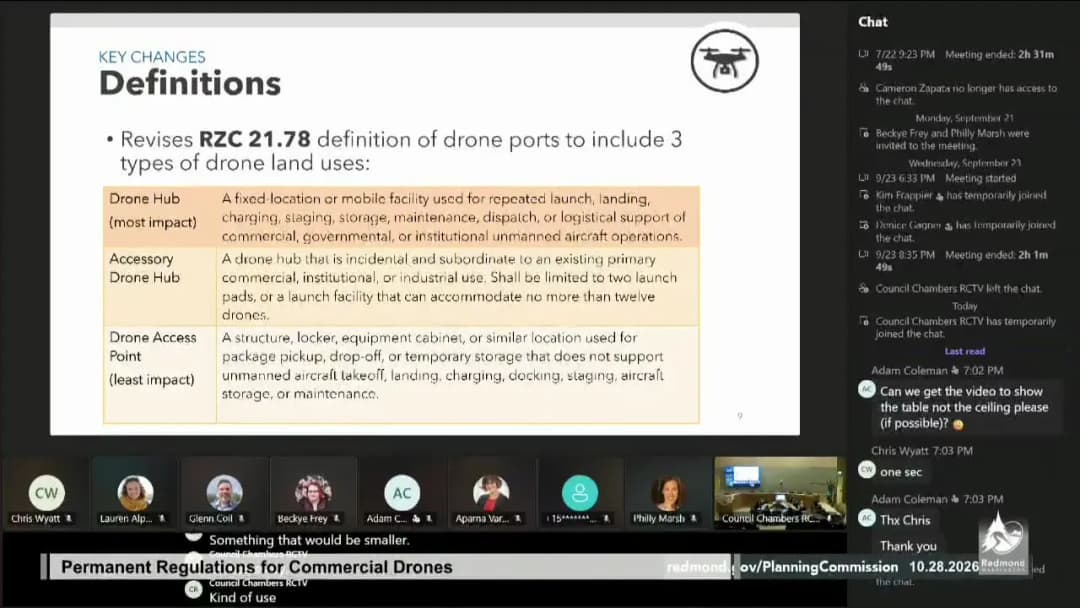
The Redmond Planning Commission met on October 28, 2026, starting at 3:15 PM, to address three major agenda items. Chairperson Woodyer presided, with Commissioners Arparna, Gong, Gagnier, Van Nyman, and Vice Chair Coleman present. Staff included Lauren Alpert, Becky Fry, Michael Hinz, Glenn Coyle, and Chris Wyatt. The agenda and meeting summary from October 14, 2026, were approved unanimously. Public Comments & Testimony - Susan Weston, former Planning Commission Chair, expressed strong opposition to the timeline for commercial drone regulations. She questioned the rush, noting the city council passed a 12-month moratorium only 3 months ago, high staff turnover, a reduced commission (4 of 7 seats), and an incomplete meeting packet (missing CEPA analysis and noise rules). She requested the city provide a list of NDAs signed by staff on the topic and disclose gifts or financial ties between city officials and drone companies, observing that the chief of police had started a side consulting business about drones. - Dr. David Morton requested briefings on PFAS testing at the Allwood recycling fire site (a potential PFOS source for Redmond's wells) and on requiring Parks-certified arborists to independently review applicant tree reports rather than leaving such review to administrator discretion. Discussion Items TFP Projects Update – Report Approval - The public hearing was closed. Commissioners reviewed the final issues matrix. - Prioritization (Closed): Staff noted projects align with transportation strategies but are not ranked. - Environmental Analysis (Conditionally Closed): Commissioners deemed the response stating CEPA criteria were "met" inaccurate, as the analysis was not performed at this planning level. Staff will clarify the language to reflect this scope. - Costs and Scope: Updated planning-level cost estimates were confirmed, including a shared-use path on Northeast 72nd Street. - Typos: Corrections were reflected in meeting materials. - The Commission agreed to advance a formal report and recommendation to the City Council. Repeal Neighborhood Connections Map – Study Session - The public hearing was closed. Staff presented five neighborhood connections mistakenly not carried over to the Transportation Master Plan maps, identified by Commissioner Gagnier. - The item is paused. A new public hearing was opened (notice issued October 28) and the Commission will hear testimony on December 2, 2026, before a final vote. Commercial Drones Regulations – Introduction and Study Session - Staff (Glenn Coyle) introduced proposed permanent zoning regulations for commercial drones, driven by an Interim Official Control (IOC) expiring April 2027. - Proposed Framework: Three use types: Drone Hubs (industrial zones only), Accessory Drone Hubs (adding commercial/mixed-use), and Drone Access Points (adding multifamily zones). Roughly 40–50 percent of the city, including all neighborhood residential and conservation zones, would be excluded. A 150-foot buffer from residential and public safety facilities is proposed for hubs. - Constraint: The city cannot regulate airspace (federal law) or flights originating outside city limits. - Commissioner Feedback (Unanimously Expressed Concerns): - Commissioner Van Nyman requested a comprehensive background document covering technology, regulatory layers, and a persuasive public rationale. Called the timeline "super unreasonable." - Commissioner Aparna questioned the lack of CEPA review, the expansion of zones compared to the limited IOC, city liability for accidents, and privacy implications. Stated the option to recommend a ban ("none of the above") must be available. - Commissioner Gong asked for clear context on what the IOC permits versus prior code. - Commissioner Gagnier highlighted potential conflicts of interest, referencing the police chief's financial ties to the drone industry as raised in public comment. - Vice Chair Coleman criticized the weight given to limited public feedback (69 respondents, mostly negative), requested projections for economic and sustainability benefits, and asked for the "minimum necessary" regulations if adoption is inevitable. Described the push as feeling like an experiment on residents. - Chair Woodyer summarized core concerns: safety (drones falling on people or pets), noise (specific tone/decibel issues), cumulative community impacts, and a need for robust mitigation data. Requested comparison with similar cities (not sprawled metros) that have adopted rules. - Next Steps: Discussion continues November 4, 2026. The public hearing is scheduled for November 18, 2026, with a recommendation to council expected in January 2027. Key Outcomes - TFP Projects: Commission directed staff to finalize the report with specific language clarifications. - Neighborhood Connections Map: Item paused; new public hearing set for December 2, 2026. - Commercial Drones: No action taken. Study session deferred to November 4, 2026, pending substantial additional information from staff. - Commissioner Farewell: Chair Woodyer and staff formally thanked Commissioner Gagnier for her service, especially her detailed review that identified the missing connections. Her resignation is effective immediately due to a new professional role.

PUBLIC ENGAGEMENT 21% · ZONING CODE AMENDMENT 20% · TRANSPORTATION SAFETY 16% · TECHNOLOGY AND INNOVATION 13%
04
OCT 27, 2026 · REDMOND, WASHINGTON · CITY COUNCIL
Redmond City Council Study Session: Human Services Funding and Budget Deliberations - October 27, 2026

The Redmond City Council held a study session on Tuesday, October 27, 2026, beginning at 7:00 PM at City Hall (15670 NE 85th St). All council members and Mayor Angela Birney were in attendance. The three agenda items were: the 2027-28 Human Services Funding Recommendations, the Preliminary 2027-2028 Biennial Budget Council Deliberations 2, and Council Talk Time. No meeting minutes were available for this session. The meeting was extended to 10:45 PM by unanimous motion to complete the budget revenue discussion. Human Services Funding Recommendations (Agenda Item 1) - The Human Services Commission presented its 2027-28 funding recommendations. Redmond partners with 16 other cities (17 total) through the Human Services Funding Collaborative, established in 2010, which uses a single application and shared reporting requirements. The item was referred from the September 15, 2026 Committee of the Whole. - The application period opened March 2, 2026. Over six months, commissioners met twice monthly and reviewed all 121 applications, with every commissioner reading every application. Commissioners dedicated over 900 hours to the review, excluding individual reading time. Two youth advisors, Anya and Aditi, reviewed every application and attended every meeting. - Funding requests grew from $5.4 million in the prior cycle to $8.1 million this cycle. The Mayor's proposed 2027-28 budget would raise the city's human services investment to approximately $40 per resident - nearly a 40% increase over the prior biennium (the 2021 budget was approximately $1.6 million, or $19 per resident). - Four funding priorities guided decisions: housing stability and shelter; food security and basic needs; behavioral health (including youth mental health); and community-based programs that reflect the people they serve, especially those relying heavily on city funding. - An equity rating tool developed with Communities Rise was used to reduce bias and standardize evaluations. The commission also weighed program costs, outcomes, accessibility, other funding sources, duplication of services, and service to Redmond residents. - The funding framework included: a 25% increase (or full request if smaller) for housing and homelessness set-aside programs, bringing that area to about 24% of available funds; a 5% cost-of-living adjustment (or full request) for existing programs; a 50% increase (or full request) for existing priority-area programs; and partial or full requests for new programs depending on priority status and reliance on city funds. Sixteen new programs were recommended, including nine for culturally specific services. - Opiate abatement dollars are incorporated into the overall human services budget; staff intentionally limited the number of programs receiving opiate funding because of rigorous reporting requirements. Previously funded programs will continue to receive general fund dollars. Councilmember Forsythe expressed surprise that all opiate abatement dollars were directed to a single agency. - Councilmember Prakriya observed that proposed annual awards of about $3.7 million represent a greater than 20% increase over the prior column of about $3 million, and asked how the city communicates long-term sustainability expectations to major recipients such as Hopelink. - In response to council questions, staff and commissioners explained: each program is evaluated on its own merit, including cost per service unit; outcome data from prior cycles is reviewed, and some programs were not funded due to weak outcome measures; administrative costs are proportionally allocated across programs; CDBG-funded programs are monitored on a schedule aligned with county and HUD requirements; and unfunded applicants receive offers to meet with staff for feedback. - Councilmember Prakriya asked about the unfunded LifeWire housing stability program, then corrected himself; staff confirmed LifeWire received funding for survivor advocacy services but not the housing stability program. That program expended roughly half of its prior-year funds and only about 30% of its annual contracted amount by the third quarter. - When asked about a 'next tier' of funding, commissioners identified rental assistance and housing stability, food insecurity and basic needs, youth-focused behavioral health services, and community-based programs that rely heavily on city funding. - Mayor Birney and multiple council members expressed deep gratitude for the commission's work. Preliminary 2027-2028 Biennial Budget: Council Deliberations 2 (Agenda Item 2) Budget Chair Councilmember Kritzer led the second night of budget deliberations. The council reviewed service enhancement packages under the 'Strategic and Responsive' and 'Vibrant and Connected' priorities, followed by new revenue options. Strategic and Responsive Enhancements - Ongoing positions: a community outreach coordinator (to lead community engagement, manage a reconstituted Redmond 101 program, and coordinate citywide engagement); conversion of a limited-duration communications position to full time (communications workload increased almost 39% from 2003 to YTD 2026); and a graphics/design position. - One-time items: an equity-centered citywide code review; parks website improvement implementation ($50,000); pre-approved accessory dwelling unit (ADU) and middle housing plans ($100,000); funding to compensate community-based organizations for engagement partnerships; and a low-income travel subsidy pilot (e.g., car-share or micromobility gift cards, mobility hubs). - Financial sustainability and regulation: business license compliance positions and a fee study (an audit found 30 to 40 percent of businesses operating in Redmond are not licensed); a utility tax audit; regional fire authority analysis; public records support (nearly 3,300 public records requests in 2025); and continued federal lobbyist funding (about $200,000). Councilmember Soni noted a 30% decline in grants and asked about oversight and grant-writing expectations; several council members requested a written accounting of outcomes and a timeline for a council federal agenda. - Technology: a GIS strategy and architecture update; aerial photography and LIDAR data (council members asked staff to confirm this is distinct from the May 2026 tree-canopy LIDAR study and does not duplicate prior work); a centralized real property and easement database; and an all-city connectivity study ($415,000) to evaluate a city-owned private LTE network versus a managed carrier model, including potential free or low-cost internet access for underserved communities. Vibrant and Connected Enhancements - Proposed items included: Seattle Sports Commission membership; a business district and placemaking program manager; an artist space feasibility study; business district organization seed funding; a manufacturing/business park/industrial market study responding to Senate Bill 6026; a destination marketing organization study; and Greater Seattle Partnership investment. - Planning-related items: transit-oriented development (TOD) law compliance under House Bill 1491; master planning for the 0.3-acre Bellwether parcel B adjacent to the Prisma development in Overlake Village; and an urban mixed-use zone sub-area plan. Council Proposals on Enhancements - Councilmember Parsi proposed up to $250,000 for an evaluation and modernization of the city's ethics framework. The council placed it on the deliberations matrix (five to six thumbs in favor). Councilmember Forsythe expressed support; Council President Stuart questioned the budget size but agreed to further deliberation. - Councilmember Kritzer raised the future of the community-based events innovation fund and suggested a council sponsorship program for community events. The council agreed to revisit the item (seven thumbs in favor). - Councilmember Soni proposed a $250,000 'home to storefront' seed grant to help small businesses move from home-based operations into commercial storefronts, with eligibility requirements such as a minimum two-year lease. The council placed it on the deliberations matrix (seven thumbs in favor) with staff feedback requested on alignment with existing economic development programs (e.g., One Redmond). - Councilmember Forsythe proposed public bike storage lockers at city buildings, noting the current bike locker in the City Hall parking garage is staff-only. The council placed it on the deliberations matrix (five thumbs in favor). - Councilmember Kritzer raised the Derby Days criterium/community bike ride, which has not returned since COVID. The council asked parks staff to bring back funding alternatives (seven thumbs in favor). New Revenue Options - House Bill 2442 (children and family services sales tax): King County passed an ordinance on October 6, 2026, to collect the additional 1/100 of a percent sales tax if the city does not act. The council directed staff to move forward with a city ordinance to keep the estimated $550,000 per year in Redmond (seven thumbs in favor). The tax is time-limited, cannot be used for staffing, and the earliest collection would begin April 1, 2027. Councilmembers expressed interest in directing funds to child care, before- and after-school programs, and in exploring distribution through existing city programs (e.g., Redmond Senior and Community Center child care, recreation programs, Boys and Girls Clubs). Councilmember Prakriya asked staff to report on the revenue gap between January and April 2027. - House Bill 2015 (criminal justice sales tax): An additional 1/10 of 1 percent sales tax would raise an estimated $5.5 million per year. Proposed uses included additional police officers, a bicycle unit, additional mental health professionals, a domestic violence co-response program (Project Be Free), and supplanting existing criminal justice costs to free general fund dollars for other priorities (including GIS, facilities maintenance, Bellwether campus customer service, e-mobility coordination, external data sources, and increased fire apparatus funding). The state's $100 million grant fund associated with the bill was reported as already spoken for. Councilmembers sought clarification on the number of funded and proposed mental health professional positions; staff agreed to provide an organizational chart and position matrix. Councilmember Parsi asked how jail services figures ($1 million last year, $2.56 million proposed this year, and $3.1 million in the new table) connected; staff explained that the table showed a portion of the biennial jail costs eligible for the sales tax. Councilmember Nuevacamina and Council President Stuart opposed the tax as regressive; Councilmember Prakriya requested data on household impacts and police effectiveness before deciding. Mayor Birney noted the legislature expects cities to use the revenue tools it provides. The council did not place HB 2015 on the deliberations matrix (one thumb for further deliberation). Council President Stuart noted the city has until June 2028 to adopt this tool if desired. Council Talk Time (Agenda Item 3) - Mayor Birney reminded council members that Sound Cities Association position applications are due November 6, 2026, with many openings and few applicants. - Council Vice President Nuevacamina cautioned that two council members from the same city applying for the same position would both be disqualified. - Council President Stuart welcomed new staff member Hazel, encouraged scheduling, and announced end-of-year check-ins with council leadership after budget adoption. Key Outcomes - The 2027-28 Human Services Funding Recommendations will be considered as part of the council's adoption of the 2027-28 budget; funded services are scheduled to begin January 1, 2027. - Budget deliberations will continue on Thursday, October 29, 2026, using the deliberations matrix. Staff committed to posting responses by Wednesday evening, with any carryover posted by Thursday noon. - Council leadership will meet with finance staff to consolidate items raised during the session; the tenant protection subcommittee will send its proposal by Wednesday. - The council placed the following proposals on the deliberations matrix: ethics framework evaluation/modernization; community-based events innovation fund revisit; 'home to storefront' seed grant; public bike storage lockers; and community bike ride/criterium alternatives. - The council directed staff to prepare an ordinance for HB 2442 sales tax collection and to provide additional details on eligible uses and program distribution options. - HB 2015 was not placed on the deliberations matrix; no further budget deliberation on the criminal justice sales tax was scheduled.

BUDGET 25% · HUMAN SERVICES 16% · NONPROFIT SUPPORT 8% · COMMUNITY ENGAGEMENT 7%
05
OCT 27, 2026 · REDMOND, WASHINGTON · CITY COUNCIL
Redmond City Council Special Meeting - Commission Candidate Interviews, October 27, 2026

The Redmond City Council held a special meeting on Tuesday, October 27, 2026, beginning at 6:40 p.m., to interview candidates for the Parks, Trails, and Recreation Commission (PTRC) and the Planning Commission. All councilmembers were present, so a formal roll call was not needed. No minutes were available; this summary is based on the agenda and the raw transcript. Parks Planning Manager Lindsay Falkenberg introduced Jenny Baldwin for PTRC, and Principal Planner Becky Fry introduced the Planning Commission candidate. Councilmembers questioned both candidates together about their service motivations, community engagement, future priorities, and accountability for public funds. Candidate Introductions - Jenny Baldwin: A longtime Redmond resident with personal ties to the city's parks and trails; more than 15 years of experience as an educator; current work in strategy and program management at Nordstrom; serves on the Lake Washington Schools Foundation board; and founded the Baldwin Challenge, which has raised more than $200,000 for Northwest Harvest. Staff noted that many current PTRC commissioners are newer to the city, making her longtime-resident perspective valuable, and highlighted her collaboration, stakeholder engagement, and consensus-building experience. - Planning Commission candidate: A licensed architect with a background in landscape architecture and education in urban planning. The candidate followed Redmond 2050 and was excited about its outcomes, wanting to help Redmond continue balanced, sustainable development. Discussion Items - Council President Stuart noted both commissions have strong historical reputations and are experiencing rebuilding and generational leadership changes. Jenny described PTRC as a 'new generation' in its 'sophomore era,' with major initiatives underway, including adding pre-K and early-childhood structures to parks. The Planning Commission candidate praised Redmond's thoughtful, balanced development and said Redmond 2050 aligned with the candidate's passion for contributing to the place they live and love for future generations. - Vice President Nuevacamina asked what each candidate would be proud of by December 2028. Jenny said she hoped to see new trail lighting, especially solar-generated lighting in dark stretches such as the trail from the light rail toward Whole Foods, improving safety, enjoyment, and access to transit and Marymoor Park. The Planning Commission candidate envisioned an active hub around light rail with homes, jobs, restaurants, and nighttime activity, using 'eyes on the street' for safety and avoiding a 'black hole' after dark. - Councilmember Kritzer asked how candidates would gather community feedback on difficult decisions. Jenny said engagement should meet people where they are - Little League games, musicians in Anderson Park, the light rail station, and local bike shops - rather than relying on passive social media posts. The Planning Commission candidate said community members' surface-level ideas often sit on top of shared underlying concerns; the goal should be to identify common ground and find a 'Plan C' that works for everyone. - Councilmember Soni asked what accountability means when public funds are involved, using a hypothetical $5 million legacy project. Jenny said she would choose sustainable lighting in high-traffic dark areas, potentially with commemorative naming; accountability means clear reporting, every line item reconciling, and accessible public reporting. The Planning Commission candidate said they do not have a financial or fundraising background; given Redmond's current position, they would seek projects that not only deliver the project itself but also create surrounding benefits, such as neighborhood growth, jobs, and housing. Key Outcomes - No formal vote was taken during the interview meeting. - Mayor Birney thanked both candidates and said they would be placed on the consent agenda at the council meeting next Monday, the day before Election Day (November 3, 2026). - If candidates attend that meeting, they will be sworn in there and may bring family and friends; if they cannot attend, arrangements will be made to swear them in later, after which they will be assigned to their respective commissions.

COMMUNITY ENGAGEMENT 61% · PARKS AND RECREATION 31% · PUBLIC SAFETY 8%
06
OCT 27, 2026 · REDMOND, WASHINGTON · CITY COUNCIL
Redmond Committee of the Whole – Parks & Environmental Sustainability Meeting – October 27, 2026

On Tuesday, October 27, 2026, at 4:30 PM, the City of Redmond Committee of the Whole for Parks and Environmental Sustainability met at City Hall and remotely. Presiding Officer Menka Soni chaired the meeting; all council members were present. The agenda included two action items intended for future consent, three informational reports, and two pay-related items referred from other committees. The committee did not take final legislative votes, but gave direction on advancing several items. Action Item: Park Impact Fee Schedule Update (CM 26-466) - Parks staff presented the final update on park impact fees, noting the fees were last updated in 2017 and should have been updated with the 2023 park plan. The proposed standards-based 20-year methodology aligns with the park plan level-of-service metrics, using acres per resident and walkability. - Staff recapped the project timeline: consultant FCS contract approved in November 2025, council updates and community engagement through spring and summer 2026, and draft Redmond Municipal Code language presented on September 22, 2026. The packet included a side-by-side comparison of current and proposed rates. - Councilmember Stuart noted a scrivener error on the informal one-pager referencing a future 2028 contract date. Another council member confirmed that single-family residential would be the only fee category increasing and voiced support for the approach as consistent with density and middle-housing goals. One council member also asked for earlier council review of methodologies when approving future consultant fee studies. - Staff warned that if the fee update is not approved now, updating it later would require reopening the consultant contract and likely delay the update to the next biennium. - Outcome: The committee agreed to include the park impact fee ordinance in the impact fee omnibus being prepared by long-range planning staff. Although the agenda listed a November 2 consent date, staff clarified the item will return through the Committee of the Whole and then go to consent on November 17. Action Item: Old Fire House Teen Center Demolition – Final Contract and Acceptance (CM 26-614) - Eric Dawson presented the request to accept the completed demolition and finalize the contract with the contractor. The project finished about $50,000 under budget. - Staff displayed a 1948 newspaper recovered from the building. Salvaged materials include newspapers, part of the hose-tower ladder, and original window hardware. The Redmond Historical Society visited before demolition and recommended salvaging the window hardware; items are being held for possible integration into the rebuilt teen center, with future handoff to preservation organizations for items not reused. - Councilmembers asked about unexpected site conditions; staff reported no real surprises or hindrances to the next phase. - Outcome: The committee agreed to forward the item to the November 2 consent agenda. The agenda names the contractor as Dickson Company, while the transcript refers to Dixon Contracting; that discrepancy is noted. Informational Item: Teen Center Project Update (CM 26-652) - Parks Director Lauren Hamilton reported that the city received nine statements of qualifications for the design-build team, shortlisted three, held informational interviews on September 16, received proposals on October 13, and selected Miller Hull with Lise Crutcher Lewis after staff evaluation. The evaluation emphasized community engagement, inclusive design, and an effective progressive design-build process. - A two-day protest period applies before contract negotiations. Staff plan to bring a preliminary contract to the November 17 Committee of the Whole and, if supported, to the December 1 consent agenda. - Community engagement to date includes two teen-only visioning sessions with 78 unduplicated teens and a broader community visioning session on October 8. The owner's representative is compiling feedback for the design-build team. - Councilmembers requested clearer scoring transparency with the future contract, a timeline of when decisions will be known, and assurances that teen input will be carried through the process. One council member asked about maximizing building activation and utilization throughout the day and week. - Outcome: Informational only; no action taken. Staff will return November 17 with a more detailed primer on the progressive design-build process. Informational Item: Events and Derby Days Recap 2026 (CM 26-650) - Special event permitting increased more than 20% year over year: 44 special event permits and 49 miscellaneous park use permits were issued or in process, representing approximately 168,000 attendees. New producers included Fullenco Sports, Seed Kite Foundation, Cascade Stride, Green Stage, and CMP Seattle; Redmond also hosted a large-scale Taiwanese musical festival and four Shakespeare in the Park performances. - The Redmond Busker program returned with a QR-code credentialing system; 19 busker permits have been issued. A pilot busker location is planned at Astera Park during Redmond Lights. - Derby Days 2026 drew about 35,000 people over two days. Because the carnival could not attend, the city offered Kids Cove inflatables at a flat $5 fee and sold over 2,400 tickets. Additional highlights included 130 staff, 100 volunteers, 72 craft marketers, 14 food vendors, 11 performers, 46 local businesses and community organizations, and more than 600 participants in the kids' bike parade. Environmental measures included reusable cups replacing 2,241 plastic cups and 108 pounds of waste diverted from landfill. - In discussion, council members expressed interest in restoring a community bike element rather than the old criterium and asked staff to provide cost options during budget deliberations. Staff said the prior criterium was removed pre-pandemic due to ongoing budget shortfalls and lack of internal capacity, with about $40,000 in event savings and $15,000 in staff savings. Councilmember Kritzer noted that the council had allocated $10,000 through LTAC to the Washington State Bicycle Association, but the race still did not occur. - Outcome: Informational only; staff will bring additional bike element options through the budget process. Informational Item: Redmond Lights 2026 Program Plan (CM 26-647) - Staff previewed Redmond Lights 2026: a kickoff event on Saturday, December 5, 2026, at Downtown Park, with light and art activations continuing at Downtown Park and Astera Park through January 4, 2027. Planned features include snowfall, performances, a kids' light fashion show, craft booths, a luminary trail, a Woodblock signature menu, and 10 selected artist installations. Astera Park will add weekly acoustic performances on Saturdays. - Council feedback included increasing transparency about artist selection criteria and exploring reuse of art installations across the year. Council President Stuart praised local business participation and asked whether nearby and Astera businesses were invited; staff confirmed they are engaging businesses. - Outcome: Informational only; no action taken. Item from Other Committees: Mayor's Salary Pay Plan Update (CM 26-538) - Staff presented the proposed elected official pay plan update for the mayor's salary. Council members raised concerns that the recommended market adjustment would place the mayor's pay at or above several statewide elected officials and would be a large increase while city payroll issues remain unresolved. - Several council members stated they would not support an increase above the COLA at this time; Council President Stuart said she supports the COLA alternative. The committee did not consent to placing the item on the November 10 consent agenda. Staff will email the COLA options and ordinance language for council review, with a possible follow-up at the November 2 committee meeting. Item from Other Committees: 2027 Pay Plan Updates (CM 26-545) - Interim HR Director Lisa Meyer presented the 2027 pay plans. All 17 pay plans would receive a 4.1% cost-of-living adjustment based on the first-half 2026 CPI-W for the Seattle-Tacoma-Bellevue area, consistent with approved union contracts, the personnel manual, and the salary commission. The update also includes classification movements for executive analyst, chief operating officer, and city attorney, including a new EX33 band. - Council discussion raised concerns about the size of percentage-based increases, top-heavy compensation, transparency in the elected official pay table, and the need for an equity and gender pay review. Several council members said they were not ready to move the item forward until broader budget discussions occur. - Outcome: The item was not advanced to the November 10 special meeting consent agenda; staff will receive additional questions and continue budget-related discussions. Key Outcomes - Park impact fee update: advance as part of the November 17 omnibus and consent package, not November 2. - Old Fire House Teen Center demolition: committee agreed to forward final contract acceptance for November 2 consent; contractor name discrepancy noted. - Teen Center rebuild: Miller Hull and Lise Crutcher Lewis selected as design-build team; contract expected November 17 and December 1 consent. - Derby Days bike element: staff to bring options through budget deliberation. - Redmond Lights 2026: received as informational. - Mayor's salary EO pay plan: not advanced; staff to email COLA options. - 2027 pay plan updates: not advanced; further budget discussion and council questions needed.

PARKS AND RECREATION 38% · BUDGET 32% · COMMUNITY ENGAGEMENT 10% · ENGINEERING AND INFRASTRUCTURE 6%
07
OCT 20, 2026 · REDMOND, WASHINGTON · CITY COUNCIL
Redmond City Council Meeting Summary - October 20, 2026

The Redmond City Council met on Tuesday, October 20, 2026, at 7:00 PM. The meeting included a public hearing on the Preliminary 2027-2028 Biennial Budget, staff reports on the World Cup Program and Economic Development, and unanimous passage of two resolutions opposing state ballot initiatives (I-638 and I-001). The meeting was extended to 11:00 PM to accommodate the full agenda. Consent Calendar - Routine Approvals: Minutes, accounts payable, the Lucity Enterprise Asset Management Cloud Contract ($390,816), the 2027 Tourism Grant Funding recommendations, and a resolution joining the Washington Cities Insurance Authority (WCIA) were approved in a single vote. - Item 6 - Surplus Real Estate (Pacer Propane): Council President Stuart pulled the item to provide context. She confirmed environmental due diligence occurred and explained the property was no longer needed after the city acquired the larger Heidelberg site for the Municipal Operations Center. The council voted unanimously to authorize the sale. - Item 7 - Planning Commission Rules: Pulled by Councilmember Parsi due to confusion in the text. An amendment to clarify the code reference failed 4-3. The council then voted unanimously to refer the item back to a Committee of the Whole for further revision. Public Comments & Testimony - Items from the Audience: Residents spoke on the affordable housing shortage (unable to find 30%-AMI housing downtown), safety concerns at Leary and Cleveland (requesting new public intoxication codes), advocacy for a community arts and science center (MASK), and concerns over the city's sale of the Pacer Propane property without full public environmental disclosure. A youth representative from BAPS Shri Swaminarayan Mandir invited the council to a Diwali celebration. - Budget Public Hearing: Nine residents testified on the 2027-2028 Biennial Budget and Business Technology Investment Program (BTIP). Speakers expressed support for the Housing Navigator position, Active Transportation Safety Program, Red Link transit expansion, and environmental sustainability funding (ESAP, Energy Smart Eastside). Specific requests were made for capital funding for the Wayfinder Hub and for the city to reconcile discrepancies in the BTIP documents before adoption. Discussion Items - World Cup Program Annual Report: Staff presented a report detailing the program's financials ($2.4M total budget, $1.4M spent, $500k from sponsorships) and legacy. Key figures included 328 grant-funded events drawing over 27,000 attendees and a peak of 2,000 people at the USA-Belgium match watch party. Councilmembers unanimously praised the cross-departmental collaboration and community goodwill generated. - Economic Development Division Annual Report: Staff highlighted the adoption of the Redmond 2050 districts, the opening of the UW Global Innovation Exchange on the Microsoft campus, and a study revealing 1,555 licensed home-based businesses generating $115.7 million in gross income. Mayor Birney was appointed to the Governor's Space Council. Key Outcomes - Resolutions on Ballot Initiatives: The council unanimously passed Resolution 1634 formally opposing Initiative 638 (relating to K-12 athletics and transgender students) and Resolution 1635 formally opposing Initiative 001 (relating to parental rights in schools). Council President Stewart noted the expedited process for these items but voted in favor. - Planning Commission Rules: Referred to committee for clarification of commissioner removal processes. - Budget Schedule: Council will continue budget deliberation on October 22nd and 27th, with several testifiers requesting specific amendments.

PROCEDURAL 18% · CIVIL RIGHTS PROTECTION 17% · ECONOMIC DEVELOPMENT 10% · WORLD CUP PLANNING 9%
08
OCT 20, 2026 · REDMOND, WASHINGTON · CITY COUNCIL
City Council Special Meeting on Creation of New Development Services Department - October 20, 2026

The Redmond City Council held a special meeting on Tuesday, October 20, 2026, at 6:15 PM to discuss the proposed creation of a new department for improved development service functions. The meeting was a continuation of previous study sessions on September 8 and October 13, 2026. The council heard from staff, asked questions, and debated the proposal's scope, cost, and process. Mayor Angela Birney presided, with Council President Melissa Stuart, Vice President Angie Nuevacamina, and Councilmembers Forsythe, Kritzer, Parsi, and Prakriya in attendance. Councilmember Soni was absent. Discussion Items - Department Structure and Silos: Councilmember Kritzer questioned why creating a new department and SLAs would be more effective than using SLAs in the current structure or simply giving authority to an existing director. Staff responded that a single decision-maker and unified team provide the best foundation for success, creating an "economy of time" for deconfliction. Councilmember Parsi shared concerns about creating new silos and fragmenting existing departments without fully addressing the root problems. She requested a smaller, scoped pilot program and analysis of alternative approaches from other cities. Council Vice President Nuevacamina pointed out that the 8 new FTEs were administrative or supervisory, not permit reviewers, questioning how this directly reduces permit times. Staff responded that current staff are under-supported and that adding supervisory and administrative support increases productivity. - Process and Transparency: Council Vice President Nuevacamina expressed frustration with the process, noting the council was not brought along during the four months between the matrix report and the proposal's introduction. She requested to know who championed and who opposed the proposal internally. Mayor Birney explained the iterative process, stating she changed the team and brought in a facilitator when progress stalled. Council President Stuart noted that the lack of alternatives presented impacted trust, though she viewed the direction as correct. - Startup Costs and Budget: Councilmember Prakriya questioned the $2.5 million one-time startup cost, noting it was higher than the annual cost of the 8 new FTEs. Staff explained it was a worst-case estimate incorporating potential fire negotiations and moving costs, and they hoped not to use most of it. - Performance Metrics and Accountability: Councilmember Prakriya asked about current and future data collection on permit times, wanting to be able to measure a specific percentage improvement (e.g., "14%") in the future to evaluate the department's success. Staff confirmed they can produce detailed reports from the permitting software. - Growth Management Context: Staff member Chris Singer contextualized the proposal against the Redmond 2050 plan, citing targets of 20,000 to 24,800 additional housing units and over 40,000 new residents by 2050. He argued the department would enable proactive coordination of public and private capital projects, preventing future infrastructure conflicts. - Councilmember Positions: Councilmember Parsi expressed ongoing concern that the investment felt "disproportionate" to the problem, stating "we have a flat tire, but we are replacing the car." Council President Stuart and Councilmember Kritzer indicated conditional support, emphasizing the need for careful change management and regular council updates. Key Outcomes - No Formal Vote: The meeting concluded without a formal vote on the creation of the new department. Mayor Birney noted that at least four council members would need to be "good to go" for the proposal to proceed. - Deferral to Budget Deliberations: After gauging council readiness, the conversation was deferred to the upcoming budget meeting on Thursday, October 22, 2026. Councilmember Kritzer suggested the budget meeting could focus on budget implications only if the council was ready to move forward, but the council was not yet at that consensus. - Continued Discussion Required: The council requested additional time to deliberate, indicating that substantial discussion on the proposal is expected during the budget process.

PROCEDURAL 55% · ENGINEERING AND INFRASTRUCTURE 33% · PUBLIC WORKS 8% · BUDGET 4%
09
OCT 20, 2026 · REDMOND, WASHINGTON · CITY COUNCIL
Redmond Public Safety and Human Services Committee of the Whole – October 20, 2026

The Public Safety and Human Services Committee of the Whole met on Tuesday, October 20, 2026, at 4:30 PM. Councilmember Vivek Prakriya presided, joined by Council President Melissa Stuart, Council Vice President Angie Nuevacamina, and Council Members Jessica Forsythe, Vanessa Kritzer, Sayna Parsi, and Menka Soni. The committee discussed action items on a noise code SEPA appeal, a housing and human services plan, and the SCORE jail contract, provided feedback for a study session on a drone coordination office, received the Q3 police activity report, and deliberated on a fire impact fee phase-in. Consent Calendar - Noise Code SEPA Appeal (CM 26-639): Voted to move to the November 2nd consent agenda. - Housing and Human Services Action Plan (CM 26-638): Voted to move to the November 2nd consent agenda. - SCORE Jail Cost Adjustment (CM 26-653): Voted to move to the November 2nd consent agenda, contingent on Chief Law sending the missing SCORE attachment on the Keep Washington Working Act requested by Councilmember Forsythe. - Fire Impact Fee Phase-In (CM 26-654): Consensus was reached on a three-year phase-in (50% in 2027, 75% in 2028, 100% in 2029) to be placed on the November 17th consent agenda. Discussion Items Noise Code SEPA Appeal (CM 26-639) Jeff Churchill (Planning) outlined the quasi-judicial process for the appeal filed by the Interlake Sporting Association. The hearing examiner issued a recommendation on October 19th. The City Council will hold a final hearing on November 2nd, with each side limited to 10 minutes of argument and no new evidence permitted. The committee had no procedural questions. Housing and Human Services Action Plan (CM 26-638) Director Allen, Ian Lefcourt, Alaric Bean, and Brooke Buckingham presented the updated plan, incorporating council feedback on nutritious food access, healthy aging, teen mental health, child care, domestic violence, and safety concerns. Councilmember Soni asked about protections for mobile home parks. Staff stated these are covered under broader anti-displacement and natural affordable housing preservation strategies within the plan and Redmond 2050. Council President Stewart praised the creation of Action 6 (tenant stability) and requested quarterly updates to the committee. Director Allen noted a new Community Health Manager would begin the following day. The committee voted to move it to the November 2nd consent agenda. SCORE Jail Cost Adjustment (CM 26-653) Chief Darrell Law requested authorization to guarantee 22 beds for 2027, with the annual cost rising to approximately $2.13 million. Council Vice President Nuevacamina noted the increase from the $1.65 million budgeted in the current biennium and asked if alternatives to SCORE were being sought. Chief Law stated that a potential partner (Kirkland) was not viable due to lack of remote court access, and that the corrections system is in a crisis of liability, reducing options. Councilmember Soni raised the issue of recidivism prevention; Chief Law stated this falls outside the direct scope of law enforcement, suggesting the council could direct support to community-based organizations. Councilmember Forsythe expressed discomfort voting without seeing Attachment D, which details SCORE's policies relating to the Keep Washington Working Act. Chief Law agreed to circulate the document. Low-Altitude Radar System & Office of Airspace Management (CM 26-465) Chief Law briefed the committee on a proposed Drone Coordination Office to serve as a community ombuds for drone-related questions and complaints, initially housed within the police department. Hardware costs for low-altitude radar may be covered by a pending federal appropriation. Councilmembers provided feedback for the November 10th study session: - Councilmember Forsythe suggested integrating public drone tracking with the Pulse Point app. - Councilmember Kritzer requested clarity on hardware vs. ongoing software costs, privacy protections and data collection, and inter-agency coordination. - Councilmember Parsi expressed concerns about placing the program in the police department due to surveillance and privacy implications, questioned whether this is the best use of public funds, and suggested a private or nonprofit entity might be more appropriate. - Councilmember Stuart questioned whether this should be a regional or county-level service rather than a city function and asked for options on jurisdictional levels. - Council Vice President Nuevacamina asked for proactive planning around data-sharing concerns given the use of Axon technology. Redmond Police Department 2026 Q3 Activity Report (CM 26-645) Chief Law reported key metrics. The drone (DFR) program conducted over 2,300 flights for the year, allowing ground units to be cancelled 15.5% of the time. Year-to-date arrests increased 21.6%. Significant crime reductions included auto theft (-56%), residential burglaries (-30%), violent crime (-53%), and property crime (-28%). DUIs increased 58% due to increased traffic unit staffing. Assaults increased 16.8%, with 48% of those being domestic violence-related. Traffic collisions increased 7.5%. The department is fully staffed for the first time since the late 1990s. A new domestic violence co-response pilot program, Project B Free, is launching in Redmond. Redmond Fire Impact Fee Update (CM 26-654) The Deputy Chief presented phase-in options for the fire impact fee schedule. Staff recommended a uniform three-year phase-in at 50% in 2027, 75% in 2028, and 100% in 2029. Council debated options. Councilmembers Kritzer and Soni initially leaned toward a slower 33/66/100 option. Councilmembers Forsythe and Parsi, and Chair Prakriya, expressed support for a two-year phase-in (50% in 2027, 100% in 2028) to bring roughly $350,000 in additional revenue into the city sooner or to invest elsewhere. Council President Stewart supported the three-year 50/75/100 recommendation, balancing development community impacts with funding needs for fire stations. The committee reached consensus on the three-year 50/75/100 option for the November 17th consent agenda. Contract for Fully Managed Video Production (CM 26-648) Zach Hovener (Executive) presented a contract with Granicus for fully managed video production for public meetings. The cost includes a $71,000 one-time implementation fee and a $99,000 annual subscription. Council asked for the item to return with more information. Councilmember Forsythe raised concerns about physical technical issues, staff support burden, and cost justification relative to current staff time. Councilmember Parsi requested a list of comparable cities using the service. Councilmember Kritzer asked for a clear contingency and transition plan. Chair Prakriya requested a direct comparative analysis between the in-house option (costs, pros, cons) and the proposed contract. Key Outcomes - Noise Code SEPA Appeal, Housing and Human Services Action Plan, and SCORE Jail Contract all voted to move to the November 2nd consent agenda. - Fire Impact Fee Phase-In reached consensus on the three-year 50/75/100 model for the November 17th consent agenda. - Drone Coordination Office to be discussed further at the November 10th study session with council feedback incorporated. - Video Production Contract to return for additional council discussion with a full options analysis and written answers to outstanding questions.

TECHNOLOGY AND INNOVATION 25% · PUBLIC SAFETY 22% · FIRE IMPACT FEE 11% · PUBLIC ENGAGEMENT 8%
10
OCT 14, 2026 · REDMOND, WASHINGTON · CITY COUNCIL
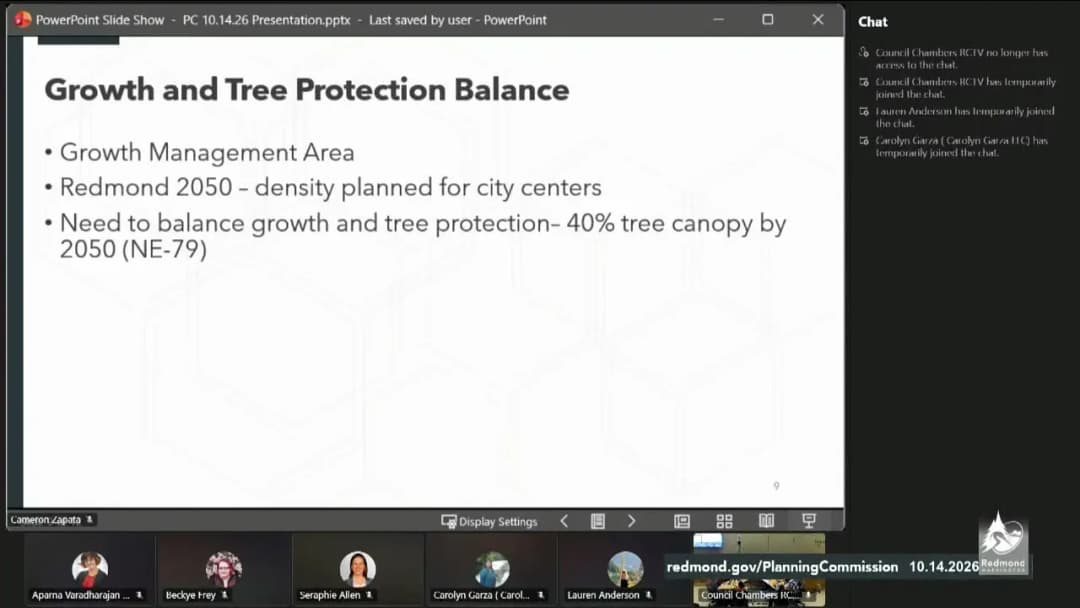
Redmond Planning Commission Meeting – October 14, 2026: Elections, Neighborhood Connections Repeal, TFP Updates, and Tree Code Hearing

The Redmond Planning Commission held a hybrid meeting on October 14, 2026, beginning at 7:00 p.m. and adjourning at approximately 9:25 p.m. The meeting included officer elections, two public hearings, a study session on the tree code update, and staff/commissioner updates. Chairperson Susan Weston resigned earlier, making the election of a new chair and vice chair necessary. The commission heard public testimony from Dr. David Morton on several agenda items and deliberated on three docket items from the 2026–2027 Comprehensive Plan Docket. Consent Calendar - Approval of the Agenda: Moved and seconded; passed unanimously. - Approval of Meeting Summary (September 23, 2026): Moved and seconded; passed unanimously. Public Comments & Testimony - General Public Comment (Not Related to Hearings): Dr. David Morton (Redmond 98053) raised concerns about PFAS contamination in soil and groundwater, specifically referencing the former Allwood Recycling Site (DTG Recycle) and the adjacent Evans Creek relocation site, both in critical aquifer recharge areas. He urged the commission to ask staff whether environmental baseline data, including PFAS, has been collected for affected parcels before ground disturbance. He also requested that the commission recommend funding for PFAS testing in the 2027–2028 city budget. No action was taken on this comment. - Public Hearing – Repeal Neighborhood Connections Map: Dr. David Morton spoke in support of repealing the five outdated neighborhood connections maps and replacing them with the Transportation Master Plan (TMP) maps adopted in February 2026. He made three requests: (1) update policy references that currently cite the old maps to point to the new TMP figures; (2) provide a crosswalk listing each connection on the old maps and whether it was retained, modified, or removed; (3) clean up Appendix G, Table 1 (e.g., blank fields and duplicate entries). He recommended Option 1 (immediate repeal) conditioned on these requests. - Public Hearing – Transportation Facilities Plan (TFP) Projects Update: Dr. David Morton supported the proposed shared-use paths but raised concerns about the environmental analysis (criteria F and G stated as “not applicable” without supporting analysis), a conflict in the issues matrix regarding project prioritization, missing cost estimates and time frames for new projects, and procedural record errors (e.g., conflicting SEPA dates and incorrect document headers). He requested corrections before the October 28 recommendation. - Public Hearing – Tree Code Update: Dr. David Morton made four requests: (1) define when third-party permit review is mandatory (not just at administrator’s discretion); (2) require an explicit exception request and independent review for the impervious surface provision (Section 2172.100 C2); (3) urge council to fund a city arborist in the 2027–2028 budget; (4) provide a tree canopy projection before the November 18 recommendation, noting canopy dropped from 38% (2019) to 37% (2023) against a 40% goal for 2050. Discussion Items - Election of Officers: Commissioners elected a new Chair and Vice Chair for the remainder of the one-year term (through March 2027). Jeannine Woodyear was nominated and elected Chair by acclamation. Adam Coleman (absent but expressed interest) was nominated and elected Vice Chair by acclamation. - Repeal Neighborhood Connections Map – Study Session: Staff (Michael Hintze) presented two options: (1) approve the repeal now, replacing the five old maps with the TMP maps; (2) combine this action with the larger neighborhood planning docket item in 2027. Commissioner Van Niman initially supported option 2 but changed to option 1 after hearing public testimony and staff’s rationale. Commissioner Bisht and Gagnier also supported option 1. Commissioner Aparna preferred option 2 for consistency. The commission voted to move forward with Option 1, conditioned on staff providing a written crosswalk of removed connections and cleaning up references. Staff will prepare a report and recommendation for the October 28 meeting. The written public comment period will remain open until that date. - TFP Projects Update – Study Session: Staff (Michael Hintze) presented updates adding two shared-use paths (NE 40th St and NE 70th St) and correcting an existing project (NE 72nd St) to include a shared-use path. Commissioner Aparna requested that Dr. Morton’s comments about date errors and document inconsistencies be addressed in the issues matrix and cleaned up before approval. Other commissioners concurred. Staff will bring a revised report and recommendation to the October 28 meeting. - Tree Code Update – Public Hearing and Study Session: Staff (Lauren Anderson remotely, Cameron Zapata) presented an overview of proposed changes: cleaned-up definitions, a tree credit calculation for development, expanded fee-in-lieu uses, updated exception criteria, a one-to-one replacement requirement for hazardous landmark/heritage trees, and new protection zone rules. The study session focused on the issues matrix from the September 23 session. Commissioners discussed several items: - Code navigation: The code is 97 pages (39 pages of code plus references). Commissioners requested a clearer structure or a “how-to guide” for homeowners vs. developers; staff will include improved navigation aids and public education materials post-adoption. - Third-party review and enforcement: Staff added third-party review provisions but questions remained about mandatory triggers and independence. Commissioner Aparna and others stressed the need for stronger enforcement mechanisms, including a city arborist. - Tree credit system complexity: Commissioner Aparna argued the development tree credit formula is overly complex and difficult to enforce, especially for smaller projects and homeowners. She suggested a simpler, threshold-based approach. Chair Woodyear emphasized the importance of a strong replacement requirement, regardless of the formula. - Replacement and canopy tracking: Staff noted the tree canopy strategic plan will be updated, but no timeline was given. Commissioners requested current canopy data and projections, and expressed concern about equitable replanting in areas experiencing highest loss. - Several issues were closed or kept open for further study. The commission will continue the tree code study session on November 4 and aim for a recommendation on November 18. Key Outcomes - Election: Jeannine Woodyear elected Chair; Adam Coleman elected Vice Chair (term through March 2027). - Neighborhood Connections Map Repeal: Commission directed staff to proceed with Option 1 (immediate repeal) and to provide a written crosswalk of changes. A recommendation and report will be presented on October 28. - TFP Projects Update: Commission directed staff to correct procedural errors (dates, headers, cost estimates) and bring a revised recommendation to October 28. - Tree Code Update: Commission kept several issues open, including: code navigation/structure, third-party review triggers, tree credit complexity, canopy data and projections, replacement requirements for heritage/dying trees, and relief for low-income homeowners. The next study session is November 4. - Next Meeting: October 28, 2026 – report approval for the Neighborhood Connections repeal and TFP updates, plus introduction of commercial drones docket.

TREE MANAGEMENT 35% · TRANSPORTATION SAFETY 25% · TREE CODE UPDATE 18% · PUBLIC ENGAGEMENT 11%
0102
NEXT →
OPENPUBLICA · PUBLIC MEETING INDEXUPDATED DAILY · openpublica.com