Redmond City Council Study Session – November 12, 2025
STREAMING COPY IN PREPARATION — RECORDING AVAILABLE FROM THE ORIGINAL SOURCE
Redmond City Council Study Session – November 12, 2025
The Redmond City Council held a study session on Wednesday, November 12, 2025, commencing at 7:00 PM. The meeting covered five agenda items: the Old Fire House (OFH) Facility Recommendation, a Budget Update, the 2025 Environmental Sustainability Action Plan (ESAP) Draft Review, the Council Vacancy Appointment Process, and Council Talk Time.
Old Fire House Facility Recommendation
- Parks and Recreation Director Lorraine Hamilton presented the stakeholder group recommendation from a six-meeting process (August–October 2025) involving 8 teens, 6 service providers, 5 city commissioners, and other community members. The stakeholder group's majority recommendation is to rebuild the teen center at its current location, with renovation as a second choice and rebuilding at a new location as least preferred.
- The council subcommittee (President Kritzer, Councilmembers Fields and Nuevacamina) proposed a direction: "expediently rebuild the teen center on the same location with music space to continue the old firehouse legacy." Council Vice President Forsythe suggested adding a "dedicated recording studio." Councilmember Stewart cautioned against over-prescription, emphasizing a teen-led design process.
- The council agreed to put the direction on the consent agenda for the November 18, 2025 meeting, with final language to be developed by the subcommittee and Vice President Forsythe.
Budget Update
- Finance Director Kelly Cochran provided an update on service enhancements: 44 new FTEs approved, with 14 still to be hired. Cost recovery programs are progressing, and the comprehensive community response program has some positions on hold pending partnership outcomes. The DEI specialist position is on hold until 2026.
- Cochran presented the draft Long-Range Financial Strategy update, reframing "price of government" as "community investment plan" and adding 10 guiding principles. The strategy will be discussed further in early 2026.
- House Bill 2015 discussion: This state legislation allows a sales tax increase (up to 0.1%) and a grant for criminal justice funding. The city could receive approximately $5.5 million annually. Councilmembers expressed mixed views; some favored waiting for the next budget cycle, while others raised concerns about taxpayer burden. No consensus was reached. Cochran recommended moving forward with the business license ordinance as previously budgeted, which council agreed to place on consent for the November 18 meeting.
2025 Environmental Sustainability Action Plan – Draft Document Review
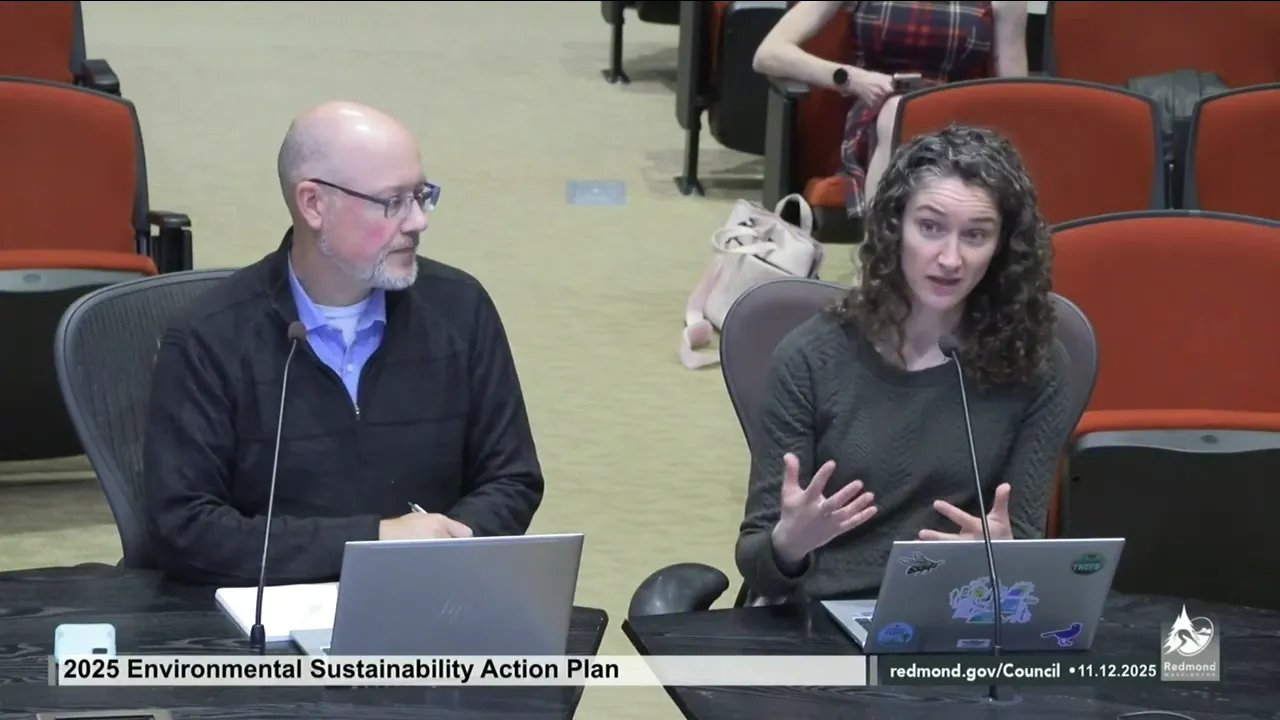
- Sustainability Program Manager Jenny Liebeck and team presented the final draft of the ESAP, structured around five "big moves": building energy efficiency, clean energy, transportation, waste reduction, and natural systems resilience. The plan includes 62 actions over five years.
- Data analysis shows the plan keeps the city on track for carbon neutrality by 2050 but not for the 2030 goal for municipal operations (set in the 2019 climate emergency declaration). The plan assumes Puget Sound Energy will provide 80% clean energy by 2030 per state law.
- Council asked about contingency plans if PSE fails to meet its targets. Staff noted ongoing grid capacity studies and that the plan would be updated annually. Council also raised the need for a recalibrated municipal operations goal.
- Council agreed to place the ESAP on the consent agenda for the December 2, 2025 meeting for adoption.
Council Vacancy Appointment Process
- Due to the resignation of Councilmember Salahudin on November 4, 2025, the council must fill the vacancy within 90 days (by February 1, 2026). Chief Operating Officer Melissa Files proposed a process: applications open November 19, close January 2, 2026; interviews on January 13; top candidates interviewed again on January 20; appointment and swearing-in on January 20.
- Council discussed capping interviews at 10–15 candidates, interview questions, and the use of ranked-choice voting to narrow the field. Councilmember Stewart raised questions about council members meeting individually with applicants; it was agreed that such meetings should focus on sharing the role's experience, not interviewing, and that applicants should be directed to the formal process. Council will continue discussion at the Committee of the Whole on November 18.
Council Talk Time
- Councilmember Nuevacamina addressed recent public controversy regarding her comments on ICE activity. She clarified that she advocated for community solidarity, rights education, and support, not physical confrontation. She reported receiving graphic threats and emphasized her commitment to the Fourth and Fifth Amendments and the rule of law.
Key Outcomes
- Old Firehouse: Council direction to be finalized and voted on at the November 18 meeting (consent).
- Budget: Business license ordinance for 2026 placed on consent for November 18; HB 2015 discussion will continue in January 2026.
- ESAP: Placed on consent for December 2, 2025 adoption.
- Council Vacancy: Process to be refined at the November 18 Committee of the Whole; applications will open November 19.
Meeting Transcript
Session held on Wednesday, November 12th, 2025, commencing at 7 p.m. Council members in attendance are Councilmember Anderson, Councilmember Nueva Comina, Council Vice President Forsyth, Councilmember Stewart, Councilmember Fields, and myself, Council President Kritzer. We're also joined by Mayor Burney. There are five items on the agenda tonight. The old firehouse facility recommendation, a budget update, 2025 environmental sustainability action plan, draft document review, council appointment process, and council talk time. So with that packed agenda, we'll go to the first item on the agenda, which is the old firehouse facility recommendation. Lorreen Hamilton, our Parks and Recreation Director will introduce this item. Go ahead. Good evening, City Council. I'm Lorraine Hamilton, Parks and Recreation Director here at the City of Redmond. I'm joined today by Lindsay Falkenberg, our parks planning manager, as well as Darcy Edmonds, who helped lead this engagement effort from Stefferson and Associates. Tonight we will be updating City Council on the stakeholder group and engagement process for the Old Firehouse Teen Center. I want to start by thanking all of our stakeholder group members and community members for taking the time to make your voice heard in this process. Our stakeholder group was a diverse group made up of eight teens, six service providers, five city commissioners, one facility staff member, three old firehouse alumni, uh, one of our old firehouse music staff, the OFH founding director, um a former council member, and two parents of OFH alumni. And so we worked very closely with this group over the last few months. Um tonight we're gonna be sharing the recommendation from the stakeholder group and the council subcommittee will also share their insight at the end of our presentation. Oh, I'm too far. That was way too far. We went to the end. There we go. There we go. Just jumped to the end. Um so uh this evening we're gonna go over kind of just a brief timeline as to how we got here today, review our process, present the recommendation and impacts, and then share what the next steps after this evening will be. Uh so this is just an overarching timeline. In April of this year, operations moved out of the old firehouse into the Redmond Community Center at Marymoor Village. Uh in July of 2025, we brought an expanded facility condition and the options, and we brought them here to City Council to seek um direction on our next steps. Through from August through October, our stakeholder group met and went through a recommendation process led by Stepherson and Associates, as well as our parks planning team, so that we could uh really truly dive into the recommendation for the future of the facility to bring forward to you. Uh tonight we are here to present that recommendation to City Council for direction, and then in Q1 of 2026, we would begin implementation of the received direction from City Council. In our last committee of the whole update, council requested information on facility usage for teen programs. Uh, is not easily available due to the fact that most of that um check-in and programs were done uh not within our technology systems, and so a lot of those that data is not as easily available. That being said, uh the hours and services for the old firehouse teen center have followed the school schedules and take into account holidays and whatnot uh for the better part of its history. In the last two years, our data has gotten significantly better as we've implemented a Microsoft Teams or a Microsoft Forums check-in, and then recently moved into our Smart Rec, which is our recreation um software for check-in. Uh that check-in process has not always been adhered to strongly, yet this is kind of the best data that we are able to bring forward to city council in line with the questions that were asked. The hours of operation prior to movement over to RCCMV was Tuesday through Thursday from 3:30 to 8 and Friday from 3:30 to 6. Some Fridays would also have live music. Uh the services offered were drop-in spaces for after school classes and mental health and behavioral services with youth east side services or YES. YES also participated in the stakeholder group process. Our Redmond Youth Partnership Advisory Committee had a very strong presence in that facility, both meeting there as well as leading programming, and then of course our live music programming was one of the most um popular and influential programs that we've had. In the 24 to 25 school year, uh our data shows 122 unique users. Um staff stated that 10 to 30 drop-in teens were um present daily. There was 31 RIPAC members, um, but 50 plus teens in the meetings. And then live music events were two to three times a month and averaged 60 to 100 attendees, and these were all ages events. We did not have registration or check-ins for the live music events they were drop-in. At this time, I'm gonna hand off to Darcy Edmonds and Lindsay Falkenberg for the next two slides. Thank you. Thank you, Lorraine. Sorry, not used to using mics. Thank you. So yeah, so we um we had a six meeting process essentially, and we started out with evaluating uh two options or presenting two options uh for recommendation, um, and those were to renovate or to rebuild. Um, over the course of the process, I think as the subcommittee saw, um, we started to hear feedback that um made us realize that uh towards the end, it would be really, really helpful to add in an option to recommend the location as well later on in the process.
openpublica.com