Redmond City Council Study Session: CIP, Overlake, Rules, Welcoming Resolution (Feb 24, 2026)
STREAMING COPY IN PREPARATION — RECORDING AVAILABLE FROM THE ORIGINAL SOURCE
Redmond City Council Study Session – February 24, 2026
This study session covered five major agenda items: the Capital Investment Program (CIP) funding strategy, the R22 Overlake consolidated land use application, the draft 8th amendment to the Council Rules of Procedure, the expansion and implementation of Redmond's Welcoming Resolution, and Council Talk Time. The meeting was held on February 24, 2026, beginning at 7:01 PM at City Hall, with all council members and the mayor in attendance. No public comments were heard during this session.
Discussion Items
1. Capital Investment Program (CIP) Funding Strategy
- Director Kelly Cochran presented three key areas: redeeming callable bonds (Series 15 and 16) to save interest and spend down impact fees, a future debt issuance of up to $51 million for critical projects (Teen Center, MOC, transportation, parks), and moving public art funding from the 1% for arts ordinance to a consistent $300,000 annual program within the CIP.
- Staff noted that redeeming Series 15 and 16 bonds would save $1.4 million in interest and help spend $3.8 million in transportation impact fees that are approaching a 10-year deadline. The city's total debt is $43 million against a $989 million ceiling.
- Council members asked about debt ratios, risk of delaying bond issuance, and the impact of potential REIT downturns. Director Cochran confirmed the plan is conservative and includes a $25 million buffer for the MOC project.
- Council expressed general support for moving forward with the bond redemption and reimbursement resolutions, though some members wanted to review fiscal policies first. The next touch point will be at the Finance, Administration, and Communications (FAC) committee in March.
2. R22 Overlake Consolidated Land Use Application
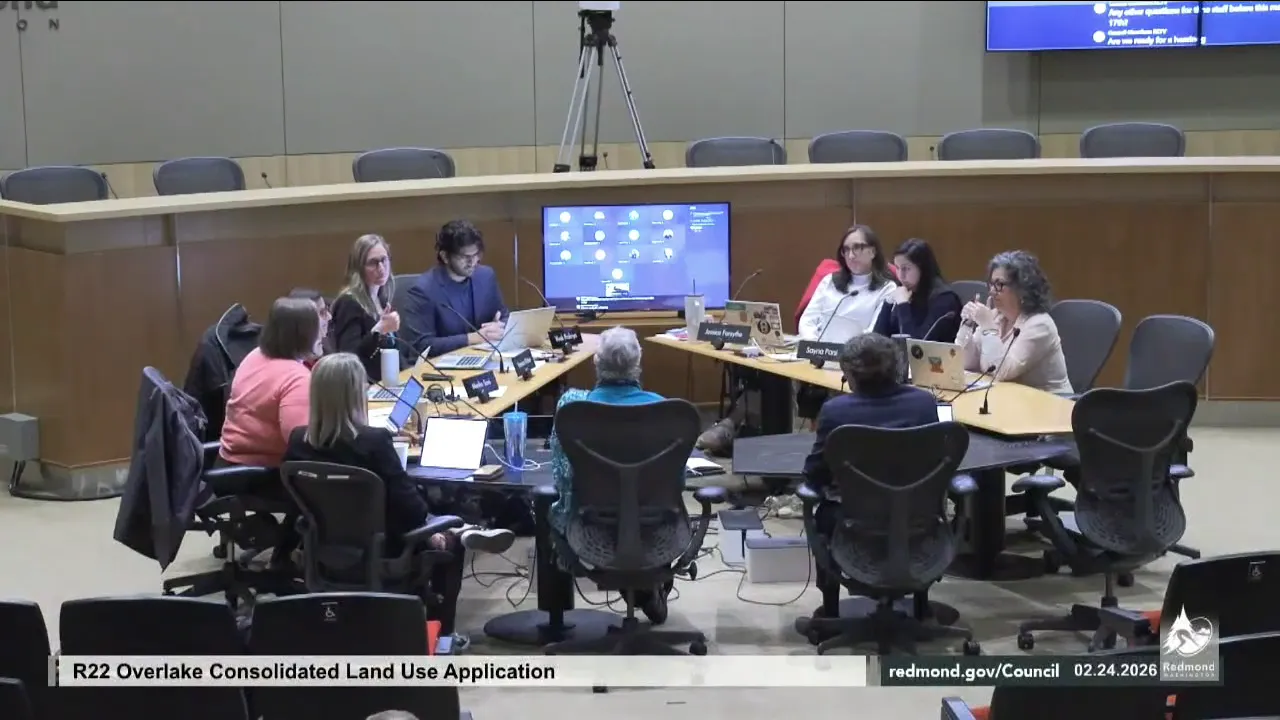
- Staff (Director Carol Hellent, Senior Planner Alex Hunt) presented the proposed 5.3-acre mixed-use development at Microsoft Building 22, near Overlake Village Station. The project includes up to 800 multifamily units, 8,000 sq ft of commercial space, and 12.5% affordable housing at 50% AMI (including one additional unit via the development incentive program).
- The technical committee recommended approval with conditions. Nine deviation requests were discussed, including reduced tree retention, private open space, and courtyard dimensions. Staff noted these deviations are typical for urban projects.
- Council members asked about affordable housing distribution across phases, deviations' impact on quality of life, and displacement policies. Staff confirmed that affordable units will be built in each phase and that the site is a former office building, minimizing displacement concerns.
- A public hearing is scheduled for March 17, 2026, with a possible decision that same evening.
3. Draft 8th Amendment to the Council Rules of Procedure
- Council President Stewart, Vice President Nuevacamina, and Councilmember Kritzer led the discussion on revisions to the vacancy process, subcommittees, remote participation, and excused absences.
- Key proposals included: blind review of applications, a minimum of 4 interviews, guidance on council member interactions with candidates (to be set by the future council), a maximum of 10 applicants or one-third of applicants moving forward, and ranked choice voting as an option for final selection.
- On subcommittees, the council agreed to add a sunset provision based on consensus and to allow flexibility on the number of subcommittees.
- For remote participation, the council compromised on requiring cameras on “at least when speaking or voting” unless not possible. The limit for remote attendance was changed from two to three per quarter to align with state law. Excused absence notifications should go to the clerk, mayor, and COO, without requiring a reason.
- The council will continue the rules discussion at the Committee of the Whole meeting the following week, with additional small edits to be submitted.
4. Expansion and Implementation of Redmond's Welcoming Resolution
- Councilmember Forsyth introduced a resolution reaffirming Redmond's commitment to immigrant communities and constitutional rights. The resolution includes specific actions like maintaining a website with resources, waiving certain fees, and ensuring no local law enforcement cooperation with federal immigration enforcement except as required by law.
- Council members provided feedback: the mayor suggested using “request” instead of “direct” for staff actions, and Vice President Nuevacamina recommended replacing “nationwide attacks” with more precise language about federal enforcement actions. Councilmember Prakria suggested adding language about direct city outreach to affected communities, and Councilmember Kritzer proposed adding a commitment to hire a community engagement liaison within the READY program.
- Councilmember Forsyth will incorporate feedback and bring a revised version back for further discussion.
5. Council Talk Time
- Council President Stewart reminded members that questions about the Health through Housing site should be directed to King County, which manages the site.
- Subcommittee assignments were announced: Councilmember Prakria joined the Tenant Protections Subcommittee, and Councilmember Sony joined the Alternative Crisis Response Subcommittee. The council agreed to have the Tenant Protections Subcommittee evaluate an inbound advocacy proposal from the Housing Justice Project.
- Councilmember Kritzer requested a proclamation for Transgender Day of Visibility on March 31, 2026, which the mayor will consider.
- Councilmember Prakria volunteered to speak at a Scouts of America event on March 19.
- Mayor Birney reminded members of the Sound Cities Association networking event on March 4.
Key Outcomes
- CIP: Council directed staff to bring forward redemption and reimbursement resolutions to the FAC committee in March. No formal vote was taken, but support was expressed.
- R22 Overlake Application: The public hearing is confirmed for March 17, 2026. Council will consider a decision that evening.
- Rules of Procedure: The council agreed to multiple amendments, including ranked choice voting option, camera policy, and remote attendance limits. The discussion will continue at the Committee of the Whole on March 3.
- Welcoming Resolution: Councilmember Forsyth will revise the resolution based on feedback and bring it back to the council.
- Future Meetings: Council retreat (part 2) on February 26; FAC committee meeting in March; Committee of the Whole on March 3.
Meeting Transcript
To order. This is a study session of the Redmond City Council held on February 24th, 2026, commencing at 7.01 p.m. All council members and Mayor Burney are in attendance, and there are five items on the agenda tonight. The Capital Investment Program Funding Strategy, R22 overlay consolidated land use application, the draft eighth amendment to the council rules of procedure, expansion and implementation of Redmond's welcoming resolution, enhancing our commitment to community and the U.S. Constitution, and finally council talk time. So the first item on the agenda tonight is the capital investment program funding strategy, and introducing this item. We're very well very happy to welcome Director Kelly Cochran. Welcome. Thank you. Good evening, everyone. With me tonight, I have Blake Ruiz. He is a senior financial analyst who helps manage the capital investment program for the general government side of our programs. We are here tonight to talk to you about some decisions that we would like to have made or direction provided on the funding strategy for the next update to the capital investment program. There are three items that I are three sections of the funding strategy that I want to discuss tonight. One is our debt portfolio. We have an option or an opportunity to redeem some of our bonds. We go to the next slide. It's all right, we're all right. We have an option to call some of our bonds and pay those off early. There are advantages to each one of the series that are available to us. I also want to discuss council's appetite for a future debt issuance and get your feedback and input before we move forward with the development of the 27 through 32 CIP, so that when we come back to you in the fall with the proposed CIP, we aren't really out of alignment with where council is comfortable. I also want to walk through my proposal for the art aspect of the capital investment program. As part of the public art plan, we've touched on a little bit my proposal at providing a consistent predictable funding strategy for art. And so I want to walk through that with you to let you see sort of how that integrates with the rest of the program and provide some benefits to the art program. I don't need any decisions on that tonight. So on the first goals overall, um, this is a really unique opportunity for the city to have so many things working in our favor at the same time when it comes to the capital investment program. We have already a pretty secure amount of cash on hand to take care of projects that we have been anticipating, but we also have recently updated plans that are very informative to the projects that run through this program. So the capital facilities plan, fire functional plan, um, and quite a few at the transportation master plan, quite a few other pivotal planning documents with a tremendous amount of community input in them. And what I would like to do is sort of take this opportunity to reset the capital investment program so that we're meeting the priorities of today, um, not slowly integrating these plan updates into the CIP. Um, and so to do that, um really big objective is to make sure that we can take care of some of our critical um needs while minimizing impacts on the rest of the capital program. Um there are large facility projects, the MOC, um, teen center, things like that. And I want to be able to deliver those improvements to the community while not impacting some of our maintenance programs or pavement management projects, um, things like that that are still very important to make sure that we keep up on our due diligence. We also have some risk right now within the program with some transportation impact fees that we collected and need to spend. So I'd like to minimize that risk with this plan and then build in art like we discussed. So on the debt portfolio side, we have two debt issuances, debt issuance 15 and series 16 issued in 2015 and 16. Each were a restructuring of existing debt that the city already had for transportation projects. These bonds are both now callable, and I'm recommending that we take advantage of both of those. So for series 15, um, the amount of savings that we achieve is not that significant. But what it does do is allow us to use some business tax revenues that we have accumulated in fund balance to pay off this debt and allow us to then have that revenue source available in the future to pay um back a new uh debt service package. Um so that is recommendation number one. This um this bond is currently it's a 3% um uh bond, and even after we pay off what's currently um owing, after we have funded what we currently know is in um being proposed in the CIP, we will have 11 million dollars, a little over 11 million dollars still available, and that is um a very high fund balance for this revenue source. It's one of the more difficult um funding sources to spend because it is restricted to transportation or transportation improvement projects that um benefit the business community. So we have fund balance and um like to utilize that here. And then on series 16. Um again, the the savings is a little uh more significant here, but what this does is help us um spend down some of the impact fees that we collected in 2021 and 2022. The reason for that is um because can you go to the next slide? Thanks I provided you a couple of um slides of just information about impact fees for those that may not be familiar, but what I'm particularly worried about is the bottom um bullet on this slide, which requires us to spend our impact fees within a 10-year period or refund. So um if you keep going for me. In um 20 to keep going for me, thank you. Thank you.
openpublica.com