Redmond City Council Study Session on Budget Process and Fiscal Policies, April 14, 2026
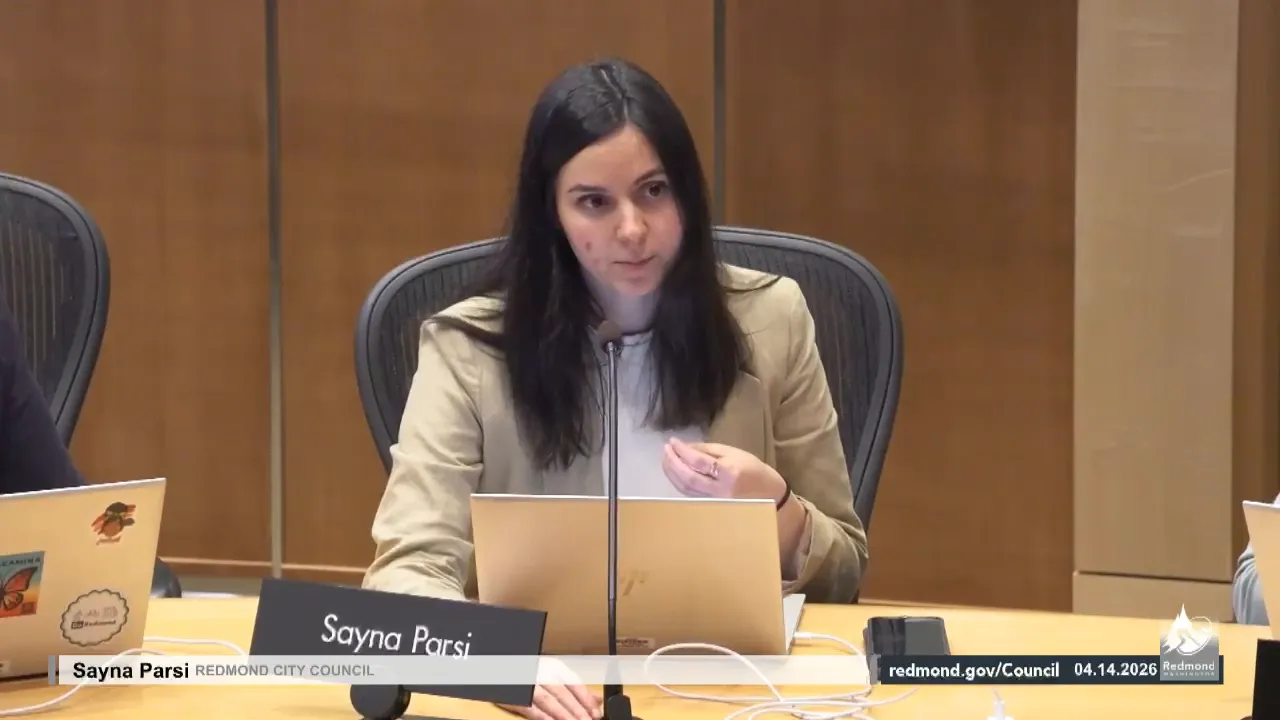
STREAMING COPY IN PREPARATION — RECORDING AVAILABLE FROM THE ORIGINAL SOURCE
Redmond City Council Study Session – April 14, 2026
The Redmond City Council held a study session on Tuesday, April 14, 2026, starting at 7:04 p.m. All council members were present. The agenda included departmental budget overviews for the 2027-2028 biennium (Executive, Finance, Human Resources, and Technology & Information Services), a review of the Long-Range Financial Strategy and Fiscal Policies, and council talk time.
Executive Department Overview
- Key Speakers: Melissa Files (COO), Lisa Maher (Assistant COO)
- Divisions: The executive department includes city clerk, communications, city attorney (brought in-house), environmental sustainability, grant management (new), and others. Baseline budget changes include a new FTE for environmental sustainability, reclassification of a position, and transfer of a domestic violence advocate to the prosecutor's office.
- Performance Measures: Environmental sustainability action plan targets moved from 2030 to 2040; community survey data; DEI measures from the Ready Plan.
- Council Questions:
- Councilmember Parsi asked about FTE changes reflected in the numbers.
- Councilmember Prakriya questioned the precipitous 21.5% drop in community-wide greenhouse gas emissions from 2023 to 2024; staff attributed it to changing to Green Direct electricity purchasing and promised follow-up.
- Vice President Nuevacamina asked about the increase in public records requests; staff noted growth in complexity (chats, texts, AI records) and will follow up with the city clerk.
- Councilmember Soni inquired about savings from bringing legal services in-house; staff will provide exact figures.
- Councilmember Forsyth asked about the domestic violence advocate role; it is a reclassification and transfer, not a new position.
- Councilmember Kritzer suggested evaluating World Cup investment outcomes and noted the need for two Ready FTEs.
- Council President Stuart supported restoring two Ready FTEs and asked about federal lobbyist impact; staff highlighted federal earmarks and legislative support.
- Challenges: Increasing public records complexity; continued implementation of Ready plan and environmental sustainability plan.
Finance Department Overview
- Key Speaker: Kelly Cochrane (Finance Director)
- Baseline Changes: Increases in risk insurance and state auditor fees; process improvements from new financial system (accounts payable, accounts receivable, purchasing).
- Performance Measures: Community investment rate (formerly price of government), vendor diversity, bond rating (Triple A reconfirmed).
- Reserves: Working to increase reserves from 8% to 12% per best practices.
- Council Questions:
- Vice President Nuevacamina asked if reserve increases were due to recession concerns; staff said it followed industry standards post-pandemic.
- Councilmember Forsyth asked about insurance options; staff is evaluating a change and will report before end of summer.
- Councilmember Kritzer asked about credit card fee implementation and auto-pay adoption; staff noted compliance challenges but said adoption has normalized after a transition period.
- Challenges: Managing cost increases from King County wastewater rates; automating financial statements to shift focus from preparation to analysis.
Human Resources Department Overview
- Key Speaker: Catherine Laird (HR Director)
- Baseline Changes: Medical benefit increases (~10% per year); addition of a senior HR analyst and an administrative specialist for payroll accuracy.
- Performance Measures: Turnover rate, average days to fill vacancies, and new measure for professional development enrollment.
- Council Questions:
- Councilmember Parsi asked about tracking one-time fees and whether spending is on track; staff confirmed monitoring and that carryover information will be provided.
- Councilmember Forsyth asked why a recruitment specialist position became ongoing; staff said the role proved essential for full-cycle recruitment.
- Councilmember Parsi questioned whether performance measures (e.g., time to fill) could incentivize speed over quality; staff explained they balance timeliness with candidate quality.
- Councilmember Forsyth asked about 18.1 FTEs; the 0.1 FTE is from fractional allocations of directors' time.
- Challenges: Stabilizing new HRIS system (UKG); compliance with state requirements; dual payroll processes during transition.
Technology & Information Services (TIS) Overview
- Key Speaker: Mike Marshand (Chief Information Officer)
- Baseline Changes: 9% increase due to contract escalations; real-time language translation devices deployed (4 devices, $4,200 spent of $30,000 budget).
- Service Enhancements: Senior systems analyst for UKG implementation; GIS business analyst hired; aerial photos consortium; security tools and phishing automation.
- Performance Measures: Staff security training completion (91%), service desk SLA resolution (89%), net promoter score (38, close to industry median of 40).
- Council Questions:
- Councilmember Parsi asked about usage of translation devices; staff recently announced and are monitoring usage; will share learnings if desired.
- Councilmember Prakriya asked about the HRIS project; staff confirmed it will automate manual payroll calculations.
- Challenges: Rising technology costs (tariffs doubling laptop costs); high demand for new systems.
Long-Range Financial Strategy & Fiscal Policies
- Key Speaker: Kelly Cochrane
- Long-Range Financial Strategy: Updated guiding principles (10 consolidated from 5); new structure emphasizing community-informed planning, revenue diversity, asset management, and performance management. Community investment rate currently between 5% and 5.5% of personal income; declining due to community growth. Fiscal resilience and reserve management are priorities.
- Fiscal Policies: Consolidated and clarified; new policies on economic downturn action, leasing equipment, and biennial review. Investment policies expanded to include alignment with city values (e.g., divestment from fossil fuels).
- Council Discussion:
- Council president identified three key decisions: community investment plan rate, strategic alignment with Redmond 2050 and community strategic plan, and principles for taxpayer involvement in new taxes.
- Councilmember Kritzer emphasized maintaining prior investments and value proposition.
- Councilmember Forsyth praised clarity and asked about climate divestiture; staff confirmed it is in investment policies.
- Vice President Nuevacamina stressed equity and community-based organizations for data.
- Councilmember Prakriya requested concrete examples to understand fiscal terms.
- Councilmember Soni desired simpler language for community.
- Council president suggested policies on spending priorities and reserve levels.
- Process: Council will use SharePoint for individual feedback; staff will collate and identify decisions for deliberation. Target: June/July check-in.
Council Talk Time
- Budget Community Engagement: Decided to use the May 21 council conversation as a budget input opportunity and brand it accordingly. Also agreed to have a booth at the Downtown Redmond Art Walk on September 17. Further discussions on engaging community-based organizations will continue with staff. Council will revisit the community strategic plan for possible updates.
- Micromobility Devices: Councilmember Parsi raised concerns about electric scooters and bikes on sidewalks; will be discussed in committee next week.
- Parks Cost of Service Model: Councilmember Kritzer suggested reviewing the cost recovery policy for parks, especially regarding youth fee waivers. Council agreed to hold the idea and schedule it alongside other priority items.
Key Outcomes
- No formal votes were taken; all discussions were informational and preparatory.
- Council directed staff to facilitate a SharePoint-based review of the Long-Range Financial Strategy and Fiscal Policies, with feedback due in approximately two weeks.
- Council agreed to incorporate budget engagement into the May 21 council conversation and to table at the September 17 Downtown Redmond Art Walk.
- Council will follow up on community engagement gaps with community-based organizations.
- Council will revisit the community strategic plan and park cost-recovery model for future scheduling.
- Staff will provide additional data on greenhouse gas emissions drop, legal cost savings, public records trends, and federal grant attestations.
Meeting Transcript
Are we live, Chip? It's a bit quiet, but I think we are live. So I'll go ahead and call this meeting to order. We are now live. This is a Redmond City Council study session held on Tuesday, April 14th, 2026, commencing at 7.04 p.m. All council members are in attendance. Thank you so much. We had a just finished a recent special meeting with a couple of commission candidates, so we're a couple minutes late coming on the air. I also wanted to acknowledge that we've had a few meetings at City Hall this afternoon, including many of the team members who will be sitting with us through the study session tonight and helping us out, probably ate a granola bar for dinner at their desk. So thank you for extending your work day with us. It's been a busy evening. We're excited to work with you. So there are three items on the agenda tonight. First is the 2027-2028 budget process, departmental budget overviews. Tonight we'll be looking at the executive, finance, human resources, and technology and information services departments. We will also study the long-range financial strategy and fiscal policies, and finally have council talk time. So for the first item on the agenda, the 27-28 budget process with the department overviews. I'll introduce Kelly Cochrane finance director for this item. Thank you. Thank you very much. I'm not sure that there's much more to say, other than we have had some switcharounds with department scheduling as we work with their availability. So thank you for working with us on that and your flexibility. I will go ahead and turn it over to Melissa Files, our COO, to get us started with the executive department, and we'll start with finance after that. Thank you. Good evening, Council. As uh Kelly said, I'm Melissa Files. I'm the chief operating officer for the city, and joining me today is Lisa Maher, the assistant COO. She'll be sharing some budget information with the council as we go through. So just an overview of the executive department. The executive department provides leadership mostly in a variety of ways. Most of the divisions, well, I should say all the divisions work cross-departmentally in the city to bring uh the goals of the city together. Um using strategic leadership as well as transparency and excellence, as you see in the mission statement. For an overview of the partners uh on this slide is all the divisions that we have in the executive office. Um the leadership uh includes Lisa and I and the mayor and Zach, who you heard from today. Um, we look over city operations, uh regional work, as well as legislative support and um and again oversight of operations. The city clerk, which you're all familiar with, um works with the council on agendas as well as the mayor. Um of the things that we'll talk about in the city clerk's office is public records requests, um, which takes up a lot of time in our city clerk's office as well as they oversee records management and the hearing examiner. Uh City Council, your budget sits under the executive office. Um, communications, which you also heard from today, so I won't um go over that. Um, you also heard about our ready initiative today. Um, the city attorney's office under legal and litigation, as well as environmental sustainability, which I know you hear from Ginny, our environmental sustainability manager on a regular basis and committee of the whole. Um, all of these divisions uh except for two, um, are um you know, prior divisions that we've had. There are two new ones, which was grant management and um the city attorney's office. So as you recall, in this budget, um, we actually had a long time contracted city attorney. Now we brought that in-house. Um, and grant management was new to look over the our um grant management systems, policies, and workflows. Um so that is new in the executive office. I'm gonna turn over to Lisa to go over some um budget highlights and then I'll be back to talk about performance measures. So over the next two slides, I'm just gonna highlight a few areas uh for you as a quick update. So on the baseline budget plans, I wanted to just chat real quick about the two largest changes, percentage changes you might see in the right-hand column.
openpublica.com