Redmond City Council Study Session: Legislative Debrief & Budget Overviews - May 12, 2026
STREAMING COPY IN PREPARATION — RECORDING AVAILABLE FROM THE ORIGINAL SOURCE
Redmond City Council Study Session - May 12, 2026 (7:15 PM – ~10:30 PM)
This study session covered four major agenda items: a debrief of the 2026 state legislative session, departmental budget overviews for Planning & Community Development and the Police Department, a continued discussion of the council retreat matrix, and council talk time. No formal votes were taken; the session focused on information sharing and direction-setting for future budget and policy work.
Discussion Items
-
2026 State Legislative Session Debrief: Chief Policy Officer Amy Sai and state lobbyist Brianna Murray presented themes and outcomes. The 60-day session had the lowest number of bills passed (268) in five years. Key themes: response to federal actions, tax reform (including a millionaires tax on income over $1 million), and affordability. The legislature passed a $2.4 billion operating budget increase primarily to maintain existing services, using $880 million from the rainy day fund and $375 million from the public works assistance account. Notably, the city secured $515,000 for Hartman Park playground improvements, thanks to strong delegation support. Other city priorities: state support for vulnerable neighbors (SNAP, Apple Health, refugee assistance), affordable housing (flexibility in density bonuses and housing tax funds), and transportation (no new local funds, but backfill of public works assistance account). Several bills were highlighted: SB 6026 (residential uses in commercial zones, with exceptions for ground-floor commercial in TOD areas and 40% of other mixed-use zones – city has 18 months to implement), autonomous vehicle regulation deferred to 2027, and eMoto legislation creating a work group. The legislature also addressed shelter/housing siting (self-certification for providers, but cities retain authority when contributing land/lease). The city’s legislative agenda for 2027 will be discussed starting September 8, with a focus on the maintenance and operations center.
-
2027-2028 Budget Process: Departmental Overviews: Finance Director Kelly Cochran introduced presentations from Planning & Community Development (PCD) Director Carol Heland and Police Chief Lowe (online).
- Planning & Community Development: PCD has 93.2 FTEs (out of 107.35 authorized). Key points: The department will recruit for three previously on-hold positions (community health manager, mental health professional, and social workers) to fill gaps in community health co-response, with a focus on juvenile mental health cases. A third code enforcement officer was hired. The department processed nearly 9,700 permits and 46,000 inspections in 2025. Redmond added ~1,400-1,500 housing units in 2024-2025, with over 3,700 units in the pipeline. Land use application timelines are improving with process improvements (Intergov cloud migration in June). Lodging tax revenues declined 5.86% due to economic uncertainty. Challenges include housing affordability, revenue uncertainties from federal funding and permit volumes, and state mandates adding workload. Highlights: Plymouth Housing project underway, Prisma condo purchase for transit-oriented development support, human services funded served over 33,000 people.
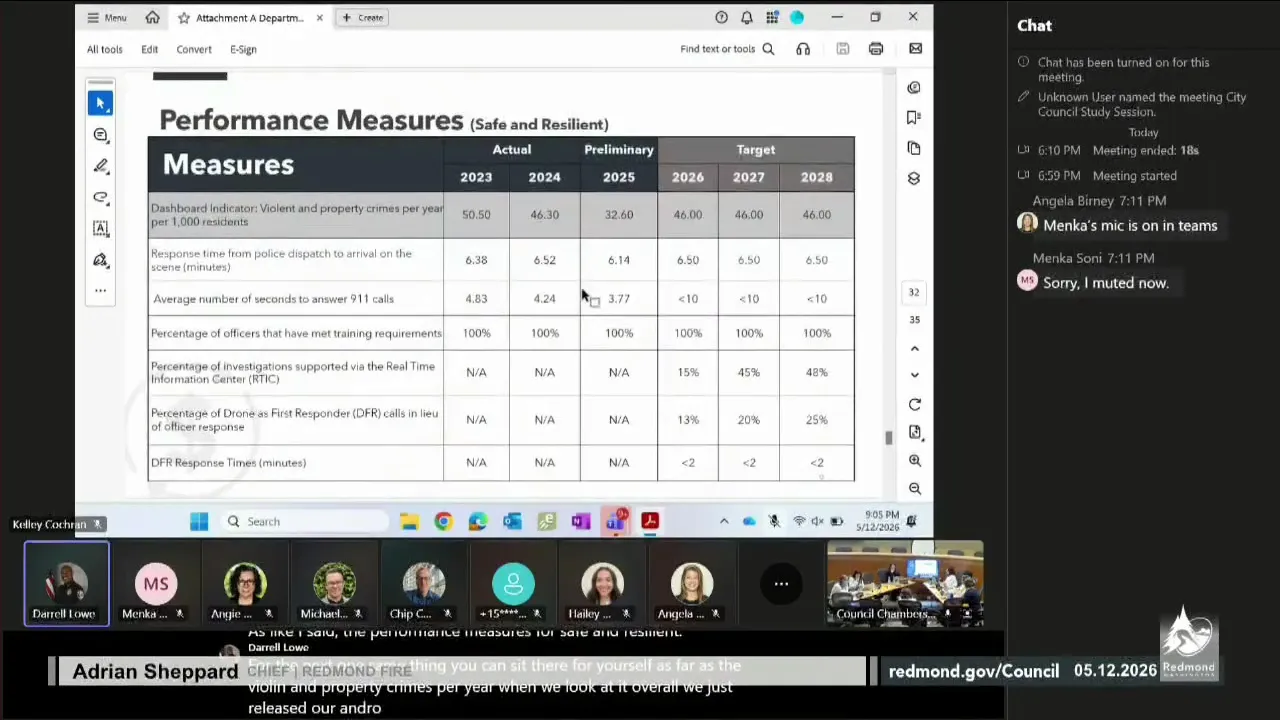
- Police Department: Chief Lowe reported that the department has four vacant commissioned positions (close to fully staffed). Crime overall decreased 26.9% in the last year. The gun buyback program used $51,500 (including staffing costs) and removed guns from the community; remaining funds could be used for future events if council chooses. Performance measures are at or above state/national averages. Challenges: increasing costs for compliance technology, public records requests, recruitment/retention (18-month hiring timeline), digital forensics complexity, mental health-related calls, jail costs, and state training mandates. The department is exploring a domestic violence co-response program with Project B Free (successful in South King County) and may seek additional commissioned officers and support staff in the next biennium, citing understaffing relative to national averages.
-
Council Matrix Discussion: Council continued refining priorities from the February retreat. Key decisions: The housing navigation services (housing ombuds) item will advance for further exploration via the tenant protections subcommittee. The adopt-a-street program was moved to the preliminary budget column for cost scoping. The living wage study remains in discussion, with staff asked to gather existing data. The outdoor play (CIP) item will be considered for early CIP investments. Several items were noted as already in progress (e.g., housing stability funding from prior biennium, community childcare for council members). Council will also explore recognition of holidays/community diversity, tech innovation study (Councilmember Prakriya), and equitable fees/income-based fee structure. Council leadership will meet with the mayor to convey updated priorities.
-
Council Talk Time: Topics included: the transition of the legislative coordinator role (interest in expanding to include constituent relations), a briefing request on the Marymoor parking situation, flagging increased waste collection costs (Recollege 20% increase compared to previous hauler, noted as a cost-saving measure), and upcoming community events (Bike Everywhere Day, tree code community engagement session).
Key Outcomes
- No formal votes (study session).
- Hartman Park funding of $515,000 was secured in the state capital budget.
- Staff direction: Recruit for three community health positions (community health manager, mental health professional for juvenile co-response, one community care coordinator) to be in place by end of 2026.
- Police department will seek additional officers and support staff in the 2027-2028 budget, with a domestic violence co-response program being explored.
- Council matrix updated: Several items moved toward preliminary budget investigation; others assigned to subcommittees or retained for further discussion.
- Legislative coordinator role to be redefined and posted, with potential focus on constituent services.
- Upcoming: Staff report on World Cup readiness (May 19), tree code update community session (June 2), and legislative agenda draft discussion scheduled for September 8. Council will also revisit the Marymoor parking issue in a future session.
Meeting Transcript
Thank you. I am calling this meeting to order. This is a Redmond City Council study session held on Tuesday, May 12th, 2026, commencing at 7 15 p.m. Thanks for your patience, everyone. All council members are in attendance, and Mayor Bernie is joining us online. There are four items on the legis on the agenda tonight. The first is the 2026 legislative state legislative session debrief, a 2027-2028 budget process departmental budget overview with the planning and community development department as well as the police department. Council will continue its discussion of its retreat matrix, and we will conclude with council talk time. So the first item on the agenda is the 2026 state legislative session debrief. And introducing this item will be Amy Sai, our chief policy officer. Welcome, Amy. Thank you, Council President. Good evening, Council members. Let me go ahead and get this presentation started. So Amy Sai, Chief Policy Advisor, and I am joined today by Brianna Murray, our state lobbyist with Gordon Thomas Honeywell government relations. And I'll just take this title slide to just briefly note how grateful we are for her ever present expertise on the Hill and supporting us in the legislative agenda, and just so fortunate to have her, and you'll see her expertise tonight. Um setting a low bar there. Sorry, Brianna. Uh so today we're gonna cover the 2026 legislative legislative session themes. Brianna will talk about some of the activities on the hill that were going on this session. Um we will then transition together to talk about our city priorities and how those outcomes worked out for us this short session and talk about some of the deep dive into some of the work that was going on to give you a flavor of the work that happens on the hill for us, and then a brief recap of next steps. Well, thank you, Amy. I'm gonna kick us off with the legislative themes component, and I like this section of the presentation because I think it provides the context and grounding for which you can then understand in place some of the other issues that are more Redmond specific. So, as a reminder, the legislature operates on a two-year cycle, and this past legislative session was the second year of that two-year cycle. As such, was a short 60-day legislative session. Uh, Democrats continued to hold the majority in both the House and the Senate by 59 to 39 in the House and 30 to 19 in the Senate. As the majority party Democrats were able to establish the major themes and priorities of the session, and they focused on responding to actions of the federal government, tax reform, and a focus on affordability for Washingtonians. Um, including all bills that were considered in the first year of the legislative biennium that did not pass into law and carried over to the second year, as well as an additional 1,238 bills. Of the many thousands of bills that were under consideration, 268 bills passed into law this session. That is actually the lowest number to pass into law in a session over the past five years. And uh there are a few different reasons for that low number. One is that the legislature tackled some really big issues that took some a great deal of time. And the second is that the minority party pulled out every single procedural motion they could think of out of the out of the rule book. Um, in addition to working on bills, the legislature also had the task of developing supplemental budgets or mid-biennial budget adjustments amid shortfalls. When the legislature concluded the 2025 legislative session, they had developed a balanced biennial budget that would run July 1 of 2025 through June 30th of 2027. By the time the 2026 legislative session rolled around, revenue collections had come in flat, slightly below what was expected, nothing like a start, a stark decline. But the cost of maintaining programs and existing services went up significantly. So, in order to maintain those existing programs and services, the legislature really had to grapple with how to address a shortfall. One was the short-term and immediate need of a balance of balancing the 2025-27 budget, and then the long-term need of readjusting, refocusing the state's tax code to support a lot of the new programs that Washingtonians have clearly indicated they want to see funded. So, in an effort to bring about that more significant tax reform, uh the legislature advanced a millionaires tax proposal and enacted it into law. The millionaires tax proposal is in addition to a slate of tax changes that were made in 2025. So the overarching state tax code reform is really a combination of the 2025 tax code changes as well as the millionaires tax in 2026. The bill 6346 is a 9.9% tax on income over $1 million that's scheduled to go into effect in 2029. Uh in an effort to demonstrate that there's a reinvestment into working families. The bill included several different uh provisions on other tax policy, including a sales and use tax exemption on diapers, hygiene products, over-the-counter medications, a repeal of sales tax on services that was enacted in 2025, expansion of the BO tax credit for small businesses to an additional 180,000 businesses, and an expansion of the working families tax credit to apply to another 460,000 families. There's also an intent to fund child care and free lunch for all K through 12 students expressed in the bill. One thing that's notable about this bill in relation to cities is that the sales and use tax exemptions on diapers, hygiene products, and over-the-counter medications, those exemptions apply to state and local sales tax. Similarly, the sales tax on services that was included in Senate Bill 5814 that's being rolled back in the millionaires tax bill applied to both state and local sales taxes. We shared with members of the House the concerns that these exemptions would have, the impact that the exemptions would have on city budgets. And in response, the legislature allocated 200 million for city and county fiscal health that's scheduled in 2029.
openpublica.com