Redmond City Council Study Session Summary — June 9, 2026
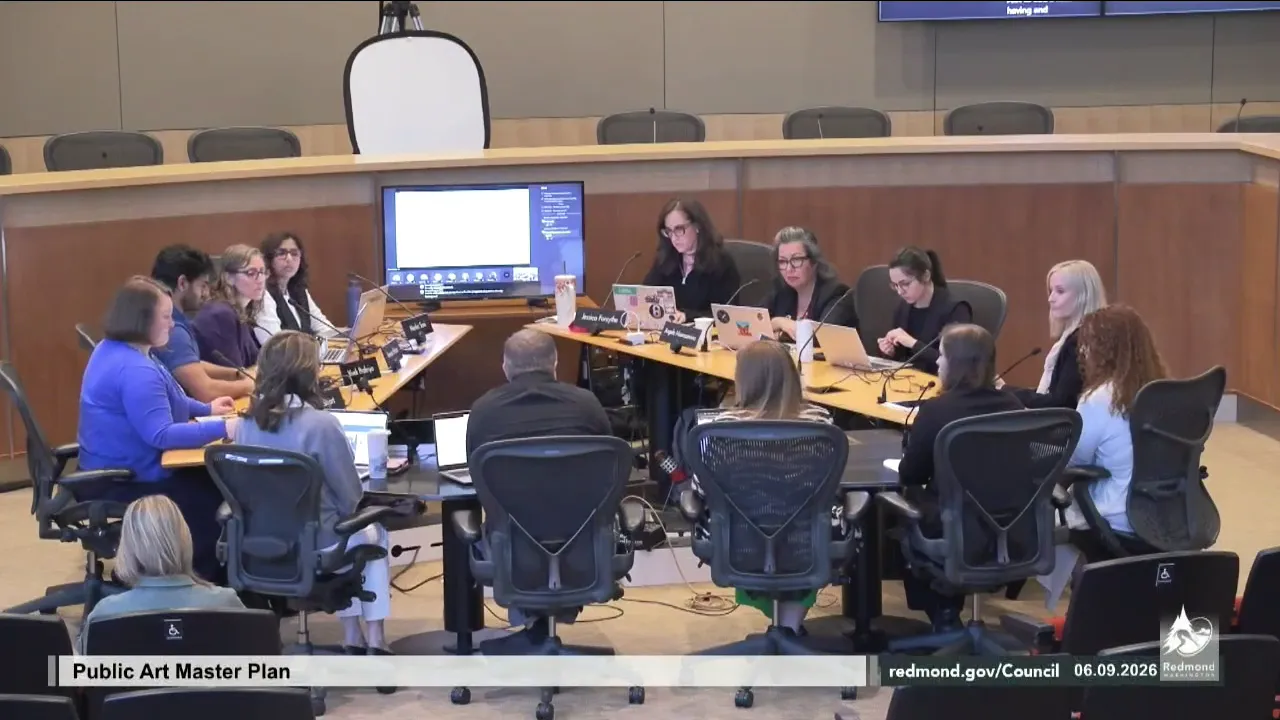
STREAMING COPY IN PREPARATION — RECORDING AVAILABLE FROM THE ORIGINAL SOURCE
Redmond City Council Study Session — June 9, 2026
The Redmond City Council met for a study session on Tuesday, June 9, 2026, beginning at approximately 6:00 p.m. (the agenda listed 7:00 p.m.). Mayor Birney and all council members were present. The agenda included a grant threshold proposal, a park impact fee schedule update, the public art master plan, Vision Blueprint 2050, and council talk time. No consent calendar or public comment period occurred.
Grant Threshold
- Deputy Director Zach Hoovner introduced grant supervisor Lauren Thompson, grant coordinator Amanda LaSalle, and capital and grant analyst Jeanette St. Paul.
- Staff said the current council approval workflow has three touchpoints and takes a five- to six-week minimum. Finance estimated the council approval process costs $3,411.95, and some departments have stopped pursuing small grants because the administrative cost exceeds the award.
- Staff recommended a $50,000 threshold for accepting grants, with exceptions for grants requiring unbudgeted matching funds, creating future staffing or operational commitments, or requiring council acceptance by the grantor. The threshold would align with existing $50,000 procurement authority, and grants would be reported through quarterly budget adjustments.
- Staff noted that of 16 grants under $50,000 received in 2024, 2025, and 2026, only one did not meet the exception criteria. They also reported the city manages roughly 45 grants annually and receives about 18 new grants each year, with about five on average under $50,000.
- Councilmembers raised concerns about approving a threshold before seeing the legislation and asked for additional exceptions, including new programs, new technology, and new policy implications. Councilmember Parsi also raised concerns about new city ownership/operating obligations, litigation, regulatory, environmental, and privacy risks. Councilmember Forsythe and others asked for a council leadership check-in on grants below the threshold.
- Council gave direction to continue developing the threshold with the added exceptions and with a council leadership notification role. Staff agreed to bring draft legislation to the Parks and Environmental Sustainability Committee of the Whole on June 23 and to prepare the item for the July 7 regular business meeting.
Park Impact Fee Schedule Update
- Parks planning manager Lindsay Falkenberg introduced Cameron Zapata and FCS consultants John Gillarducci and Zach Hazel. Parks Director Laureen Hamilton participated remotely.
- Staff explained impact fees are one-time fees paid by new development for growth-related capital projects and can only fund capital projects in an adopted plan.
- The updated current approach produced fees of $3,194 per 1,000 square feet for residential development, $224 for industrial, and $1,500 for non-industrial commercial development.
- A standards-based approach produced $3,783 per residential equivalent on a 20-year basis and $6,959 per residential equivalent on a six-year basis. For a single-family residence, that equals $8,290 under the 20-year approach and $15,000 under the six-year approach. Staff emphasized these are maximum legally defensible rates and the council may choose lower rates.
- The Parks, Trails and Recreation Commission asked that the fee amount not negatively affect housing development, including affordable and market-rate housing.
- Councilmembers asked about variability over time, the last update (2017), inflation indexing, developer credits for privately owned public spaces, and potential impacts on ADUs and home remodels. Council President Stuart expressed support for the standards-based approach, and Mayor Birney noted that six-year CIP projects sometimes roll forward, which could make the 20-year approach more practical.
- Staff planned to brief interested parties, including Master Builders and OneRedmond, and will return to the council in July with engagement results and in September with an ordinance.
Public Art Master Plan
- Recreation business manager Brittany Pratt, cultural arts supervisor Chris Weber, MIG consultants Linda Flynn and Ann Birchold, and Finance Director Kelly Cochran presented.
- The plan was launched in June 2025 and engaged more than 5,000 people through 60 touchpoints. Ninety-one percent of questionnaire respondents said public art is important to their experience of the city. The previous plan was adopted in 2017, and Redmond has grown by more than 20,000 residents since then.
- The plan is organized around three framework goals: integrated citywide public art, an artist ecosystem in Redmond, and a durable foundation for the program.
- Director Cochran recommended moving away from the current 1% for the arts ordinance toward embedding public art projects in the capital investment program with a minimum annual funding level. She also mentioned a $75,000 deferred maintenance catch-up this year and about $50,000 in ongoing maintenance next year.
- Councilmembers asked about maintaining an ordinance-level commitment, how CIP integration would work with infrastructure projects such as bridges, and the maintenance liability for art. Councilmember Prakriya asked whether the MOC project would generate 1% funding under the existing ordinance; staff acknowledged it and other projects could, but said the new approach would provide more predictability and roughly equivalent funding over six years. Councilmember Kritzer and Councilmember Forsythe requested more detail on the math for the MOC and teen center.
- Staff will incorporate council feedback into the final plan, and Director Cochran will return with an ordinance on the funding proposal. The council also asked to see the calculations for the 1% for the arts on the MOC and teen center.
Vision Blueprint 2050
- Deputy Director Serafi Allen introduced senior planner Glenn Coyle; Jeff Churchill was also present.
- Vision Blueprint 2050 is a capital investment strategy that connects the Redmond 2050 Comprehensive Plan to the six-year capital improvement program and two-year budget. It updates the previous Blueprint 2030 out to 2050.
- Staff sought council direction to prepare a resolution for approval on the July 7 consent agenda.
- Councilmembers discussed the timing of the plan, noting the city is in a budget year and other plans are still being updated. Staff said the next planned update would be in 2027.
- Councilmember Kritzer noted public art was not referenced in the plan; the council agreed to add a sentence referencing the public art master plan. Councilmember Parsi asked for metrics and links to functional plans; staff explained the document is a high-level roll-up and would add references where feasible.
- Staff will provide a preview of the added language before the plan is placed on the July 7 consent agenda.
Council Talk Time
- Council President Stuart announced the legislative coordinator position would be posted soon, an Ombud process update would come in the next few weeks, and upcoming events included a commemorative sign installation on Friday, World Cup events, and a retirement celebration for Tisa Rutherford.
- Councilmembers expressed interest in sending a letter to neighboring councils about the council's recent commercial drone delivery land use decision and in developing a federal legislative agenda. Councilmember Parsi also suggested adding a section to staff memos highlighting potential concerns or tradeoffs with Redmond 2050 goals; council leadership said they would consider it.
Key Outcomes
- The council directed staff to proceed with a $50,000 grant threshold, including additions for new programs, new technology, and new policy implications, plus a council leadership check-in. Staff will return with legislation for the June 23 committee of the whole and the July 7 business meeting.
- The council provided feedback on the park impact fee update; staff will return in July and September with engagement results and an ordinance.
- The council asked for final public art plan revisions and an ordinance from the finance director, plus a calculation of 1% for the arts on the MOC and teen center.
- The council agreed to add a public art reference to Vision Blueprint 2050 and place it on the July 7 consent agenda.
- Council leadership will follow up on a federal legislative agenda, a letter to neighboring councils, and potential memo format improvements.
Meeting Transcript
Good evening. I'm calling this meeting to order. This is a Redmond City Council study session held on Tuesday, June 9th, 2026, convent commencing at 6 p.m. All council members and Mayor Burney are in attendance. There are five items on the agenda tonight, and tonight's a little bit shorter topics. It's it's kind of like a glorified committee meeting, folks. It's gonna it's gonna have a little bit different pace, but we'll have some fun. Uh the first item on the agenda is the grant thresholds, followed by the park impact fee, schedule updates, the public art master plan, vision blueprint 2050, and council talk time. So for the grant thresholds, Deputy Director of Equity and Strategic Services, Zach Hoovner will introduce the team. Thank you. Thank you, Council President. Uh pleased to introduce Lauren Thompson, our grant supervisor, Amanda and Amanda LaSalle, grant coordinator and Jeanette St. Paul, Capital and Grant Analyst to introduce this item. I will be pulling up the PowerPoint here shortly. Good evening, Council members. My name is Lauren Thompson. I'm the grant supervisor. I will be conducting the presentation tonight just for sake of one person speaking and swiftness through the presentation, and then we all three of us are present to answer any questions you may have. Perfect. So I'm gonna walk through the current challenges that we face in our grant approval process and present a recommendation for establishing a grant threshold. The goal is to streamline our ability to pursue smaller grants by reducing administrative burden while still maintaining strong oversight and transparency. Our current council workflow process includes three touch points internal committee, committee of the whole, and the consent meeting. Typically it results in a five to six week minimum before an item can be approved. This long timeline affects our ability to implement grants effectively, especially those with short turnaround requirements or limited performance periods. Finance conducted a cost analysis of the council approval process for contracts that estimates a total cost of $3,000 or $3,411.95. This means that for smaller grant awards, it costs the city more to accept the award than the award value. Some departments have stopped applying for smaller grants entirely because the administrative time required to take a grant through council is not cost effective. Staff have consistently expressed the need for a grant threshold that would allow them to pursue low dollar opportunities while being fiscally responsible. The grants team recommendation is to establish a $50,000 threshold for all grants, with a few important exceptions. Grants will still go to council for award acceptance if they require unbudgeted matching funds, create any future staffing or operational commitments, or if the grantor explicitly explicitly requires council acceptance prior to execution. CIP grants are significantly larger awards, so different thresholds are not necessary. Using a single threshold across all grants is intentional. It simplifies the process, provides clarity for staff, and reduces the need for interpretation. Creating category-based exclusions would add complexity rather than support efficiency. One important point we want to highlight is that this threshold aligns with our existing professional services procurement limits. Today, department leadership already has the authority to spend up to $50,000 without coming to council. However, what they cannot do under current structure is bring revenue into the city, like grant funds of any amount without council approval. So the authority to execute expenditures up to $50,000 already exists, but the authority to accept funding does not. This recommendation simply brings those two practice processes into alignment. It allows staff to apply for, accept, and fully execute grant agreements up to $50,000 under the same level of delegated authority they already have for spending. Council will still review and approve the budget authority through the quarterly budget adjustment process before any grant funds are spent. This does not include the added cost of administering the grant itself once awarded. If you compare this cost to the value of small grant awards, the burden becomes clear. For example, the effort to approve a $6,000 grant represents roughly 62% of the grant's value. For a $12,000 grant, it's 31%. At $50,000, the administrative cost is about 7.5%. National data shows that local governments typically spend between 7 to 10% of the grant award on administration. By reducing the number of small grants that must go through council individually, we reduce administrative costs, avoid agenda congestion, and improve our ability to meet short execution deadlines, which is especially important for some state agencies with turnaround times as short as 45 days. Implementing the proposed threshold still allows for strong internal controls. Staff must get approval from their department leadership and from the appropriate governance body before they apply for a grant.
openpublica.com