Redmond Public Safety & Human Services Committee of the Whole Summary – June 16, 2026
STREAMING COPY IN PREPARATION — RECORDING AVAILABLE FROM THE ORIGINAL SOURCE
Committee of the Whole - Public Safety and Human Services Summary
The City of Redmond's Committee of the Whole for Public Safety and Human Services convened on Tuesday, June 16, 2026, at 4:33 p.m. (agenda start 4:30 p.m.) at City Hall (15670 NE 85th St). Presiding Officer Vivek Prakriya led the meeting with Council President Melissa Stuart, Council Vice President Angie Nuevacamina, and Council Members Jessica Forsythe, Vanessa Kritzer, Sayna Parsi, and Menka Soni present. The committee considered six action items intended for the July 7 consent agenda and one informational report. No public comment period was held.
Consent Calendar
-
Memorandum of Understanding for Behavioral Health Crisis Intervention Services (CM 26-4021) – Police Chief and Dispatch Manager Corey James presented a partnership with Crisis Connections. Trained behavioral health specialists will assist Redmond dispatchers via warm transfers for non-emergency behavioral health 911 calls. Funded by King County at no cost to the city. Committee advanced to July 7 consent.
-
On-Call Legal Services Agreement with Baker, Sterchi, Cowden & Rice, LLC (CM 26-3952) – Police Department presented a contract amendment reflecting a name change and market rate fee adjustments ($50/hour increase for associates, $100/hour for senior partners) within the existing $200,000 budget. Chief noted this is only the second rate increase in seven years; the budget has not been exhausted. Committee advanced to July 7 consent.
-
Accept Safe Streets For All (SS4A) Grant Funding from FHWA (CM 26-3974) – Senior Planning Engineer Micah Ross reported a $300,000 federal grant with $883,000 in matching funds for quick-build traffic calming and pedestrian safety improvements on NE 85th Street, 161st Avenue, NE 79th Street, and 188th Avenue. City attorney reviewed for executive order compliance and found no concerns. Committee advanced to July 7 consent.
-
Consultant Agreement with Shrewsberry & Associates for the Overlake Area Bicycle and Pedestrian Project (CM 26-3985) – $971,000 contract for engineering/design of the 148th Ave shared use path and NE 36th St bike lanes, with $8 million in state funding. Councilmember Forsyth voiced support but urged clear communication on future extension beyond the Microsoft frontage; staff noted sections north of NE 40th St are in the TMP for 5–10 year implementation. Committee advanced to July 7 consent.
-
Consultant Agreement for Feasibility Study of Fire Station 11 (CM 26-4016) – Deputy Chief Ami Varrell presented a $125,000 agreement with TCA Architecture to evaluate renovation/rebuild options for the downtown station, including site assessments, operational analysis, and cost estimates. Councilmembers encouraged evaluating co-location with affordable housing and a "world-class" workplace. Committee advanced to July 7 consent.
Discussion Items
-
2026 Amendments to RMC 3.38 Multifamily Housing Property Tax Exemption (CM 26-3923) – Planning staff (Ian Lefcourt, Jeff Churchill, Serafi Allen) proposed adding a 12-year extension option to the MFTE program in three of six residential targeted areas, based on a 2026 analysis with the Regional Coalition for Housing. The option targets deeper affordability (50% AMI) and includes tenant relocation assistance. Council President Stewart expressed strong support, citing Redmond 2050 commitments and noted the council had received substantial public commentary and letters in recent days. Councilmember Parsi asked about fiscal implications; staff estimated the median homeowner tax shift at approximately $45. Councilmember Kritzer requested data on existing MFTE uptake and financial feasibility. Concerns about 12 vs. 20-year terms led to discussion; staff noted conflicting state interpretations of the 20-year provision. The committee did not advance to consent but will continue discussion at a scheduled July 28 study session, with council questions due by early July.
-
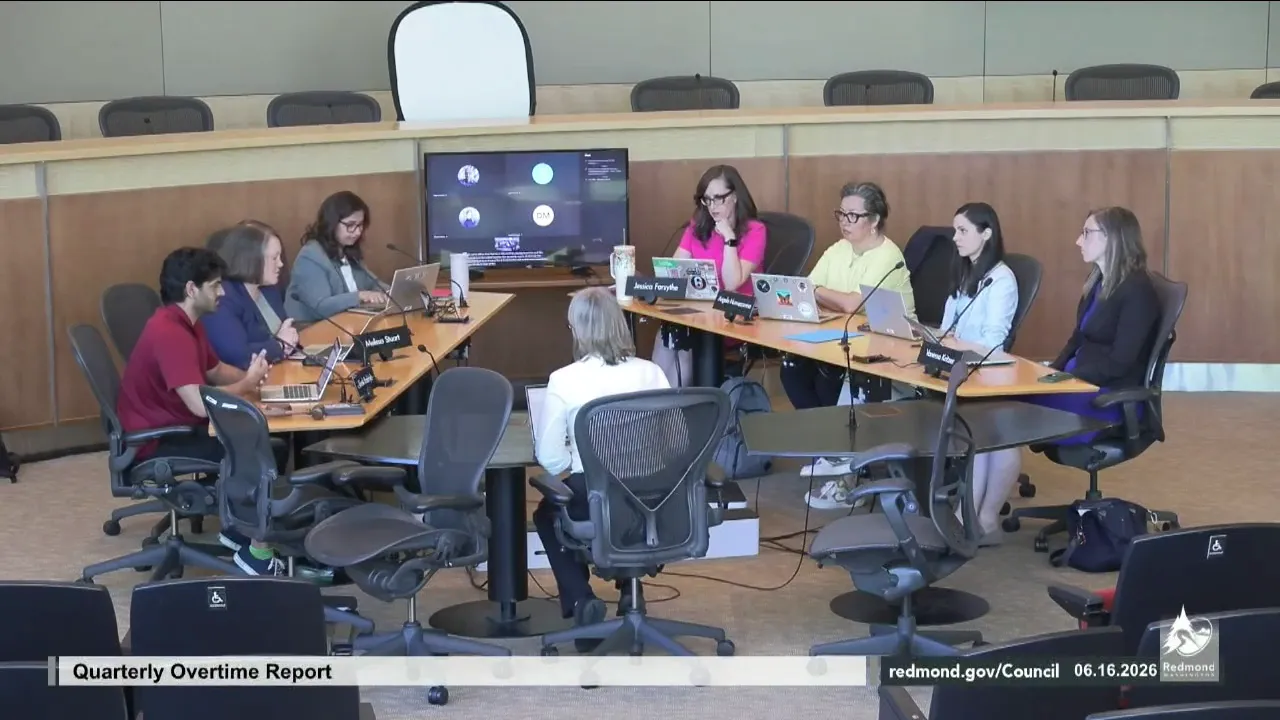
Quarterly Overtime Report: January 1, 2025, through March 31, 2026 (CM 26-4001) – Deputy Chief Varrell reported salaries at 60.8% of budget (below the 62.5% target) while overtime is at 88% of its budget, offset by vacancy savings. Overtime drivers include backfilling recruit academies, FMLA leave, and rank outages. A modest OT increase is expected with FIFA World Cup activities. Councilmember Soni asked about burnout and morale; Varrell acknowledged changing workforce values and mandatory OT concerns. Council President Stuart asked about hiring strategies; Varrell cited earlier academy starts leading to 100% graduation and ongoing conversations about overhiring.
Key Outcomes
- Five action items (Behavioral Health MOU, Legal Services Agreement, SS4A Grant, Overlake Bike/Ped Consultant, Fire Station 11 Feasibility) were cleared for the July 7, 2026 consent agenda by consensus.
- The MFTE amendments were referred to a July 28 study session (already on the calendar); no consent date was set. Council members will submit questions by early July. A potential adoption could occur at the August 3 business meeting if staff can meet packet deadlines.
- The overtime report was received as informational; no action taken.
Meeting Transcript
Perfect. It is 4 33 p.m. Uh, this is the June 16th Public Safety and Human Services Committee of the Whole. Should have done that a bit earlier. Uh council members in attendance are myself, presiding officer, council member Procria, uh, Council President Stewart, Council Vice President Nueva Kamina, and Council Members Kritzer, Parsi, Forsyth, and Sony. Um we have six six action items uh of the day. The first one is a memorandum of understanding for behavioral health crises uh intervention services presented by uh we have uh our police chief and um I think the police department is presenting. Good afternoon. I'm joined today uh by our uh dispatch manager uh Corey James. The uh memorandum of understanding is uh that we're asking you to authorize allows us to enter into a partnership with with uh crisis connection. Uh this partnership will establish a collaborative framework in which our or in which trained behavioral health specialists uh from crisis connections uh will assist our uh dispatchers uh by providing crisis intervention information and referral services uh and support for non-emergency behavioral health related uh 911 calls. Uh this agreement strengthens our ability to have uh more uh robust alternative response uh by enabling a more effective uh triage of behavioral health calls, uh reducing unnecessary deployment of police or fire units and ensuring community members receive timely appropriate and uh clinic the clinically informed support. Uh so we've had this conversation uh multiple times over the years around the alternative response. Uh this is similar to uh Denver Star program, etc. The call comes in, it gets triaged uh by our dispatchers, and if it meets the criteria, then there's a warm transfer uh to crisis connections uh in which uh they have the uh uh trained behavior health specialists uh and access to uh resources and referral services uh for that community member. Uh the kind of behind the scenes, just like when uh individual calls uh 988 directly, uh same group of individuals, uh the MERGAT uh group that we've been uh working with and talking about, uh they are dispatched by Crisis Connections as well. So this is part of that bigger uh infrastructure and framework that we're trying to uh plug into to be able to provide those uh services uh to the community. Thank you. Any questions for my colleagues? Councilmember Kritzer. So you mentioned Merquet. So how would this differ from the way that we're um processing calls right now with Mercat? So this process here allows for the actual uh what we refer to as the warm transfer of the call. So if the call comes in, if it meets the criteria, we're able to uh essentially patch that person into crisis connections directly. Uh and it and at that point, they will take over the call. They will decide what uh services, uh referrals, et cetera, are needed. If MERCAT is appropriate, then they would dispatch uh MERCAT uh you know to that call. Uh so this is uh this is just a a piece in the puzzle, but it's a um I'll call it a cleaner connection uh because it's that warm transfer. Uh it's not just a blind or here, call this number. Uh it's uh hey, this is the Redmond Police Department. We have this individual on the line, here's the circumstance, they then take it over uh at that point. Great. I I think uh this is great for us to be able to have this research. I know for a while we've been wanting to be able to solve on this issue around routing dispatch, so appreciate the work on it. So I'll council president stewart next. Thank you so much. Um I also want to ask about 988 calls and if this service uh will receive calls routed from that number as well. So 988 is uh on the technical side. If a person calls 988, it does not come to our communications center, it goes directly uh to I'll call the 988 line, which happens to be at Crisis Connections. Uh so these are two uh separate things. So if a community member calls 988, it goes directly to them. If a community member calls 911, uh it comes to our uh dispatch center, uh it it gets triaged, and then if appropriate, we can then make that warm uh handoff to uh crisis connections. Okay, thank you. I appreciate that. And then the follow-up is on the funding. Um the memo says that this is uh service being provided being provided by Crisis Connections, funded by King County, and at no cost to the city. Does the city need to receive grant dollars or simply join in the service? Uh we simply need to enter into the uh MOU, and that is the only there is no cost, that's the only process for the city is to enter into the uh MOU. I think I uh council member Parsi, did you were you next or yeah? I wanted to ask if you could kind of elaborate on the warm transfer.
openpublica.com