Public Safety and Human Services Committee - July 21, 2026: CDBG, CRO, Radar, Q2 Report, Housing Stability
STREAMING COPY IN PREPARATION — RECORDING AVAILABLE FROM THE ORIGINAL SOURCE
Public Safety and Human Services Committee of the Whole Meeting - July 21, 2026
The Public Safety and Human Services Committee of the Whole met on July 21, 2026, at 4:30 PM. The packed agenda covered four action/informational items: the proposed 2027 CDBG funding allocation, the LWSD School Community Resource Officer contract renewal, the Low-Altitude Radar System and Office of Airspace Management, the Redmond Police Department Q2 2026 Activity Report, a housing stability presentation, and read-only Q2 Capital Investment Program updates. The meeting adjourned at approximately 5:30 PM.
Consent Calendar
- Proposed King County Community Development Block Grant (CDBG) 2027 Funding Allocation Plan (CM 26-4591): Staff presented the proposed allocation of estimated CDBG funds. The city leverages funds with ARCH for regional housing projects. Contingency plan covers proportional increases/decreases based on final award. Council Vice President Nuevacamina noted timely submission; Councilmember Soni asked about scope of work and metrics—quarterly reporting will occur. The item was moved to consent for the September 1 business meeting (no vote taken).
- Lake Washington School District 2026-2027 School Community Resource Officer Contract Agreement (CM 26-4672): Chief Lowe presented the renewal with no significant changes. Councilmember Forsythe requested the dashboard be reshared before the final vote. The item was moved to consent for the August 3 business meeting (no vote taken).
Public Comments & Testimony
- None were made or noted during the meeting.
Discussion Items
Low-Altitude Radar System & Office of Airspace Management
Chief Lowe presented: The city applied for congressionally directed spending (accepted, awaiting House Ways and Means Committee approval) to fund hardware and first-year software. The system provides operational awareness of airspace below 400 feet (where the DFR program operates). No regulatory authority—city would monitor and report violations to FAA. The Office of Airspace Management would serve as an ombuds point of contact; no additional staffing requested at this time. Councilmembers raised concerns: Council President Stewart noted council was not involved in the grant application; Vice President Nuevacamina worried about vendor creating a surveillance network; Councilmember Parsi questioned the purpose given drones have collision avoidance; Councilmember Kritzer requested a study session for more detail; Councilmember Forsythe asked about tracking identifiers and implications of federal grant—Chief Lowe answered no on both. The committee agreed to move this item to a future study session.
Redmond Police Department Q2 2026 Activity Report
Chief Lowe reported: Drone as First Responder program: ~1,500 calls year-to-date, 90-second response time, 20% cancel ground response, 84.5% first on scene. Calls for service up ~3.5% (14,400+ year-to-date). Arrests up 17.8%. Auto thefts down 65% (27 year-to-date vs. 77 in 2025, high of 168 in 2024). Residential burglaries down 8%+. Shoplifts down 17.5%. Traffic collisions up 15%. Property crimes down 34.5%. Violent crime down 64.5%. Assaults up 8.1%—50% domestic violence related. Primary collision factors: speeding and distracted driving. Emphasis patrols ongoing. Councilmember Soni asked about geographic clusters of burglaries—Chief Lowe said they move; crews come and go. Also asked about proactive drone patrols—not allowed. Councilmember Kritzer inquired about speed trailers and school zone cameras—preliminary warnings, data not yet substantive. Vice President Nuevacamina noted correlation between declining crimes and increased arrests due to good police work. No action taken.
Housing and Human Services Overview: Keep People Housed (Presentation 4 of 4)
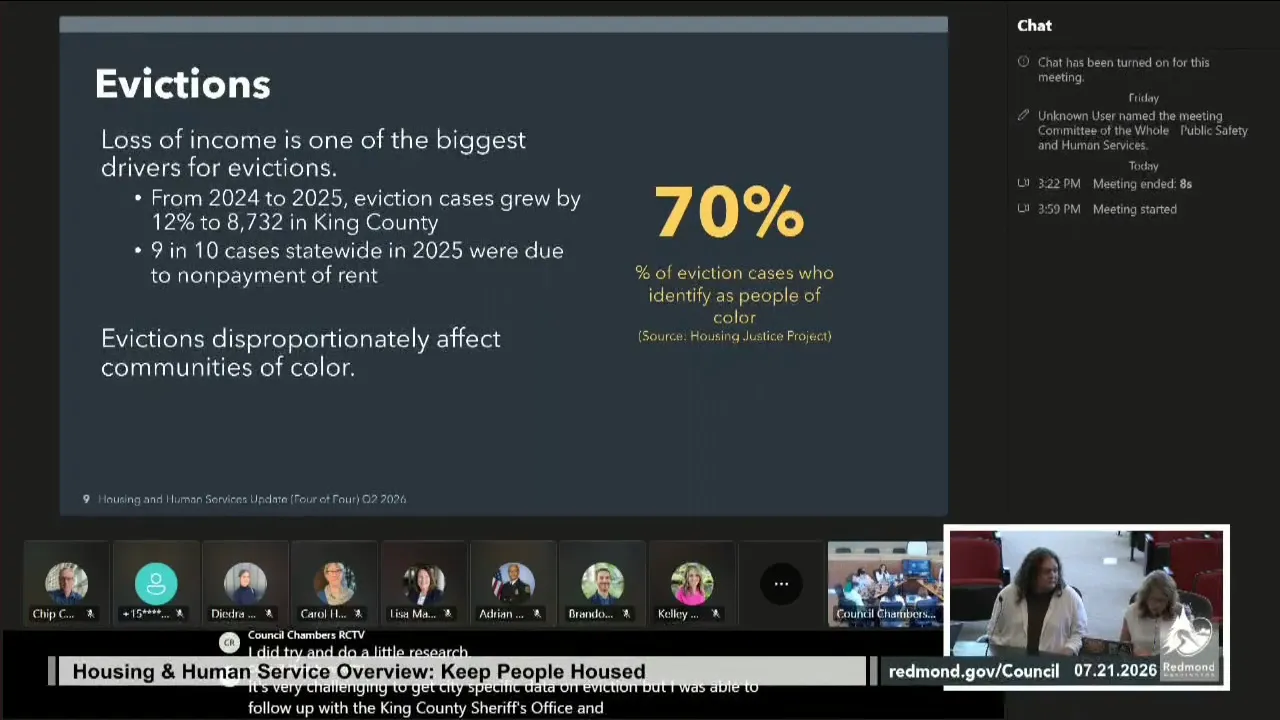
Brooke Buckingham, Ian Lefcourt, and new Homeless Outreach Administrator Xavier Wright presented. Key themes: Housing stability is affected by rising costs (rent up 50% since 2015, home prices doubled). Nearly 1 in 4 households is cost-burdened (over 30% income) or severely cost-burdened (over 50%). City contracts with Eastside Legal Assistance: 268 hours to 52 households in 2025. Rental assistance: $286,000 in human services grants; Hope Link reported serving 1 household for every 112 unable to help per month. Evictions: King County Sheriff served 177 writs of restitution in Redmond in 2024-2025 (150 in 98052 zip code). Councilmember Parsi asked about fixed-income seniors—Ian Lefcourt noted they struggle to downsize, need home rehabilitation, and face trip hazards. Xavier Wright observed many elderly clients facing financial trouble and scams. Council President Stewart highlighted the Capella pilot success (40 households housed) and requested tracking evictions prevented. Councilmember Kritzer noted the staff already function as a housing ombuds. No action taken; further study session scheduled September 22, with strategic plan adoption expected October 2026.
Capital Investment Program (CIP) Project Updates Q2 2026 (Read Only)
Tess Wilkinson, Steve Gibbs, and Chris Danger answered questions. Council President Stewart requested a future highlight on ADA curb ramp program and pavement condition index. Councilmember Kritzer expressed excitement about Bell-Red buffered bike lane and asked about Idlewood Park parking lot expansion—contract award later this year with construction early next summer. Councilmember Parsi asked about teen center design progress—staff reported engaging design-build teams, state board approval expected Friday, October stakeholder engagement still on track. Councilmember Stewart noted that teen center item would be on the next week's Parks and Human Services committee agenda.
Key Outcomes
- CDBG Allocation Plan: Moved to consent agenda for September 1, 2026 business meeting.
- LWSD CRO Contract: Moved to consent agenda for August 3, 2026 business meeting.
- Low-Altitude Radar System: Referred to a future study session; no vote.
- Q2 Police Report: Received as information; no action.
- Housing Overview: Received as information; upcoming milestones: Let's Connect survey closes August 12, draft strategic plan to PWS committee September 2, study session September 22, adoption early October, funding recommendations October 27.
- CIP Updates: Received as information; future update on ADA curb ramps requested.
Meeting Transcript
Thank you. Hello and welcome. It is 4 30 p.m. and this is the July 2 21st meeting of the Public Safety and Human Services Committee of the Whole. All council members are in attendance. And I just want to note that this is a very packed meeting for this committee. Um due to an item from another committee that is at the end and just being very packed for relative to how this committee goes in general. So please try uh to be brief and I may have to cut folks off at some point. Um but the first item of the three action items is the community development block grant projects presented by Deputy Director Allen and Alaric Bean of the planning department. Thank you, Council. We figured we'd get up here, so since it's a tight agenda. Um presenting on the proposed allocation of the estimated 2027 community development block grant funds. Alaric, it will explain how the determinations were made as well as some background information on how CBDG works and what uh the requirements are for the distribution of funds. Uh the plan is very similar in uh compared to prior years, and we are looking for guidance from the council on how to proceed and are open to answering any questions you may have. Alaric? Great, thank you. Um so the city is under an interlocal agreement with the county for administration of the federal community development block grant awards, so it's C D BG. Um and under this arrangement, Redmond is what we call the joint agreement city. So that means that some of the CDBG funds are allocated directly to us, passed through the county for us to allocate directly while the remainder is administered by the county. The benefit of this is that we have some control over a portion of our funds, but uh we don't have to deal with all the additional requirements of being a full entitlement city. Um things like the very complicated annual consolidated performance and evaluation report, the CAPER, uh entering data into their integrated disbursement and information system, IDIS, and meeting and documenting all of the federal civil rights and fair housing requirements. So the portion that we do control goes to public services, to capital projects, and for out and an allocation for some administrative expenses. How we determine what projects to fund, um CDBG capital funds can only support certain public improvement or parks projects, and because the amount that we get for um for capital is so small, it's difficult to use um to complete a whole single project. The amount of staff time to run a full request for proposals and perform the required oversight and monitoring for a small amount would be overly burdensome for both the city as well as the grantee. So by allocating these funds to Arch, um the city can leverage its CDBG dollars along with Redmond's general funds and the contributions of 13 other participating jurisdictions to support regional housing projects that Redmond couldn't finance alone. And Arch's expertise in federal requirements and housing development also allows them to combine Redmond's CDBG funds with those from other cities like Kirkland to support major projects in Redmond like the John Gabriel House right here. CDBG grants don't allow for the supplantation of existing funds, only the newly only newly funded or newly expanded programs are eligible. And as part of the human services grant project process, the city staff reviews proposals to determine which programs meet these criteria and also have an interest and in and capacity to manage the federal funding. So I'm happy to answer any questions. Thank you. And the the proposed um requested action is to go to consent on September 1st. Um any questions from my colleagues. Council Vice President Nueva Camino. Thank you, Chair. Um thank you, Alec, for presenting. Um couple of quick comments on it is one. Um, thank you for bringing it forward in a timely manner because I did notice the October deadline with budget with recess, all of the things. So thank you for bringing it to us now while we've got time to get it where it needs to go. Um I can't find it as I'm looking for it right now. I vaguely remember reading, and please correct me if I'm wrong. Um, that we needed if we weren't going to utilize the funds, then there needed to be a contingency plan. Oh, yes, the contingency plan, because we don't know how much money we're actually going to get until probably the spring or early summer of next year. The contingency plan, it's in the uh in the attachment. The contingency plan, it's in the uh in the attachment, it's like if we get more we'll we'll um increase by proportionately more and if we get less we'll decrease proportionately for that. And that was the question that I was getting to was what specifically is the contingency plan because I I as we're we're talking I remembered reading it somewhere in there but I just wanted to clarify on that before we move forward. Great thank you. Councilmember Sony will there be an SOW that you will receive it once the funds allocation is guaranteed and do or do we have to submit any report back or any metrics uh you know once these funds have been used and how we're going to keep a track of that. Yes we um it's federal funding so there are a lot of requirements along with it so there is quarterly reporting and we have to document um everything and get monitored by the county actually every two years and we just finished our monitoring visit for this last um period. I'm sorry what was the first part of the question? First question was regarding the SOSOW I believe like you know we'll be signing the SOW with uh for this to receive this funding.
openpublica.com