Rochester City Council Study Session - November 13, 2024
STREAMING COPY IN PREPARATION — RECORDING AVAILABLE FROM THE ORIGINAL SOURCE
Rochester City Council Study Session - November 13, 2024
The City Council held a study session on November 13, 2024, to discuss Phase Two Public Safety Aid recommendations, special 2 a.m. liquor license endorsements, and the study session schedule. No public comments were received. The council provided direction on the liquor license topic and received information on the public safety aid item, which will be on the next regular council agenda.
Discussion Items
Phase Two Public Safety Aid Recommendations
Deputy City Administrator Aaron Parrish presented the remaining recommendations for the $5.3 million in state-allocated public safety aid. Previously, the council approved $4.4 million in Phase One investments. The proposed Phase Two allocations include:
- Extending the Axon platform contract to lock in 2024 pricing for seven years, making the investment budget neutral in 2025 and 2026 but requiring a one-time levy increase in 2027. Police Chief Jim Franklin noted that future costs would rise if the deal is not made now.
- $140,000 for additional fire turnout gear to comply with OSHA standards and provide two sets per firefighter to reduce carcinogen exposure.
- $93,000 for emergency management vehicle and other needs.
- $293,000 to fit out unbuilt space at Fire Station 2 for temporary emergency management use, with potential for future dispatch relocation.
- Reallocation of $100,000 from the original $200,000 for community impact, including $50,000 for a CERT collaboration, $15,000 for the community service team, and funding for two flock cameras.
Councilmember Keene asked about PFAS in turnout gear; Deputy Fire Chief Holly Mulholland clarified the funding addresses carcinogen exposure, not PFOS. Councilmember Keene also questioned future financial commitments from the Axon deal, and Chief Franklin confirmed that while the upfront cost uses one-time funds, future budgets will see a levy increase. The item is scheduled for the next council meeting.
Special 2:00 a.m. Liquor License Endorsements
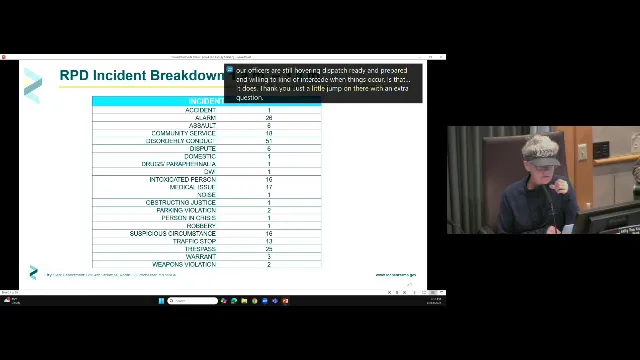
Deputy City Clerk Christiaan Cartwright presented an overview of the eight businesses currently holding 2 a.m. licenses. Advantages included significant revenue (25-30% of annual sales for some businesses), employee tips, and alignment with other Minnesota cities. Police dispatch data from November 2023 to October 2024 showed higher officer workload between 1 a.m. and 3 a.m., especially on summer weekends, with incidents of disorderly conduct, alarms, trespasses, and suspicious circumstances. Chief Franklin stated that the decision is a policy choice for the council and that officer deployment would continue regardless of closing time. Councilmembers Keene, Brandsford, and Kirkpatrick expressed opposition to changing the current policy, citing economic harm, limited impact on police workload, and the need to maintain downtown vibrancy. Councilmember Dennis noted the mayor was absent but saw no need for change. The council directed the Clerk’s Office to take no further action at this time, but the topic may be revisited by the incoming council.
Study Session Schedule
City Administrator Ms. Elms reviewed the final study session of the year on November 25, 2024, which will include the National Community Survey feedback, an update on the Planning to Succeed comprehensive plan, the fire service contract, and Olmsted County general land use plan changes.
Key Outcomes
- No formal votes were taken. The council provided direction to maintain the current 2 a.m. liquor license policy and not to pursue changes at this time.
- The Phase Two Public Safety Aid recommendations will proceed to the regular council meeting on November 20, 2024, for a vote.
- The study session schedule for November 25 was confirmed.
Meeting Transcript
Last night. And I was like, she didn't know about it. Mayor. That's what we kind of want to things. You got me. Oh, I got you already. And the news work. Here I have. Do you need next one? I think I have pocket. Thank you so much. And our first topic is phase two of the public safety aid recommendations. And our deputy administrator recording in progress. Karen Parrish will start us off in this presentation. President members of the council, this is the second verse same as the first. Yeah. So uh president members of the council, this is second verse, same as the first. Do you recall we went through an original conversation around the phase one recommendations for all there's about 5.3 million dollars in public safety aid that was allocated by the state? Previously, you approved about 4.4 million dollars in phase one investments. Um and what we're bringing forward to you is a collective recommendation around the remainder of those. Um as you can see on the screen, there's uh a number of eligible uses and some things that specifically are not allowable. Um, and then that also reflects your initial investments um that were made um back uh back in February. Um really just a few things that are being recommended here, and I think they're strategic investments, but as you know, the budgeting process, you know, is uh a lot of conversations happened around that, and some of these things actually will be helpful to that in the future in terms of uh investing in things that we would otherwise have to pay for but for this funding, and so I think this uh allows us to um be good uh fiscal stewards. Um so I will uh maybe advance me. There we go. Um so as we as we look at the different options, uh I think one uh that you're familiar with, you've invested in the Axon sort of platform for the PD. Um they're really on the cutting edge of utilizing this for any number of different things for body cams or records, um they're getting really uh ready um to see some of the benefits of that investment in technology. I know they've worked very hard on getting uh through the implementation process. Um, but that is a limited term agreement. Um by extending that out now and fixing our pricing, we can actually through a modest investment at this point, um, leverage uh future costs uh out into uh into year seven, out to year seven in this contract. And so you know it's a really uh wise thing to do, and it gives you a longer time horizon for um what your costs are and fixing those. Um as we've done benchmarking uh with other agencies, um we're definitely very competitive and we feel like we're in a good position um to deliver you know on this product and are you know leveraging it to the maximum extent possible at a lower cost than what many other agencies are seeing through our collaboration with that group. Uh secondly, um with through some evolution in uh OSHA standards, we are required to uh provide additional turnout gear to our firefighters. Um so this would provide additional investment in that area, so that's 140,000. Um, and really just you know, it's really part of a fire safety initiative. So allowing folks, you know, if they are on a fire scene to come and change out into new clothing while their other clothing's going through a good washing process, and so to think this is in line with some of our uh safety and wellness initiatives, and so really a good use of those fundings. Uh emergency management at about 93,000. We have a vehicle that is uh currently not depreciated and some other limited needs in that area. Um and so as we sort of go with this new collaborative emergency management model, this is just sort of trueing up some expenses that we have there and really appreciate you know the strong partnership that's happening between the PD and FIRE in terms of our delivery of emergency management services. Um and then last but not least, uh we are recommending about 293,000 for the fit out of the uh space that is currently unbuilt over at station two. Um you might remember uh back at the rec center, we had kind of a similar unbuilt out space. Um and this would allow us to do something similar there to get it into a usable condition for temporary use by emergency management, so they don't have to do all the setup and tear down. Um it just gives us an extends out the flexibility of that space in the future if we want to have a backup display dispatch location or relocated dispatch there, it also gives us the opportunity uh to do that, but really um extends that out. And just as a by way of example, we're you know, 80% across the line with this space. Oh, that's great on my computer, but I'm not hooked up. So there we go. Um, so you can kind of see some pictures. These weren't included in the packet, but I just thought it'd be helpful as a visual reference to say, you know, if we can get the concrete in and get the walls built out and some light mechanical work, you know, we'll be in a good position to utilize this space. Um, by the way, probably won't recommend like leaving the floors undone in the future, not the easiest thing to do after the building's occupied, but um something that is uh helpful, I think, for the overall um utilization of that building. And then finally, um we are proposing a few phase one reallocations.
openpublica.com