The Rochester City Council held its regular session on November 2, 2026, at 6:00 p.m. in the Government Center Council Chamber. All seven council members and Mayor Norton were present. The meeting included open comment on automated license plate readers and Salvation Army housing assistance, four public hearings, a report on private sewer lateral cost assistance, and ordinance readings. Consent Calendar - The agenda was approved as presented (Miller moved; Keene seconded). - The consent agenda was approved in full with no items pulled (Fredericks moved; Miller seconded). It included minutes from October 19, 2026; accounts payable totaling $65,176,428.94, including $24,997,618.72 in investment purchases and $40,178,810.22 in accounts payable; authorization for Electric Utility Revenue and Refunding Bonds, Series 2027A; a temporary two-hour free parking program in City ramps from December 1–31, 2026; FY2026 Edward Byrne Memorial Justice Assistance Grant application/acceptance; MnDPS 2027 Traffic Enforcement grant acceptance; and multiple contract amendments and agreements (including Toole Design $60,283.95, Widseth $96,720, Kimley-Horn $25,120, Bolton & Menk $445,883, amended Farmland LLC annexation of about 188 acres, Mayo Clinic B3/B4 coordination, and a settlement related to the Tap House litigation). - During consent, a council member clarified that the MnDPS 2027 traffic enforcement grant (F6) covers salaries for enforcement activities such as distracted driving, DWI, and speed—not equipment. Public Comments & Testimony - Adam Sechla and Sarah Jackham spoke against automated license plate readers (ALPRs), which they associated with Axon/Flock cameras. They asked that the MnDPS 2027 traffic enforcement grant not fund ALPRs and urged the Council to cancel current ALPR contracts, remove equipment, and commit to no further installations. Jackham cited United States v. Kyle (case no. 426 CR00189) as finding ALPR use an unconstitutional warrantless search and listed numerous Minnesota communities and counties that she said had paused or suspended ALPR use. The speakers expressed concerns about privacy, data sharing, and wrongful tracking. - Major Randy Halstrom, commanding officer of the Salvation Army in Rochester, thanked the city for a block grant. He said the $12,000 grant would help 10 to 16 additional households remain in their homes this year; the Salvation Army averages 12 households per month receiving rental assistance but receives about 30 calls per month it cannot cover. He said more than 40 households call weekly because they are not secure in their housing and described the need as greater than available resources. - John Creasel opposed the proposed 4% increase in 2027 Downtown Special Service District charges. As a street-level business owner, he cited difficulty for clients accessing his facility, lack of handicap parking on Third Street, and street closures during downtown events; he said downtown retail businesses were not seeing 4% growth. - Linda Parker urged the Council to embed rigorous fraud-prevention and oversight measures in the CDBG Annual Action Plan, including sub-recipient audits, progress-to-payment disbursements verified by city inspectors, data matching against county property records, and a public-facing CDBG contract tracker. - No public testimony was offered during the vacation petition (G3) or Cassidy Heights final plat (G4) hearings. City Administrator and Mayor Reports - City Administrator Zelms noted that election day was the next day and that Rochester Public Transit would provide free rides to polling places. He announced a Rochester Public Library event on Friday, November 6, 2026, from 6 to 8 p.m., and a Sound School performance by Dusky Waters at the Historic Chateau Theater on Saturday, November 21, 2026, at 7 p.m. with a $10 entry fee. - Mayor Norton responded to the ALPR comments by saying Rochester does not use Flock cameras but uses Axon, which she said is not used to track citizens. She cited a June town hall with RPD, strict access rules, in-house data retention, and regular deletion unless needed for court. She also mentioned a recent shooting at 41st and 52 in which no one was shot but a car was hit, said a 41st Street camera had been vandalized and was not active, and encouraged residents to contact Chief Franklin with questions. - Mayor Norton also announced the League of Minnesota Cities Mayor for a Day contest through December 11, a free all-ages fifth-anniversary New Year’s Eve celebration on December 31 from 11 a.m. to 7 p.m., several board and commission vacancies, and a December event to recognize board and commission members. Discussion Items - 2027 Special Service District Service Charges (G1): Josh Johnson explained that the Downtown SSD is a self-imposed charge supported by downtown property owners, not a traditional city property tax levy, and funds Rochester Downtown Alliance services. The district was renewed in 2024 for 10 years. Staff recommended a 4% increase, within a 4%–8% range, producing approximately $425,893 in total 2027 service charges—about a $16,000 year-over-year increase and about 30% of the RDA annual budget. Sean Fagan described RDA programming, including 424 free live musical performances in summer/fall, marketing, and a Sunday market pilot; he said one business reported its busiest Sunday in months, another reported an 11% sales increase, and a survey found 60% of attendees came downtown for the event and 60–65% planned to explore more of downtown. Council members discussed the RDA role, accessibility parking, and the December free-parking program. Public Works noted that hang-tag holders can park four hours at any downtown location and that accessible parking would be inventoried and addressed block by block during upcoming downtown reconstruction projects over the next four to five years. - 2027 CDBG Allocations (G2): Brent Svenby presented the 2027 Annual Action Plan. The city projects $650,000 in HUD CDBG funds plus $75,000 in program income. Public-service requests totaled about $260,000, but the 15% cap allowed about $97,500. The plan included about $97,500 for public services, $145,000 for administrative activities, $70,000 for housing coalition affordable-housing planning, $250,000 for single-family rehab loans, $125,000 for rental rehab loans, and $107,000 for rehab-program administration. Svenby said public-service grantees are reimbursed after expenses, monitored, and subject to agreements; rehab work is inspected before payment. Councilmember Doring asked whether any grantee had fallen out of compliance or been accused of fraud; Svenby said he was not aware of any, and noncompliance would result in funds not being released. - Vacation Petition CD2026-008VAC (G3): Elliot Muller presented a request from Pougiales SE Rochester LLC to vacate an unused 10-foot-wide utility easement south of Center Street East and west of Sixth Avenue Southeast. Public Works and RPU supported the vacation with a future easement; new utility easements would be dedicated through site development and minor subdivision. The overall project is a six-story, 211-unit multifamily development. The Development Review Team recommended approval with one condition. Applicant engineer Craig Britton acknowledged the developer would pay relocation fees for a service serving the adjacent property and that RPU Electric required certain facilities to remain until relocation. Councilmember Keene asked about notification; Britton said the relocation affects the home to the south and other lots would be consolidated. - Cassidy Heights Final Plat CD2026-028PLAT (G4): Muller presented a final plat by RJR Land Development LLC to subdivide 12.7 acres (agenda: 12.77 acres) into 18 residential lots and one outlot at the terminus of Cassidy Ridge Drive Northeast. The roadway would be extended and temporarily terminated in a cul-de-sac for fire access, with future extension. The major land subdivision was approved September 9, 2026, and the final plat was consistent with the general development plan and major subdivision. The Development Review Team recommended approval with four conditions. Applicant Dan Horsch of SEH said the applicant would meet the conditions. - Private Sewer Lateral Line Cost Assistance Research (H1): Aaron Luxtein reported on a 2025 action-plan item. Under current ordinance, homeowners are responsible for private sewer laterals from the main to the house, and right-of-way work can be costly. From January 1, 2021 through September 17, 2026, the city recorded 84 permits for private lateral repair or replacement—an average of 14 per year, with a high of 18 in 2024. Luxtein said 59% of permits included work from the main to the house and characterized the split as roughly 70% full main-to-house work versus 30% only within the street/sidewalk area. Staff evaluated expanding RPU Service Assured, shifting responsibility to the curb/right-of-way, grants or low-interest loans, and voluntary private insurance. Staff did not recommend the first three because of staffing/funding, rate increases, or lack of Rochester-specific inflow/infiltration need. The recommended option was a voluntary third-party insurance program through Oncourse Home Solutions: up to $30,000 coverage, average repair about $1,000 but potentially $15,000 when sidewalks/streets are involved and up to $30,000 in worst cases; a discounted introductory rate (transcript records $699 per month) rising to just under $10 per month after the first year; 95%+ claims approval; no city funds; opt-in with no minimum policies; and a one-time $25,000 community partnership fund for hardship assistance. Administrator Zelms noted the proposal has no deductibles or service fees. Council members debated the value of the program, prior logo-use concerns, geographic distribution, homeowner responsibility, and whether to bring Oncourse in for more discussion. Palmer raised concern about a prior program using the city logo; Zelms said the earlier use was unauthorized and not a city partnership. Keene estimated about 80 repairs over roughly 40,000 services, about two per 1,000 over five years. - Ordinance Readings: First readings were introduced for Zone Change CD2026-002ZC by 75th AZ, LLC (15.75 acres at the northwest corner of 60th Avenue Northwest and Valley High Road from H Holding to MXC Mixed Use General); Zone Change CD2026-001ZC by Stencil Group (about 3.83 acres northwest of Superior Drive Northwest and Badger Hills Drive Northwest from MX-S to R-3 Medium Density Residential); and a stormwater management criteria text amendment to Rochester Code Title 6, Chapter 6-4, Section 6-4-12. The 2027 Master Fee Schedule ordinance received its second reading and was adopted. Key Outcomes - Consent agenda approved in full; no items were pulled. - G1: Adopted a resolution authorizing $425,893 in 2027 Downtown Special Service District service charges (Doring moved; Fredericks seconded; voice vote, no opposition noted). - G2: Adopted a resolution approving the 2027 CDBG Annual Action Plan (Fredericks moved; Miller seconded; voice vote, no opposition noted). - G3: Adopted a resolution approving Vacation Petition CD2026-008VAC with one condition (Fredericks moved; Keene seconded; voice vote, no opposition noted). - G4: Adopted a resolution approving Final Plat CD2026-028PLAT, Cassidy Heights, with four conditions (Fredericks moved; Doring seconded; voice vote, no opposition noted). - H1: A motion to maintain the current approach on private sewer lateral cost assistance failed on a roll-call vote; Fredericks and Palmer voted aye, Keene, Miller, Doring, and Schobring voted nay, and Wall’s vote was unclear in the transcript. A subsequent motion directing staff to bring Oncourse Home Solutions to a study session or report and recommendation for continued discussion of a voluntary insurance program passed 6–1 (Fredericks voted nay; Keene, Miller, Wall, Palmer, Doring, and Schobring voted aye). - K1: The 2027 Master Fee Schedule ordinance was adopted (Keene moved; Wall seconded; voice vote, no opposition noted). - The meeting adjourned after a motion by Miller, seconded by Wall.
Public Meetings - Rochester, Minnesota
Public Meetings - Rochester, MinnesotaThe Ethical Practices Board of Rochester, Minnesota, met on October 30, 2026, at 10:30 a.m. in City Hall Room 320. The board addressed routine business, received an update from the City Attorney on election-related inquiries, and conducted a lengthy discussion on a pending complaint before voting unanimously to dismiss it. Consent Calendar - Meeting called to order with roll call; members Faye Harris, Timothy Hornseth, Nick Nedland, Morgan B Muenster, Ndidi V Nwaneri present; Bob Haeussinger and Paul H Grinde absent. - Minutes of September 17, 2026, approved unanimously. - Reports: City Attorney Michael Spindler-Krage updated the board on election season inquiries, noting an increase in questions about candidate ethics disclosures and conflict of interest, and previewed new elected official orientation in November that will include ethics training. Public Comments & Testimony - No members of the public spoke during the open comment period. Discussion Items - The board continued its review of a complaint/inquiry dated August 17, 2026. The complaint alleged ethical violations related to a parks department contract, including a $17,000 accounting error (later corrected), a change in contracting process mid-negotiation, and claims of bias by city staff based on personal interactions. Board members debated whether the issues raised constituted an ethics code violation or were matters of professional judgment. City Attorney clarified that staff have discretion in presenting information to boards, that the park board made the final decision to pursue an RFP, and that the ethics code requires impartiality but not that staff ignore legitimate experiences with vendors. The board examined the specific language of the city's ethics ordinance, particularly the duty to discharge duties faithfully and impartially. After discussion, members concluded that the accounting error was unintentional and corrected, and that the decision to change the process was based on actual interactions and not on prohibited bias. No personal financial gain or clear violation was identified. Key Outcomes - Motion by Timothy Hornseth, seconded by Nick Nedland, to dismiss the complaint/inquiry dated August 17, 2026. Approved unanimously (5 ayes, 0 nays, 2 absent). - The board set its next meeting for November 19, 2026, at 10:30 a.m. in conference room 104. - Meeting adjourned.
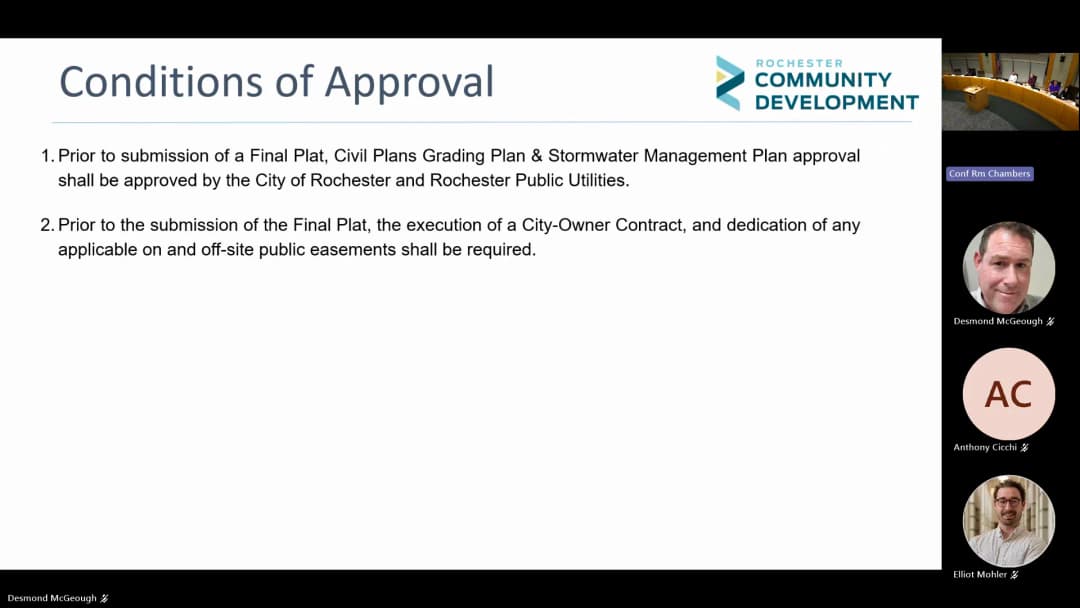
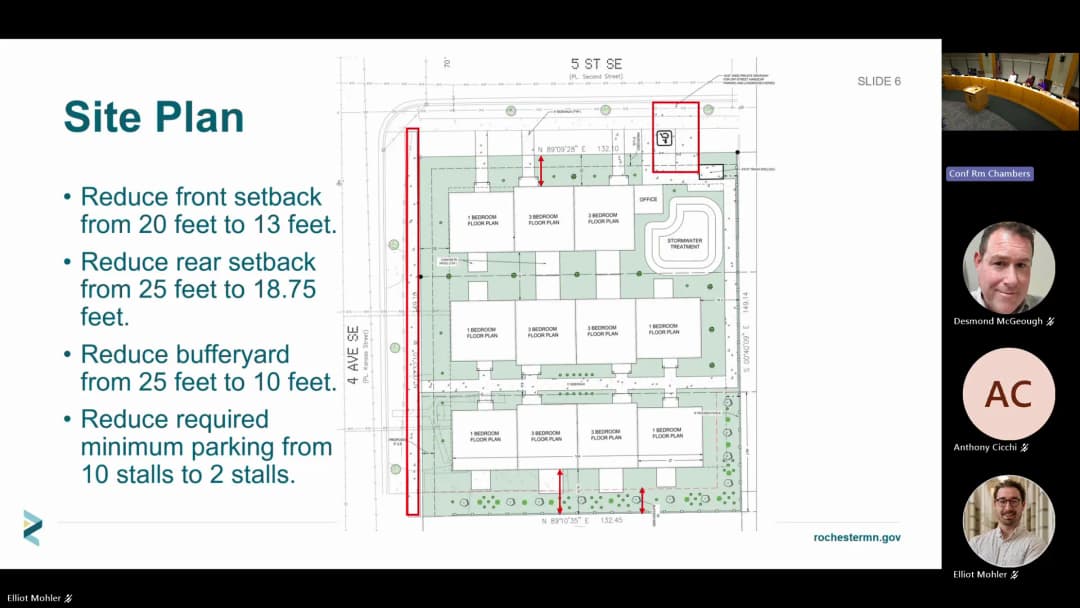
The Rochester (Minnesota) Planning & Zoning Commission convened on October 29, 2026, at the Government Center Council/Board Chambers. The meeting covered a major land subdivision recommendation for the Shannon Oaks Eighth development and combined public hearings for a veteran housing development proposed by Lennar on behalf of the Minnesota Assistance Council for Veterans (MACV). Discussions focused heavily on wetland protection, infrastructure planning, and parking demand management for infill projects. Commissioner Ross recused herself from votes on the two MACV items, and Commissioner Ahmed arrived after the first vote. Consent Calendar - The minutes of the September 30, 2026, Planning & Zoning Commission meeting were approved unanimously. Public Comments & Testimony - Kelly Rae Kirkpatrick addressed the commission during the open public comment period regarding the Shannon Oaks Eighth subdivision. Ms. Kirkpatrick urged the commission to table the plat to allow for the completion of a full environmental record. She specifically requested a formal wetland delineation and an assessment of the land's geology and drainage, arguing the current packet lacked sufficient technical evidence to ensure protection of wetlands, groundwater, and neighboring properties. She explicitly stated her position was "not against housing" but for proceeding with complete findings. Discussion Items Shannon Oaks Eighth Major Land Subdivision (CD2026-026PLAT): - Staff presented a recommendation to forward the subdivision of 25 single-family lots on 10.73 acres within the R-1 zone district by Castlewood Homes, Inc. to the City Council with five conditions. - Mark Welch (G-Cubed Engineering, representing the applicant) detailed a redesigned grading and drainage plan for the Phase 8 development. He argued the new plan reduced infrastructure depth and grading impact compared to previous designs. He confirmed a new wetland delineation and mitigation plan had been submitted to the Soil and Water Conservation District and that there are no decorah edge features present within the development footprint. He stated the applicant was comfortable with the five proposed conditions. - Commissioner Ross expressed concern about the outstanding wetland sequencing plan approval and community opposition, suggesting a lack of complete information. Staff confirmed that conditioning wetland mitigation approval is established precedent for preliminary plats, with a 60-day statutory review timeline. Commissioner Cline also expressed a need for more information before approving. - Vote (3-2): Motion to forward a recommendation of approval to the City Council with five conditions. Commissioners Boyum, Eischen, and Krull voted in favor; Commissioners Cline and Ross voted against. Commissioner Ahmed arrived late and was not present for the vote. MACV Veteran Housing – Parking & Setback Modifications (CD2026-015CUP & CD2026-014MOD): - Staff presented two applications for a single, 11-unit townhome development providing housing for veterans at 5th Street SE and 4th Avenue SE. - Jon Lovald (COO, MACV) described the mission of ending veteran homelessness. He stated that 15% of their residents statewide own vehicles and that 90% of their clients are at or below 50% of Area Median Income, making car ownership a luxury. He emphasized the project includes supportive services and residents are case-managed. - Ryan Schoenfelder (WSE Engineering) argued the parking reduction (from 10 code-minimum stalls to 2) was supported by abundant nearby frequent transit (Link BRT), on-street parking without permit restrictions, and future parking from the redevelopment of the adjacent AMP/Kmart site. He stated that additional off-street parking would result in lost housing units. - Public Comment (Andrew Knauff) expressed strong support for the project's mission but questioned the feasibility of the parking plan given high existing on-street parking demand in the downtown-adjacent neighborhood and proximity to an elementary school. - Commission Discussion (Parking): A motion to approve the Travel Demand Management Plan for a reduction to 2 stalls failed (2-3). After extensive deliberation, a second motion was made to approve the plan for a reduction to 4 parking stalls (from the code minimum of 10), factoring in the applicant's data on vehicle ownership, the surrounding transit network, and emergency vehicle access. Approved (4-1, with one recusal). The approval was tied specifically to this MACV project. - Commission Discussion (Setbacks & Buffer Yard): A motion to approve the Major Modification for reduced front setbacks (20 ft to 13 ft), rear setbacks (25 ft to 18.75 ft), and buffer yard width (25 ft to 10 ft) was made. The approval required the full Level 4 bufferyard plantings (6 canopy trees, 5 understory plants, 20 bushes per 100 linear feet) and a 6-foot privacy fence. - Vote (Unanimous): The motion passed 5-0 (Commissioner Ross recused herself). Other Business: - Community Development staff provided a recap of the October 19, 2026, City Council meeting, noting the approval of several other major subdivision projects (Graham Acres, Westbury 2nd, Pebble Creek 7th, Eastwood Townhomes, Danielson Farms). Key Outcomes - Shannon Oaks Eighth Subdivision: Forwarded to the City Council with a recommendation for approval on a 3-2 vote. The approval includes five conditions requiring final engineering plan approval, specific wetland replacement sequencing documentation from the Local Government Unit (LGU) and Technical Evaluation Panel (TEP), execution of a City owner contract, and payment of parkland and boulevard tree fees. - MACV Housing Parking (6A): Approved 4-1. The commission permitted a reduction in the minimum parking requirement from 10 on-site stalls to 4 stalls (including one ADA stall), relying on the applicant's data on resident characteristics and the abundance of nearby transit and on-street parking. - MACV Housing Setbacks (6B): Approved 5-0. The commission permitted reduced front and rear setbacks and a reduced buffer yard width, contingent on maintaining the required Level 4 bufferyard plantings and a 6-foot privacy fence. - Next Meeting: The next Planning & Zoning Commission meeting is scheduled for November 18, 2026.
The Planning Commission met on October 29, 2026, to consider two major land use items: a preliminary plat for the Shannon Oaks 8th subdivision and a consolidated public hearing for a travel demand management plan and major modification to support a veteran housing project. The meeting included public comments, staff reports, and commission deliberation. Key votes included approval of the Shannon Oaks plat with conditions (3-2) and approval of the veteran housing parking reduction (4-1) and modification (5-0). Consent Calendar - Approved the September 16, 2026, meeting minutes unanimously. - Approved the order of agenda, combining items 6A and 6B into one public hearing, unanimously. Public Comments & Testimony - Kelly Raykirkpatrick (1107 East Center Street) urged the commission to table the Shannon Oaks 8th plat pending a complete environmental record, including a wetland delineation and verification that grading would not require engineered mitigation. She emphasized the need for adequate technical evidence before approval. - Andrew Inford (resident seven blocks from the veteran housing site) expressed support for the project's mission and infill density goals but raised concerns about parking adequacy given existing traffic and the nearby school. - John Lovald (COO, Minnesota Assistance Council for Veterans) stated the project provides permanent supportive housing for veterans, with 90% of residents at or below 50% AMI and 15% vehicle ownership based on their statewide experience. He emphasized the nonprofit's commitment to maintaining the property and addressing issues. - Ryan Schoenfeller (WSC, consultant) addressed parking concerns, noting availability of on-street parking, future multimodal investments (Link BRT), and a process for permit parking if needed. He explained that reducing parking further would cost housing units. Discussion Items Shannon Oaks 8th Preliminary Plat (Item 5A) - Staff report (Desmond McGill, Community Development) : The 10.73-acre site (zoned R1) would be divided into 25 single-family lots. The wetland delineation from 2015 has expired; a new one is pending with the Soil and Water Conservation District. Staff recommended approval with five conditions, including wetland sequencing approval before final plat. - Applicant (Mark Wells, GCUBE Engineering) : Presented a revised grading plan to reduce infrastructure costs and environmental impact. The wetland delineation was resubmitted; the incidental pond is not a permanent wetland. He confirmed no Decorah Edge features are present. The applicant agreed to the five conditions. - Commission discussion : Concerns were raised about missing wetland documentation, tree removal, and community opposition. Commissioner Ross moved to table for more information, but legal counsel noted the 60-day statutory deadline and availability of an extension. After debate, the commission approved forwarding the plat to city council with the five conditions (vote 3-2: Ayes: Commissioner Ross (recused?), Commissioner Ixon, Commissioner Kroll; Nays: Commissioner Klein, Commissioner Boyham; Commissioner Ahmed abstained/arrived late). Veteran Housing TDM & Major Modification (Items 6A & 6B) - Staff report (Elliott Miller, Community Development) : The project by Lenar/MACV at 5th St SE & 4th Ave SE seeks a travel demand management plan (reducing parking from 10 to 2 stalls) and a major modification (reducing front/rear setbacks and buffer yard). Staff recommended approval for both, citing transit access (frequent bus routes, future Link BRT), limited vehicle ownership among residents, and alignment with comprehensive plan goals. - First vote on parking reduction : Motion to approve 2 stalls failed (2-3). - Amended motion : After discussion of emergency access and precedent, the commission amended the parking reduction from 10 to 4 stalls. The new motion passed 4-1 (Ayes: Commissioners Ixon, Kroll, Boyham, Ahmed; Nay: Commissioner Klein; Commissioner Ross recused). - Major modification vote : Motion to approve with the one condition (buffer yard plantings) passed unanimously (5-0). Key Outcomes - Shannon Oaks 8th Preliminary Plat (CD 2026-026) : Forwarded a recommendation of approval to the City Council with five conditions (wetland sequencing, grading/civil plans, parkland fees, boulevard trees) by a vote of 3-2. - Travel Demand Management Plan (CD 2026-015 CUP) : Approved with a reduction from 10 to 4 parking stalls, tied to the MACV project, by a vote of 4-1. - Major Modification (CD 2026-014 MOD) : Approved with one condition (full buffer yard plantings despite reduced width) by a vote of 5-0. - Next Meeting : November 18, 2026. Adjourned.
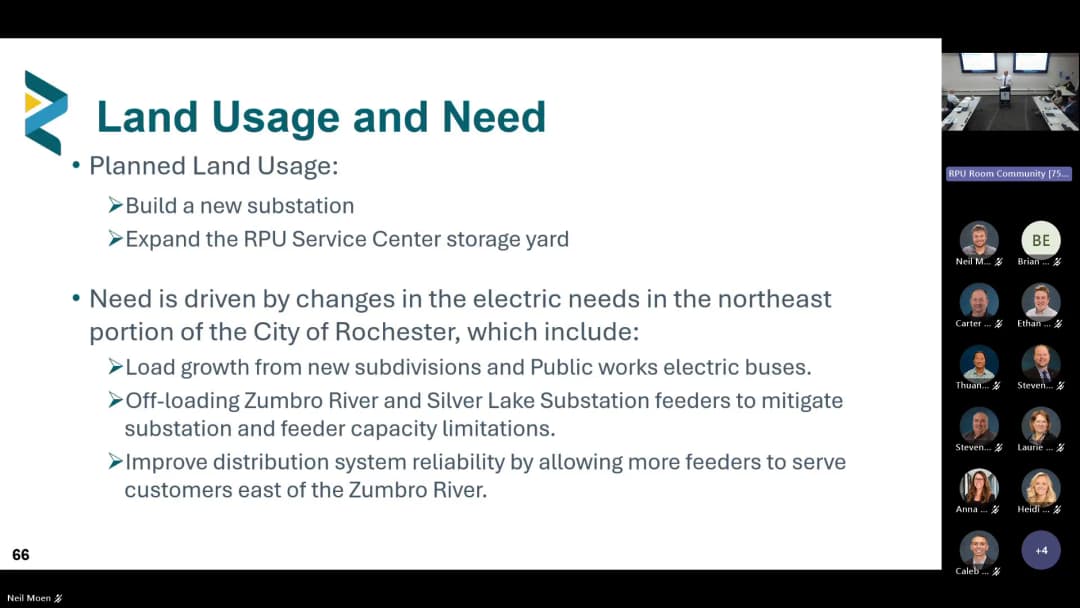
The Rochester Public Utility (RPU) Board met on October 27, 2026, at 4:00 PM in the RPU Community Room. The Board unanimously approved a consent agenda covering routine items, passed several regular agenda items including budgets and rate tariffs, received informational updates on groundwater modeling and a land purchase, and discussed revisions to Board Policy 22. The meeting adjourned at 5:25 PM, followed by an outdoor ceremony for the new solar array on the RPU building. Consent Calendar - Approved the minutes of the September 29, 2026 meeting. - Reviewed accounts payable for 09/11/2026 to 10/09/2026 totaling $20,939,657.80. - Approved revised Board Policy 11: Safety Program (formerly Worker Safety). - Approved a resolution for 2026 and 2027 hourly power line clearance tree services with Asplundh Tree Expert, LLC, including overtime and double-time rates, and a one-year contract extension through December 31, 2027. - Ratified Amendment No. 2 to the USIC contract for underground locating services, extending the term and revising pricing. - Adopted a resolution supporting continued participation in the Climate-Smart Counties and Communities (CCC) program through June 2029 and accepting up to $27,000 in technical-support grant funds for 2027 projects. Public Comments & Testimony - Fred Carlson addressed the Board to thank them for quickly resolving a street light replacement issue on a footbridge near Elton Hills Drive, noting that five new lights were installed within two days of his email to the Board. Discussion Items - Solar on RPU Building Ceremony (Informational): Jake Shones, Residential Energy Advisor, reported that the City and RPU were awarded 20 solar projects totaling 766 kW capacity, costing about $2.7 million, offset by $1.9 million in state grants and up to $810,000 in federal tax incentives. 12 projects are already operational. The RPU Service Center system (39.5 kW, 92 panels) will produce an estimated 64,734 kWh/year, covering 4-5% of the building's load. The Board postponed the outdoor ceremony to the end of the meeting. - Safety Moment: James Keltgen, Director of IT, discussed the recent “PHP to Shell” vulnerabilities (zero-day exploits) and emphasized the importance of patching, asset inventory, and layered security defenses for utility resilience. - 2026-2027 Insurance Renewals (Approved): Shavonn Eastlee, Manager of Purchasing, presented renewals totaling $1,834,526.12, a 5.43% increase over the prior year. The portfolio maintains coverage with the League of Minnesota Cities Trust, Aegis, Travelers, StarTech, and switches cyber liability from Great American to Crum & Forster for better pricing and similar coverage. The largest increase (18.44%) was in generation asset insurance (StarTech), partly due to a prior claim at GT1. - Solicitation of Underwriter for 2027A Bonds (Approved): Peter Hogan, Assistant GM of Administration, explained the request to authorize an RFP for a senior managing underwriter for proposed Electric Utility Revenue and Refunding Bonds (Series 2027A). The bonds would finance up to $141 million for the Mount Simon project and $32 million for Grid North transmission, with potential refunding of $80 million in 2017 bonds. A selection committee (City Finance Director, RPU Finance Director, RPU Assistant GM, RPU GM, with Baker Tilly as advisor) would evaluate proposals. No bonds are issued by this action; a parameters resolution will follow in December/January. - 2027 Supplemental Electric Utility Budget (Approved): The Board approved the $141 million capital budget (down $100 million from original due to insurance coverage for Cascade Creek and earlier-than-expected permits for Mount Simon). Management recommended reducing the previously approved 6% general rate increase to 4%, resulting from lower debt service and a reduced wholesale power cost adjustment. The average residential customer will see about $5.17/month increase. - 2027 Supplemental Water Utility Budget (Approved): The Board approved operating and capital budgets incorporating the previously approved 9.0% rate adjustment. A $3.23 million project for Kalmar Township was included. Average residential water bill will increase about $1.78/month. - 2027 Electric and Water Utilities Rate Tariff (Approved): Two separate motions approved the fee and tariff adjustments effective January 1, 2027. The electric tariff includes a new section addressing large loads (including computational loads), allowing evaluation and potential creation of new rate structures. The water tariff remains unchanged from previously approved levels. - Water System Master Plan and Groundwater Study Update (Informational): Todd Blomstrom, Assistant GM of Operations, presented initial results from groundwater modeling. Three scenarios were tested for future water supply (through 2085): using only the Jordan aquifer, only the Tunnel City aquifer, or only the Mount Simon aquifer. The Jordan option showed good yield but increased stream flow diversion and negative impacts on calcareous fens. Tunnel City showed poor yield (exceeding DNR thresholds for drawdown) but neutral surface water impacts. Mount Simon showed good yield and positive recovery trends for streams and fens, but may require treatment for water quality. Next steps include evaluating surface water options and optimizing hybrid scenarios. RPU launched a public website, “Water for Tomorrow,” and will present results to the City Council on November 23. - North Broadway Land Purchase Update (Informational): Scott Nickels, Director of Power Delivery, reported a signed purchase agreement for two parcels adjacent to the RPU Service Center for $2.725 million (under the budgeted $2.8 million). The land is intended for a future substation (needed in 5-10 years for northeast load growth) and interim yard expansion. Due diligence (environmental, title, geotech) is underway; a reassignment agreement to RPU is expected in January. The purchase is within appraised value and aligns with existing Board Policy 22. - Board Policy 22: Acquisition and Disposal of Interest in Real Property (No Action): General Manager Tim McCollough presented proposed revisions to Policy 22, reorganized for clarity and including key changes: allowing land acquisitions up to slightly over appraised value if justified to avoid condemnation, clarifying the $100,000 threshold requiring Board/Council action, and adding language on easements and disposal of idle land. The Board supported the direction; the revised policy will return for approval at the next meeting. - General Manager’s Report: Tim McCollough noted two major Mount Simon-related decisions (groundwater study results and PUC approval for local siting authority) and the commencement of the Silver Lake dam project (lake drained). He thanked staff for their efforts and invited board members to the “Haunted Hallways” event on October 31. - Division Reports & Metrics: No questions or discussion. Key Outcomes - All consent agenda items (4.A–4.F) approved unanimously. - Regular agenda items 5.A–5.E approved unanimously with separate motions for each budget and rate tariff. - The underwriter selection process for 2027A bonds will proceed to the Rochester Common Council for authorization. - The 2027 electric rate will increase by 4% (reduced from previously approved 6%), with new large-load tariff language. - The water utility will implement the previously approved 9.0% rate adjustment. - Groundwater modeling continues; surface water alternatives will be evaluated; a decision on future water supply is expected by December 2026, with cost estimates in Q1 2027. - The North Broadway land purchase will move forward after due diligence, with a formal action anticipated in January 2027. - Revised Board Policy 22 will be brought back for approval at the next meeting. - Meeting adjourned at 5:25 PM; the Board then participated in the solar ceremony outside.
The Rochester City Council held a study session on October 26, 2026, from approximately 3:30 p.m. to 6:30 p.m., before adjourning to a closed executive session for the city attorney's performance review. The session covered strategic management of Tax Increment Financing (TIF), a prevailing wage policy overview, a downtown employee parking program, and a review of the parkland dedication ordinance. Council provided direction on staff proposals without formal votes, as is typical for a study session. Tax Increment Financing (TIF) – Strategic Management and Policy Considerations (3:30 - 4:30 p.m.) - Staff outlined a plan to shift from managing TIF districts individually to strategically managing them as a citywide portfolio. Senior Economic Development Specialist Josh Johnson highlighted that Rochester has invested over $120 million across 43-44 open districts, creating over 4,000 residential units (46% affordable at 60% AMI or less). - Key recommendations included tracking and allocating staff time to TIF districts to recoup costs from administrative fees (currently a standard 5%), establishing broader project areas for coding efficiency, and passing legal fees for negotiations directly to developers. - Staff presented a major opportunity under the DMC legislation to pool 100% of increment for the full 25-year term. Decertifying districts immediately upon obligation completion would generate an estimated $14.5 million, while preserving eligibility for pooling could yield up to $66 million. Councilmembers expressed broad support for the strategic portfolio approach and the potential for pooling funds for infrastructure and affordable housing. Prevailing Wage Background and Overview (4:30 - 5:00 p.m.) - Staff provided an overview of prevailing wage requirements for federally funded, state-funded, DMC, and city-funded projects. The city's current policy requires prevailing wage for all city-funded projects over $175,000. - A debate emerged over the policy's impact on project costs and competition. Councilmember Palmer argued it reduces competition and increases costs, particularly for wood-frame housing, questioning the efficacy of the city's own requirement. Councilmember Fredericks echoed concerns about cost. - Mayor Norton clarified that prevailing wage is the average wage for a trade in the region, not necessarily the highest. Staff noted that state and federal requirements apply to most projects anyway; of 44 past TIF projects, only 11 (wood-frame, non-subsidized) over 15 years would have been affected by a change in city-only prevailing wage rules. The Minnesota Housing Finance Agency (MFA) recently adopted a lower residential carpentry rate for projects under six stories, representing a potential 23% savings on carpentry labor. Councilmember Miller and Doring expressed openness to adopting a similar reduced rate for affordable housing projects, while Councilmember Keene requested more data from industry stakeholders before making broader changes. Downtown Employee Parking Program (5:00 - 5:45 p.m.) - Transit and Parking Director Rachel Fauch presented options to address the cost of parking for non-Mayo downtown employees. Current ramp occupancy ranges from 62% to 73%, with 53% of spaces under contract. Options included a flat discounted parking rate, a reduced transit pass subsidy, or no program. - Councilmember Doring challenged the fairness of subsidizing downtown employee parking with city funds. Councilmember Fredericks countered that utilizing empty ramp space is not a true subsidy and is vital for struggling downtown businesses. Councilmember Wall and Keene expressed concern about potential impacts on the parking enterprise fund. - Councilmembers Miller and Palmer advocated strongly for partnering with the Rochester Downtown Alliance (RDA) to design and administer a pilot program, focusing on data collection and strict caps to avoid unintended consequences. The Mayor noted that getting employees off metered street spaces is a key goal. Parkland Dedication (5:45 - 6:30 p.m.) - Parks and Recreation staff Paul Widman and Irene Woodward presented options to update the 1989 ordinance, including establishing a predictable per-unit fee instead of the current population-based formula. Current costs vary widely based on fair market value (e.g., a $300 fee versus a $1,000 fee for a single lot split). - Proposed per-unit fees ranged from $1,127 to $1,607 depending on density and whether the fee included full (Option B) or partial (Option C) park improvement costs. Staff recommended a hybrid geographic allocation (75% to the quadrant where development occurs, 25% citywide) and adding trails as eligible uses. - Councilmember Wall favored Option B but worried about housing affordability. Councilmember Miller supported adding trails and favored flexibility for affordable housing projects. Councilmember Palmer strongly supported a legislative change to allow fees on redevelopment sites (like the former YMCA). Councilmember Keene cautioned that legislative changes are difficult without regional allies. Councilmember Fredericks urged smart design to control maintenance costs. Key Outcomes - TIF Policy: Council directed staff to implement a portfolio management approach, track staff hours for reimbursement, develop a legal fee pass-through policy, and return annually in Q2 for decertification and pooling guidance. - Prevailing Wage: No direction was given to change the city's policy. Staff were asked to gather specific regional wage data and engage with the local building industry to better understand the cost impacts, particularly regarding the potential use of MFA's lower carpentry wage rate for affordable wood-frame projects. - Downtown Employee Parking: Council directed staff to develop a formal proposal for a downtown employee parking and transit program in partnership with the Rochester Downtown Alliance (RDA). The proposal should include strict parameters and a plan to evaluate utilization and financial impact, to be brought back for council approval in the second quarter of 2027, aligned with the Link BRT launch. - Parkland Dedication: Council endorsed moving forward with a per-unit fee structure. Staff will engage the Rochester Area Builders and the Park Board before drafting specific ordinance language. The preferred model is a hybrid approach that includes improvement costs and a citywide funding component. Council supports pursuing a state legislative change to allow parkland dedication requirements for redevelopment projects.
The Joint Airport Zoning Board (JAZB) held its fourth and final meeting to adopt the updated State Model Zoning Ordinance for Rochester International Airport. The board addressed minor text and map revisions requested by the Minnesota Department of Transportation (MnDOT) following a 90-day review of the ordinance submitted in April 2026. After a public hearing and discussion, the board unanimously approved the ordinance as amended. Consent Calendar - Minutes of April 1, 2026: Approved unanimously (7-0) as the official record of the JAZB. Public Comments & Testimony - Duane Schumann (self-identified as a representative of Highport Township) spoke during the public hearing. He described a scenario where a tower application sent to multiple agencies received no response within the required 30 days, leading to delays and a second hearing. He urged the board to improve the response process for such inquiries. Discussion Items - Presentation of MnDOT-Required Revisions: - Text Update: Clarified that the inner width of the non-precision instrument approach zone for Runway 21 is 1,000 feet, correcting ambiguous language that could be read as 200 feet. - Map Update: Adjusted the outer width of Zone A from 1,842 to 2,000 feet and Zone B from 2,300 to 2,500 feet to extend zones to the edge of the approach surface. The expansion does not affect any new parcels or structures—only previously affected property owners see slightly larger portions of their land included. - Evan Barrett (airport planner, Mead & Hunt) presented the changes and noted that MnDOT has pre-approved these adjustments; resubmission is expected to be a formality, likely taking less than the full 90-day review period. - Readability and Public Understanding: - Commissioner David Senjem raised concerns that lay readers may struggle to determine building height limitations from the ordinance text alone. He suggested adding clarifying language or references to the heat maps (which show maximum construction heights) in the preamble. - Deputy City Attorney Brent Carlson expressed caution about altering language already cleared by MnDOT, as that could trigger a new review. Senjem withdrew his request for a formal amendment, leaving it as a “strong suggestion” for staff to consider adding informational references without substantive change. - Implementation and Enforcement: - Discussion confirmed that once adopted, the underlying jurisdictions (counties, townships, and the City of Rochester) are responsible for integrating the ordinance into their codes and reviewing building permits within the affected zones. Staff noted that existing airport zoning has been in place for years, so processes remain familiar. - Commissioner Ruchi Gupta asked about potential land uses that could interfere with aviation safety (e.g., a limestone quarry). Evan Barrett responded that the ordinance prohibits uses that pose safety risks, but variance and conditional use procedures exist; a quarry could potentially fall under those provisions. - Commissioner Polly Glynn raised the need for training or outreach to townships to ensure they understand the new ordinance. The board agreed that each jurisdiction’s representatives could assist their local planning offices. Key Outcomes - Motion to Adopt the State Model Zoning Ordinance: Moved by Ruchi Gupta, seconded by David Kenworthy. Passed unanimously (7-0) with three members absent. The motion includes authorization for staff to resubmit the updated ordinance text and maps to MnDOT for final approval. - Adjournment: Moved by Brian Mueller, seconded by Polly Glynn. The meeting adjourned at approximately 5:35 p.m. - Next Steps: Staff will incorporate the minor text and map corrections, then submit the final ordinance to MnDOT. The board expects approval within 90 days, with the understanding that the ordinance is substantively complete.
The Rochester Public Library Board met at 4:30 p.m. and adjourned at 5:38 p.m., using the meeting timestamp supplied as 2026-10-22T10:30:00+00:00. The agenda and minutes list the meeting date as October 21, 2026; this discrepancy is noted rather than silently resolved. Members present: Steve Baule, Nicholas J Goetzfridt, Adam F Nelson, Constance Mudore, Laura A Wheatman, Ryan Mihalak, Mary E Sancomb-Moran, and Michelle G Rogers Kull. Absent: Emily J Soltis. The board first amended the agenda to add the recommended slate of Foundation officers to item 7.B. No public comments were offered. Consent Calendar - The amended agenda was approved unanimously. - Consent items 6.A–6.D were approved as a block: September 16, 2026 meeting minutes; October 15, 2026 accounts payable totaling $223,077.93, including a $196,269.89 SirsiDynix payment; September 2026 monthly reports; and contracts signed by the Library Director. Public Comments & Testimony - No community members spoke during the public comment period. Updates and Reports - Rochester Public Library Foundation: Executive Director Brenda Kardock reported the imaginative play area grand opening, a soft launch of a fund for satellite libraries, a book sponsorship with RDA Downtown for Here Comes Santa Claus, and an online auction. She noted the Foundation board officer slate needed Library Board approval. - Friends of the Rochester Public Library: Treasurer Dee Voldal reported a $1,000 grant from the Rochester Commercial Banks Association, an autumn auditorium sale netting over $7,000, bookstore activity, and community outreach. - SELCO: A board representative reported the start of a three-year strategic planning process, about 34 SELCO member libraries with 20 not sending representatives, expansion of SELCO's automated sorting system from 17 to 21 bins, and a push for member libraries to adopt RFID. - Executive Committee: Informational only; other topics were covered elsewhere on the agenda. - Teen Library Council: Lucy Kreuter, a Mayo High School junior, reported that TLC focused on community connections and networking, and included a visit from Rochester's DEI director. Reports and Recommendations - Nominating Committee (7.A): Approved unanimously a proposed officer slate to be formally voted on at a future board meeting: Adam F Nelson for president, Ryan Mihalak for vice president, and Constance Mudore for secretary. - Foundation Bylaws (7.B): Approved bylaws changes and the slate of Foundation officers. Changes were described as mostly modernizing language and removing old waiver provisions; a prior removal of Library Board approval of Foundation directors was restored because it had never been approved by this board. The minutes list "AYES: None" for this motion while also recording unanimous approval, an apparent records conflict. - Satellite Library Budget and Fundraising Goal (7.C): Approved a revised budget estimate and a $6 million fundraising goal for two satellite libraries targeting a 2028 start. Staff said the estimate aims at a larger roughly 4,000-square-foot space, excludes the delivery van because the library already owns one, and uses a 7% cost escalator. The high-end two-location estimate was $5.8 million for a 2028 opening and $6.1 million for 2029. Board discussion covered temporary staffing costs, market rent assumptions, utilities/custodial estimates, marketing budgets, delivery between locations, bookmobile hold pickup volumes (about 625 items currently on the bookmobile), and the need for clear site-selection criteria. Some members leaned toward a northwest location because of growth and underserved census tracts. Parking Pilot Review - Staff presented the June–August parking pilot: library cardholders 16 and older could check out a barcode at the circulation desk to validate one extra hour at the Civic Center Ramp. Data included 3,110 barcodes checked out by 1,140 unique users; 1,674 validations were used; 1,035 survey responses were received, split about evenly between users and non-users. - Of those who used the extra hour, 66% visited the library; 44% of library visitors browsed materials, followed by time in the youth area and attending programs. 23% visited downtown businesses, with estimated downtown spending between about $2,900 and $5,000. Average stay for used passes was 1 hour 44 minutes. - Marketing totaled $6,300 of a $13,000 budget; channels included newsletters/emails, posters/flyers, website/social media, and a mailer to 65,000 households. Disney+ ads were canceled. 65% of checkouts came from census tracts with already high library card saturation; nine of the top ten usage census tracts were green on the affordability index. 181 new card registrants also checked out a parking pass, about 7% of new registrations, while total registered users dipped slightly. - 56% of survey respondents said they would support donating to the Friends/Foundation to continue the service. Public comments included calls for branch locations rather than extra downtown parking, support for the extra hour, and accessibility concerns for people unable to walk from the ramp. - The board received the review and provided input but made no allocation decision on the roughly $68,000 remaining pilot budget. Possible uses discussed included hold-pickup lockers, holds pickup at partner locations, bookmobile marketing, or reserving the funds for satellites. Board members noted hold lockers cost roughly $30,000–$40,000 plus setup fees, raised placement and misuse concerns, and said they were open to staff exploring a proposal if a viable location exists. Staff may return with options. Other Board Discussion / Q&A - Staff updated the board on the upcoming January 1 change to electronic-access eligibility for non-Rochester residents, including outreach to SELCO libraries, updated city knowledge-base articles, and expected phone calls. - A board member urged stronger advocacy relationships with county commissioners and city council members after learning a county commissioner was unaware of a proposal affecting rural library users. Staff noted participation in a "Get Funded" advocacy training and agreed that board member relationships are important. Key Outcomes - Agenda amended and approved; consent calendar approved; nominating slate approved; Foundation bylaws and officer slate approved; revised satellite budget and $6 million fundraising goal approved. - Parking pilot review received and filed; no use was designated for the $68,000 pilot balance; staff may return with proposals. - Meeting adjourned at 5:38 p.m.
The Rochester City Council met in regular session at 6:00 p.m. on October 19, 2026, in the Government Center Council Chamber. The agenda included an open comment period, a 21-item consent calendar, eight public hearings, and one council-initiated civility pledge. Council President Schubring noted that the eight public hearings were a record during his service on the council. No public testimony was offered during any of the public hearings. Consent Calendar - The council approved the consent agenda (F.1-F.21) by voice vote after a motion by Councilmember Doring and a second by Councilmember Keene. Approved items included the October 5, 2026 meeting minutes; an annual gambling permit for Dodge County Youth Hockey Association at Smoak BBQ; the payment card processing fee policy; the Nice Healthcare contract for the self-insured employee health plan; Mayor Norton as voting delegate for the National League of Cities City Summit; stormwater water quality treatment credit transfer policy and ordinance updates; juvenile curfew ordinance amendments; public hearing dates for November 16, 2026, on unpaid special charges, administrative citations, and utility charges; bid advertisements; multiple construction and design contracts; a contamination cleanup grant application; a joint powers agreement; a partial release of development agreement for Hunter Valley Estates; and other routine items. - Key contract amounts approved included $3,270,774.55 for the 37th St NE Stormwater Management Facility, $1,194,370 for Central Loop design services, $367,240 for Zumbro River Siphon construction services, and $285,273.27 for the Lincolnshire Drainage Improvement Project. - Councilmember Wall noted that on consent items with both an engineer's estimate and an award amount, the city saved approximately $1,035,000. Public Comments & Testimony - Craig Shub, founder of Symbiotic Relations, used the open comment period to describe his company's work on PFAS, or 'forever chemicals,' and its graphene sorbent systems designed to capture and reuse PFAS-containing waste. He asked the council for help connecting with city staff in environmental services, solid waste, water resources, public works, or other relevant departments to review a no-cost pilot proposal, and he stated he was not asking the city for funding. City Administrator's Report - Administrator Zelms announced the annual Snow Summit on Saturday, October 24, 2026, from 9:00–11:30 a.m. at the new Rochester Maintenance Center, 580 44th Street NE; reminded residents that seasonal parking requirements begin November 1 and involve odd/even side parking from 2 a.m. to 3 p.m.; and noted a community and council forum on November 30, 2026, from 5:30–8:00 p.m. at the historic Chateau Theater. Mayor's Report - Mayor Norton announced that Rochester received the Heart Safe Community designation through the American Heart Association and Minnesota Department of Health, crediting Mayo Clinic, Homestead Medical Center, Rochester Community and Technical College, the fire and police departments, Rochester Public Schools, and Schaefer Academy. - He also announced a Rotary 'wear purple' community walk on Saturday, October 24, 2026, at the RCTC Regional Sports Center; reminded residents that Mayor's Medal of Honor nominations are due by October 31, 2026; noted the Mayor for a Day essay contest deadline of December 11, 2026; and listed upcoming openings on boards and commissions. Public Hearings - G1 - MGK LLC Conditional Use Permit No. CD2026-008CUP: The council continued the limestone aggregate quarry application to the November 16, 2026, council meeting at the applicant's request. Motion by Councilmember Keene, second by Councilmember Fredericks; passed. - G2 - Graham Acres (DR Horton, Inc. - Minnesota): The council approved Major Land Subdivision No. CD2026-021PLAT with two conditions, creating 580 single-family residential lots on 185 acres in the R-2 Low Density Residential Small Lot district. Motion by Councilmember Fredericks, second by Councilmember Palmer; passed. Palmer thanked DR Horton and noted 580 new homes and an eight-acre park. - G3 - Westbury Second (Bigelow Homes): The council approved Major Land Subdivision No. CD2026-022PLAT with five conditions, subdividing 24.6 acres into 115 residential lots and one outlot. Motion by Councilmember Wall, second by Councilmember Palmer; passed. Public works staff confirmed the project triggers no required intersection mitigation on 60th Avenue; Councilmember Keene expressed general concern about residential density along major corridors but joined the approval. - G4 - Danielson Farm (Anthony Properties): The council approved Major Land Subdivision No. CD2026-023PLAT with four conditions, subdividing 26.56 acres at the northeast corner of 55th Street NW and 18th Avenue NW into one lot, two outlots, and rights-of-way for 18th Avenue NW and an internal collector road. Motion by Councilmember Doring, second by Councilmember Fredericks; passed. Staff said unresolved agency comments about utility and roadway capacity would be resolved before the final plat, and Councilmember Keene asked that they be resolved before final plat approval. - G5 - Pebble Creek Seventh (DRP MN 3, LLC): The council approved Major Land Subdivision No. CD2026-024PLAT with two conditions for 100 residential units on 14.98 acres in R-2 and MXS districts; staff described the layout as 95 townhomes and five single-family lots. Motion by Councilmember Fredericks, second by Councilmember Palmer; passed. Palmer noted the mix includes 55+ senior villas and lot widths of 45 to 75 feet. - G6 - Vacation Petition No. CD2026-006VAC (DRP MN 3, LLC): The council approved vacating the right-of-way and adjoining public utility easements for an approximately 440-foot-long segment of Town Square Place NW platted as part of Pebble Creek Fourth. Motion by Councilmember Keene, second by Councilmember Palmer; passed. Keene said the work had been done to ensure the city's utility options were preserved. - G7 - Vacation Petition No. CD2026-007VAC (Seneca Foods Corp.): The council approved vacating a 20-foot public utility easement at 308 20th Street SE to allow a warehouse expansion. Motion by Councilmember Fredericks, second by Councilmember Keene; passed. Staff stated the water main would be relocated at the same size and capacity, and RPU required a new easement and city/RPU-approved construction plans. Mayor Norton asked about capacity for future growth; public works staff responded the line is a local feeder, not a trunk water main. - G8 - Zone Change No. CD2026-003ZC (Joseph Sveen): The council approved rezoning an approximately 15,000-square-foot lot from R-1 Mixed Single-Family to R-2 Single-Family Small Lot and directed the City Attorney to prepare an ordinance for first reading. Motion by Councilmember Keene, second by Councilmember Miller; passed. Keene said the change was reasonable because R-2 zoning exists on either side. Council Initiated Actions - The council adopted a resolution pledging to lead with civility, dignity, and respect. Council President Schubring and Councilmember Fredericks introduced it as a League of Minnesota Cities model resolution. Councilmember Wall cited the League initiative, a Braver Angels workshop, and an incident involving a volunteer; Councilmember Miller referenced a dignity index concept; and Mayor Norton said local government can model civil behavior. Motion by Councilmember Fredericks, second by Councilmember Doring; passed. Key Outcomes - The agenda was approved after a motion by Councilmember Fredericks and a second by Councilmember Wall. - The consent agenda was approved, and public hearing items G2 through G8 were approved; G1 was continued to November 16, 2026. - The civility pledge resolution was adopted. - All votes passed by voice vote with no audible opposition. - No items were considered under Reports and Recommendations, Ordinance First or Second Readings, Tabled Items, or Other Business, and the meeting was adjourned.
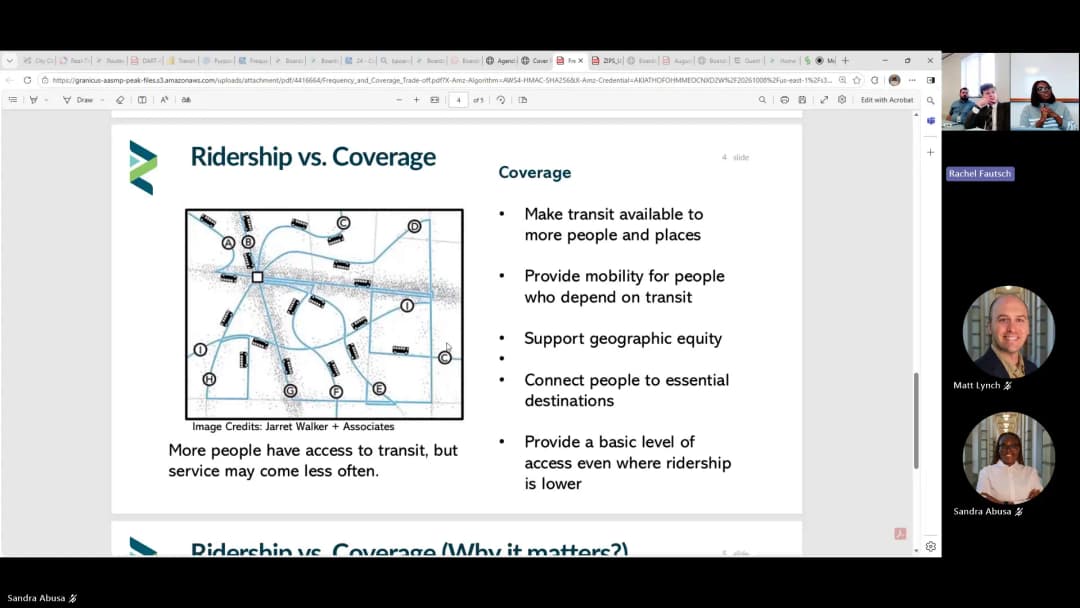
The Citizens Advisory on Transit (CAT) of Rochester, Minnesota, met to receive the August 2026 Transit Report, hear an update on the ZIPS paratransit service, and discuss the trade-off between frequency and coverage in transit service design. The committee approved the prior meeting minutes and agenda, accepted a member resignation, and was notified of a temporary park-and-ride relocation. No public comments were offered. Note: The agenda and minutes are dated October 8, 2026, while the metadata provided for this summary specifies 2026-10-19; this summary uses the specified metadata date. Consent Calendar & Routine Approvals - Minutes of the September 11, 2026 meeting were approved unanimously (moved by Kenneth D. Baerg, seconded by Derek S. Aiono). - The order of the agenda was approved unanimously (moved by Derek S. Aiono, seconded by Kristin E. Buchholz). Public Comments & Testimony - No members of the public offered comments during the open comment period. Transit August 2026 Report - Transit staff presented the August 2026 Transit Report as an information item. They explained that the transit reserve estimate has dropped by about three-quarters of a year because MnDOT's 15% local-share allowance for grant funding will now end in 2028 instead of 2029. - The report excludes BRT figures because Mayo Clinic operating-agreement dollars need to be split among capital, replacement, and operating accounts. Projected budget dips in 2027 and 2028 reflect large bus purchases, with no vehicle procurements outlined after 2028. - Bus purchase estimates are based on MnDOT's diesel replacement amount, which does not include electric bus costs; the agency applied for a Low-No grant for hybrid paratransit vehicles with a 15% local match. - Ridership is below the level needed for solvency; the target presented was 1.3 ridership units. Revenue per ride is $1.75 against expenses per ride of $2.91. Mayo Clinic riders make up about 49% of fixed-route riders, compared with 48% last year and 23% in 2024. ZIPS Update - Devin Lihall, Mobility Coordinator, reported that Via became the ZIPS paratransit operator on September 1, 2026, following a competitive procurement. The previous operator contract ran for 10 years. - ZIPS serves people unable to use fixed-route transit, typically due to disability or mobility needs. Applications require a care provider's sign-off; staff have 21 days to make a determination, and reviews typically take 3 to 4 business days. - The fleet has 13 vehicles, including accessible minivans, small buses with wheelchair ramps, and electric vehicles, with a required 20% spare ratio. - September performance: the on-time goal is 90% for both pickup and drop-off; the first week of October improved to 93% pickup on-time and 92% drop-off on-time. The service averages about 4,000 rides per month and averaged 192.5 riders per day in September. - Rides per vehicle revenue hour reached 2.0 and are trending toward the contract target of 2.4. Overflow services (Handy Van/Med City Taxi) carried 13% of August rides and 0% in September. - A new rider app provides vehicle tracking and arrival notifications. Staff stated that every paratransit rider was individually notified about the change. One member suggested a press release about the improvements; staff responded that they want to see consistent improvement before publicizing, to avoid advertising a temporary gain. - The fare is $3 per trip, while the federal maximum allowed is $4. The program is near break-even but is expected to run a deficit of about $50,000. Operations are currently 85% grant-funded through MnDOT/FTA, shifting to 80% in 2028. - Microtransit is included in the Via contract but has not yet been activated; it could be used later as a mixed service with fixed routes. Transit Priorities: Frequency vs. Coverage Trade-off - Staff presented an informational briefing on two service-design approaches: a ridership/frequency model concentrating buses on high-demand corridors such as Second Street SW and Broadway, and a coverage model spreading service across the city at lower frequencies, such as every 60 minutes. - Staff emphasized that no decision was requested today; Rochester-specific options will be presented next year to the committee, city council, and public. Most cities use a blend, such as 70/30 or 80/20 ridership/coverage. - The current system has 22 routes, and about 98% of the city is within half a mile of a transit stop. Low-frequency coverage routes can make trips impractical; one member noted that a bus trip could take up to two hours for a trip that would be a 15-minute drive. - Microtransit was discussed as a potential hybrid tool: fixed routes on high-demand corridors plus on-demand zones for broader coverage, with paratransit riders prioritized and microtransit riders paying a premium. - Staff compared Duluth, which runs 13 routes and has nearly 3 million annual riders; Duluth's ridership increased after reducing coverage and increasing frequency. Other Business - The committee was notified that Parker Acree resigned because his schedule no longer allowed him to serve. A motion to accept the resignation was made, seconded, and passed unanimously. Staff will contact the mayor's office about a new appointment. - Staff announced that the North Broadway Park and Ride is temporarily relocating to the Transportation Center (RPT office) parking lot, about half a mile from the current site, while a new park-and-ride facility is built. The new facility is expected to be ready around March. Key Outcomes - Minutes and agenda order approved unanimously. - Parker Acree's resignation accepted unanimously. - The meeting adjourned unanimously (moved by Kenneth D. Baerg, seconded by Kristin E. Buchholz). - No formal votes were taken on the transit report, ZIPS update, or frequency/coverage discussion; all three were informational items that will inform future decisions.