Rochester City Council Study Session – February 24, 2025: Fire Contract, Survey, Annual Plan
STREAMING COPY IN PREPARATION — RECORDING AVAILABLE FROM THE ORIGINAL SOURCE
Rochester City Council Study Session – February 24, 2025
This study session covered three major agenda items: the renewal of the fire service contract with adjacent townships (Marion, Cascade, and Haverhill), the presentation of the 2024 National Community Survey results, and the 2024 Year-End Action Plan & Operations Plan update. Council members deliberated growth coordination language for the fire contract, reviewed survey data highlighting community strengths and areas of concern, and examined progress on strategic priorities.
Discussion Items
Fire Service Contract Renewal
- City Administrator Zelms presented a proposal for a new 10-year contract (2026–2036) to replace the current agreement ending in 2025. The contract covers fire response (excluding EMS) for Rochester, Marion, Cascade, and part of Haverhill Township.
- Key changes from the prior contract include: a simplified 4.5% annual compensation increase (previously based on cost of valuation or 4%, whichever was lower); updated service language; and a new section on growth coordination.
- Two options were presented to address growth coordination:
- Option 1: Requires negotiation if physical infrastructure changes (e.g., new fire stations, water supply) jeopardize coverage; must be acceptable to both city council and township board.
- Option 2: Removes the separate growth coordination section and instead defines the service area as existing commercial development and residential areas designated suburban on the Olmsted County land use map prior to a set date; new development not on that map would require renegotiation.
- Council discussion included:
- Councilmember Palmer preferred the version signed by townships (without growth coordination language), arguing it was simpler and the current contract had no issues.
- Councilmember Keene stressed equity: the city should not subsidize township growth, and fire service is an insurance policy, not a fee-for-service. He supported inclusion of growth coordination.
- Councilmember Wall gave an extreme example (e.g., Disney World North) to justify the clause.
- Assistant City Attorney Yetzer clarified that Option 2 is not about zoning but about coordinating when significant new development occurs.
- Councilmember Fredericks wanted to hear from township representatives present, but the meeting remained a study session with no formal public comment.
- Administration stated they need council direction before meeting with townships in March.
2024 National Community Survey Results
- Brandon Burnett of Polco presented findings from the second biennial survey (administered July–August 2024). 4,200 randomly selected households received surveys; 633 responded (16% response rate, ±4% margin of error).
- Key findings:
- Safety: ~90% of residents felt safe in their neighborhood and downtown during the day; safety from property crime rated lower (~75%).
- Economy: 70% positive on economic health; cost of living rated positively by only ~30%.
- Quality of Life: 70% rated Rochester as a good place to live, but this dropped 7 percentage points from 2022.
- Governance: Nearly all governance metrics increased (e.g., open and transparent government up 8 points).
- Unique questions: For a sports complex, outdoor playground received most support; library use: 3% daily, 20% weekly; better parking and digital resources would increase library use.
- Council discussed:
- A gap between importance and quality for “inclusivity and engagement” (62% importance vs 46% quality), similar to national benchmarks.
- Mobility gap concerns; Councilmember Miller asked if demographic breakdowns exist (yes, in full online report).
- Councilmember Wall noted all governance ratings are between 50–60%, but Burnett said that is strong compared to national declines.
- Mayor Norton suggested that some low ratings (e.g., ease of parking, bicycle travel) may be due to ongoing construction and could improve with better communication.
2024 Year-End Action Plan & Operations Plan Update
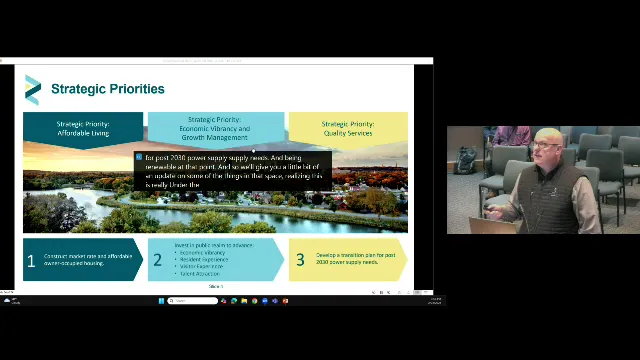
- Deputy Administrator Parrish presented progress on strategic priorities (affordable living, economic vibrancy, quality services). Highlights:
- Affordable living: 289 affordable homeownership units supported; 134 units through the Coalition of Rochester Area Housing; two lots conveyed for single-family homes; Sherman on Civic Center project (380 units near downtown).
- Economic vibrancy: Discovery Walk, Link Rapid Transit, Silver Lake pool, Soldier’s Field renovations.
- Quality services: Post-2030 renewable energy plan complicated by rising demand (AI, data centers), higher costs; 311 handled 12,000 calls; 1 million+ parking ramp utilizations (nearly half free); ZIPs on-time at 92% (up from 89% in 2023); 175,000 dispatch calls; 2 million website visits.
- Council discussed:
- Councilmember Doring praised the operations metrics and asked how unmet goals are communicated back to council. Administrator Zelms explained that unmet goals (e.g., digital library wait times) are discussed in updates and may indicate resource needs.
- Councilmember Palmer questioned ZIPs on-time goal (93%) vs resident expectations; Administrator Zelms noted investments in staffing and that a new transit RFP may improve contractor accountability.
- Councilmember Miller asked for data on owner-occupied homes converted to rentals; staff indicated rental permits can track conversions.
- Next steps: Strategic planning workshop on March 24; budget process starts in April.
Key Outcomes
- Fire Service Contract: Council indicated direction to proceed with either Option 1 or Option 2 (growth coordination language), with most members supporting one of those options over removing the section entirely. Staff will re-engage townships in March and return for formal approval.
- Community Survey: No formal action; council took the information for use in strategic planning and budget discussions.
- Action Plan: Council acknowledged the report and will incorporate insights into the March 24 strategic planning session.
- Study Session Schedule: Next study session on March 10 will cover homelessness outreach (RPD) and sidewalk gap fill prioritization; March 24 is strategic planning.
Meeting Transcript
Welcome everyone to our uh February 24th uh Rochester City Council study session. We have three items on our agenda this afternoon, and I'm looking for maybe 45 minutes per uh item. So hopefully we'll get out of here by six o'clock, but no promises. So with that I am I am going to turn it over to Administrator Zelms who will uh introduce us to our four first item, which is the fire service contract. Uh thank you. Uh my goodness, I'm totally having a blank. Um thank you. Randy Hubert. I know, but I'm blanking on your title. Council President Schuberg, sorry. I was in a committee meeting earlier and I was saying that. So that threw me off. Um thank you, Randall. Um, so I um here on behalf of a team of folks that have been um working to bring this back to the city council. Um the fire service contract is something that um we have been um in partnership with our um township partners for quite some time. Um obviously we've had a changeover in our fire chief. So um Chief Pooler is here with his team, also Brian Anderson, finance director, myself, and then Ryan Yetzer, city uh assistant city administrator is joining us online. So um excited to be able to bring this to you and be able to answer any questions that you have. I just also want to acknowledge that we have some of our partners from the township in the audience um from uh Marion, Cascade, and Haverhill are some board members from there. So welcome. Um with that, I will um just get started. Um what we're here to talk about is the renewal of the contract. Um we are um gonna be at the end of a 10-year contract period at the end of 2025, and then going into um, I believe a new 10-year contract for 26 through 2036. So with that, um, just a little bit of background um for um the current makeup of our city council. Um it is an agreement to serve Rochester, Mary and Cascade, and then a portion um of Haverhill Township. Um the agreements were established and have been ongoing since 2005, so quite some time. And again, that current agreement um was 2016 through the end of 2025. Um just a little bit of background on the timeline for when we started talking about this um with our partners and then to where we are today. Um so there was a meeting in October of 2024 between um the townships, the fire department, and administration group, um, a couple of meetings in October, um, then in November. Um we also um attended a the annual township board meeting, which is all of the townships in Olmsted County and had some discussion with a couple of council members and uh town board members at that uh meeting on November 26th. Um there was uh uh a vote um not directly related to this um but related to planning um for Olmsted County and uh change to their approval of their general land use plan amendment process in December. Obviously, we have a new council seated now in January of 2025. Um there was approval of a contract that didn't reflect all of the conversations that was sent to the city council understanding of um why that happened with the townships, and then um obviously we have between now and the end of the year, but probably sooner than later, um, to talk through any um changes and proposals for a contract with the townships. Um the changes that were previously discussed um our general uh cleanup of the language, the 10-year-old language for the service specific services that are provided to the townships, which differ from what happens within the city limits. Um, a simplification of the compensation approach that reflects uh four and a half percent a year. Um that's a change from the prior that had reflected uh um cost of valuation or four percent, whichever was lower, um, and better reflect some of the averages that we we've seen for the um operations uh costs for fire over the last 10 years. Um updated the contract services. That's also a cleanup of language, just making it very clear what services are provided, and then a section on growth coordination that's probably had the most discussion. So I think through this process, one of the things that we would recommend as a team is that matter what we need to have better coordination and communication, have that be a priority so that we're remain aligned and there's clarity about what's happening with fire service in the city of Rochester and how that might impact our ability and what the expectations might be for our partners for fire service as either we continue to grow, they continue to grow, things change in the fire service. We continue to make sure that we're providing services. Obviously, it's no surprise that we are looking at expanding the fire service over a period of time. That's something that we've been talking about, and there are implications to that for all of us. So especially the operating budget, but also the capital budget. So I think just knowing all of those things, it will be good to coordinate more, get together more on a you know semi-annual basis, talk with the fire chief and administration about what are some of the things that are happening, provide a monthly report on response data goals, just so that the boards can be better informed so that they can make sure that our township residents understand, you know, what are some of the expectations they could have for Rochester fire department service to them. Um and they've already started working on a draft that's actually very detailed and provides a lot of clarity on what kinds of calls they're going to and what amount of time they're spending there, just so that there can be some clarity on the services. So obviously, growth does impact service, it impacts services in the city of Rochester, it also impacts services for our partners. Um, these are the types of things that that occur that the fire chief is thinking about when we're talking about you know, 10, 20, 30 year planning for a city like Rochester and our region. Um, so it increase the larger your service area is and the more that's in there, the longer it takes to respond. Obviously, if you're further away from the fire station, it's going to take us longer to get there. Um, there can be increased drawdown times.
openpublica.com