Rochester City Council Study Session: Facilities, Parking Policies, and Schedule — June 9, 2025
STREAMING COPY IN PREPARATION — RECORDING AVAILABLE FROM THE ORIGINAL SOURCE
Rochester City Council Study Session: Facilities, Parking Policies, and Schedule — June 9, 2025
The Rochester City Council met for a study session on June 9, 2025, at 3:30 p.m. in the Government Center Council Chamber. The agenda included a facilities condition assessment presentation, downtown residential parking minimums, a developer parking agreement policy, and future study session scheduling. No formal votes were taken on the substantive policy items; council members provided direction for staff to return in July.
Facilities Condition Assessment
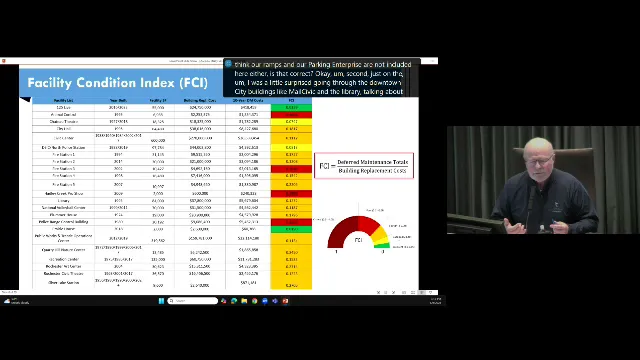
- Zach Wood, Manager of Facilities and Property, presented a citywide facilities condition assessment covering 23 facilities and roughly 1.7 million square feet. It identified approximately $126.9 million in deferred maintenance needs over 10 years, described as the "cost of inaction."
- Four facilities were rated in poor condition: the police range control building, animal shelter, Hadley Creek Pro Shop, and Fire Station 3.
- Representative facility details: Animal shelter (1995, 6,900 sq ft, $2.2M replacement value, $1.3M deferred), police range (1980, 20,000 sq ft, $9M replacement, $5.5M deferred), Fire Station 3 (2002, 10,500 sq ft, $4.7M replacement, $2M deferred), Hadley Creek Pro Shop (2009, 2,000 sq ft, $600K replacement, $240K deferred), Chateau Theater (1927, 18,000 sq ft, $18M replacement, $1.9M deferred), 125 Live (2016, 55,000 sq ft, $24.7M replacement, $400K deferred), D6/North Precinct (97,000 sq ft, $44M replacement, $4.4M deferred), National Volleyball Center (70,000 sq ft, $31M replacement, $4.5M deferred), Rochester Art Center (30,000 sq ft, $15.3M replacement, $4.3M deferred), and Civic Theater (36,000 sq ft, $16.5M replacement, $2.5M deferred).
- Deputy Administrator Parrish said the city currently invests about 0.25% of replacement value annually versus an industry recommendation of 4–7%. The recommended 2026 CIP includes about $1 million for facility investment, while the identified need is $126.9 million; addressing general fund facilities alone would require increasing to about $8.5 million per year.
- Staff highlighted strategies: incremental CIP growth, energy rebates, energy savings reinvestment, building automation, redirecting expiring debt, and one-time funding. Mayo Civic Center has about $40 million in 10-year needs, potentially funded by lodging tax after existing debt ends around 2033.
- Council discussion included Councilmember Wall asking how much of the total is truly deferred versus ordinary maintenance; staff said they could provide critical-item details. Councilmember Palmer questioned separating building versus department equipment costs and suggested using surplus property sales. Mayor Norton asked about bundling tuck pointing/window repairs and noted newer buildings already need repairs; staff attributed some issues to prior decentralized project delivery. Councilmember Keene noted parks facilities were missing and utility/enterprise facilities were intentionally excluded, and expressed concern that geothermal investments were expected to cover more HVAC costs than they did; staff explained the Downtown Building Energy Transition addresses central plants, not all building-level equipment.
Residential Parking Minimums within Downtown
- Community Development staff presented a history of downtown parking requirements: no minimums in the CBD from 1992 to 2017; the 2017 DMC DPOZ reintroduced requirements; current UDC requires 0.5 spaces per dwelling unit citywide, with reductions and a transportation demand management (TDM) option that can yield a 100% reduction.
- Staff cited examples of cities removing parking minimums: Buffalo saw a 39% increase in mixed-use development; Hartford reduced car dependency; Hamilton saw 15–20% lower construction costs. Staff cautioned that local context matters.
- Staff reviewed 13 downtown projects since 2011: four were underparked relative to the ordinance, but projects averaged 26% more parking than required. Developer feedback indicated lenders and investors generally expect parking, tenants still rely on vehicles, and underparking can hurt lease-up; proximity to public parking and transit can reduce dependence.
- Four options were presented: (1) remove residential parking minimums downtown with the upcoming UDC update; (2) remove them when Link BRT goes online; (3) reduce the requirement to 0.25 per unit; (4) maintain current requirements and continue evaluation.
- Councilmember Palmer said he favored option 1 and cited parking costs as about 25% of apartment construction costs. Councilmember Fredericks also favored option 1, saying downtown residents increasingly do not expect parking and developers should assume risk. Councilmember Miller favored option 1 and suggested studying other uses and being ready for state zoning reform. Council President Schubert noted downtown parking minimums are effectively zero already via a TDM plan, and that maintaining some requirement could force developers to justify zero parking.
- Mayor Norton preferred option 3 (0.25 per unit), warning that zero parking is not pragmatic because many residents and visitors will still have cars, and expressed concern about spillover into neighborhoods. Councilmember Keene asked about spillover, financing, and the adequacy of TDM; Councilmember Wall asked how developers in case-study cities obtain financing without parking and whether neighborhood complaints occurred.
- No formal vote was taken; staff will incorporate feedback before the July UDC update.
Developer Parking Agreement Policy
- Nolan Shield, Parking Systems Manager, presented a draft policy for developer parking agreements. Currently there is no formal policy, and 13 special parking agreements exist; five are development-related, representing approximately 400 spaces. Non-development agreements total 632 spaces and individual monthly contract parkers total 539 spaces.
- Staff said existing agreements are inconsistent in duration, terms, and number of spaces; some have no end date (including one in perpetuity), and some reserve spaces that are not paid for or fully used. New parking equipment will improve tracking.
- Draft policy criteria include: agreements no longer than five years with possible five-year renewals; space counts based on system capacity; city reserves the right to adjust based on actual use; all reserved spaces would be paid for; and preference for developments providing at least 50% of required parking on-site.
- Council discussions: Councilmember Palmer preferred guidelines over policy and supported five-year reviews; Councilmember Keene opposed giving away parking and said reserved spaces should be paid at market rates; Councilmember Fredericks sought clarity on how many agreements are "pay to play" (staff said fewer than 100 spaces) and noted unused reservations can harm public access; Councilmember Miller suggested market-rate pricing and using TDM tools; Mayor Norton stressed the need to plan for future parking demand and noted surface lots will be lost to development.
- No formal vote was taken; staff will use council feedback to refine the policy.
Study Session Schedule
- The City Administrator proposed canceling the August 4 council meeting due to quorum concerns, moving the meeting to August 11, and adding a study session on August 18 from 3:30–5:00 p.m. Council members agreed by consensus; a formal decision will be placed on the June 16 consent agenda.
- Upcoming sessions highlighted include the audit, capital improvement plan, and outside agency recommendations on June 23; no council meeting on June 30; and on July 14, city real estate disposition, electric vehicle charging rates, surface water management, and equity in the built environment update.
Key Outcomes
- No formal votes were taken on facilities assessment, parking minimums, or developer parking agreements; council feedback will inform staff work and future presentations.
- Council reached consensus on the August meeting schedule change, to be formalized June 16.
- Staff will return in July with UDC updates and refined developer parking agreement policy details.
Meeting Transcript
Well, we're going to get started with our study session for June 9th. Councilmember Miller is on his way. We have three issues on our agenda today. We have a facilities condition assessment presentation. Then we'll be talking about residential parking minimums within downtown. And then developer parking agreement policy. So we'll start off with our facilities commission. I mean, facilities condition assessment presentation. And Zach Wood step forward and take it away. Good afternoon, Council President, Council members, Mayor, Zach Wood, Manager of Facilities and Property. Going to give a quick update on our facilities condition assessment project we've had going on. So just a real high-level overview of facilities. So prior to 2021, facilities were all managed by individual departments. There was no central group overseeing and directing facilities. In 2021, the manager of facilities and property role was established to lead citywide facilities oversight. And in 2022, the building automation system specialist and facility supervisor role was implemented to enhance operational efficiency. In 2023, the joint facilities group was launched to bring all the facilities teammates under one department and manage citywide facilities as one group and work on collaboration across departments. As part of that initiative, some strategic strategic initiatives were rolled out. The first was developing a sustainable annual funding model for facilities maintenance projects, standardizing prioritization for framework for facilities projects, conducting a comprehensive facilities condition assessment and a 10-year capital project roadmap, and then identifying and documenting our deferred maintenance needs at all of our facilities. Just right now, an update on some of the key facilities initiatives that the facilities department is working on. We have our downtown building energy transition phase two project. That project is installing geothermal central heating and cooling plants to see to serve Mayo Civic Center, Art Center, Civic Theater, and Rochester Public Library. That project is under construction. We expect it to go online in November to December of 2025 and wrap up construction with some site work in 2026. We also have the regional sports and recreation complex. We're currently working on design and budgeting the schematic design of that project that will be coming to council this summer for review. Our parks and forestry expansion at the PWTLC campus is in progress. We have site grading and utility work going on. We'll be coming back in July to award all the remaining trade packages for that project. Team alignment, as we've kind of moved uh teammates from across the organization into one department, continuing to collaborate with other departments to make sure we're managing facilities as well as we can. And the fire station three roof replacement, which was approved last week. So just an overview of the facility condition assessment as a whole. So we can really look at all these issues that were identified in a focused lens. So we're working with the right consultants and contractors to implement the fixes. It was also reviewed with their construction estimation team to ensure that we have pricing accuracy and we're using industry standard escalation rates as we move our projects throughout this 10-year roadmap and beyond. And we plan to re revisit this report every five years and have it reassessed. So we're making sure we're always on top of the condition of our facilities and alignment with our evolving standards for our facilities. So an overall summary of this report overviewed 23 city facilities, roughly 1.7 million square feet. There are still a few more facilities forthcoming. The airport will be performed later this year and a few small parks facilities. Through this report, approximately 126.9 million dollars of deferred maintenance needs were identified over the next 10 years. And that 126.9 million dollar number is really the cost of inaction. If we continue to operate as usual, don't get proactive funding with our maintenance needs. That's the cost we can expect to pay to continue to operate the facilities that we have. Those costs are escalating the burden. They highlight the escalation of those burden by moving those projects out so we have expected escalation for each year. And it serves as a reference point to compare against our strategic investment plans and justify funding needs. So through this report, four facilities were identified as in poor condition, and we'll get into those in a few minutes. Those were the police range control building, the animal shelter, Hadley Creek Pro Shop, and Fire Station 3. So this next slide highlights the facilities condition index rating.
openpublica.com